
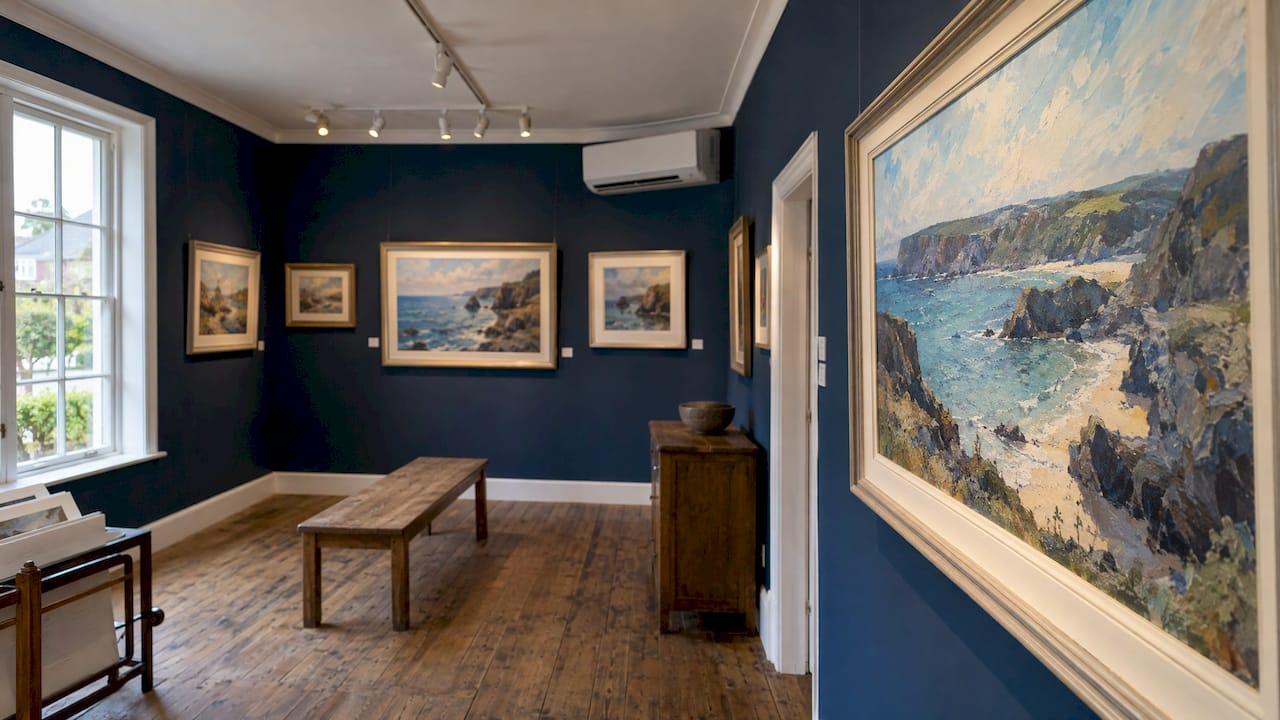
Gallery climate control means holding temperature, relative humidity (RH, the amount of moisture in the air compared with the most it could hold) and air quality steady around artwork. For most paintings the big risk is humidity that swings quickly, not heat. The most dependable way to manage it in a gallery, studio or art room is a correctly sized air conditioning system, designed for the room and installed by F-Gas certified engineers. We install these across Devon and Cornwall, and this guide sets out the figures to aim for and how a system gets you there.
TL;DR
- Aim for stable RH of about 40–60% and a temperature of 16–25°C. Stability matters more than hitting one exact number.
- Fast humidity swings damage canvas and wood supports; light and UV are the other major risk.
- Air conditioning that controls humidity, temperature and filters the air is described by the National Gallery as the best practical means of control.
- Size, airflow and filtration are decided room by room, so the survey is the most important step.
- We offer free surveys, same day or next day installs where available, and 0% finance.
Table of Contents
- What climate control does for artwork
- The numbers to aim for
- Why a gallery is different from a comfort-cooled room
- Clean air matters as much as cool air
- Light and UV
- What a gallery installation involves, step by step
- Running it efficiently
- Period buildings, conservatories and spare rooms
- Worked example: a ground-floor gallery room
- Our approach to gallery rooms
- Our view on gallery climate control
- FAQ
- Sources
What climate control does for artwork
Art is made of materials that absorb and release moisture. Canvas, timber panels, paper, textiles and animal glue all swell when the air is damp and shrink when it is dry. The National Gallery explains that rapidly changing humidity makes a painting's support shrink, swell, twist and crack, and because paint cannot move with it, paint is lost. It names air conditioning that controls RH, temperature and pollutants as the best practical means of preventing this.
It also ranks the risks. Rapid humidity change and too much light are the two most significant. Temperature changes are a lesser problem, and paintings are generally safe within normal human comfort ranges.
For a homeowner with a collection, a small commercial gallery or a studio space, that is good news. You are not trying to build a vault. You are trying to stop the room swinging between damp and dry, and to keep the air clean.
The numbers to aim for
UK museums publish their targets, and they are a sensible guide for a smaller space.
| Source | Temperature | Relative humidity | Notes |
|---|---|---|---|
| National Museum Directors' Council | 16–25°C | 40–60% | No more than ±10% RH change in 24 hours for canvas paintings, textiles and similar objects |
| Icon, UK guidance note (November 2023) | Cooler in winter is fine | 35–65% | Proven safe for materials in a well-maintained UK building |
| National Gallery | Normal comfort range | Around 55% | Figure given for UK easel paintings |
The refreshed Bizot Green Protocol, as summarised by Museums Galleries Scotland in May 2026, recommends 16–25°C at 40–60% RH for many collections. It favours stable humidity over rigid targets and notes that stores do not need the same conditions as public galleries.
In practice, choose a target RH in the middle of the 40–60% band and ask the system to hold it. Very sensitive or valuable pieces may need tighter control, and for loans the NMDC says a conservator should assess the requirements. If you are lending work to or borrowing from an institution, ask the lender for their conditions before you plan anything.
Why a gallery is different from a comfort-cooled room
A normal split system cools a room until the thermostat is satisfied. A gallery needs more than that.
Humidity is the priority. A system should keep humidity in a narrow band across the day and across the seasons, not only lower the temperature on a hot afternoon.
Slow change. English Heritage's loan guidance says that, without air conditioning, seasonal temperature changes should be made as slowly as possible, no more than 1°C in any 24 hours. A well-specified system lets you set conditions and hold them, instead of reacting to the weather.
Even conditions across the room. English Heritage's comparison of control strategies in more than 60 historic buildings found that air conditioning also performs very well, alongside dehumidification, which was very effective in stores. Where air is distributed evenly, a picture on the north wall sees the same conditions as one by the window.
Lights add heat. Spotlights and case lighting warm the space. A National Museums Liverpool paper found that heat from case lighting raised the air exchange rate of showcases by a factor of 4. When you plan cooling, count the lighting load as well as the sun and the visitors.

Clean air matters as much as cool air
Pollutants and dust settle on varnish and canvas. The National Gallery lists filtering pollutants as part of what air conditioning does for paintings. English Heritage's research adds that older systems without chemical filtration can badly increase silver and copper corrosion, so if you display metalwork or silver, specify filtration when the system is designed.
If your collection includes canvas pieces, a canvas art care preservation guide covers the handling side of keeping the work in good condition alongside a stable room.
Light and UV
Air conditioning does not remove the second big risk, light. Keep sensitive work out of direct sun, use blinds or UV-filtering film on windows, and choose LED lighting, which the Bizot Green Protocol lists among its energy-saving measures. Less light also means less heat for the cooling system to remove.
What a gallery installation involves, step by step

1. Decide what you are protecting
List the materials in the room: canvas, panel, paper, photographs, textiles, frames. Work out which is the most sensitive, because that sets the target. Collections can be arranged so that the most sensitive objects sit in rooms with the right conditions, with small cases for delicate pieces, rather than every room being held to a tight setpoint. For a home or small gallery, that often means treating one or two rooms properly.
2. Survey the room
A proper survey looks at the room size, glazing, sun exposure, lighting, how many people use the space, where the cold or damp comes from and where indoor and outdoor units can go. Older Devon and Cornwall buildings often have thick walls, sash windows and limited wall space, and these shape the layout. We carry out surveys free of charge.
3. Choose the system
We supply Samsung, Mitsubishi, Toshiba and Daikin systems and design the setup around the room. For galleries we also offer the LG Artcool Gallery Premium, a model designed with art display in mind. The right choice depends on room size, how many spaces you need to serve and whether you want wall-mounted, ceiling or multi-room units.
4. Install and commission
Our installations are typically completed within one to two days by our own F-Gas certified, REFCOM-registered engineers, without subcontractors. Same day and next day installs are available. Handling refrigerant legally requires F-Gas certification, which is why it matters who is on your wall.
5. Monitor the room
Do not assume it is working: measure. A simple temperature and humidity data logger with alarms tells you when readings drift. Museums use these widely, and one example is Tinytag loggers with out-of-range email and text alerts, used by National Museum Cardiff while it reduced air conditioning costs. A Moray Council report on a museum recommends that loggers are calibrated once a year.
Compare your readings with the 40–60% band and the 24-hour change limit above. If the line wobbles at certain times, such as when the sun reaches a window or the doors open for an event, that tells you where to adjust.
6. Keep it serviced
Filters clog, coils gather dust and drain lines block. A system that has drifted out of condition can no longer hold the room steady, so servicing is part of the climate control, not an extra. Our service and maintenance covers annual contracts and emergency breakdown response.
Running it efficiently
Stable conditions do not have to mean a big energy bill. Icon notes that keeping rooms a little cooler over winter helps hold RH above 35% and reduces energy bills. The Bizot Green Protocol also lists setting back conditions when the building is unoccupied and removing standby loads overnight.
For chemically unstable materials, the Bizot handbook gives a rule of thumb that each 5°C drop in temperature roughly doubles the preservation benefit. A system with sensible set-back schedules and a steady setpoint gives you both. Set a target, hold it, and avoid frequent changes to the thermostat.
Period buildings, conservatories and spare rooms
Many galleries and home collections in Devon and Cornwall sit in older properties. If yours is a period house, our guide to air conditioning in heritage homes covers how systems are fitted with minimal impact on the fabric. If the building is listed, read consent and humidity control for listed buildings first, because work may need permission.
If the damp is a general household issue, keeping home humidity at 40–60% explains the problem rooms, and our guide to condensation prevention with aircon shows how to stop moisture forming on cold surfaces. A sunny conservatory used as a studio is its own case, covered in our conservatory air conditioning guide.
Worked example: a ground-floor gallery room
Take a ground-floor room of a Devon house used to hang a family collection of oils and watercolours. The owner's targets are 50% RH and about 20°C, with no more than ±10% RH change in a day, in line with the NMDC figures above. The plan: one properly sized wall-mounted unit, blinds on the south window, LED picture lights and a data logger on the far wall. After installation, the owner checks the logger weekly, sees the line stay inside the band and books an annual service. This is an illustration of the process, not a client case.
Our approach to gallery rooms
We install and service air conditioning for homes and businesses in Exeter and across the South West. For a gallery, studio or art room, we start with a free survey, then design the system around the room and the work in it. Our domestic installation team handles private homes, and our commercial team handles shops and galleries.
- Domestic installation for art rooms and collections at home.
- Shop fitting and commercial for galleries and retail display spaces.
- 0% finance is available, so the cost can be spread.

To start, contact us through our website and tell us the room size, what you display and the conditions you are aiming for.
Our view on gallery climate control
Most people picture gallery climate control as something only a national museum can afford. The published guidance says otherwise. The targets are a stable humidity band, steady temperature, clean air and controlled light, and a well-designed system is how a smaller room meets them reliably.
What we see as the sensible path is to design the system around the work, not around the thermostat. That means a survey that takes in sun, lighting and room use, a choice of unit that can hold a setpoint, and a service plan so conditions stay where you set them. We install with our own F-Gas certified engineers, so the person who surveys your room is accountable for the result.
The National Gallery points to air conditioning as the best practical way to control humidity, temperature and pollutants for paintings. For a homeowner who wants their collection to look the same in ten years as it does today, that is the route we recommend.
James
FAQ
What humidity should a gallery room be kept at?
Aim for a stable 40–60% RH, as the NMDC gives for canvas paintings and similar objects, with no more than a 10% swing in 24 hours. The National Gallery cites around 55% for UK easel paintings. Pick a value in the middle of the band and hold it.
What temperature is right for a gallery?
The NMDC gives 16–25°C for many collections. Paintings are generally safe within normal human comfort temperatures, so a comfortable room for visitors works, provided it stays steady and does not change quickly.
Can I use one air conditioning unit for the whole building?
Often you only need to condition the rooms where sensitive work is displayed or stored. Which units suit depends on the layout, the glazing and the lighting, so the free survey sets out the options for your property.
How often should the system be serviced?
An annual service is the usual routine, and we offer annual maintenance contracts and emergency breakdown response. If you keep a data logger, calibrate it once a year, as the Moray Council monitoring report recommends.
Sources
- National Gallery: Paintings and their environment (page 3)
- National Gallery: Paintings and their environment (page 2)
- NMDC: Environmental conditions
- Icon: Guidance note on environmental management for collections
- Museums Galleries Scotland: Introduction to environmental monitoring
- English Heritage: Comparison of environmental control strategies
- English Heritage: Loan environmental conditions appendix
- National Museums Liverpool: showcase paper
- Bizot Green Protocol with handbooks
- Bizot Green Protocol, Handbook 1
- Museums and Heritage: temperature and humidity monitoring
- Moray Council: Falconer Museum monitoring report
- Canvas art care preservation guide