
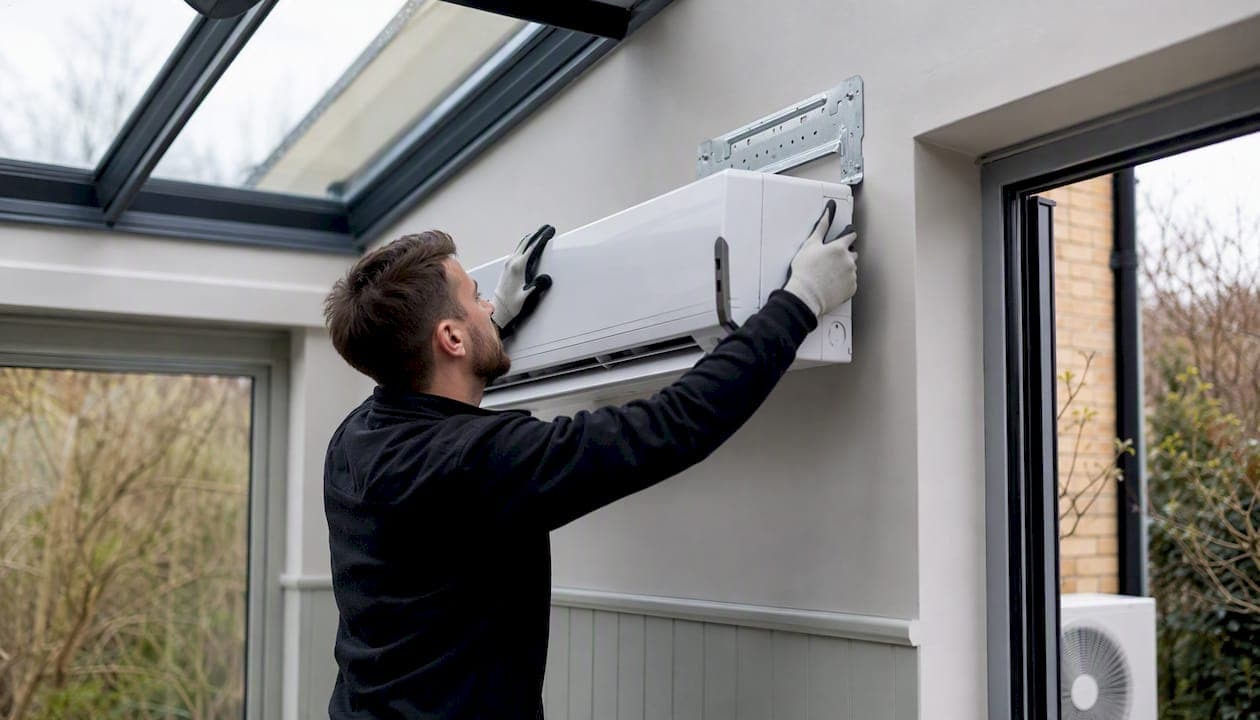
A permanently installed split or multi-split system is the best solution for a conservatory used regularly throughout the year. Portable units are cheaper upfront but struggle against the thermal extremes of a glazed room, run noisily, and consume more electricity for less output. If your conservatory is a genuine living space rather than a seasonal overflow room, the right move is to book a site survey with a REFCOM/F-Gas certified installer who can size and specify a system properly.
Why a permanent install wins:
- Reverse-cycle heat pump technology cools in summer and heats in winter from a single unit, making it genuinely year-round
- Modern wall-mounted or low-wall units operate at 19–26 dB in quiet mode, far below the 50–60 dB typical of portable compressors
- Permanently installed systems carry manufacturer warranties from brands such as Daikin, Mitsubishi Electric, Samsung, and Toshiba, plus the option of annual maintenance contracts
Your immediate next step: request a free survey from a certified installer before buying any equipment.
Key takeaways
A permanently installed split system, correctly sized by a REFCOM-certified engineer after a site survey, is the most effective and cost-efficient solution for a conservatory used year-round.
| Point | Details |
|---|---|
| Permanent install beats portable | Split and multi-split systems are quieter, more efficient, and heat as well as cool; portables are a stop-gap. |
| Sizing depends on glazing, not just floor area | Roof material, orientation, and glazing area all push required capacity above a standard room calculation. |
| Most installs need no planning permission | External unit siting can trigger local checks; a certified installer confirms this at survey. |
| Passive measures reduce running costs | Roof blinds and external shading cut peak solar gain and can allow a smaller, cheaper system. |
| Frostairconditioning covers the South West | REFCOM-certified engineers, 0% finance, and manufacturer warranties from Daikin, Mitsubishi Electric, Samsung, and Toshiba. |
Table of Contents
- Which air-conditioning system types suit your conservatory?
- How installers size conservatory air conditioning
- What a professional installer will check before fitting
- What does conservatory air conditioning cost to install and run?
- Do passive measures work, or do you still need air conditioning?
- Why a certified installer matters for your conservatory project
- An installer's honest perspective on conservatory projects
- Get a fixed-price survey for your conservatory from Frostairconditioning
- Sources
Which air-conditioning system types suit your conservatory?
Conservatories present a specific set of challenges: large glazing areas, variable roof materials, limited high-wall space, and often a direct opening into the main house. Not every system type handles those equally well.
Single split (wall-mounted or low-wall)
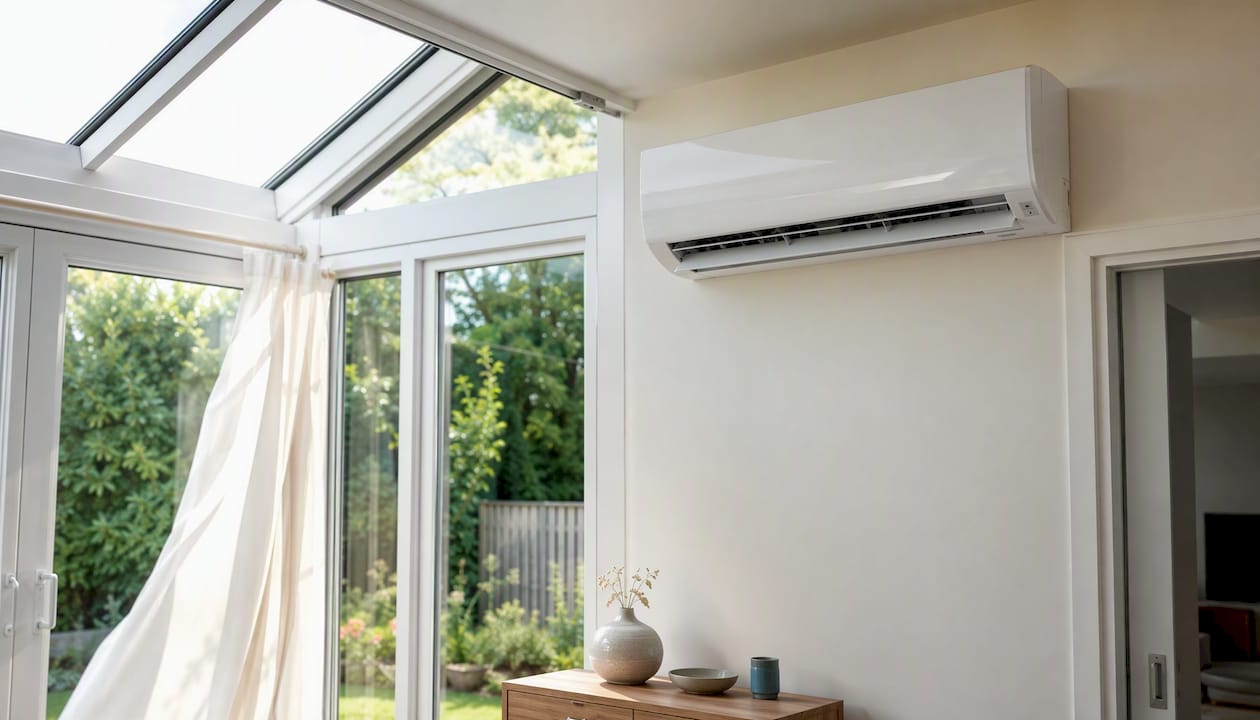
The most common choice. One outdoor compressor unit connects to one indoor head, typically wall-mounted at high level or, where wall height is restricted by a dwarf wall, fitted as a low-wall console near floor level. Single splits suit conservatories up to roughly 25–30 m², are straightforward to install, and carry the lowest installed cost of any permanent system. They heat and cool efficiently and are the default recommendation for a standalone conservatory that does not connect to adjacent rooms.
Multi-split systems
One outdoor unit serving two or more indoor heads. Useful when the conservatory opens directly into a kitchen or dining room and you want both spaces conditioned from a single compressor. The outdoor unit is larger and the installed cost is higher, but you avoid a second compressor on the external wall and the system runs more efficiently at part load.
Floor-standing console units
Where wall mounting is genuinely impossible (very low dwarf walls, listed building restrictions on wall penetration), a floor console sits at skirting level and blows air upward. Output and efficiency are comparable to wall units; the visual footprint is larger.
Cassette and ducted systems
Cassette units recess into a ceiling void and distribute air in four directions, which suits larger glazed extensions or orangeries with a solid roof section. Ducted systems are quieter still but require a ceiling or floor void for the ductwork, making them more common in new-build glazed rooms than retrofits.
Portable units
A portable unit requires no installation and costs less upfront, but experts quoted by Ideal Home consistently describe them as a stop-gap rather than a solution. They exhaust hot air through a window kit that also admits warm outside air, reducing net cooling significantly. Noise levels are high, efficiency is low, and they cannot heat effectively in winter.
| System type | Best for | Typical cooling capacity | Noise level | Running cost shape |
|---|---|---|---|---|
| Single split (wall/low-wall) | Smaller conservatories | low-to-moderate output | Quiet | Efficient |
| Multi-split | Medium to large or linked rooms | moderate output range | Quiet | Efficient at part load |
| Floor console | Where wall mounting is restricted | moderate typical output | Low to moderate noise | Similar efficiency |
| Cassette/ducted | Large glazed extension or orangery | higher output typical | Very low noise | Efficient installation |
| Portable | Temporary or occasional use only | lower output typical | High noise | Least efficient |
Pro Tip: If your conservatory is south- or west-facing with a polycarbonate roof, a portable unit will almost certainly be overwhelmed on a hot July afternoon. A correctly sized split system with a low-wall head is a far better long-term investment, and the types of air conditioning available for UK homes cover the full range of options worth considering.
How installers size conservatory air conditioning
A glazed room is not a standard room. Government technical guidance on conservatory construction confirms that large areas of glazing and the roof specification materially increase both heat gain in summer and heat loss in winter compared with an insulated room of the same floor area. That is why a conservatory almost always needs a higher output than a same-size bedroom.
Starting rules of thumb for glazed conservatories:
- Small conservatory: base output starts at a few kilowatts suitable for smaller spaces
- Medium conservatory (15–25 m²): 3.5–5.0 kW (roughly 12,000–17,000 BTU)
- Large conservatory or glazed extension (25–40 m²): 5.0–8.0 kW (roughly 17,000–27,000 BTU)
These are starting points only. Several factors push the required capacity upward.
Factors that increase the load:
- Roof material. A polycarbonate roof transmits far more solar heat than a glass roof with a solar-control coating, and both transmit more than a solid tiled replacement roof.
- Orientation. South- and west-facing conservatories receive peak solar gain in the afternoon, often the hottest part of the day. North-facing rooms need less cooling but more heating.
- Glazing area. Floor-to-ceiling glazing on multiple walls raises the load considerably above the floor-area rule of thumb.
- Ceiling height. Higher ceilings increase the volume of air to condition.
- Connection to the house. An open-plan conservatory that flows into a kitchen or living room effectively enlarges the space the system must serve.
- Internal heat sources. A home office with multiple screens, a television, or kitchen appliances all add to the cooling load.
- Shading. Roof blinds and external awnings can reduce peak solar gain enough to allow a smaller system.
A competent installer will not quote from floor area alone. The checklist they work through at survey:
- Measure total glazing area (walls and roof separately)
- Confirm roof material and any solar-control coating
- Note compass orientation and any external shading
- Check ceiling height and room volume
- Identify any open connections to adjacent rooms
- Record internal heat sources (appliances, occupancy)
- Assess existing blinds or shading and their effectiveness
What a professional installer will check before fitting
A site survey is not a formality. It is where an experienced engineer spots the problems that turn a straightforward install into an expensive one, and where the system specification gets locked in correctly.
What the surveyor will assess:
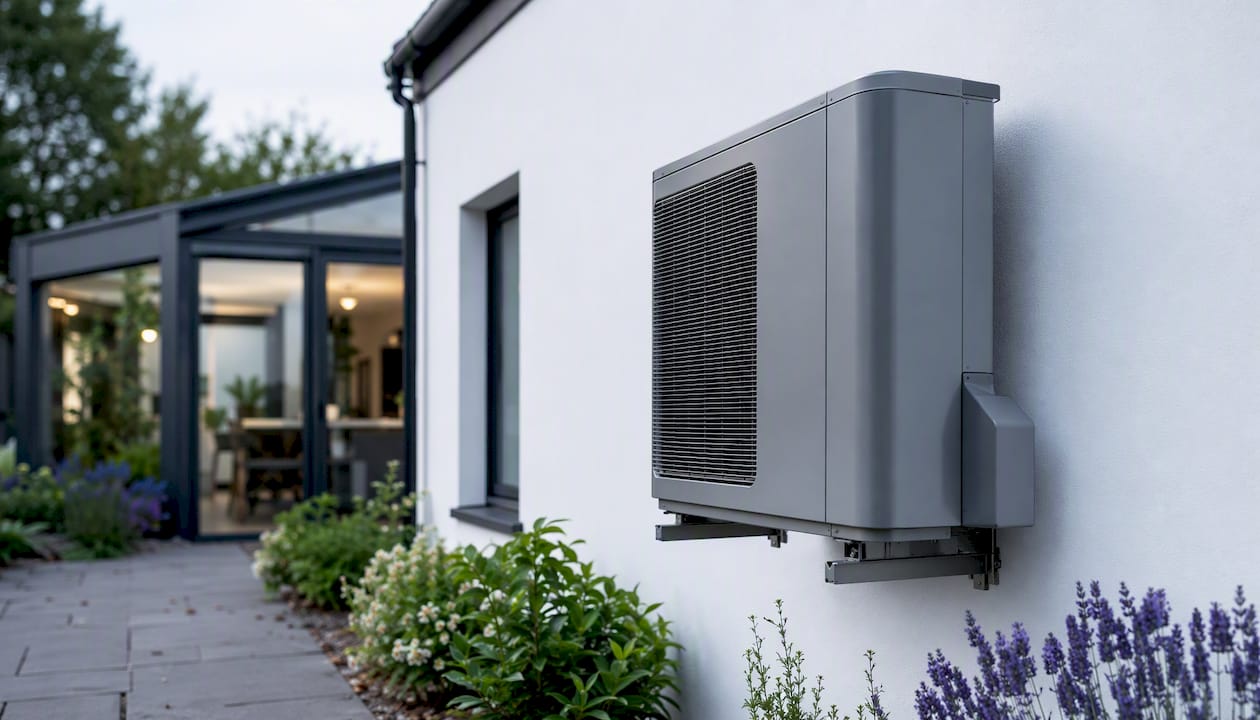
- Outdoor unit position. The compressor needs clear airflow on the intake and discharge sides, a stable surface or bracket, and a route for refrigerant pipework that keeps pipe runs as short as practical. Positioning affects noise, efficiency, and planning considerations.
- Pipework route. Refrigerant lines, condensate drain, and electrical cable all need a route from the outdoor unit to the indoor head. In a conservatory this often means running trunking along a dwarf wall or through a small core in the brickwork.
- Condensate drainage. The indoor unit produces condensate during cooling. It needs a gravity drain or a condensate pump to a suitable outlet. Conservatories with no nearby drain can require a pump, which adds a small cost.
- Electrical supply. Most domestic split systems need a dedicated spur from the consumer unit. The surveyor will check whether the existing supply and RCD protection are adequate.
- Wall and roof access. Low dwarf walls or wide spans of glass limit where an indoor head can be mounted. The surveyor will identify whether a wall-mounted, low-wall, or floor-console unit is the right fit.
Regulatory and planning points:
MHCLG guidance confirms that most small domestic air conditioning installations do not require planning permission. The external unit does, however, need to be sited carefully: units on a front elevation visible from a highway, or on a listed building or in a conservation area, can trigger local planning or building-control checks. A certified installer will confirm the position at survey and advise if any notification is needed.
On the refrigerant side, all handling of F-Gas refrigerants is legally restricted to engineers holding a valid F-Gas certificate. Using an uncertified installer is both illegal and invalidates manufacturer warranties. REFCOM registration is the standard UK certification scheme to look for.
Questions to ask at the survey:
- What output (kW) are you specifying, and why?
- What is the expected noise level (dB) in the room at normal operating speed?
- What are the estimated annual running costs at current energy prices?
- What warranty does the manufacturer offer, and what does your installation warranty cover?
- Do you offer an annual maintenance plan?
For a fuller checklist on choosing a certified AC installer, it is worth reviewing before the survey visit.
What does conservatory air conditioning cost to install and run?
Installation costs vary with system type, pipework complexity, and electrical work required. These are realistic UK price bands for a straightforward conservatory install in 2026:
Running costs depend on the system's efficiency rating (expressed as SCOP for heating and SEER for cooling), how many hours it runs, and the electricity unit rate. A modern inverter split system with a SCOP of 4.0 delivers four units of heat for every unit of electricity consumed, making it roughly three to four times cheaper to run than a direct electric panel heater for the same heat output. A portable electric cooler, by contrast, typically has a COP below 2.0 and produces noise and waste heat in the room it is trying to cool.
For a medium conservatory run for around four hours per day across a six-month season, a well-specified split system will cost materially less to run than a portable unit covering the same period, and it will also serve as the primary heating source in autumn and spring, displacing an electric or gas heater. The energy-efficient cooling guide covers the efficiency metrics worth comparing when shortlisting systems.
Ways to reduce installation and running costs:
- Fit solar-control roof blinds before the survey: they can reduce the required system size by a meaningful margin
- Ask about 0% finance options, which spread the installation cost without interest charges
- Choose a system with a high SCOP/SEER rating from the outset; the efficiency difference compounds over years of use
- Combine the install with an annual maintenance plan to protect the warranty and keep the system running at rated efficiency
Do passive measures work, or do you still need air conditioning?
Passive measures genuinely reduce the cooling load, and in some conservatories they reduce it enough to make a smaller, quieter system viable. Hillarys notes that roof blinds and reflective fabrics can significantly cut solar gain, which directly reduces peak temperature and the hours an AC system needs to run.
Shading options worth considering:
- Roof blinds (internal or external) with reflective or solar-control fabric
- External awnings or a pergola with a louvred or solid roof
- Solar-control window film applied to glazed walls
- Full-height internal blinds or shutters on south- and west-facing elevations
Ventilation measures:
Roof vents, trickle vents, and extract fans move warm air out and draw cooler air in. Practical guidance on ventilation for glazed rooms suggests that combining roof vents with a ceiling fan can maintain comfortable temperatures on mild summer days. On a 30°C afternoon with a polycarbonate roof, ventilation alone will not be enough.
When passive measures are sufficient:
- The conservatory is used occasionally and only in spring and autumn
- The roof is already tiled or has a solid insulated panel
- External shading already blocks the majority of direct sun
When air conditioning is the right choice regardless:
- The conservatory is used as a home office, dining room, or bedroom
- It is south- or west-facing with a glass or polycarbonate roof
- You want reliable comfort in July and August, not just on mild days
- Humidity control matters (passive measures do not dehumidify)
- You want year-round use, including heating in winter
Conservatory Blinds' practical cooling guide recommends treating passive measures and active cooling as complementary rather than competing: fit the blinds, then size the AC system against the reduced load. That combination gives the best total cost of ownership.
Why a certified installer matters for your conservatory project
The single biggest risk in a conservatory AC install is under-sizing. A system that cannot keep pace with peak solar gain on a hot day runs continuously at full load, wears faster, and never achieves the set temperature. A certified installer with a proper site survey eliminates that risk by specifying output against the actual thermal load of the room, not a generic floor-area estimate.
What to look for in an installer:
- F-Gas / REFCOM certification (legally required for refrigerant handling)
- Manufacturer authorisation for the brands they supply (Daikin, Mitsubishi Electric, Samsung, Toshiba all require authorised installers to validate extended warranties)
- A written installation warranty separate from the manufacturer's product warranty
- Annual maintenance plans that keep the system running at rated efficiency and protect the warranty
Frost Air Conditioning's process for conservatory projects:
- Enquiry. Contact Frostairconditioning by phone or via the quote page to describe the conservatory and how you use it.
- Site survey. A REFCOM-certified engineer visits, measures the space, checks glazing, orientation, roof type, and electrical supply, and specifies the correct system.
- Specification and quote. You receive a fixed-price quote with the recommended system (from Daikin, Mitsubishi Electric, Samsung, or Toshiba), installation scope, and timescale.
- Installation. Frostairconditioning's engineers carry out the full install, including pipework, electrical connection, and commissioning. Same-day and next-day installs are available across the South West.
- Handover and maintenance. The engineer walks you through the controls, registers the warranty, and discusses the service maintenance plan options.
Pro Tip: Before the survey, take photos of the conservatory from outside (showing the roof and external walls), note the compass direction it faces, and measure the floor area. Having that information ready means the engineer can focus on the technical checks rather than the basics, and your quote will be more accurate.
An installer's honest perspective on conservatory projects
The most common mistake homeowners make before calling an installer is buying a portable unit first. By the time they book a survey, they have already spent £400–£700 on a machine that runs loudly, struggles on hot days, and has to be stored every winter. That money would have covered a meaningful portion of a permanent install.
The second most common issue is expecting a site survey to be a quick phone call. A conservatory is genuinely one of the more complex domestic installs: the glazing area, roof type, orientation, and connection to the house all interact in ways that change the specification. An engineer who quotes without visiting is guessing, and a guessed specification usually means an under-sized system.
Before your survey, do these things:
- Clear access to the conservatory walls and roof void if there is one
- Note where your consumer unit (fuse box) is and whether there are spare ways
- Take photos of the roof from inside and outside, showing the material and any existing vents
- Note whether you have blinds fitted and how much shade they provide
- Write down how you use the space: hours per day, whether it is a home office, and whether you need heating in winter as well as cooling
On the heating question: a modern reverse-cycle split system is an effective primary heat source in a conservatory for most of the UK year. In a very cold spell, or in a conservatory with a poorly insulated roof, a secondary heat source (underfloor heating, a small electric panel) may still be useful. An honest installer will tell you which situation applies to your room rather than overselling the AC as the only answer.
*— James
Get a fixed-price survey for your conservatory from Frostairconditioning
Frostairconditioning offers something most homeowners do not get from a national supplier: a REFCOM-certified engineer who visits, measures the actual thermal load of your conservatory, and gives you a fixed price before any work begins. No call-centre sizing estimates, no under-specified systems that run flat out on a hot day.

Systems are supplied from Daikin, Mitsubishi Electric, Samsung, and Toshiba, all carrying full manufacturer warranties. 0% finance is available, spreading the cost of a domestic installation without interest. Same-day and next-day installs are available across Devon, Cornwall, and the wider South West. Annual maintenance plans keep the system at peak efficiency and protect the warranty long term.
Request a free quote and a certified engineer will be in touch to arrange a survey at a time that suits you.
Sources
- Is conservatory air conditioning worthwhile or a waste? | Ideal Home
- Assets
- Air conditioning rules - MHCLG in the Media
- How to keep a conservatory cool - Hillarys
- How to Make Your Conservatory Cooler in the Summer - Expert Advice