
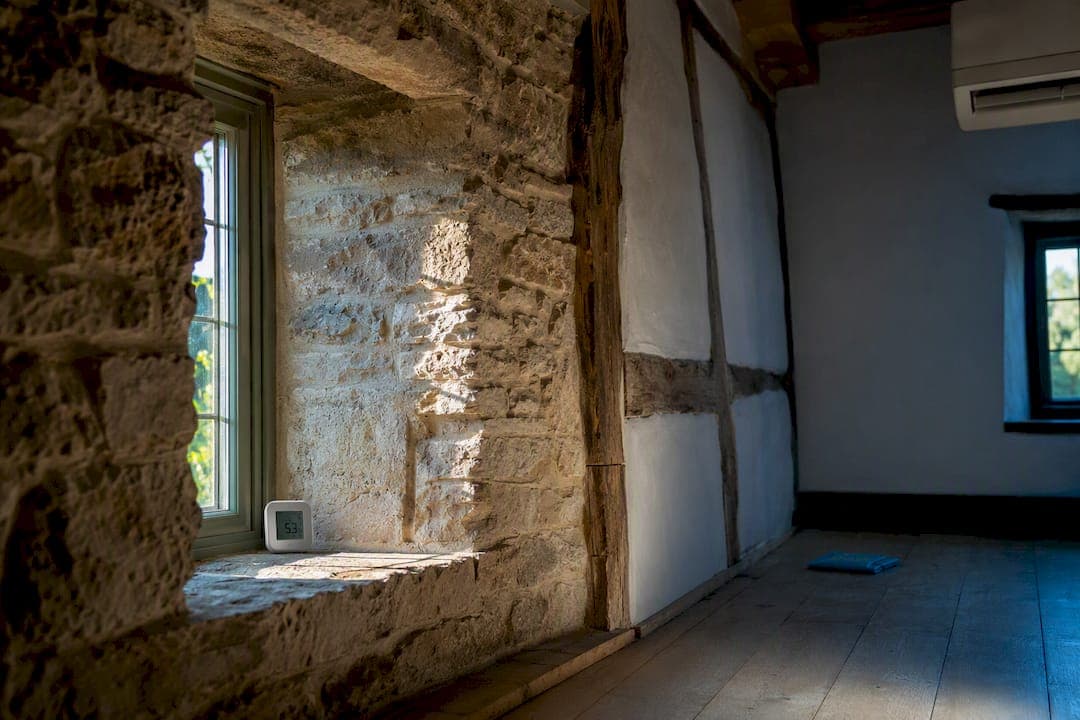
Yes, you can usually install air conditioning in a listed building, but Listed Building Consent is commonly required before any pipework, cassette or condenser goes in. Internal or condenser‑free systems make consent easier to secure because they reduce visible change. Any refrigerant work must be carried out by an F‑Gas certified engineer. Start with a site survey and an informal chat with your local conservation officer before you commit to a system.
TL;DR:
- Installing air conditioning in a listed building typically requires Listed Building Consent, especially for internal work or visible pipework, even if planning permission is not needed.
- A site survey, early discussion with the conservation officer, and detailed supporting documents are essential to prevent delays, refusals, or enforcement actions later.
- Condenserless or internal heat pumps, concealed duct systems, and carefully sited split units are the best options to minimize visual impact and simplify consent.
- Compliance with F-Gas regulations through an certified engineer is mandatory, with technical constraints like condensate management and noise control also influencing installation success.
- Heritage-sensitive installations usually cost 20–40% more than standard systems due to bespoke routing, specialist reinstatement, and extra professional fees.
Table of Contents
- What the law requires: Listed Building Consent and the conservation officer
- Which systems and approaches work best in listed properties
- What conservation officers actually want to see
- Practical installation constraints: condensate, noise, power and F‑Gas compliance
- Permissions, process, timeline and likely costs
- How to choose an installer for listed building work
- Author perspective and Frost Air Conditioning's heritage experience
- What actually matters here, and what doesn't
- Book a heritage‑aware survey with Frost Air Conditioning
- Sources
- FAQ
What the law requires: Listed Building Consent and the conservation officer
Listed Building Consent (LBC) is a separate approval from planning permission, and it covers something planning permission does not: the impact of works on a building's special architectural or historic interest. You can need LBC even when a project would be permitted development on an unlisted house, because listing removes those automatic rights. Planning permission looks at land use and external appearance in the wider environment; LBC looks specifically at what a change does to the character of the listed asset itself, inside or out.
That "inside or out" point catches people out constantly. Listing status attaches to the whole building, not just the facade the public sees. Running a refrigerant pipe through an internal stud wall, drilling a hole in a back bedroom, or fitting a ceiling cassette in an attic room can all trigger the same consent requirement as bolting a condenser to the front elevation. Historic England's guidance on installing new services makes clear there is no de minimis exemption for LBC. There's no such thing as "it's only a small hole, surely that's fine" in law, whatever a contractor might tell you.
The local planning authority's conservation officer is the person who actually decides, or at least strongly shapes, whether your application succeeds. Their job is to weigh the benefit of the work against the harm to significance, not to block cooling on principle. Get in front of them early. Most authorities offer some form of pre‑application advice, and conservation officers vary widely in what they'll accept, so a five‑minute conversation before you draw anything up can save weeks of redesign later.
Ignore this stage and the risks are real, not theoretical:
- Enforcement action can require removal of unauthorised work, at your cost, even years after installation.
- Unauthorised alterations to a listed building can be treated as a criminal offence in serious cases.
- Selling the property later becomes harder if a buyer's solicitor spots consented works during searches.
- Insurance and warranty claims can be refused if installation didn't follow the consented method.
Determination times vary by authority and by how contested the case is, but straightforward domestic applications with good supporting documents tend to move faster than proposals that arrive without a method statement or reversibility plan.
Which systems and approaches work best in listed properties
The system choice you make before you ever contact the council often decides whether the application is straightforward or a fight. Some approaches sidestep the conservation officer's biggest objection outright; others invite it.
- Condenserless or internal all‑in‑one heat pumps house the entire refrigerant circuit inside, with no external box on the wall. They remove the single most common reason for refusal, a visible condenser, though they still need careful planning for condensate drainage, air intake and access for servicing.
- Concealed ducted systems route conditioned air through ceiling voids or non‑historic partition walls, surfacing only at a discreet grille. These work best where a Victorian extension, a converted attic, or a 1960s service wing gives you a void that isn't part of the protected fabric.
- Ceiling cassettes suit rooms with suspended or already‑altered ceilings, where the visual change reads as a modern addition rather than a loss of historic finish.
- Carefully sited split systems keep a conventional outdoor unit but place it somewhere it genuinely can't be seen from a public viewpoint, a flat roof behind a parapet, a rear yard, an existing plant enclosure.
- Ventilation add‑ons like MVHR or MEV manage moisture as well as air quality, which matters more in old buildings than most homeowners expect.
That last point deserves more attention than it usually gets. Cooling isn't only about comfort in a listed building, it's about the building's own health. Timber, lime plaster and old paint schemes react badly to swings in humidity, and a well‑specified system that dehumidifies as it cools can do more for a Georgian sash window's joinery than any amount of careful redecorating. A relative humidity band of roughly 45–60% is a sensible target for protecting historic materials, and running AC purely as a temperature tool wastes that side benefit.
Pro Tip: Ask your installer whether the system can be zoned to just one or two priority rooms, a bedroom or home office, rather than proposed as a whole‑house retrofit. Smaller interventions are both cheaper and easier to get consented, and they usually deliver the comfort improvement that actually matters to you.
Combining a condenserless unit with an internal condensate route often gives conservation officers the least to object to, since nothing about the building's external appearance changes at all. For more detail on choosing between these, our guide to air conditioning in heritage homes covers the trade‑offs room by room.
What conservation officers actually want to see
Every conservation officer working from the same national guidance still applies it differently, but the underlying principles they're checking against don't change. Get these right and you're arguing from strength.
- Reversibility. The clearest way to win an argument with a conservation officer is to show the work can be undone without permanent loss. A pipe run fixed with resin anchors into mortar joints, rather than chased into decorative stonework, reads as reversible; chiselling a channel through carved plasterwork does not.
- Use of existing routes. Service voids, old chimney flues, and previously altered areas should always be your first port of call before touching original fabric. If a Victorian extension already has a modern service duct, route through it rather than opening up an untouched Georgian wall next door.
- A heritage impact statement. This document sets out what's proposed, what fabric is affected, and why the harm (if any) is outweighed by the benefit. It doesn't need to be long. A short, precise statement that clearly demonstrates minimal impact often carries more weight with a conservation officer than a lengthy technical appendix full of specification sheets.
- A method statement. Specify the exact fixing method, drill sizes, anchor types and finish. Vague language like "cables will be discreetly routed" invites refusal; "35mm conduit fixed with resin anchors into existing mortar joints, repointed to match" invites approval.
- A reversibility statement. A short, separate note confirming that removal of the system at end of life would leave the fabric substantially as found.
A competent site survey should record wall construction, the location of any usable voids, likely pipe routes, existing electrical capacity, and a clear plan for making good afterwards. Where the building is particularly sensitive, a listed church, a scheduled monument, or a Grade I house with fine interiors, bringing in an independent heritage consultant alongside your installer is worth the fee. They speak the conservation officer's language and can pre‑empt objections before the application ever lands on a desk.
Practical installation constraints: condensate, noise, power and F‑Gas compliance
Getting consent is only half the job. Several technical constraints decide whether the installed system actually performs well and stays compliant once it's running.
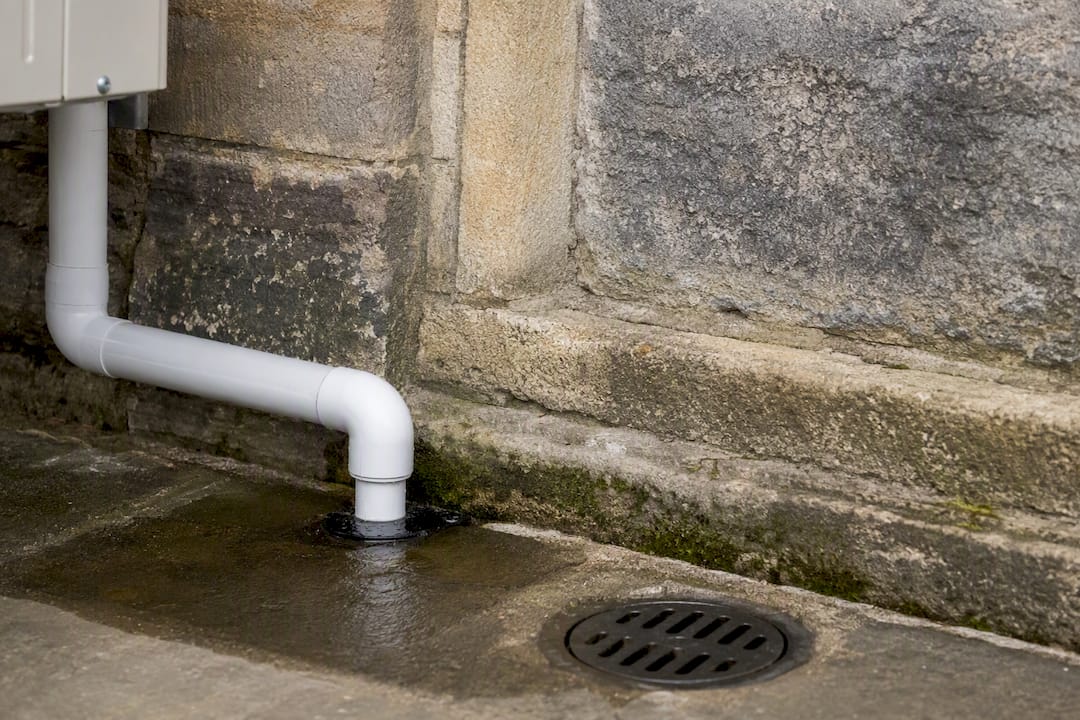
Condensate management is the detail most homeowners never think about until it goes wrong; practical advice on how to handle extractor and small fan issues can be found in quick DIY fixes for UK homes. Every air conditioning unit produces water as it cools, and that water has to go somewhere. Running it to an existing drain or downpipe is the tidiest solution where one is accessible; where it isn't, an internal condensate pump can lift the water to a suitable outlet. What you must avoid is any discharge that stains historic stonework or feeds damp into a wall, both of which are exactly the kind of long‑term fabric damage a conservation officer is trying to prevent.
Noise matters more in listed properties than in a modern estate, partly because thick masonry can transmit vibration in unexpected ways, and partly because neighbours in a conservation area tend to notice and complain. Acoustic screening around external plant, and careful selection of low‑noise internal fan coils, both reduce the risk of a complaint escalating into a planning enforcement query. Our piece on quiet air conditioning systems goes into the specification detail if noise is a live concern for your property.
Electrical supply in older buildings is frequently the quiet blocker nobody budgets for. A Victorian or Georgian consumer unit may need upgrading before it can safely take a new air conditioning circuit, and that's a separate piece of work with its own cost and its own timeline.
Then there's compliance that has nothing to do with heritage at all. UK F‑Gas regulations restrict all work on fluorinated refrigerant gases to certified engineers, and this isn't a box‑ticking formality:
- Non‑compliant refrigerant handling can void your system's warranty outright.
- Some buildings insurance policies require evidence of F‑Gas certified installation before they'll pay out on an AC‑related claim.
- Certified engineers are trained to detect and prevent refrigerant leaks, which matters for both safety and running cost.
- REFCOM registration is the most widely recognised certification route installers use to demonstrate F‑Gas compliance.
Combine an F‑Gas certified installer with heritage‑aware design and you've closed off the two biggest ways a listed building AC project goes wrong.
Permissions, process, timeline and likely costs
The sequence that works, in every case where consent runs smoothly, follows the same order. Skip a step and you tend to pay for it later in redesign fees or delay.
- Site survey. A heritage‑aware installer records construction, voids, routes and electrical capacity before anything is designed.
- Pre‑application conversation. An informal chat with the conservation officer, ideally with sketch proposals in hand, flags objections before they become formal refusals.
- Design and supporting documents. Drawings, a heritage impact statement, a method statement and a reversibility statement all get drafted around what the pre‑app conversation revealed.
- LBC submission. The formal application goes to the local planning authority, alongside any planning permission application if the system also needs one.
- Installation and making good. Work proceeds to the consented method, with repointing, redecoration or repair carried out to match existing finishes.
Timescales depend heavily on the authority and the complexity of the case. A straightforward single‑room, condenserless installation with a clean pre‑app conversation can move from survey to installed system in a matter of weeks once consent is granted. A multi‑room retrofit in a Grade I or II* building, particularly one with sensitive interiors, can take considerably longer simply because the LBC process itself carries no fixed statutory deadline in the way some planning applications do.
Budget matters here too. Heritage‑sensitive installations typically run 20–40% higher than a standard domestic install, and the reasons are consistent across most projects:
| Cost driver | Why it adds cost |
|---|---|
| Bespoke pipe routing | Avoiding historic fabric often means longer, more complex runs than a straight wall chase |
| Making good to match finishes | Lime plaster, historic paint and traditional pointing all need specialist reinstatement |
| Specialist access or scaffolding | Working around delicate stonework or high ceilings can require extra rigging |
| Heritage consultant fees | Independent advice on sensitive buildings adds a professional fee on top of installation |
Any installer worth hiring for this work should be able to hand you drawings, a method statement, and a reversibility statement as standard, not as an optional extra you have to request.
How to choose an installer for listed building work
Not every AC installer is set up for heritage work, and the gap between "can fit a split system" and "can get a listed building through consent" is bigger than most homeowners expect.
- Confirm F‑Gas / REFCOM certification and ask to see it, not just hear it claimed.
- Check public liability insurance covers work on listed or historic structures specifically.
- Ask for a sample method statement from a previous heritage project, not a generic template.
- Request photographs of prior work in listed or period buildings, and if possible, a reference you can actually call.
Our checklist on verifying F‑Gas compliance before you hire walks through exactly what to ask for and why it matters.
Pro Tip: If a quote arrives with no mention of making good, no reversibility statement, and an assumption that the condenser will just go "on the wall outside," treat that as a red flag rather than a minor omission. It usually means the installer hasn't done this kind of work before.
A reliable quote sets out scope clearly, includes an allowance for heritage‑standard making good, carries a contingency line for unexpected fabric issues, and gives you a realistic timescale rather than an optimistic one. For general background on why professional installation matters even outside listed buildings, see our reasons for professional AC installation.
Author perspective and Frost Air Conditioning's heritage experience
James writes on regulation‑aware home improvement topics for UK property owners, with a particular focus on how national planning and F‑Gas rules translate into practical decisions on site. His pieces here draw on the same conservation guidance that shapes this article.
An experienced air conditioning installer can operate across the South West, with engineers holding required F‑Gas certification and same‑day installation available where the project allows it. Homeowners considering a listed building project may be able to discuss case examples and photographs of comparable installations with knowledgeable installers before committing to a survey.
What actually matters here, and what doesn't
Most guidance on this topic treats air conditioning in listed buildings as a visibility problem: hide the condenser, keep the pipework out of sight, get past the planning officer. That's not wrong, but it's incomplete, and it leads homeowners to over‑invest in disguise and under‑invest in the thing that actually protects the building, humidity control.
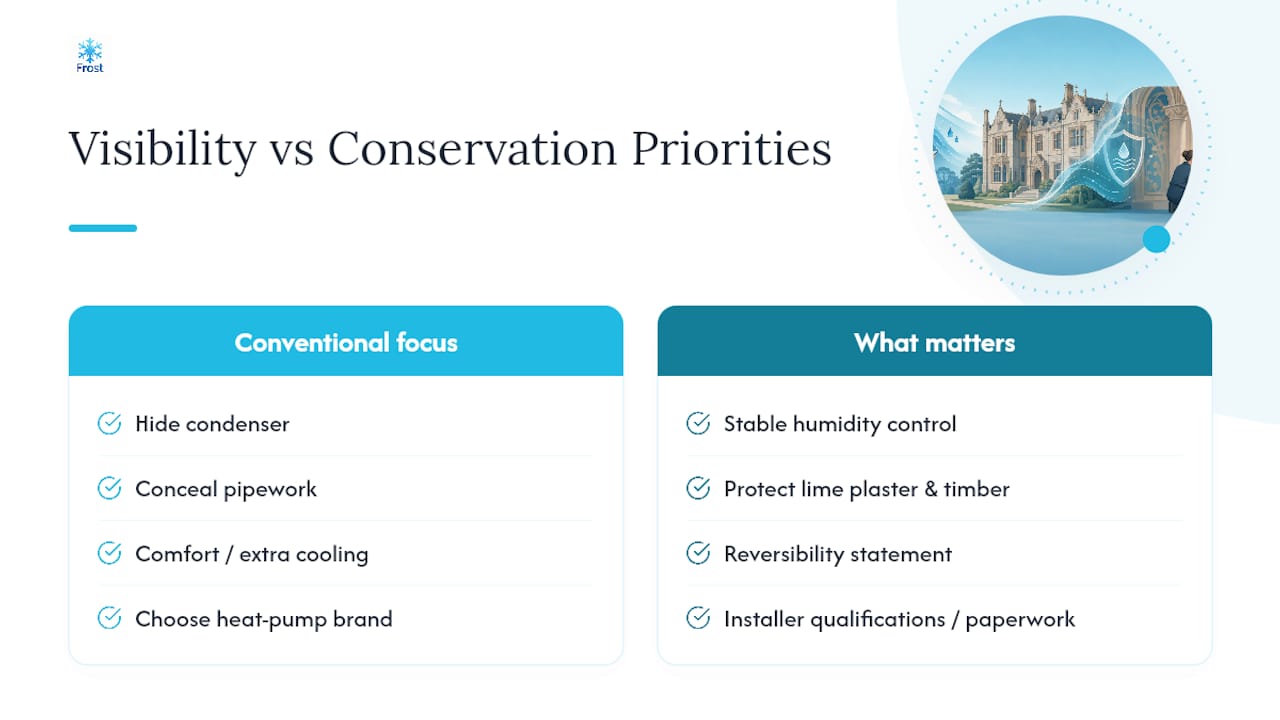
A listed property with damp‑prone lime plaster or historic timber joinery benefits more from stable relative humidity than from a few degrees of extra cooling. Framing air conditioning purely as a comfort upgrade misses that the same system, specified well, is a conservation tool. I'd go further: if your conservation officer is hesitant, lead the conversation with what the system does for the fabric, not what it does for you on a hot afternoon in July.
The other place conventional advice falls short is installer selection. Homeowners spend weeks agonising over which brand of heat pump to buy and almost no time checking whether the installer has ever produced a reversibility statement. That document, more than the hardware, decides whether your application succeeds. Prioritise the paperwork and the qualifications first. The system choice matters far less once those are right.
— James
Book a heritage‑aware survey with Frost Air Conditioning
If you've read this far, you already know the hard part of a listed building AC project isn't the hardware, it's the paperwork, the routing decisions, and the conservation conversation. Choosing an installer that provides F-Gas certified engineers who can carry out the site survey, help draft the required method statement and reversibility documentation, and handle the installation once consent is granted, all under one contract rather than several separate quotes, can simplify this process.

We cover Exeter and the wider South West, with 0% finance available to spread the cost of a heritage‑sensitive install and same‑day installation where the scope allows it. If you're weighing up a listed property project, the sensible next step is a proper domestic installation survey rather than a phone quote based on guesswork. Get in touch through our contact page to arrange a site visit, or ask about our maintenance contracts if you already have a system that needs F‑Gas‑compliant servicing.
Sources
- Installing new services — Historic England
- Gov
- A guide to air conditioning for listed buildings — Controlled Climate LTD
FAQ
Does the 10 year rule apply to listed buildings?
No. There is a rule for immunity from enforcement that applies to certain unauthorised planning breaches, but unauthorised works on listed buildings carry no such time limit and can be enforced against at any point.
Do I need planning permission to install an air conditioner in London?
You may need both planning permission and Listed Building Consent depending on the property and the works proposed, and London boroughs often apply particularly strict conservation area policies, so a pre‑application conversation with the local authority is essential before installation.
What are the legal requirements for air conditioning installation in the UK?
Any refrigerant work must be carried out by an F‑Gas certified engineer under UK F‑Gas regulations, and listed buildings additionally require Listed Building Consent for alterations affecting historic character, inside or out.
What are you not allowed to do to a listed building?
You cannot alter, extend, or demolish any part of a listed building, internal or external, in a way that affects its special architectural or historic interest without first obtaining Listed Building Consent from the local planning authority.
Can Frost Air Conditioning help with the Listed Building Consent application?
Experienced engineers can supply the drawings, method statement and reversibility statement needed for the application, though the formal consent decision always rests with the local planning authority's conservation officer.