
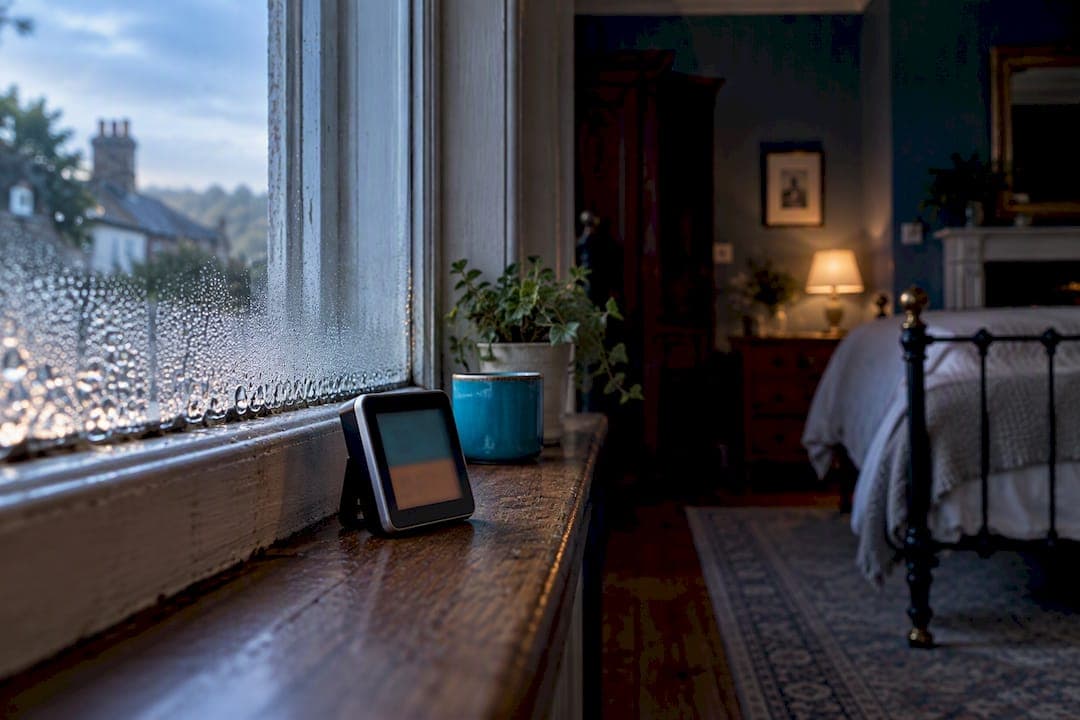
Put a hygrometer in the room that worries you most, run the extractor fan during and after cooking or showering, crack a window for a few minutes afterwards, and wipe down cold windows before condensation sits and breeds mould.
TL;DR:
- Maintaining indoor humidity between 40 and 60% is crucial, especially in rooms prone to moisture like kitchens, bathrooms, and bedrooms.
- Using a hygrometer to monitor humidity at different times of day and after activities like cooking or showering helps identify persistent issues.
- Immediate actions such as running extractor fans, opening windows briefly, and wiping condensation reduce mold risk without costly equipment.
- Combining proper ventilation with steady heating and avoiding sealing gaps without airflow prevents long-term damp and mold problems.
- For ongoing issues, installing humidistat-controlled extractors, dehumidifiers suited to room size, or whole-house ventilation systems offers effective long-term solutions.
Table of Contents
- What counts as healthy humidity in UK homes and why it matters
- How to measure humidity: picking and using hygrometers and sensors
- Immediate, low-cost actions to reduce humidity and prevent condensation
- Longer-term fixes: insulation, ventilation upgrades and building considerations
- Mechanical solutions: dehumidifiers, mechanical ventilation and air conditioning
- Installer perspective: how professionals diagnose persistent humidity problems
- Practical recap and common mistakes to avoid
- How Frost Air Conditioning can help with a professional survey
- Sources
- FAQ
What counts as healthy humidity in UK homes and why it matters
Gov explains that condensation forms when moisture from everyday activities, cooking, showering, even breathing, meets a cold surface such as a single-glazed window or an external wall. That's why humidity problems cluster in bathrooms, kitchens and bedrooms with poor airflow, and why older UK houses with solid walls or thin insulation tend to suffer more than newer, better-insulated ones.
New-build homes have their own version of the problem. Bricks, plaster and screed hold construction moisture that can take 18 to 24 months to fully dry out, so a property can run damper than expected in its first two years even with normal habits; extra ventilation during that period helps.
A government-backed report on indoor hygrothermal conditions links sustained humidity outside the 40 to 60% band to a higher risk of biological contaminants in the home, which is why both public health guidance and building advice converge on that same target.
How to measure humidity: picking and using hygrometers and sensors
You can't manage what you don't measure, and a hygrometer costs far less than a bottle of mould spray. Simple digital meters give you a single room reading and cost very little; smart sensors add app alerts, humidity logging over time, and sometimes a built-in humidistat that can trigger a fan or dehumidifier automatically. For most homes, a basic digital hygrometer in each problem room is plenty.
The Centre for Sustainable Energy recommends testing at specific moments rather than relying on a single glance at the dial: straight after cooking, after a shower or bath, and first thing on waking, when overnight moisture from breathing has had all night to build up. A single reading rarely tells you much. Tracking a room over a few days at different times builds a profile that separates a temporary spike from a genuine problem.
A few practical pointers:
- Placement matters: keep the sensor away from kettles, extractor outlets and direct sunlight, at roughly chest height and away from an external wall.
- One device per problem room is enough: bathrooms, kitchens and any bedroom with a history of condensation on the windows.
- If a reading looks wrong, check the battery, move the unit away from a draught or heat source, and compare it against a second hygrometer before assuming the room itself is the issue.
Immediate, low-cost actions to reduce humidity and prevent condensation
Most condensation problems respond to habit changes before they need any equipment or building work. The order below reflects what tends to make the biggest difference first.
- Ventilate at the source: switch on the extractor fan before you start cooking or showering, and leave it running for a few minutes afterwards rather than switching it off the moment you're done.
- Open a window briefly: five to ten minutes after a shower or a pan of pasta clears the worst of the moist air before it settles on cold surfaces.
- Wipe down sills and glass: a quick pass with a cloth each morning stops condensation soaking into wood or plaster.
- Keep lids on pans: it cuts the moisture a hob puts into the air by a noticeable margin and saves energy too.
- Dry laundry outdoors or in a vented tumble dryer where you can. Indoor drying racks push a surprising amount of water vapour into a room with nowhere for it to go.
- Close the door while showering or cooking, so moisture stays in one room with an extractor rather than drifting through the house to condense on a colder window elsewhere.
Heating habits count too. GOV.UK guidance points to consistent, low-level background heat as more effective than blasting the heating for an hour and switching it off, because a steady temperature keeps wall surfaces above the point where moisture condenses out of the air. Furniture placement plays a smaller but real role: leave a gap of a few centimetres behind wardrobes and sofas pushed against external walls, since airflow behind them stops those cold spots turning into hidden mould patches.
Pro Tip: Keep a small dish of silica gel or a moisture absorber in a wardrobe against an external wall. It won't fix a whole room, but it catches the localised damp that builds up in enclosed spaces.
Longer-term fixes: insulation, ventilation upgrades and building considerations
Here's the trap that catches a lot of well-meaning homeowners: sealing up draughts to save on heating bills without adjusting ventilation. GOV.UK is explicit that energy-efficiency upgrades can trap moisture indoors, so any draught-proofing, double glazing or wall insulation project should go hand in hand with a look at how the house breathes. A tighter building envelope without more ventilation is a near-guaranteed route to a mould problem within a year or two.
A few retrofit options worth discussing with a tradesperson or surveyor:
- Loft insulation depth: the usual recommendation for UK lofts is around 270mm, but it needs to sit alongside adequate airflow at the eaves, not block it.
- Trickle vents: the small slotted vents built into modern window frames should stay open, particularly in bedrooms and bathrooms, even in winter.
- Air bricks: these ventilate underfloor voids and should never be blocked by flower beds, decking or a fresh coat of render.
- Humidistat-controlled extractor fans: these switch on automatically once humidity crosses a set threshold, useful in bathrooms without windows.
- Positive input ventilation (PIV) or mechanical ventilation with heat recovery (MVHR): whole-house systems that constantly exchange stale, moist air for fresh air, sensible for homes with persistent, whole-property condensation rather than a single problem room.
Loft ventilation problems in particular are easy to miss until damp patches appear on a ceiling, and advice on roof ventilation issues covers the warning signs worth checking before they turn into a bigger repair.
Not every damp problem is condensation. If patches keep returning in the same spot regardless of how well you ventilate, if you see a tide mark near the floor, or if a wall feels damp to the touch even in summer, that points to penetrating or rising damp rather than everyday moisture in the air, and it needs a proper survey rather than another dehumidifier.

Mechanical solutions: dehumidifiers, mechanical ventilation and air conditioning
A portable dehumidifier earns its keep in a room where ventilation alone isn't enough, a bedroom with no extractor, a basement, or a flat where opening windows isn't practical in winter. Compressor (refrigerant) models tend to work best in warmer rooms and run more efficiently; desiccant models keep performing in colder spaces where a compressor unit struggles.
Which? testing groups dehumidifiers by capacity, and matching the unit to the room size matters more than buying the biggest one available:
- 7 to 12 litre units suit a single bedroom or small flat.
- 14 to 16 litre units cover a typical family home with more than one problem room.
- 18 litre-plus units are aimed at larger properties or persistent whole-house damp.
A decent dehumidifier typically starts around £100, and running costs depend on power draw, usually in the 200 to 300 watt range for a domestic unit, so a humidistat that switches the unit off once the target humidity is reached saves a meaningful amount on the electricity bill over a winter.
For homes that need more than a portable unit, humidistat-controlled extractor fans and PIV systems offer whole-property coverage without the daily emptying of a dehumidifier's tank. Installed air conditioning is another route: as it cools air, it also condenses moisture out of it, which is why air conditioning reduces humidity as a side effect of normal operation, not just in summer. The caveat is sizing and upkeep: an oversized or poorly maintained system can short-cycle without properly dehumidifying the air, and a neglected filter or condensate drain turns a helpful appliance into a hygiene risk rather than a fix.

Installer perspective: how professionals diagnose persistent humidity problems
When a persistent problem doesn't respond to the basics, an installer's approach usually follows a set pattern rather than guesswork.
- Log readings room by room over several days, matching them against cooking, showering and drying routines.
- Check every extractor fan actually vents outside rather than into a loft space, and that none are blocked by dust or a failed motor.
- Inspect for leaks or penetrating damp before assuming a patch is condensation.
- Assess insulation and existing ventilation together, since one without the other is usually the root cause.
From there, the fix tends to be one of three things: a humidistat-controlled extractor where ventilation is the gap, a correctly sized dehumidifier for a single stubborn room, or an installed air conditioning system where a homeowner wants year-round humidity and temperature control rather than a portable appliance to manage. Anyone weighing that last option against a portable dehumidifier can find more detail on how air conditioning prevents condensation in a typical UK home.
Practical recap and common mistakes to avoid
The order that works is measure first, ventilate at source, hold a steady background heat, then consider a dehumidifier, mechanical ventilation or a retrofit if the problem persists. Only call in a professional once you've ruled out the basics.
The mistakes worth avoiding: sealing draughts without adding ventilation, relying on short bursts of high heat instead of a steady background temperature, and letting extractor fans or vents sit blocked with dust for years without checking they still work.
— James
How Frost Air Conditioning can help with a professional survey
If you've measured, ventilated and adjusted your heating and a room is still running damp, that's usually the point where a proper survey pays off rather than another gadget.

What that looks like in practice:
- Domestic Installation for homes wanting year-round humidity and temperature control from brands including Samsung, Mitsubishi, Toshiba and Daikin.
- Service & Maintenance, including annual service contracts, to keep an existing system running efficiently and hygienically.
- Emergency breakdown response for when a system stops working and moisture control can't wait.
Installations can be scheduled promptly depending on the job requirements. Bring your hygrometer readings to a free survey and an engineer can tell you fairly quickly whether ventilation, a dehumidifier or an installed system is the right call for your property. Book a domestic installation survey to get a straight answer.
This article is general information, not a substitute for advice from a qualified doctor. Consult a qualified healthcare professional about your own circumstances before acting on anything here.
Sources
- Gov
- Testing the air quality, temperature and humidity of your home — Centre for Sustainable Energy
- How to buy the best dehumidifier — Which?
FAQ
Is 50% humidity in a house in the UK normal?
Yes, relative humidity within the recommended 40 to 60% band for UK homes is considered healthy. There's no need to take any action at that level beyond your usual ventilation habits.
Is 70% humidity too high for a home?
Yes, relative humidity above the 40 to 60% range that UK guidance recommends raises the risk of condensation and mould. Increase ventilation, check your extractor fans are working, and consider a dehumidifier if the reading doesn't come down within a few days.
Is 35% humidity in a house normal?
A reading just below the recommended 40 to 60% band can leave air feeling dry and uncomfortable, particularly in winter with the heating on. It isn't a mould risk, but it's worth checking whether the reading holds across other rooms before assuming it's a house-wide issue.
Is 63% humidity in a house bad?
A reading above the 60% upper threshold UK guidance recommends is worth taking seriously if it persists rather than being a one-off spike after a shower. Ventilate the room, check for condensation on windows, and retest at a few different times of day before deciding whether it needs further action.