
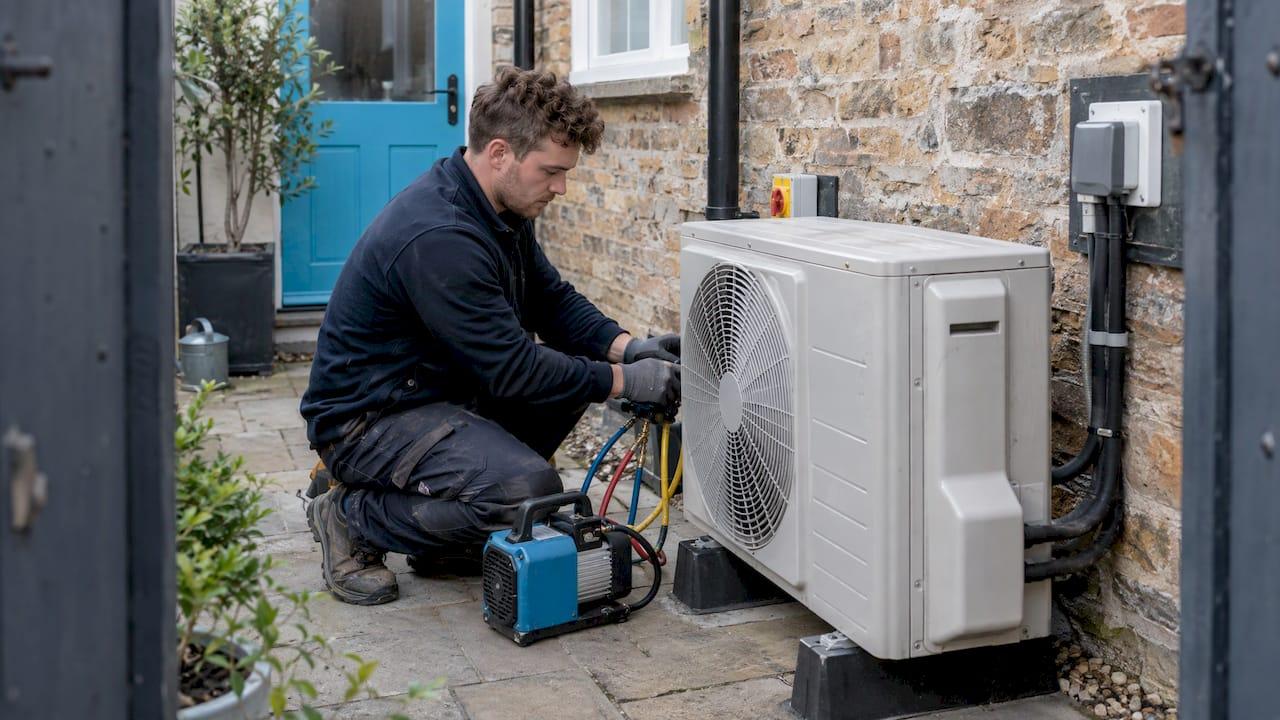
The UK F-gas rules do not stop you fitting air conditioning at home in 2026. They do change what the refrigerant supply looks like: the HFC phase-down tightens again on 1 January 2027, when the quota for HFC supply falls from 31% to 24% of the baseline. They also mean the person who installs and services your unit must hold their own F-gas qualification. In practice, the safest route is to hire a certified local installer who deals with the refrigerant, the paperwork and the servicing for you. That is how we work at Frost Air Conditioning, from our base in Exeter.
TL;DR
- F gases (HFCs, PFCs and SF6) are controlled in Great Britain, and the HFC phase-down cuts supply by 79% by 2030 compared with average use in 2009 to 2012.
- Defra decided in May 2026 not to change the phase-down steps from 1 January 2027, so the quota drop to 24% of baseline goes ahead.
- Anyone handling refrigerant in your air conditioning must hold their own F-gas qualification, even if they work for a company.
- Most new home split systems are built to meet the current bans on high-GWP refrigerants, so you do not need to select a gas yourself.
- Choose an installer who is F-Gas certified, keeps records and can service the system for the years ahead.
Table of Contents
- What F-gas legislation actually covers
- The HFC phase-down in 2026 and 2027
- Which systems can legally be sold new
- Who is allowed to fit and service your system
- Leak checks, records and what a homeowner must do
- Energy inspections are a different rule
- A practical checklist before you buy
- Why a local certified installer is the better route
- Get your home system fitted and looked after
- FAQ
- Sources
What F-gas legislation actually covers
Fluorinated gases, or F gases, are man-made greenhouse gases. The Environment Agency's GOV.UK guidance names HFCs, PFCs and SF6 as the F gases in scope. It says the rules can affect users and servicers of refrigeration and air-conditioning equipment, as well as producers, importers, exporters and sellers.
For a homeowner, the group that matters is HFCs: the refrigerants that sit inside most split air conditioning systems. They work well, but they have a high global warming potential (GWP), a measure of how much heat a gas traps compared with carbon dioxide. That is why the rules push the market towards lower-GWP gases.
The legislation itself is blunt about the basics. The retained regulation on legislation.gov.uk prohibits intentional release of F gas where it is not technically necessary, and requires operators to take feasible measures to prevent leaks. In plain terms: refrigerant should stay in the circuit, and when it has to come out, it must be recovered properly rather than vented.
Ordinary domestic air conditioning is not on the list of exempt uses, which covers things like feedstocks, military equipment and metered-dose inhalers. So your home system is within the rules.
The HFC phase-down in 2026 and 2027
The UK is phasing down HFCs, including mixtures, by 79% by 2030 relative to average use during 2009 to 2012. The phase-down works through quotas: a shrinking amount of HFC that can be placed on the market each year.
The Federation of Environmental Trade Associations' 28 May 2026 briefing describes the existing Great Britain schedule as falling from 31% of baseline in 2024 to 2026 to 24% in 2027 to 2029, a 22.6% reduction in availability, and then to 21% from 2030.

There was a question over whether that 2027 step would be softened. Defra ran a consultation, and in May 2026, after assessing 137 responses, it decided not to legislate in 2026 to change the phase-down steps from 1 January 2027. The existing step continues to apply.
The same trade briefing points out that unchanged legislation still produces a material quota contraction in 2027. So no new law does not mean no change: the supply of some refrigerants tightens on 1 January 2027 regardless.
What that means for your wallet
Quotas govern the market, not your living room. Your system does not stop working because the step down arrives. But a tighter quota is a reason to think about the refrigerant in the unit you buy, because that gas is what your engineer will top up or recover for the next ten years or more. Newer systems from the major manufacturers are designed around current rules, and a specialist installer will recommend a model that fits them.
Which systems can legally be sold new
GOV.UK keeps a table of bans on F gas in new products and equipment. Two entries matter for homes:
| Type of equipment | What the GOV.UK ban says |
|---|---|
| New single-split air conditioning containing less than 3 kg of refrigerant | Cannot be placed on the Great Britain market from 2025 if it uses HFCs with a GWP above 750, subject to listed exceptions |
| Movable air-conditioning equipment | Banned from new-market placement if it contains HFCs with a GWP above 150 |
The first row covers the typical one-room wall unit. The second covers portable units. These restrictions fall on whoever places the product on the market, so a reputable installer working with mainstream branded systems should already be on the right side of them. Our range includes Samsung, Mitsubishi, Toshiba and Daikin systems, and your survey is where we match a model to your rooms.
Who is allowed to fit and service your system
This is the part that affects you most. GOV.UK's qualifications guidance says a person must hold their own qualification to work with F gas, even when employed by another person, and that working without the correct qualification is unlawful.
For stationary refrigeration, air-conditioning and heat-pump work, the same guidance sets out four categories:
- Category 1: all activities.
- Category 2: installation, maintenance, service and recovery on systems below 3 kg of refrigerant, or below 6 kg for labelled hermetically sealed systems.
- Category 3: recovery only, within those limits.
- Category 4: leak checking without opening the refrigerant circuit.
Most homes use small split systems, so the work typically sits inside the limits above. The point for you is simple: the person who connects pipework, charges the system or recovers gas must personally hold the right qualification. A certificate on the company website is not enough on its own.
Our engineers are F-Gas certified and REFCOM registered, they are local, and we do not use subcontractors. If you want to understand how to check any installer's credentials, our guides on verifying F-Gas certification and five compliance checks before you hire walk through it.
Leak checks, records and what a homeowner must do
The leak-check duties in the legislation apply to listed stationary air-conditioning, refrigeration and heat-pump equipment from 5 tonnes of CO2-equivalent. There is an exception for labelled hermetically sealed equipment below 10 tonnes of CO2-equivalent.
CO2-equivalent is the refrigerant charge multiplied by its GWP. That is why a small, low-charge home unit may fall below the threshold, while a larger multi-room system or a shop installation may not. The calculation depends on the specific gas and charge in your unit, and your installer can tell you where your system sits.
Overall, GOV.UK says that depending on the equipment and the activity, F-gas users and servicers may need qualifications and company certification, leak checks, equipment records, and refrigerant recovery, reclamation or recycling.
For a homeowner this boils down to three habits:
- Keep the paperwork from your installation, including the model and refrigerant type.
- Have the system serviced on a regular schedule rather than waiting for a fault. Our guide to when to service your aircon explains the usual rhythm.
- Report poor cooling quickly. A system that slowly loses its cooling power may have a leak, and a certified engineer must be the one to find and fix it.
Energy inspections are a different rule
You may read about the 12 kW rule and think it is the same thing as F-gas. It is not. GOV.UK's guide to air-conditioning inspections says systems with an effective rated output above 12 kW must be inspected by an energy assessor at intervals of no more than five years. That applies in England and Wales under the Energy Performance of Buildings regulations, and it does not replace F-gas requirements.
A typical home split system is well under 12 kW, so this is mainly a point for larger or commercial premises. If you also run a business property in Devon or Cornwall, our guides on commercial aircon regulations and the 12 kW and F-Gas steps cover it in detail.
A practical checklist before you buy
Here is what to settle before you sign for any home air conditioning in 2026:
- The installer's qualification. The engineer handling refrigerant must hold an F-gas qualification personally.
- The system. Ask which refrigerant it uses and that the model is sold new in Great Britain within the current bans.
- The record. You should receive the make, model and refrigerant details for your files.
- The servicing plan. Decide who will service it, how often, and who you call if it fails.
- The cost spread. If the upfront cost is the obstacle, finance can help. We offer 0% finance.
Our guides to home aircon regulations and the gas in your air conditioner go further on the refrigerant side.
Why a local certified installer is the better route

F-gas compliance is not something you can bolt on afterwards. It is decided at the moment of installation: how the pipework is made, how the system is charged, what is recorded, and who is on hand when something goes wrong. Putting those in one local team's hands avoids the gaps that appear when a main contractor passes work on.
That is why we do the installation with our own engineers, without subcontractors, and typically complete a home installation within one to two days. Same-day and next-day installations are available. You also get a free survey first, so the system is sized to your rooms before any commitment.
What we think
The F-gas rules are not really a burden on the homeowner. They are a burden on whoever touches the refrigerant, and that should be us, not you.
Every year we see more households in Devon and Cornwall wanting cooling for south-facing rooms, conservatories and home offices. The 2027 step in the HFC phase-down is a good reason to buy a modern, branded system from a certified engineer who can look after it for its whole life. We install Samsung, Mitsubishi, Toshiba and Daikin systems, our engineers are F-Gas certified and REFCOM registered, and we also offer annual service contracts and emergency breakdown response, so the same people who fitted your system are the ones who look after it.
Our advice is simple: pick the installer first, then the system. A good one will survey your home, explain what is going in and why, and keep your records in order.
James
Get your home system fitted and looked after
If you want air conditioning at home in Devon or Cornwall, our domestic installation service starts with a free survey, uses premium Samsung, Mitsubishi, Toshiba or Daikin systems and can often be done within one to two days. We offer 0% finance to spread the cost.

After installation, our service and maintenance plans cover annual contracts and emergency breakdown response, so your system stays in order for the rules above.
FAQ
Is there an F-gas ban that stops me installing air conditioning at home in 2026?
No. The bans apply to particular new equipment types, such as single-split units under 3 kg using HFCs with a GWP above 750, and to portable units with HFCs above a GWP of 150. Mainstream branded home systems from a qualified installer are the route that keeps you within the rules.
What changes on 1 January 2027?
The HFC quota steps down from 31% to 24% of the baseline. Defra decided in May 2026 not to change this step, so it goes ahead as scheduled. It limits how much HFC can be supplied to the market, and it does not stop an existing system working.
Do I need an F-gas certificate to own an air conditioner?
No, the qualification is for people who install, service, maintain or recover refrigerant from the equipment. As the owner, you should make sure whoever works on your unit holds the right category, and keep the records of the work.
Does the 12 kW inspection apply to my home?
Only if your system's effective rated output is above 12 kW, which is unusual for a house. Where it applies in England and Wales, an energy assessor must inspect it at least every five years, and this is separate from F-gas duties.
Sources
- Fluorinated gas (F gas): guidance for users, producers and traders, GOV.UK
- Uses of F gas (HFCs) exempt from the phase down, GOV.UK
- Regulation (EU) No 517/2014, legislation.gov.uk
- Fluorinated gases (F gases), GOV.UK
- GB F-Gas Update 28/05/26, FETA
- Amending the hydrofluorocarbon phasedown schedule, GOV.UK
- Bans on F gas in new products and equipment, GOV.UK
- Qualifications to work with F gas, GOV.UK
- Air conditioning inspections for buildings, GOV.UK