
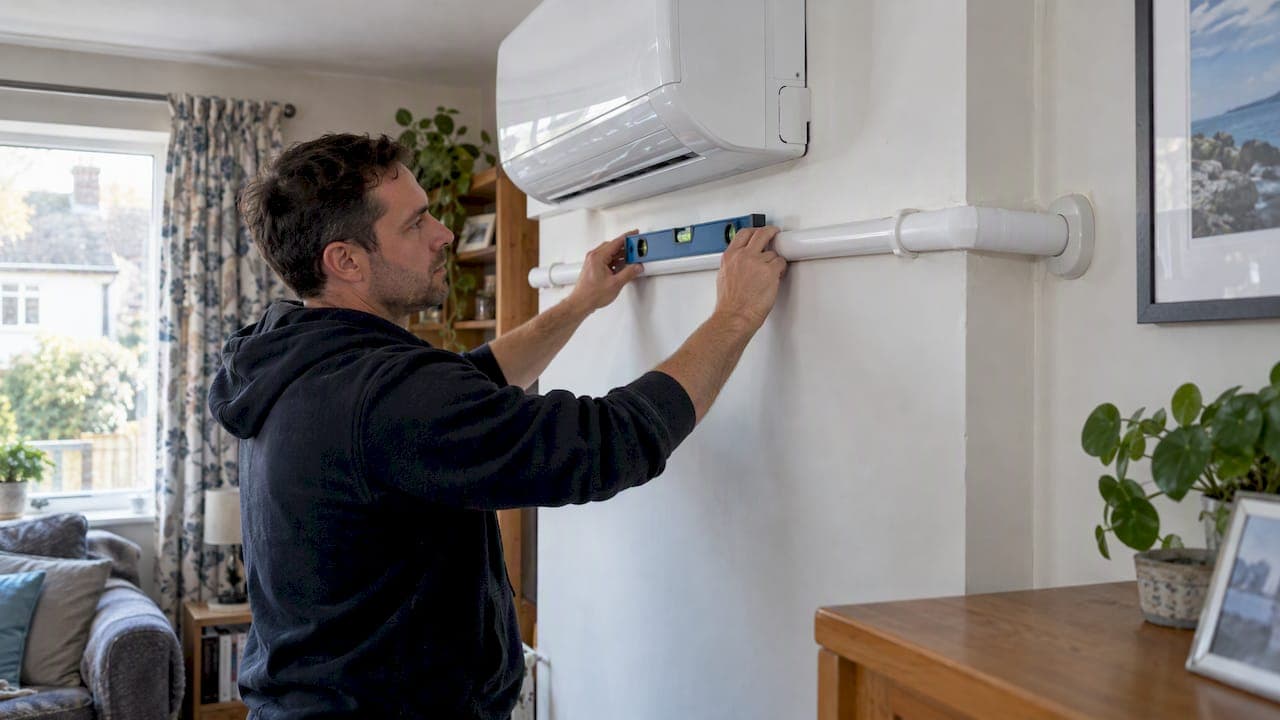
Use a gravity drain whenever the pipe can run downhill from the indoor unit to a suitable discharge point. Use a condensate pump only when it can't, for example because the unit is a long way from an outside wall, sits below the drain, or the pipe has to rise before it falls. Gravity is simpler and has nothing to break. A pump gives you freedom of placement in exchange for a moving part that needs checking. This guide explains how to decide, what each option costs you in noise, upkeep and risk, and what to ask before anyone drills a hole in your wall.
TL;DR
- Gravity drainage is the default: a continuous downhill pipe to a suitable discharge point, with no electrics, no noise and almost nothing to service.
- A condensate pump is the fix when the route has to go up, run a long way or start below the drain. It is common in retrofits, upper floors and basements.
- The pump itself is rarely the real problem. A blocked drain line, a poorly routed hose or a missing overflow safeguard is what causes water damage.
- Ask your installer to survey the whole route (fall, rise, length, bends, discharge point) before deciding, and to test it with water before they leave.
- Wiring a pump is electrical work that should meet BS 7671, so it isn't a job to improvise.
Table of Contents
- What condensate is and why it has to go somewhere
- How a gravity drain works
- How a condensate pump works
- When you can use gravity, and when you need a pump
- Condensate pump vs gravity drain: side-by-side
- Noise, power and reliability
- What actually causes the damage
- The rules that apply in the UK
- Retrofitting or swapping from a pump to gravity
- What to ask your installer
- Keeping either system trouble-free
- Our perspective
- Getting the drainage right from the start
- FAQ
- Sources
What condensate is and why it has to go somewhere
When your air conditioner cools a room, it also dries the air. Moisture condenses on the cold indoor coil, drips into a pan and flows to a drain. On a hot, humid day that can add up to a surprising amount of water, and all of it needs a safe route out of the building.
There are only two ways to move it. Either the pipe slopes downhill the whole way and gravity does the work, or a small pump collects the water in a reservoir and pushes it up and along a narrow discharge pipe to somewhere it can drain.

That is the whole comparison. Everything else is about which of the two suits your walls, your floors and the position of the unit.
How a gravity drain works
A gravity drain is a plain pipe leaving the indoor unit's drain outlet and falling continuously to a termination point. That might be outdoors over a gully, a soakaway, or a suitable internal waste connection made with the right air break. There are no moving parts, no power supply and no reservoir to clean.
The catch is geometry. Gravity drainage generally needs the indoor unit to be near an outside wall with enough space to let the water fall. Units located some distance from external walls, or in restricted spaces, can make it tricky. In practice the pipe needs a steady fall along its whole length, with no sags where water can pool and no point where it has to climb.
A few practical consequences:
- A wall-mounted split unit on an external wall is the ideal case. The pipe goes through the wall with the refrigerant lines and falls outside.
- A unit on an internal wall means a longer run, and every extra metre needs to keep falling. Eventually you run out of height.
- A ceiling cassette or ducted unit often sits in a void with very little fall available.
Outside, the termination matters too. A drain that discharges where it can freeze in winter is a known cause of blockages, which is a real consideration in the colder spells we see across Devon and Cornwall, particularly on exposed, north-facing walls.
How a condensate pump works
A condensate pump is a small unit, often sitting close to or inside the indoor unit or in a nearby void. Water reaches it by gravity from the air conditioner's drain outlet and collects in a reservoir. Most pumps use a float switch that starts and stops the motor automatically as the level rises and falls. The pump then pushes the water through a small-bore discharge hose to wherever it can drain.

Two details from manufacturer guidance are worth knowing even if you never touch the pump yourself. The installation manual for one UK-distributed pump says the pump must be installed level and close to the appliance, with the condensate reaching it by gravity. The same manual tells installers to keep the discharge hose as vertical and straight as possible, avoid kinks and use the built-in non-return valve so water doesn't run back into the pump when it stops.
So a pump doesn't remove gravity from the equation. It still needs a short gravity run to feed it. What it does is let the discharge go uphill or a long way sideways.
When you can use gravity, and when you need a pump
The decision usually comes down to the route, and the route is set by where the indoor unit goes.
Gravity works when:
- the indoor unit is on or near an external wall;
- the discharge point is lower than the unit's drain outlet, with room for a continuous fall;
- the pipe can leave the building without crossing anything awkward.
You need a pump when:
- the drain is uphill from the unit, or the water must rise before it can descend. A basement without natural slope, an uphill drain or a distant drain are textbook cases;
- the unit is on an upper floor and the nearest suitable waste is a long way off;
- you are retrofitting. Pumps make retrofit work and upper-floor or basement locations more flexible than gravity-only arrangements;
- the only practical route involves a loop or climb that gravity can't handle.
In older Devon and Cornwall homes, thick stone or cob walls, low ceilings, awkward extensions and converted spaces regularly push a job in the pump direction. That isn't a compromise. A well-specified pump with a well-planned discharge is a perfectly sound installation.
Condensate pump vs gravity drain: side-by-side
| Factor | Gravity drain | Condensate pump |
|---|---|---|
| Needs power | No | Yes, and it must be wired safely |
| Moving parts | None | Motor, float switch, non-return valve |
| Noise | Silent (water running only) | Can hum or gurgle as it cycles |
| Placement freedom | Limited by fall to the drain | Much greater: can lift and run further |
| Typical failure | Blockage, sag, freezing | Blockage, float stuck, motor failure, blocked discharge |
| Servicing | Occasional line clearing | Line clearing plus reservoir and pump check |
| Retrofit friendliness | Depends on the building | Generally better |
| Overflow protection | Relies on the drain staying clear | Can often be paired with a safety switch |
No option wins on every row. Gravity wins on simplicity and reliability. A pump wins on flexibility. The best choice is the one that matches your building without forcing an awkward route.
Noise, power and reliability
Noise. A gravity drain is effectively silent. A pump may be audible when it cycles, particularly in a quiet bedroom. A change in pump sound, or one that starts cycling more often than it used to, is an early warning that something needs looking at. Position matters: a pump in a ceiling void above a bedroom is a different proposition from one beside a unit in a utility room.
Power. A pump draws very little electricity, so running cost isn't the issue. The issue is that it needs a safe supply. The manual mentioned earlier specifies that electrical installation is for a qualified electrical engineer, must conform to BS 7671, the UK standard for electrical installations, and requires earthing and 30 mA residual-current protection. We cover the wider picture in our guide to electrical requirements for aircon in the UK.
Reliability. Gravity drains fail slowly and visibly: a slow drip, a damp patch, a unit that shuts down. Pumps add extra failure modes, but they are well understood. A failed or plugged pump can cause overflow or leaks and damage. Some pumps include a safety switch that shuts off the air conditioner if the discharge is blocked or the pump fails. If your installation relies on a pump, that safeguard is worth asking about.
What actually causes the damage
People blame the pump, but the weak point is nearly always the drain line itself. Dust, fibres and biological film build up in trays, reservoirs and narrow tubing, and a clean pump will still fail if the connected drain is blocked.
The consequences are the same whichever method you use. A blocked line can fill the drain pan and spill, damaging ceilings and walls. The same source points out that cooling performance isn't necessarily affected, so you can have a unit that seems to work perfectly while water quietly goes where it shouldn't. That is why overflow protection matters more than most owners realise.
Warning signs are worth knowing:
- a pump that sounds different, or cycles more often;
- water clearing slowly from the tray;
- musty smells near the indoor unit;
- damp marks on the wall or ceiling around it.
If you see any of these, don't wait for the next hot spell. Our guides to what causes aircon leaks and the common AC problems list help you narrow it down, and if it points to the drain, it is worth a proper visit.
Moisture control is a theme across the whole home, not just around the air conditioner. If you are also dealing with damp elsewhere, this explanation of condensation in loft spaces shows how the same principle, keeping moisture away from where it can do harm, applies to roofs and insulation.
The rules that apply in the UK
Condensate drainage isn't a free-for-all. Fixed air-conditioning systems are treated as fixed building services under the Building Regulations 2010, and building work has to comply with the applicable requirements. The regulations' Schedule 1 includes H1 (foul-water drainage), C2 (resistance to moisture) and P1 (electrical safety) in specified contexts. These apply in England and Wales, and Scotland and Northern Ireland have their own regimes.
What this means in everyday terms:
- the discharge should end somewhere appropriate, and you shouldn't connect a condensate pipe straight into a sealed waste pipe without the correct arrangement;
- the electrics for a pump must be done properly;
- the route shouldn't create a damp problem inside the building.
A competent installer deals with this as part of the design. If someone suggests simply poking a hose into the nearest drain, ask how they will deal with these points.
Retrofitting or swapping from a pump to gravity
A common question is whether an existing pump can be replaced with a gravity drain. Sometimes yes: if the indoor unit is on an external wall and the pump was only fitted for convenience, a downhill run may be possible. More often the pump is there because the route needs it, and removing it just moves the problem.
Before deciding, it is worth looking at the whole route again rather than the pump alone. Measure the fall available at the unit, the height of the discharge point, the length of the run and the number of bends. Our own experience on retrofit jobs is that the cheapest-looking option on paper isn't always the cheapest once access and making good are counted.
What to ask your installer
Here is a practical checklist to use at survey stage. Good installers will welcome these questions.
- Which method are you proposing, and why? The answer should refer to your actual building: where the unit sits, where the water goes.
- Where exactly does the water discharge? Ask them to show you. Check it won't freeze, and that it isn't going somewhere that causes a neighbour or damp issue.
- What is the complete route? Good guidance is to measure the whole route, including fall at the inlet, any rise, length, bends and discharge point.
- If a pump is needed, what is its capacity and lift? It should match the rise and distance, with spare margin.
- How will I get to the reservoir and pump? Pipework should be supported, with no dips or tight bends, and the reservoir accessible for cleaning.
- Is there an overflow safeguard? Ask whether a safety switch will shut the unit down if the pump or drain fails.
- Who does the wiring? It should be a qualified person working to BS 7671.
- Will you test it? The complete route should be tested with clean water, and the alarm tested if there is one.
If you hear vague answers to several of these, treat that as a warning about the rest of the job.
Keeping either system trouble-free
Most condensate problems are preventable with light, regular attention.
- Clean the filters. Dirty filters shed more dust into the tray and drain. Our guide on how to clean your air conditioner covers the safe homeowner tasks.
- Run a dry cycle. Letting the unit dry out after cooling helps stop damp, smelly tray conditions. See stopping aircon mould with a dry cycle.
- Know your unit's drainage. Find out whether you have a pump, where it is and where the water ends up. That one piece of knowledge speeds up any diagnosis.
- Book a service. A yearly visit lets an engineer check the drain, tray and pump when they are still clean and working, rather than after the first leak.
The aftercare guide and our condensation prevention guide go into more detail.
Our perspective
We install air conditioning across Devon, Cornwall and the wider South West, and our view is simple: start with gravity, use a pump when the building demands one, and never treat the drain as an afterthought.
The drain is the part of an installation that homeowners see least and that does the most damage when it goes wrong. We would rather spend an extra twenty minutes on a survey, walking the route from the unit to the discharge point, than return to a stained ceiling later. When the route allows a clean downhill run, we use it. When the unit has to be somewhere gravity can't reach, we plan a pump with a sensible discharge, an accessible reservoir and a safeguard, and we explain why.
Our engineers are local, F-Gas certified and REFCOM registered, and we don't use subcontractors, so the person who surveys your drain route is the person who knows the building when the job is done. That matters most on the drainage details, where a small decision on day one shows up as a problem two summers later.
One piece of advice we repeat often: the best condensate arrangement is the one you never have to think about. Ask for it to be designed, tested and explained, not just fitted.
— James
Getting the drainage right from the start
If you are planning a new system, the drain route is decided at survey, which is why we offer free surveys. We look at where the unit can go, whether gravity works and, if it doesn't, what a pump arrangement should look like. Our domestic installation service covers homes, using Samsung, Mitsubishi, Toshiba and Daikin systems, with 0% finance available and same-day or next-day installs in many cases. Running a shop or office? Our commercial and shop fitting team handles drainage across larger and more complex premises.
Already have a system with a pump that is noisy, slow or leaking? Our service and maintenance visits include checking the drain, and emergency breakdown response is available if water is already where it shouldn't be.
FAQ
Is a condensate pump better than a gravity drain?
Neither is better in general. Gravity is simpler, silent and has no moving parts, so it is the first choice when the route allows it. A pump is better when the unit sits below the drain, far from an outside wall or somewhere the pipe would have to climb.
Should a condensate pump always have water in it?
Not necessarily. The reservoir fills as the air conditioner produces condensate and the float switch starts the pump when the level rises. In cooler weather or when the unit isn't running it may be nearly empty. Constant standing water with no pumping is a sign something is wrong.
What happens when a condensate pump fails?
Water can overflow from the reservoir or back up into the drain pan and leak onto walls, ceilings or floors. Some pumps include a safety switch that shuts the air conditioner off when the pump fails or the discharge is blocked, which limits the damage. If your pump stops working, switch the unit off and call an engineer.
Can I swap my condensate pump for a gravity drain?
Only if the route allows a continuous downhill run from the unit to a suitable discharge point. If the pump was fitted because of height or distance, removing it will usually cause leaks. An installer should survey the route before you decide.
Sources
- Air Conditioning System, AHRI
- The Ultimate Guide to HVAC Condensate Pumps, Beckett
- Defying gravity: don't forget the condensate, ACR News
- Condensate Pump Installation Best Practices, Ferguson
- Sanicondens Pro / Eco installation guide
- Electrical standards and approved codes of practice, HSE
- The Building Regulations 2010, legislation.gov.uk
- Building and Buildings, England and Wales, Schedule 1
- AC Condensate Drain Line Clogged, Trane
- Condensate pump guides
- Condensate pump installation guides
- Condensation in loft spaces