
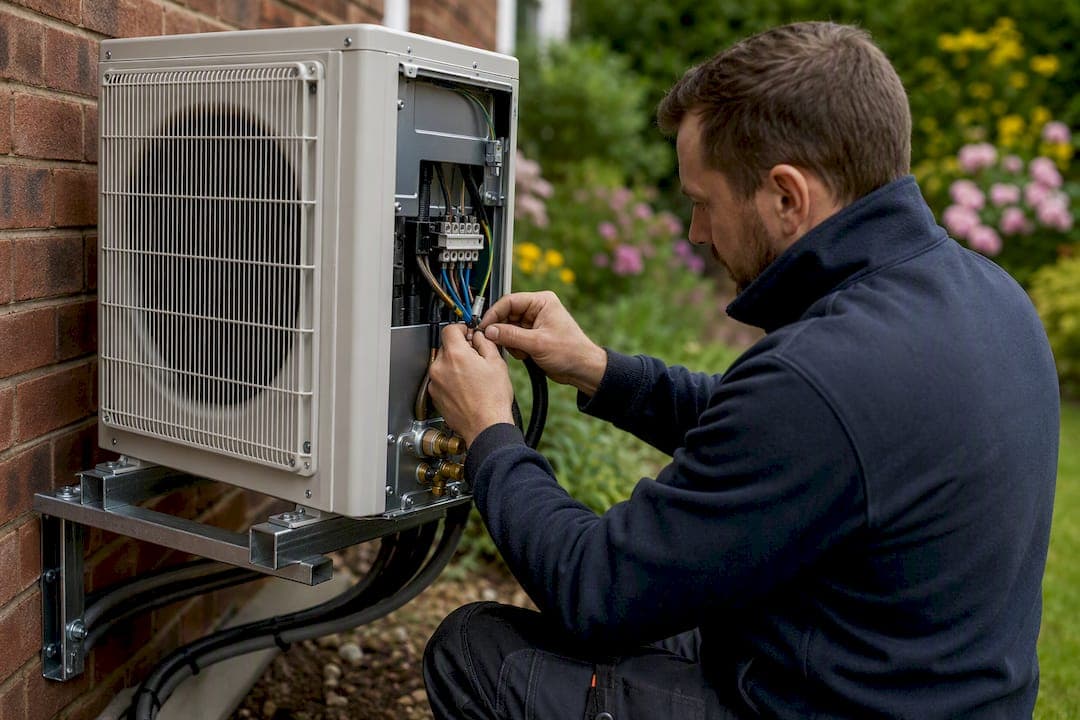
Most fixed split air conditioning systems in the UK need a dedicated, protected electrical circuit and a local isolator switch, installed to BS 7671 wiring standards. That's the direct answer. Portable plug-in units are the exception; everything permanently wired into your home is not something you plug into a spare socket.
Before an installer turns up, expect these items to be arranged or checked:
- A dedicated circuit running from your consumer unit, sized for the unit's running and inrush current
- A weatherproof outdoor isolator switch for safe local isolation during servicing
- The right combination of MCB and RCD or RCBO protection for the circuit
- Correctly sized cable, chosen against BS 7671 rules on length, routing and ambient temperature
- Confirmation of whether the work is notifiable under Part P and who will self-certify it
Key Takeaways
Fixed split air conditioning systems in the UK require a dedicated, BS 7671 compliant electrical circuit with correct protection, and skipping this step causes most installation delays.
| Point | Details |
|---|---|
| Dedicated circuit is standard | Fixed split systems need their own protected circuit from the consumer unit, not a shared socket. |
| Type C MCBs handle inrush | Compressor start-up current spikes well above running current, which is why Type C protection is common. |
| Certification isn't optional | Expect an Electrical Installation Certificate and F-Gas paperwork at completion, and keep both. |
| Prearranging electrics avoids delays | Installers expect a live, tested supply ready on arrival, or the job slips. |
| Frostairconditioning covers both sides | F-Gas certified, based in Exeter, covers the South West, with 0% finance and same-day installs available. |
Table of Contents
- Electrical requirements for aircon UK: the components that go in
- Regulations and certification you should expect to see
- How electricians size your cable and choose your MCB
- Who does the electrical work and what paperwork follows
- What the electrical work adds to cost and timeline
- Your pre-install checklist
- Common electrical mistakes homeowners make
- Why Frostairconditioning gets the electrical side right
- The bit most guides skip
- Get your electrical work and installation sorted together
- Sources
Electrical requirements for aircon UK: the components that go in
A typical split system installation involves more wiring than most homeowners expect, and it's worth knowing what should physically appear before, during and after the job.
- Dedicated circuit from the consumer unit. The outdoor condenser unit gets its own protected supply run directly from the consumer unit, not tapped off an existing ring main or spur.
- Outdoor isolator switch. A weatherproof isolator sits near the condenser so an engineer can cut power locally for servicing without touching the consumer unit.
- Protective device pairing. The circuit gets an MCB matched to the unit's electrical data, plus RCD or RCBO protection depending on the installation.
- Indoor unit supply. Some indoor units draw power through a control cable from the outdoor unit; others need their own separate feed, which affects containment planning.
- Cable containment and routing. Trunking or conduit keeps cables protected and tidy, and routing decisions made early save reworking walls or ceilings later.
Pro Tip: Ask your installer to confirm, in writing, whether your chosen indoor unit needs its own separate electrical feed. It's a small detail that changes cable routing, and it's far cheaper to plan for than to retrofit.
Regulations and certification you should expect to see
Three regulatory frameworks govern this work, and a homeowner who understands them can spot a corner-cutting quote in seconds.
BS 7671, the IET Wiring Regulations, is the technical backbone. It dictates cable sizing, protective device selection and earthing arrangements for every circuit in your home, including the one feeding your outdoor condenser.
Part P of the Building Regulations governs whether the work is notifiable. Most new circuits for fixed air conditioning fall under Part P, meaning the work should be carried out by a competent, registered electrician who can self-certify it rather than notified separately to your local authority.
F-Gas regulations and REFCOM certification cover the refrigerant side. Anyone handling refrigerant gas during installation or servicing needs F-Gas qualifications, and checking an installer's REFCOM registration before signing anything is a genuinely useful five-minute task.
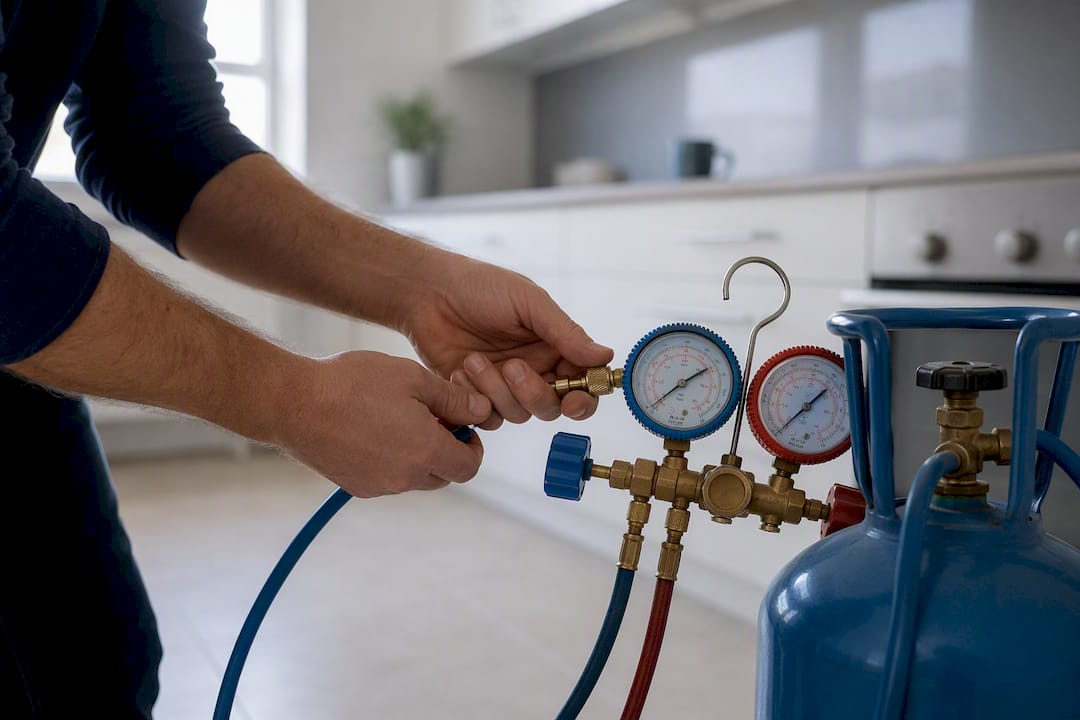
By completion, you should hold: an Electrical Installation Certificate (or Minor Works Certificate for smaller alterations) and F-Gas paperwork confirming the refrigerant handling was compliant. Keep both. They matter more than most homeowners realise, particularly if you sell the property later.
How electricians size your cable and choose your MCB
Quotes for aircon electrical work can look wildly different from one installer to the next, and the reason usually comes down to how carefully the cable and protective device have been calculated rather than guessed.
A few factors drive the decision:
- Continuous running current of the outdoor unit, taken from the manufacturer's electrical data plate
- Cable length and routing, since longer runs need larger conductors to avoid excessive voltage drop
- Installation method, because cable clipped to a surface behaves differently, thermally, than cable buried in insulation
- Compressor inrush current, which can briefly spike to several times the running current the moment the compressor kicks in
That inrush spike is why Type C MCBs are commonly specified for domestic compressor circuits rather than the Type B breakers used for lighting circuits. A Type B breaker on a compressor circuit will often nuisance-trip the moment the unit starts. Larger commercial-scale motors sometimes call for Type D protection instead.
RCBO protection is increasingly the preferred choice for a single outdoor unit circuit, since it combines overcurrent and residual current protection in one device and makes fault-finding far simpler than a shared RCD covering multiple circuits. Inverter-driven systems add a wrinkle here too: some produce DC leakage currents that standard AC-type RCDs don't reliably detect, so manufacturer guidance on RCD type should always be followed rather than assumed.
If your consumer unit is old, has no spare ways, or is still a wooden-backed board from decades ago, expect your electrician to recommend a consumer unit upgrade as part of the job rather than a patch.
Who does the electrical work and what paperwork follows
The division of labour on an aircon job trips people up more than almost anything else, so it's worth being clear on it before work starts.
- The electrician installs and certifies the dedicated circuit, isolator and consumer unit connection. They test the circuit and issue an Electrical Installation Certificate or Minor Works Certificate.
- The air conditioning engineer commissions the system itself, connecting to the live electrical supply the electrician has already provided, and handles refrigerant work under F-Gas rules.
- Credentials worth checking before either trade starts: NICEIC, NAPIT or ECS registration for the electrician, and F-Gas/REFCOM certification for anyone touching refrigerant.
- Certificates to expect on completion: an EIC or Minor Works Certificate, plus F-Gas documentation confirming compliant refrigerant handling.
When you're comparing quotes, ask one direct question: is the electrical work included in this price, or is it a separate subcontract you'll need to arrange yourself? Vague answers here are the single biggest cause of installation-day surprises.
What the electrical work adds to cost and timeline
Electrical preparation is rarely free, and pretending otherwise in a quote is a red flag rather than a bargain.
A single-split system with a straightforward dedicated circuit, isolator and certification sits at the lower end of additional cost. A consumer unit upgrade, a long cable run through multiple rooms, or a multi-split system serving several indoor units pushes the price up because cable, containment and labour all scale with distance and complexity.
Timing usually follows a set pattern: an electrician's pre-install visit to assess the consumer unit and plan the circuit, a short lead time for materials, then the AC installation and commissioning visit. Ask for electrical work and certification to be itemised separately on your quote, not folded into a single vague line labelled "installation".
Your pre-install checklist
A little preparation on your end keeps the installation day running to schedule rather than stalling on avoidable snags.
- Book a qualified electrician early, and confirm in writing who is responsible for the dedicated supply and isolator.
- Check your consumer unit has spare ways and that the existing supply is live and tested before the installation date.
- Agree the isolator's location with both trades beforehand. Moving it after fitting is expensive rework nobody enjoys.
- Ask what paperwork you'll receive on completion and keep it somewhere you can find it, ideally with your boiler and other appliance documents.
Pro Tip: Installers plan around a live, tested supply being ready on arrival. If the electrical prep hasn't happened, the whole job slips, sometimes by weeks rather than days if trades have to be rebooked.
Common electrical mistakes homeowners make
A handful of avoidable errors account for most of the delays and disputes on aircon jobs.
- Assuming a standard 13A wall socket is fine for a fixed split system, when fixed appliances legally need dedicated wiring
- Under-sizing the cable or fitting the wrong MCB type, which causes nuisance tripping or, worse, an unsafe installation
- Fitting the isolator somewhere impractical, or skipping it entirely
- Accepting a quote that doesn't clearly state who's responsible for the electrical work and whether certification is included
Why Frostairconditioning gets the electrical side right
Frostairconditioning is F-Gas certified, covers Exeter and the wider South West, offers 0% finance, and can arrange same-day installs where the electrical groundwork allows it. That combination matters more than it sounds.
An installer who understands both refrigerant compliance and domestic wiring standards closes the gap that causes most homeowner headaches, the one between "the AC works" and "the AC is legally and safely installed."
Ask any installer, on any job, for two things at handover: the Electrical Installation Certificate and the F-Gas paperwork. If either is missing, the job isn't finished, whatever the unit on your wall is doing.
What this means for you in practice:
- One point of accountability for both the electrical circuit and the refrigerant work
- Certification handed over at completion, not chased up weeks later
- Local knowledge of South West properties, from Victorian terraces to newer builds with modern consumer units
The bit most guides skip
Most articles on this topic treat the electrical work as a technical footnote squeezed between choosing a unit and picking a colour for the indoor casing. That's backwards. The electrical prep is usually the part that determines whether your installation date holds, whether your quote balloons, and whether the system is safe five years from now.
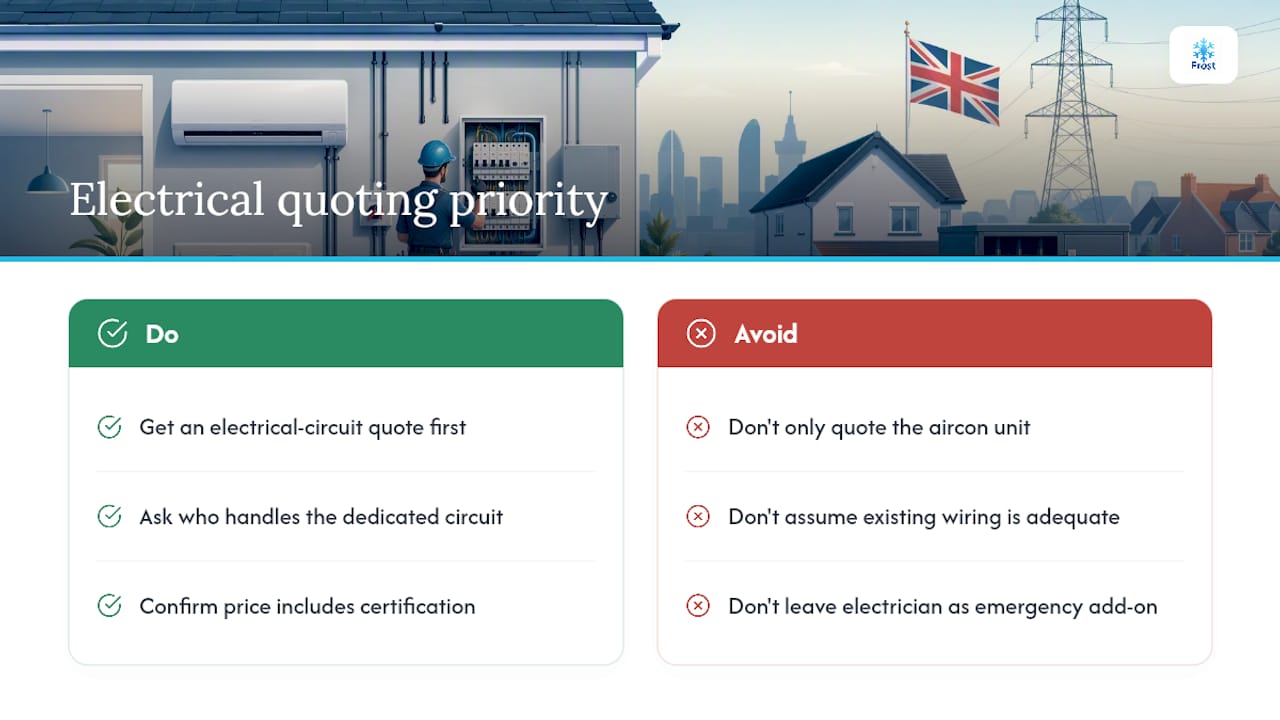
The conventional advice, "get a quote for the aircon unit," misses the actual decision point: get a quote for the electrical circuit first, because that's what dictates timescale and true cost. A £2,000 unit fitted onto inadequate wiring is a worse outcome than a £2,200 unit fitted properly, and yet most homeowners never ask the question that would reveal the difference.
If there's one priority worth taking from all of this, it's asking upfront who is responsible for the dedicated circuit and whether their price includes certification. Everything else, cable size, MCB type, isolator placement, follows from getting that one relationship right at the quoting stage. Homeowners who skip this step are the ones who end up mid-installation with an electrician being called in as an emergency add-on.
— James
Get your electrical work and installation sorted together
Booking an electrician separately from your air conditioning engineer often means chasing two invoices, two visit dates and two sets of paperwork, when one coordinated job would have done. Frostairconditioning handles the dedicated circuit, isolator, certification and the air conditioning installation itself as one job, with F-Gas certified engineers covering Exeter and the South West.

That matters most on same-day or next-day installs, where the electrical prep and the commissioning visit need to line up without a fortnight's gap between trades. If you're ready to see what your property needs, request a quote or explore the domestic installation service to get a clear picture of the electrical work involved before you commit to a date.