

Industry standards in air conditioning define the mandatory technical requirements, safety protocols, and performance benchmarks that every contractor and building operator must meet to deliver effective, efficient, and compliant HVAC systems. These standards draw from frameworks including ACCA's Manual J and Manual S, ASHRAE standards 62.1, 90.1, 170, and 180, and federal regulations from the DOE and EPA. Getting them right is not optional. Non-compliance carries financial penalties, equipment failures, and in some cases, serious safety risks. Whether you are planning a new installation or reviewing your maintenance programme, understanding these frameworks is the foundation of every sound decision.
What are the key design and installation standards in air conditioning?
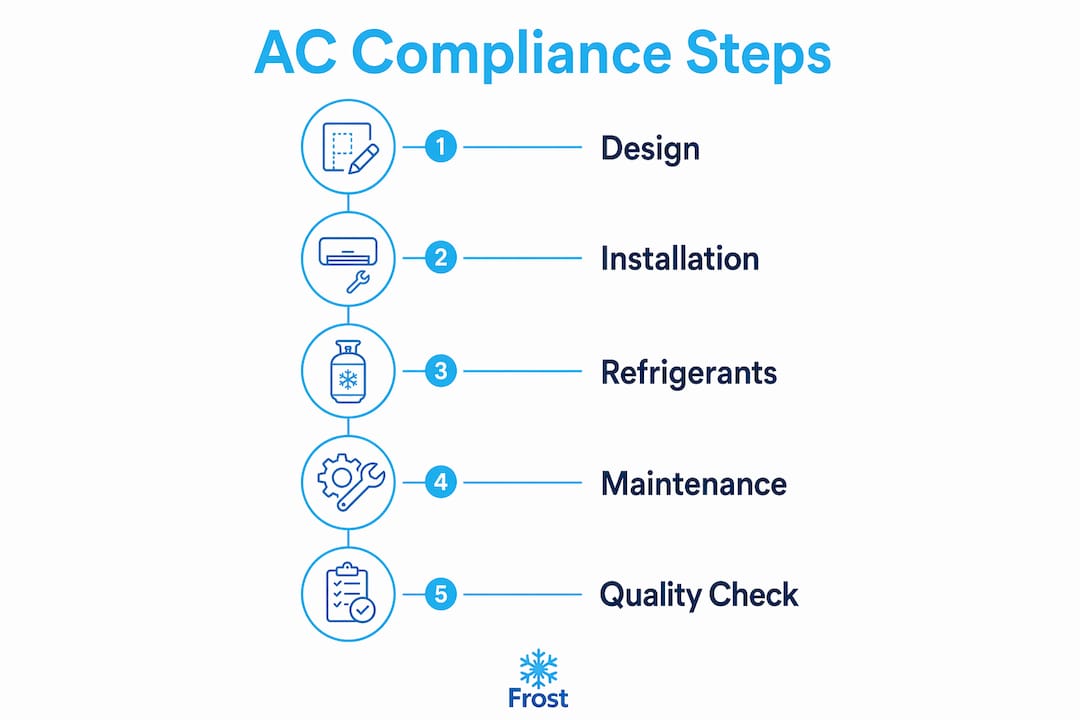
The design phase is where most compliance failures begin. ACCA's Manual J and Manual S require room-by-room load calculations and careful equipment selection, moving the industry firmly away from the old "box swap" approach where contractors simply replaced a unit with a similar-sized one and hoped for the best. That method is no longer acceptable under current HVAC industry guidelines, and for good reason.
Manual J calculates the precise heating and cooling load for each room based on insulation, window area, orientation, and occupancy. Manual S then uses those figures to select equipment that matches the calculated load rather than oversizing "just in case." Oversized units short-cycle, meaning they switch on and off too frequently, which drives up energy bills, increases wear, and creates humidity problems. Skipping a formal Manual J is a leading cause of premature equipment failure in 2026. Contractors who rely on rule-of-thumb sizing are not meeting current best practices in air conditioning, full stop.

Duct design follows ACCA Manual D, which governs airflow distribution to prevent pressure imbalances and hot or cold spots. Verified airflow measurements taken after installation confirm the system performs as designed. ACCA's Quality Installation checklists then provide a standardised verification layer, confirming that refrigerant charge, electrical connections, airflow, and safety controls all meet specification before the system is handed over.
Pro Tip: Ask your installer for a copy of the Manual J load calculation before any equipment is ordered. If they cannot produce one, that is a red flag under current compliance standards for HVAC.
Key elements covered by ACCA's design and installation standards include:
- Room-by-room load calculations per Manual J
- Equipment selection verified against load data per Manual S
- Duct sizing and layout per Manual D
- Post-installation airflow measurement and verification
- Completion of Quality Installation checklists before commissioning
How do current regulations and refrigerant rules shape compliance?
Federal efficiency rules set the floor for what equipment can legally be installed. Split-system central air conditioners must meet regional SEER2 minimums of 13.4 in the North and 14.3 in the South and Southwest as of May 2026. SEER2 is the updated efficiency rating methodology, replacing the older SEER metric with a more rigorous test procedure. A unit that met the old SEER threshold may not meet SEER2, so equipment selection requires careful attention to the current rating system.
Refrigerant compliance is equally significant. Equipment manufactured after 1 January 2025 must use refrigerants with a Global Warming Potential below 700. This requirement drives the transition to A2L low-GWP refrigerants such as R-454B and R-32, which are mildly flammable. That classification changes the installation picture considerably. A2L refrigerants require new safety system designs when charge limits exceed defined thresholds, including leak detection systems and adequate ventilation. Standards including BS EN 378 and IEC 60335-2-40 govern these requirements in the UK context.
| Compliance area | Requirement | Applies from |
|---|---|---|
| SEER2 North region | Minimum 13.4 SEER2 | May 2026 |
| SEER2 South/Southwest | Minimum 14.3 SEER2 | May 2026 |
| Refrigerant GWP limit | Below 700 GWP | 1 January 2025 |
| A2L safety systems | Leak detection and ventilation above charge limits | Ongoing |
Installers working with A2L refrigerants need updated tools, leak detection equipment, and specific training. The safety implications are not theoretical. Mildly flammable refrigerants in confined spaces with ignition sources present a genuine risk if charge limits are exceeded without the required safety measures in place.
Pro Tip: Verify that your installer holds current F-Gas certification and is familiar with A2L refrigerant handling requirements before any work begins. Frostairconditioning is F-Gas certified and covers the South West, including same-day installs where needed.
The practical consequences of non-compliance include:
- Fines for installing equipment that does not meet SEER2 minimums
- Penalties for improper refrigerant handling under EPA rules
- Voided manufacturer warranties on non-compliant installations
- Increased liability if A2L safety systems are omitted
Which maintenance standards must commercial HVAC systems follow?
ASHRAE produces the most widely referenced maintenance standards for commercial and institutional HVAC. Standard 62.1 governs ventilation for acceptable indoor air quality. Standard 90.1 sets energy efficiency requirements for buildings. Standard 170 covers ventilation in healthcare facilities. Standard 180 addresses the inspection and maintenance of commercial HVAC systems directly. Together, these four standards form the backbone of any credible commercial compliance programme.
ASHRAE Standard 180 mandates frequency-based maintenance tasks with full documentation. This goes well beyond the typical annual service visit. Standard 180 requires specific tasks such as checking variable frequency drives (VFDs) and calibrating building automation controls, tasks that most standard service contracts do not include. A maintenance schedule that is not explicitly mapped to Standard 180 cannot be considered compliant, regardless of how thorough it appears on paper.
ASHRAE standards act as the language of compliance for commercial HVAC, and translating their requirements into actionable schedules early in a project prevents permitting delays and audit failures. The challenge most facility teams face is that they treat ventilation, energy efficiency, and maintenance as separate concerns managed by different departments. Fragmented documentation across these areas is the leading cause of audit failures. A unified compliance programme that integrates all four ASHRAE standards into a single documented system is the recognised solution.
Pro Tip: Use dedicated CMMS (Computerised Maintenance Management System) software to map maintenance tasks directly to ASHRAE 180 requirements. This creates an auditable record and removes the risk of tasks falling through the gaps between service visits.
The most commonly overlooked maintenance requirements under ASHRAE 180 include:
- VFD inspection and performance verification
- Calibration of building automation and control systems
- Coil cleaning to specified intervals rather than visual judgement
- Filter replacement tracked against pressure differential, not just calendar dates
- Documentation of all tasks with technician sign-off
How does quality installation improve performance and compliance?
Code compliance and quality installation are not the same thing. Code compliance meets legal minimums. Quality installation ensures the equipment meets its performance specifications and operates as the manufacturer and designer intended. The gap between the two is where most callbacks, early failures, and efficiency shortfalls originate.
Improper installation is the most common failure point for HVAC systems according to ACCA. A system can pass a basic building inspection and still be incorrectly charged, poorly commissioned, or connected to ductwork that restricts airflow. None of those problems show up on a standard compliance checklist. ACCA's Quality Installation standard addresses this by requiring a documented verification process that goes beyond the minimum code check.
The commissioning process is where quality installation is confirmed. Before a system is handed over, the following steps must be completed and documented:
- Verify refrigerant charge against manufacturer specifications using measured superheat and subcooling values
- Confirm airflow at each supply and return register against the Manual D design
- Check all electrical connections and safety controls for correct operation
- Test thermostat and control system calibration
- Complete and retain the ACCA Quality Installation checklist as a permanent record
Quality installation also protects the homeowner or building operator directly. Manufacturer warranties frequently require documented installation to the relevant standard. Without that paperwork, a warranty claim for a failed compressor or heat exchanger can be rejected. For guidance on what a properly documented installation looks like in practice, the certified installation steps guide covers the process in detail.
Pro Tip: Request the completed ACCA Quality Installation checklist at handover. It is your evidence that the system was installed correctly and your protection if a warranty claim becomes necessary.
Key takeaways
Compliance with industry standards in air conditioning requires integrating design, installation, refrigerant, and maintenance requirements into a single documented programme rather than treating each as a separate obligation.
| Point | Details |
|---|---|
| Design starts with Manual J | Room-by-room load calculations prevent oversizing and premature equipment failure. |
| Refrigerant rules changed in 2025 | Equipment must use refrigerants below 700 GWP; A2L types require additional safety systems. |
| ASHRAE 180 sets the maintenance floor | Maintenance schedules must map explicitly to Standard 180 tasks to be considered compliant. |
| Quality installation exceeds code | ACCA checklists verify performance beyond legal minimums and protect warranty validity. |
| Unified documentation prevents audit failures | Fragmented records across ventilation, efficiency, and maintenance are the leading cause of compliance failures. |
Why I think most people underestimate the complexity of these standards
I have seen a lot of installations over the years, and the pattern that concerns me most is not deliberate corner-cutting. It is the assumption that passing a building inspection means the job is done properly. It does not. A system can be fully code-compliant and still be oversized, incorrectly charged, and connected to ductwork that will cause it to fail within five years.
The refrigerant transition to A2L types is where I think the industry is currently most exposed. The safety requirements around charge limits and leak detection are not widely understood outside specialist circles, and the consequences of getting them wrong are serious. BS EN 378 and IEC 60335-2-40 are not light reading, but any installer working with R-454B or R-32 needs to understand what they require.
What I would tell anyone commissioning an installation or reviewing their maintenance programme right now is this: ask for the paperwork. Manual J calculations, ACCA checklists, ASHRAE 180-mapped maintenance schedules. If the contractor cannot produce them, find one who can. The standards exist because they work. The energy efficiency gains from a properly designed and installed system are measurable and sustained. The cost of getting it wrong compounds over time.
— James
How Frostairconditioning supports compliant installation and maintenance

Frostairconditioning installs domestic air conditioning systems across Exeter and the wider South West, working to ACCA design and installation standards with full F-Gas certification. Every installation follows a documented process from load assessment through to commissioning verification, so you receive a system that performs as specified from day one. Same-day installs are available, and 0% finance options make compliance-grade installation accessible without upfront cost pressure. For ongoing peace of mind, the service maintenance programme is structured to keep your system operating within current guidelines. If you are ready to start with a properly documented installation, the domestic installation page covers everything you need to know.
FAQ
What are industry standards in air conditioning?
Industry standards in air conditioning are the documented technical requirements, safety protocols, and performance benchmarks that govern how HVAC systems are designed, installed, and maintained. Key frameworks include ACCA Manual J, Manual S, and Manual D, alongside ASHRAE standards 62.1, 90.1, 170, and 180.
What is SEER2 and why does it matter for compliance?
SEER2 is the updated efficiency rating methodology for air conditioning equipment, replacing the older SEER metric with a more rigorous test procedure. Split-system central air conditioners must meet regional SEER2 minimums of 13.4 in the North and 14.3 in the South and Southwest as of May 2026.
Which refrigerants are compliant under current air conditioning regulations?
Equipment manufactured after 1 January 2025 must use refrigerants with a Global Warming Potential below 700. A2L refrigerants such as R-454B and R-32 meet this requirement but introduce additional safety obligations including leak detection and ventilation systems above defined charge limits.
What does ASHRAE Standard 180 require for HVAC maintenance?
ASHRAE Standard 180 mandates frequency-based maintenance tasks with full documentation, including VFD checks, building automation calibration, and coil cleaning at specified intervals. A maintenance schedule that is not explicitly mapped to Standard 180 does not meet commercial compliance requirements.
What is the difference between code compliance and quality installation?
Code compliance meets the legal minimum required to pass a building inspection. Quality installation, as defined by ACCA's Quality Installation standard, verifies that the system meets its performance specifications through documented checks of refrigerant charge, airflow, electrical connections, and safety controls.