
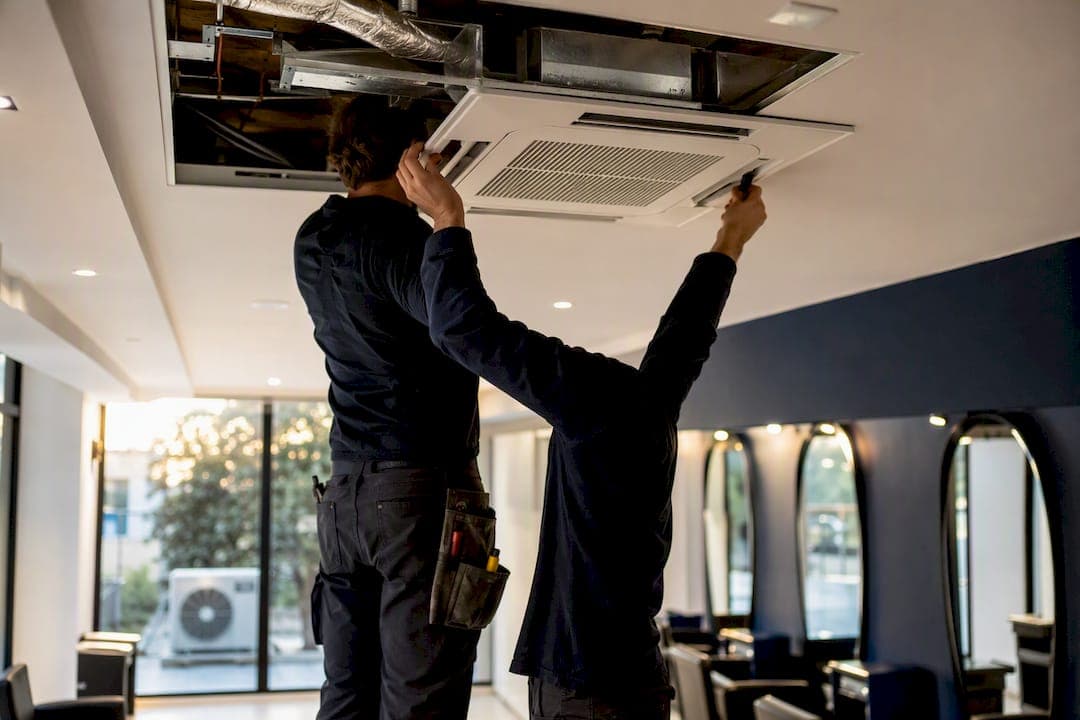
Most salons need two systems working together, not one: a correctly sized air conditioning unit for temperature and humidity, plus continuous balanced ventilation to clear chemical vapours. Getting either wrong causes short-cycling, sticky product shelves or headaches by 3pm. The rest of this guide covers system types, heat-load sizing, ventilation design, installation steps, maintenance and how to vet an installer.
TL;DR:
- Proper sizing requires a detailed heat-load calculation that accounts for body heat, styling tools, lighting, and retail equipment, not just floor area.
- Ventilation systems like energy recovery ventilators are essential for removing chemical vapours and must be designed alongside the air conditioning system to avoid performance issues.
- Installation should include site survey, airflow planning, condensate routing, and landlord or planning approvals to prevent costly errors or delays.
- Regular maintenance, including filter checks and coil cleaning, is necessary twice a year due to the high use and chemical exposure specific to salons.
- Choosing a qualified, certified installer with a detailed plan and proper calculation is critical; avoid quotes based solely on square footage or without a comprehensive site survey.
Table of Contents
- What type of salon air conditioning system do you actually need?
- How do you size air conditioning correctly for a salon?
- Why does ventilation matter as much as air conditioning?
- What does a salon air conditioning installation actually involve?
- How often should salon air conditioning be serviced?
- What should you check before hiring an installer?
- What does salon air conditioning cost and how long does it take?
- Frostairconditioning: certified installation and finance for salons
- The engineering view: why sizing and ventilation come before brand choice
- Ready to fix your salon's air and heat problems properly?
- Sources
What type of salon air conditioning system do you actually need?
The right system depends on your floor plan, not the size of your budget. A single treatment room and a five-chair open-plan salon have completely different airflow problems, and buying the wrong category of unit is the single most common mistake owners make before they've even reached the sizing conversation.
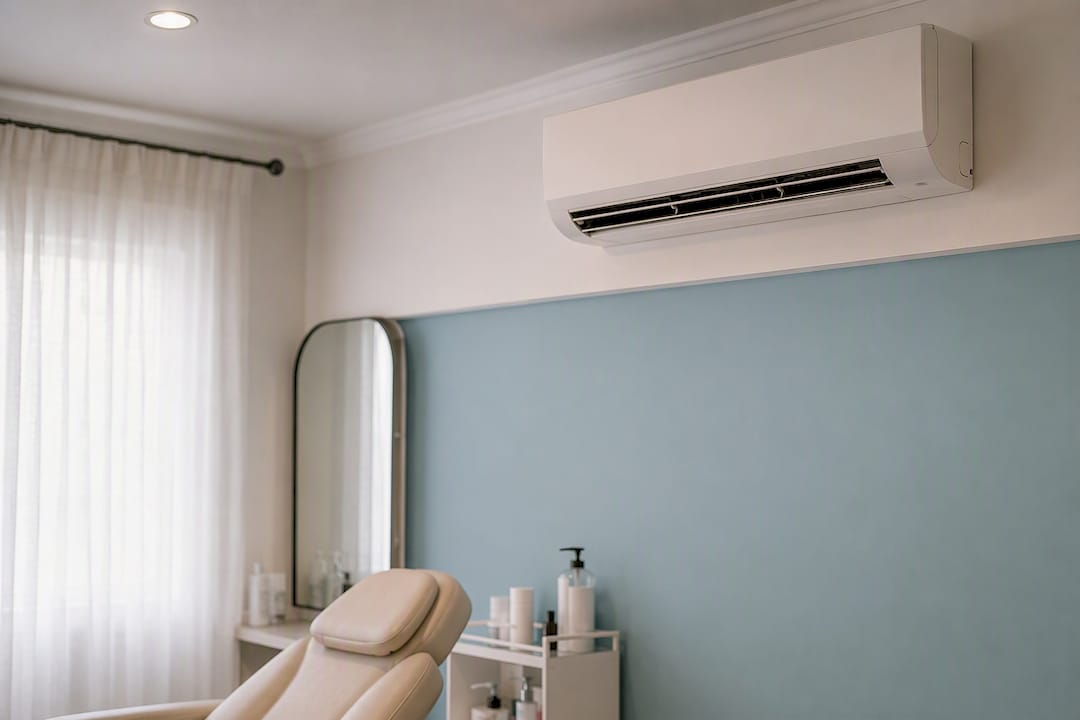
Wall-mounted split systems suit single treatment rooms, small barbershops or standalone nail bars. One outdoor condenser feeds one indoor unit, keeping install costs down and disruption minimal. They're a poor fit for open-plan spaces because airflow only reaches so far before it stalls, leaving corners warm and humid.
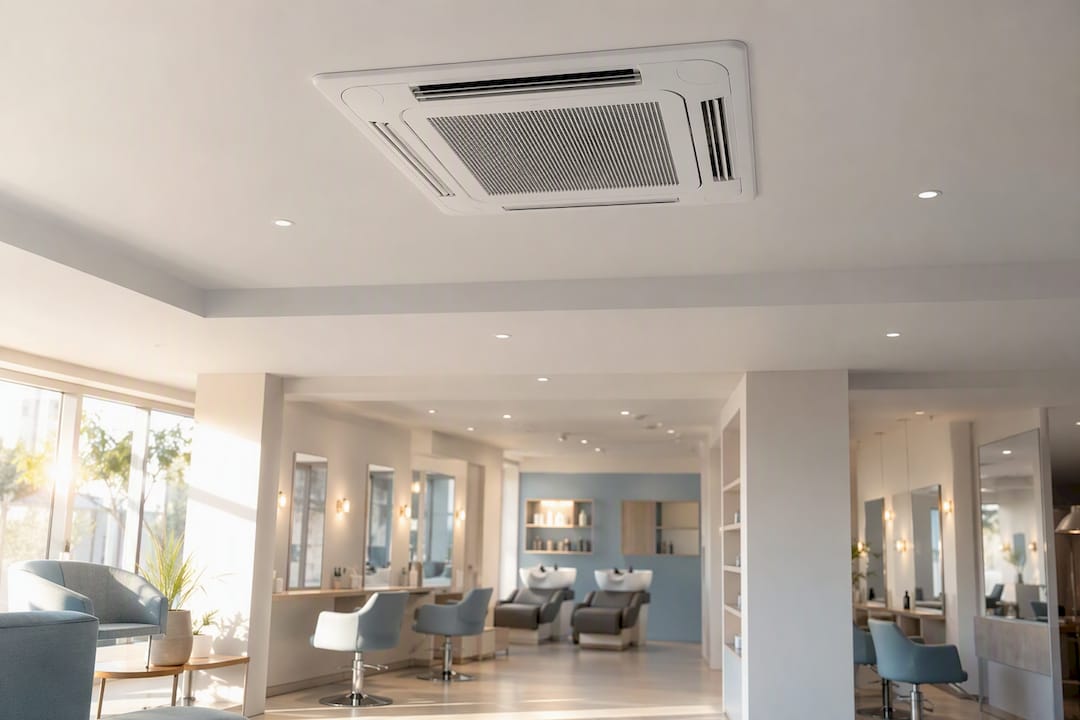
Ceiling cassette units solve that problem for open-plan salons. Mounted flush into the ceiling, they distribute air in four directions rather than one, which matters when you've got six styling chairs, three dryer stations and a reception desk all under the same roof. They cost more to install because of the ceiling void work involved, but the even coverage usually justifies it in anything larger than a two-chair salon.
Ducted and multi-split (or multi head) systems are the answer for multi-room salons or higher-end spas with separate treatment rooms, a colour bar and a retail area. One outdoor unit can run several indoor heads, each controlled independently, so a client having a facial in a quiet room isn't fighting the same thermostat as the colour bar next door. This is also the category to look at if you're planning a full shop fitting project rather than retrofitting an existing space.
Portable units are rarely the right long-term answer. They're loud, they need a window or duct hose for exhaust, and they struggle to dehumidify a room with six hairdryers running at once. Treat them as a stopgap while you wait for proper installation, not a permanent fixture.
Beyond the category, a few practical details separate a good salon install from a mediocre one:
- Noise matters more in a salon than a living room — clients are seated for 30 to 90 minutes, so a unit rated above 40dB near a chair becomes a genuine irritant.
- Condensate has to go somewhere; ceiling cassettes and ducted systems need a proper drainage route planned at survey stage, not bolted on afterwards.
- Aesthetics count in a client-facing space, and cassette or ducted systems keep the visible hardware to a discreet ceiling grille rather than a wall-mounted box.
- Access for servicing needs thinking through before installation, particularly for ceiling-void equipment above styling stations.
If quiet operation near clients is a priority, it's worth reading how modern systems handle noise reduction before you commit to a unit.
How do you size air conditioning correctly for a salon?
Square footage alone will get you the wrong unit almost every time in a salon, because the heat load in a hair or beauty salon comes from far more than the walls and windows a generic calculator assumes.
A salon generates heat from sources a bedroom or office never has to account for:
- Body heat from stylists and clients — a busy salon can have ten or more people in a modest space for hours at a stretch, each adding roughly 100 watts of sensible heat.
- Hairdryers and styling tools, which can each draw 1,500 to 2,000 watts and run almost continuously through a working day.
- Nail curing lamps and UV equipment, smaller individually but numerous across a busy nail bar.
- Lighting, especially retail-style spotlighting used to show off colour work and finished styles.
- Computers, till systems and retail display fridges, all adding a steady background load most owners forget to mention to an installer.
Get the heat load wrong and the symptoms show up fast: the unit short-cycles, switching on and off rather than running steadily, which wastes energy and never properly dehumidifies the air. An undersized system leaves the salon clammy even when the thermostat reads comfortable, because temperature and humidity aren't the same thing. Industry commentary on HVAC sizing consistently flags mis-sizing based on floor area alone as one of the most common causes of poor salon comfort, and the fix is always the same: a proper calculation, not a bigger guess.
That's why a manual heat-load calculation, not a rule of thumb, has to happen before anyone quotes a unit size. A competent installer maps out where the heat actually concentrates. A salon with four dryer stations clustered on one side and a quiet colour room on the other often needs two or three smaller indoor units rather than one large one, purely so each zone gets matched cooling instead of one end freezing while the other bakes.
Pro Tip: Ask your installer to walk the heat-load calculation with you at survey stage. If they quote a unit size before measuring your equipment count and chair layout, that's a sign they're guessing rather than calculating.
Correct sizing also protects against condensation problems down the line. Oversized units cool too fast and shut off before they've pulled enough moisture out of the air, which is a common cause of damp product shelves and misted mirrors covered in more detail in this guide to preventing condensation.
Why does ventilation matter as much as air conditioning?
Recirculating air conditioning cools a room, but it doesn't remove the chemical vapours a salon produces every day, and that's the part most owners overlook entirely.
Hair colour, bleach, acetone, acrylic monomer and UV gel all release volatile organic compounds (VOCs) into the air. A standard AC unit, even one fitted with a HEPA or carbon filter, mostly moves that air around rather than exchanging it for clean air from outside. Purifiers can trap some particulates, but they don't solve the underlying problem: stale, chemically loaded air needs to leave the building and be replaced, continuously, during working hours.
This is where an energy recovery ventilator (ERV) earns its place in salon design. An ERV brings in fresh outdoor air and expels stale indoor air simultaneously, but it recovers the heat and moisture from the outgoing air before it's lost, which stops ventilation from becoming a huge energy drain. RenewAire's technical guidance on salon air quality notes that energy recovery can markedly reduce the energy penalty of ventilation compared to simply venting conditioned air straight outside and pulling in unconditioned replacement air.
Design guidance for salon ventilation typically covers:
- Prescriptive fresh-air rates that scale with occupancy and chemical use, not just floor area
- Source-capture exhaust at nail stations and colour bars, pulling vapours away before they spread across the room
- Continuous operation during business hours rather than intermittent or on-demand ventilation
- Ductwork sized to avoid overloading the cooling system with untreated outdoor air
RenewAire's engineering design guide for salon ERVs is explicit that ventilation needs to run at full design airflow throughout occupied hours. Switching it off between clients, or running it on a low setting to save power, lets chemical vapours build back up within minutes.
Getting ERV capacity right alongside your air conditioning matters because an undersized ERV forces raw, untreated outdoor air past your AC system to make up the shortfall, which drags cooling performance down exactly when the salon is busiest. The two systems have to be specified together, at the same site survey, not bolted on separately after the AC is already fitted.
What does a salon air conditioning installation actually involve?
A rushed install is usually a badly sized one. The process that actually protects your investment looks like this:
- Site survey and heat-load mapping — an engineer walks the salon, counts equipment, notes chair and station positions, and calculates the actual cooling and ventilation demand rather than estimating from a floor plan.
- Airflow and placement planning — indoor units get positioned to avoid blowing directly onto seated clients, which feels unpleasant during a colour service, while still achieving even coverage across the salon floor.
- Condensate routing and access checks — drainage paths and future service access get planned before any drilling starts, particularly for ceiling-void equipment.
- Lease and landlord checks — if you rent your premises, confirm what alterations your lease permits before committing to external condenser units or wall penetrations; some leases require landlord sign-off for anything altering the building fabric.
- Building and planning notes — most domestic-scale salon installs won't trigger planning permission, but listed buildings, conservation areas or significant external alterations sometimes do, so it's worth checking before survey day rather than after.
- Installation and commissioning — for a single-room split system, this can often be completed in a day; multi-split or ducted systems across a full shop fit typically run longer depending on ceiling void access.
For salons that rent rather than own their premises, it's also worth checking a building's energy performance certificate during lease negotiations, since it flags existing ventilation or insulation issues that affect how your new system will perform.
A step-by-step breakdown of what a certified survey and install actually covers is worth reading before you book one in, available in this guide to certified installation steps.
How often should salon air conditioning be serviced?
Salons put air conditioning through harder use than almost any other commercial space, and the maintenance schedule needs to reflect that.
Filters catch the brunt of it. Standard filters need checking monthly in a busy salon and replacing on a schedule your installer sets, but a carbon filter is worth adding specifically for odour control given the volume of chemical product in the air. Condenser and evaporator coils need periodic cleaning too, because a coil clogged with hair particles and product residue loses efficiency fast, forcing the compressor to work harder for the same result.
A few maintenance basics keep a salon system running properly between professional visits:
- Check condensate drains and drip trays for blockages, especially where humidity is consistently high.
- Wipe down visible grilles and cassette faces to stop dust and product residue building up.
- Listen for changes in noise or rattling, which often signal a loose panel or failing fan before anything breaks outright.
- Note any drop in cooling or dehumidifying performance and report it early rather than waiting for a full breakdown.
Pro Tip: If your salon smells of chemicals within an hour of a deep clean, that's usually a ventilation or filter problem, not a cleaning product problem. Check the filter before you change your products.
A high-usage salon typically benefits from a proper service twice a year rather than once, and a maintenance contract should guarantee coil cleaning, filter changes, condensate checks and a compliance record for F-gas regulations, which govern the refrigerant used in your system. Regular servicing also protects your warranty, since most manufacturers require evidence of maintenance to honour a claim. Frostairconditioning's service maintenance contracts are built around exactly this kind of schedule, and the basics of coil and filter care are covered in more depth in this air conditioner cleaning guide.
What should you check before hiring an installer?
A cheap quote with no survey attached is the biggest red flag in this entire process, and it's the one owners fall for most often because it looks like the safer financial choice.
Before signing anything, confirm the installer holds F-gas certification through a scheme such as REFCOM, which is a legal requirement for anyone handling refrigerant in the UK. Ask whether their engineers hold recognised qualifications, such as those from City & Guilds, and check they carry public liability insurance. A contractor prequalification scheme like CHAS is a useful independent signal that a business meets recognised health and safety standards, and for installs involving ceiling voids or awkward access, ask whether engineers follow safe access guidance such as that published by IPAF.
Beyond credentials, ask for specifics:
- A written heat-load calculation, not a verbal estimate based on square footage
- A ventilation plan covering fresh-air rates and source-capture exhaust, not just the AC layout
- Drawings showing indoor unit and ductwork placement before work begins
- Manufacturer guarantee terms in writing, plus what maintenance is required to keep them valid
- References from previous commercial or salon installs, not just domestic ones
Vague sizing claims, a quote with no survey behind it, or an installer who can't produce F-gas paperwork on request are all reasons to walk away. When comparing quotes, line up equipment, labour, ventilation work, commissioning and the first year of maintenance side by side, because a lower headline price often hides a missing ventilation budget that gets added on later.
What does salon air conditioning cost and how long does it take?
Price depends far more on system complexity than on the brand badge on the unit. The main cost drivers are the number of indoor units required, whether ductwork and an ERV need installing alongside the AC, how difficult access is to ceiling voids or external wall space, and the labour hours that follow from all three.
A single wall-mounted split for a small treatment room sits at the lower end of the market and can often be installed within a day. A full shop-fit with multiple cassette units, ducted ventilation and an ERV integrated into the design takes considerably longer and costs more, but it also avoids the retrofit problems that come from adding ventilation as an afterthought.
On running costs, an ERV pays for itself over time by cutting the energy penalty of continuous fresh-air ventilation, since it recovers heat and moisture from outgoing air rather than throwing it away. A few things to demand from any quote before accepting it:
- A clear breakdown separating equipment, labour, ventilation work and commissioning, not one lump figure
- Confirmation of what's included in year one versus what becomes a maintenance contract cost afterwards
- A realistic timeline based on your specific layout, not a generic "one to two days" estimate given before survey
Frostairconditioning: certified installation and finance for salons
Frostairconditioning fits salons across Exeter and the South West with F-gas and REFCOM certified engineers, running heat-load calculations and ventilation planning at survey stage rather than quoting from a floor plan alone. The team offers same-day or next-day installs where the schedule allows, 0% finance to spread the cost of a full shop fitting project, and premium systems from Samsung, Mitsubishi, Toshiba and Daikin. For salons already trading, domestic and commercial maintenance contracts keep coils, filters and condensate lines in check between services, protecting both comfort and warranty terms.
The engineering view: why sizing and ventilation come before brand choice
The industry conversation around salon air conditioning spends too much time on brand comparisons and not enough on the two decisions that actually determine whether a system works: the heat-load calculation and the ventilation plan. Get those right and almost any reputable manufacturer's equipment performs well. Get them wrong and no amount of horsepower fixes a room that still smells of acetone by lunchtime.
The conventional advice, buy a unit rated for your square footage, fails salons specifically because it was written for houses. Houses don't have six hairdryers running simultaneously or a nail bar releasing solvent vapour all afternoon. Treating a salon like a slightly larger living room is where most underperforming installations start.
If you take one thing from this guide, prioritise the survey over the spec sheet. A properly mapped heat load and a ventilation plan matched to your chemical use will outperform a bigger, more expensive unit installed on guesswork every time. Ask any installer to show you their calculation before you ask what brand they're quoting.
— James
Ready to fix your salon's air and heat problems properly?
If you've read this far, you already know the fix isn't a bigger box on the wall, it's a system sized to your actual heat load and paired with ventilation that clears chemical vapours rather than just cooling around them. That's precisely how Frostairconditioning approaches every salon project across Exeter and the South West: a proper survey first, F-gas and REFCOM certified engineers on the tools, and 0% finance so a full multi-unit or shop-fit installation doesn't have to hit your cash flow in one go.

Whether you're retrofitting a single treatment room or planning a complete shop fit with ducted ventilation built in from the start, the same-day and next-day installation slots mean less disruption to your booking diary than a multi-week project. If your salon is also due a website refresh alongside the physical works, Switch&Save's salon website design is worth a look while the fitters are in. Start with a free quote request and get a proper survey booked in before you commit to anything.
Sources
- Air Quality & Climate Control for Salons & Spas - Rosy Salon Software
- Find-energy-certificate
- Ipaf
- Chas
- Cityandguilds