
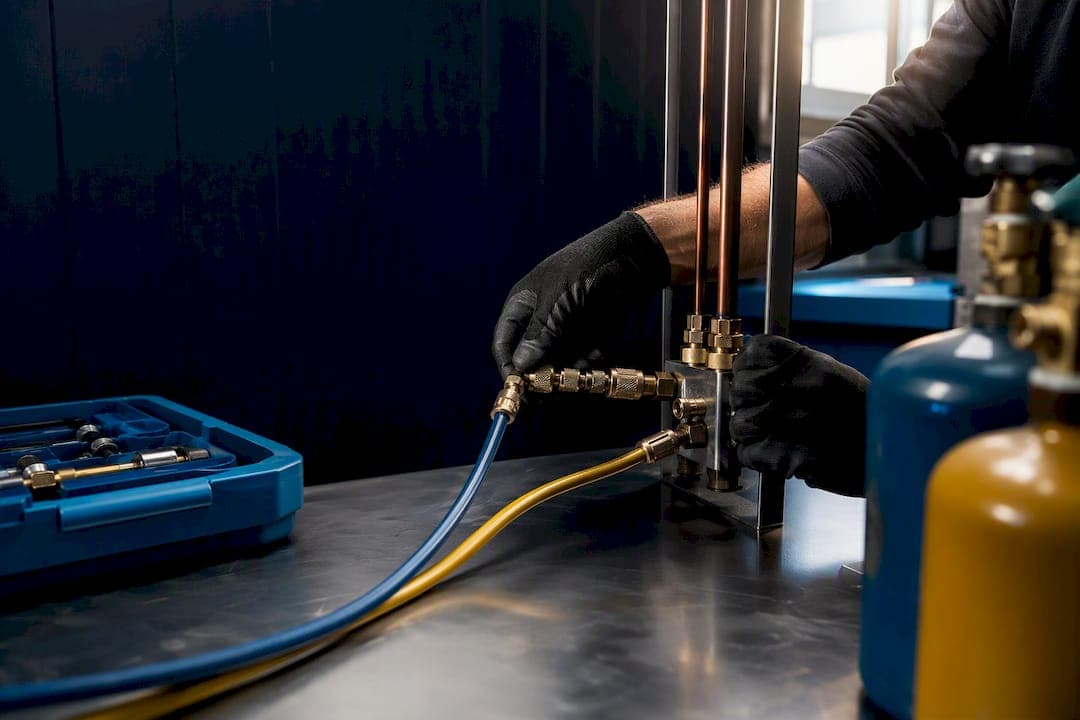
Choose R290 if minimising lifetime climate impact matters most and your property has the outdoor space and a certified installer to handle a flammable gas safely. Choose R32 if you want the widest choice of proven systems and a straightforward installation right now. Both are far better than the high-GWP refrigerants they replaced, but only one of them faces a genuine regulatory cliff edge after 2030. Check your installer's certification before either goes on your wall.
TL;DR:
- R290 has a GWP of roughly 3, making it significantly lower in climate impact compared to R32's GWP of around 675, which is a crucial factor in regulations after 2030.
- Efficiency tests show R290 can outperform R32 in heating at lower outdoor temperatures, especially in cold climates, but system performance depends heavily on installation and system design.
- Installing R290 requires strict safety measures, including specific siting clearances, leak detection sensors, and certified hydrocarbon-trained installers due to its high flammability classification.
- R32 remains more readily available and easier to install today, with a larger pool of qualified installers, but it faces increasing restrictions under future EU phase-down policies on high-GWP refrigerants.
- For long-term property owners planning a 15-year plus horizon, choosing R290 offers a more future-proof solution, provided proper certification and safety standards are met during installation.
Table of Contents
- R290 vs R32: the environmental case
- How do R290 and R32 compare on efficiency?
- Is R290 or R32 safer to install?
- Cost and availability: what you'll actually find on the market
- The regulatory timeline that changes everything
- How to choose between an R290 and R32 heat pump
- Why installer credentials matter more than the refrigerant spec sheet
- Handling, storage and disposal: what's different between the two
- Long-term reliability: what changes as the system ages
- Balancing low GWP with real-world practicality
- How Frostairconditioning gets you there safely
- Sources
R290 vs R32: the environmental case
The gap here isn't subtle. R290 (propane) carries a global warming potential of roughly 3, while R32 sits at around 675. That means a kilogram of R32 escaping into the atmosphere traps roughly 225 times more heat over a century than the same amount of R290. Both refrigerants have zero ozone-depletion potential, so the ozone layer isn't part of this particular argument. GWP is what matters for lifetime emissions, because it captures what happens if the gas ever leaks, whether through a slow seal failure or a scrappage event at end of life.
Two things shape the real-world impact beyond the headline number:
- Charge size: domestic heat pumps hold relatively small volumes of refrigerant, but larger commercial systems multiply any leak's consequences.
- Leakage rate: a well-installed, well-maintained system with sound joints and correctly rated pipework leaks far less over its lifespan than a poorly fitted one.
Fast fact: A leaking R32 system with a 2kg charge has a warming potential equivalent to over 1,300kg of CO2 if the entire charge escapes, against roughly 6kg CO2-equivalent for the same volume of R290. That maths is precisely why GWP thresholds sit at the heart of the phase-down schedule discussed later in this piece.
How do R290 and R32 compare on efficiency?
Efficiency is where R290 tends to surprise people. Experimental testing on R290 and R32 heat pump driven systems found R290 can deliver a higher coefficient of performance (COP) than R32 in certain heating conditions, particularly at lower ambient temperatures. That matters in a UK winter, when outdoor units are working hardest during the exact conditions where every fraction of a COP point shows up on the electricity bill.
The nuance worth understanding:
- Propane's thermodynamic properties allow good heat transfer efficiency, which is part of why it performs well in cold-weather heating mode.
- These COP advantages are consistent in tests run at lower ambient temperatures but tend to narrow at higher flow temperatures, so the gains aren't universal across every operating condition.
- Physical design differs too. R290 units are frequently larger, since additional casing and safety features add bulk that R32 systems don't need.
None of this means every R290 unit will outperform every R32 unit in your specific home. Compressor sizing, pipe runs, insulation levels and how the system was commissioned all affect the number you actually see on your energy bill, so treat lab COP figures as a guide to potential rather than a guarantee.
Is R290 or R32 safer to install?
This is the section most homeowners skip past and shouldn't. R290 is classified as A3, a highly flammable hydrocarbon. R32 is A2L, mildly flammable but a much lower practical risk. That single letter difference dictates everything about where a unit can sit, how much clearance it needs from doors and windows, and what safety kit has to be fitted around it.
R290 installations typically require:
- Siting clearances set out under BS EN 378, keeping the outdoor unit away from ignition sources and habitable openings.
- Leak detection sensors built into the system to shut it down automatically if propane concentration rises.
- Sealed electrical components near the refrigerant circuit, since a spark near a leak is the actual danger, not the gas itself sitting quietly in the pipework.
- Installer competence specifically for hydrocarbon refrigerants, which goes beyond standard F-Gas qualifications.
Before agreeing to an R290 system, ask your installer directly: do you hold an MCS A3 endorsement, are you F-Gas certified, and can you show me the siting assessment in writing?
Pro Tip: Ask to see the installer's F-Gas certificate and, for R290 specifically, their A3 endorsement documentation before signing anything. A reputable installer will produce both without hesitation.
Cost and availability: what you'll actually find on the market
Expect to pay a premium for R290 systems, largely down to the extra safety engineering, more expensive compressor components and lower production volumes than R32 units. R32 remains the most common refrigerant in new domestic heat pumps right now, simply because manufacturing scale and installer familiarity are further along.
A few practical constraints shape what's realistically available to you:
- Not every property has the outdoor clearance R290 siting rules demand, particularly terraced houses or flats with tight external space.
- Fewer installers currently hold the A3 endorsement needed for hydrocarbon systems, which can mean a longer wait or a narrower choice of local firms.
- Where R290's efficiency edge does hold in your climate zone, lower running costs over a 10 to 15 year system life can offset the higher purchase price.
The regulatory timeline that changes everything
The F-Gas phase-down is steadily squeezing the availability and price of higher-GWP refrigerants, with post-2030 rules set to restrict new systems above defined GWP thresholds. R32, at a GWP of roughly 675, sits well within scope of that tightening. R290, at a GWP of around 3, is essentially exempt from the pressure driving this transition.
Key points for anyone buying now:
- Availability risk: R32 systems bought today will keep working and can be serviced, but manufacturers are already shifting new product lines toward lower-GWP alternatives.
- Installer obligations: Anyone working with flammable refrigerants must hold the relevant certification and provide documentation confirming safe handling, which you're entitled to request and keep on file.
- Future-proofing: If you're planning to stay in your property for 15 years or more, an R290 system sidesteps most of the regulatory uncertainty a R32 system may eventually face regarding servicing costs or replacement parts.
None of this makes R32 a poor choice today. It makes it a choice with a shorter regulatory runway.
How to choose between an R290 and R32 heat pump
Work through this before you commit to either refrigerant:
- Check outdoor space and proximity to boundaries, windows and doors against BS EN 378 clearance rules if you're considering R290.
- Decide your priority: lowest lifetime emissions and long ownership horizon points to R290; straightforward installation and wider system choice points to R32.
- Ask for certifications in writing: F-Gas registration as standard, plus MCS A3 endorsement specifically if propane is on the table.
- Confirm leak detection and safety features are specified in the quote, not just mentioned verbally.
- Get warranty terms in writing, including what's covered if the refrigerant charge needs topping up or the system needs servicing.
Walk away if an installer can't produce certification on request, gives vague answers about warranty cover, or proposes an R290 unit with no mention of leak detection. Those are the three most common shortcuts taken on flammable refrigerant jobs.
Why installer credentials matter more than the refrigerant spec sheet
A GWP figure on a brochure means little if the person fitting the unit isn't properly trained. Frostairconditioning's engineers hold F-Gas certification as standard, which underpins every domestic and commercial installation carried out across Exeter and the South West, giving homeowners a documented safety baseline before any flammable refrigerant work begins.
Handling, storage and disposal: what's different between the two
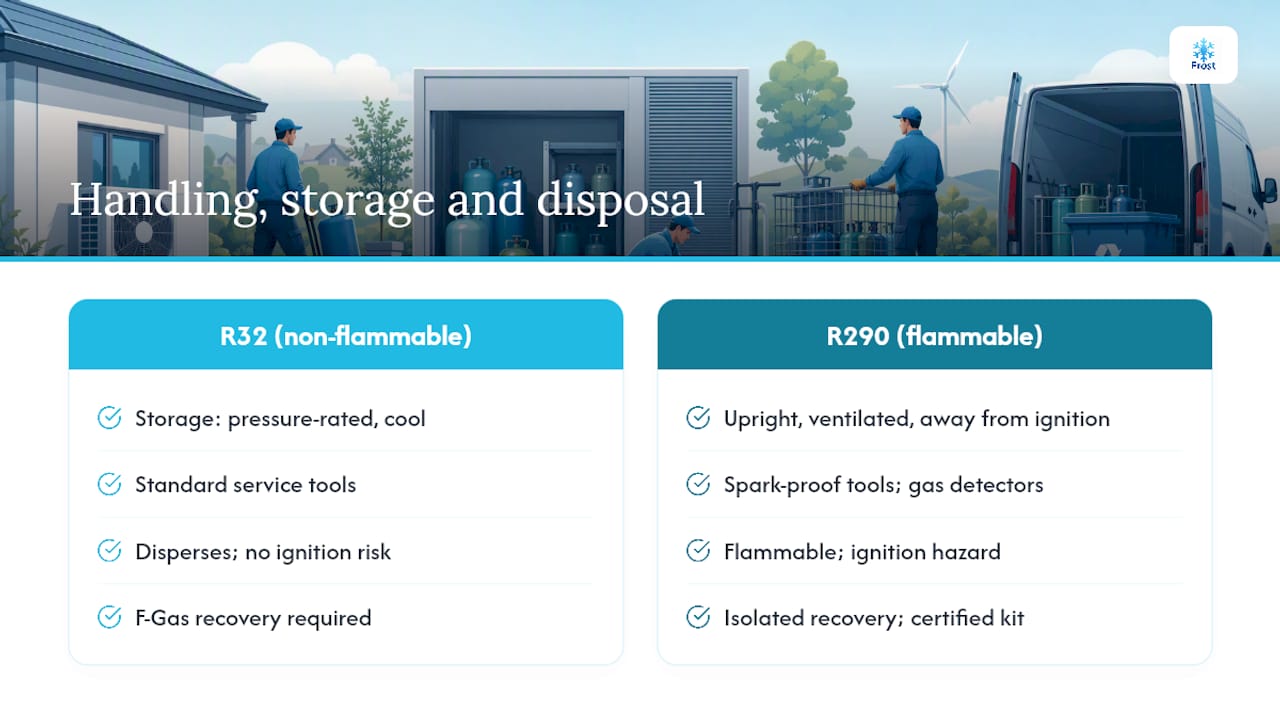
R32 and R290 both demand careful handling, but the risk profile isn't the same. R32 cylinders need standard pressure-rated storage away from heat sources, and recovery equipment must be F-Gas compliant during servicing or decommissioning. Leaked R32 disperses without an ignition risk, though it still needs proper recovery under F-Gas rules rather than venting to atmosphere, which remains illegal regardless of the refrigerant involved.
Propane storage and handling carries the extra weight you'd expect from a flammable gas. Cylinders must be stored upright, away from ignition sources, and in ventilated conditions, whether on a service van or at a depot. During installation or servicing, engineers need spark-proof tools and gas detection equipment on hand, and any recovery work has to happen with the system isolated and the area cleared of ignition risks. This is precisely why refrigerant handling knowledge matters as much as the certification itself.
Disposal follows the same principle for both gases: refrigerants must never be vented to atmosphere and always recovered by a certified technician using approved equipment, then sent for reclamation or destruction through a licensed waste handler. The practical difference is that get-it-wrong consequences are more severe with R290: a vented R32 charge is an environmental and legal problem, while a mishandled R290 charge near an ignition source is a safety incident. That distinction should inform which contractor you trust with either job.
Long-term reliability: what changes as the system ages
Both refrigerants are chemically stable within a properly designed and maintained system, so refrigerant choice alone doesn't dictate how long a heat pump lasts. What differs is the maintenance profile around each gas.
R32 systems benefit from a decade-plus of installer familiarity, meaning replacement parts, diagnostic tools and servicing expertise are widely available now and likely to remain so for years. R290 systems, being newer to the domestic market, currently rely on a smaller pool of specifically trained engineers, though that pool is growing as energy efficient cooling options expand across the UK market.
Annual servicing matters more for R290 systems in one specific respect: leak detection sensors and safety interlocks need checking as part of routine maintenance, not just the refrigerant charge and electrical connections. A missed sensor fault won't show up as reduced performance the way a slow refrigerant leak might on an R32 system, it simply won't be there when needed. Ask whatever maintenance provider you use whether their service checklist explicitly covers these safety components, not just standard refrigerant and pressure checks.
Neither refrigerant type suffers from inherent degradation over a typical 15 year system life when installed and serviced correctly. The reliability story comes down to installation quality and consistent annual maintenance far more than which gas sits in the pipework.
Balancing low GWP with real-world practicality
R290 wins the environmental argument outright, and R32 wins on availability and installer choice today. Pick the certified installer first, the refrigerant second. Anyone planning to stay put for a decade or more should weight that decision toward the lower-GWP option now.
— James
How Frostairconditioning gets you there safely
Weighing up R290 against R32 comes down to one practical question: can you find an installer who'll do either job properly?

Every R290 or R32 installation starts with a proper site survey to confirm clearances and siting are safe, followed by written certification of the work and a clear warranty, not a verbal assurance. Same-day response is available where your situation needs it. If you're ready to find out which refrigerant suits your property, book a domestic installation survey or request a quote and get a straight answer from an engineer who'll actually be doing the work.
Sources
- Heat Pumps // R32 or R290? - PHPI Online
- Experimental and Performance Analysis of R-32 and R290 Heat Pump Driven Air Conditioning System
- Heat pump refrigerant types explained (2026) | Axiom
- EHPA: Guidelines — the EU's new rules on fluorinated gases