
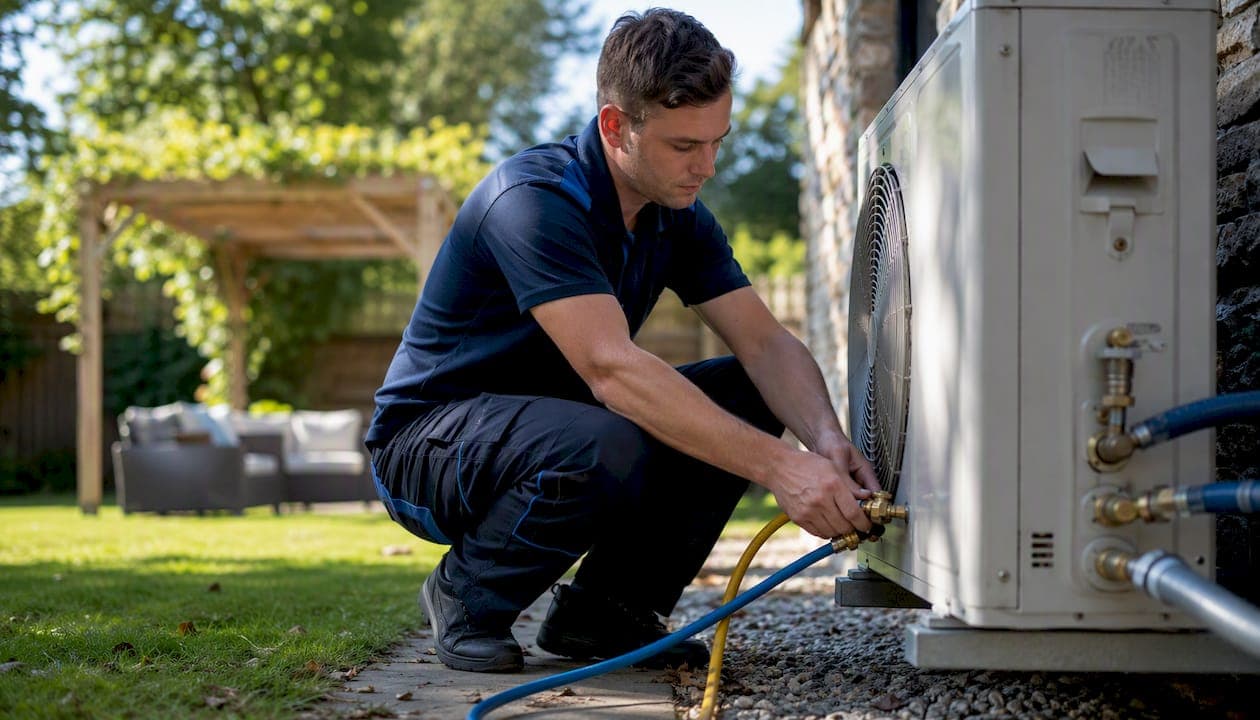
The term "air conditioning liquid" is a common way to describe refrigerant, the working fluid inside every AC system that absorbs and releases heat to produce cooling. It is not a single product you can simply top up like engine oil. In the UK, refrigerants are regulated substances under F-Gas legislation, and handling most of them requires REFCOM-registered, F-Gas certified engineers. Here is what that means in practice:
- Refrigerant (the correct industry term) changes phase between liquid and vapour inside a closed loop. It does not get "used up" in normal operation.
- A correctly sealed system should never need topping up. If yours does, there is almost certainly a leak that needs diagnosing before any refrigerant is added.
- Compressor lubricating oils (such as PAG oil in car AC) circulate alongside the refrigerant but are separate substances with their own handling rules.
- DIY recharge kits are sold at retailers such as Halfords for automotive use, but they have real legal and practical limits. For domestic or commercial HVAC systems, a certified engineer is required.
Table of Contents
- How refrigerant actually moves heat in your AC system
- Common refrigerant types used in the UK and their current status
- How car AC and home HVAC systems differ in refrigerant and oil
- How to spot a refrigerant leak and what to do immediately
- Can you legally refill refrigerant yourself in the UK?
- What a professional recharge involves and what drives the cost
- Where you can buy refrigerant or recharge kits in the UK
- How a certified installer handles refrigerant safely and legally
- Certified refrigerant services across the South West
- Sources
How refrigerant actually moves heat in your AC system
Refrigerant works by evaporating and condensing, absorbing heat in one place and releasing it in another. That phase change is the entire mechanism behind every air conditioning system, from a car dashboard vent to a commercial chiller. Understanding the loop helps explain why a leak is serious and why simply "adding more fluid" misses the point.
The four stages of the refrigeration cycle:
- Evaporator: Refrigerant enters as a cold, low-pressure liquid. It absorbs heat from the indoor air (or the car cabin) and evaporates into a vapour. This is where the cooling you feel actually happens.
- Compressor: The vapour is compressed to a high pressure, which raises its temperature significantly. This is the heart of the system and the most energy-intensive component.
- Condenser: The hot, high-pressure vapour releases its heat to the outside air (or ambient environment) and condenses back into a liquid.
- Expansion valve: The liquid passes through an expansion device, dropping in pressure and temperature rapidly before re-entering the evaporator to start the cycle again.
In a car, the condenser sits in front of the radiator and the evaporator is tucked behind the dashboard. In a domestic split system, the condenser is in the outdoor unit, and the evaporator is in the indoor wall-mounted unit. The refrigerant itself behaves the same way in both, though the specific type differs. Where the refrigerant exists as a liquid is mainly between the condenser outlet and the expansion valve; everywhere else in the circuit it is predominantly vapour or a two-phase mixture.
Common refrigerant types used in the UK and their current status
The most relevant refrigerants for UK vehicle owners and homeowners are R-22, R-410A, R-32, R-134a, R-1234yf, and R-454B. Each has a different history, environmental profile, and legal status. Knowing which one your system uses matters before any service work begins.
| Refrigerant | Typical applications | Phase-out / status | Key safety and environment note |
|---|---|---|---|
| R-22 | Older domestic and commercial HVAC | Fully phased out; reclaimed supply only | High GWP, ozone-depleting; ASHRAE class A1 |
| R-410A | Domestic splits, commercial HVAC (2010 onwards) | Being phased down under F-Gas rules | High global warming potential; ASHRAE class A1 |
| R-32 | Modern domestic splits | Active; lower GWP than R-410A | Mildly flammable; ASHRAE class A2L |
| R-134a | Automotive AC (pre-2017 vehicles) | Being replaced in new vehicles | Moderate global warming potential; ASHRAE class A1 |
| R-1234yf | Automotive AC (post-2017 vehicles) | Current standard for new cars | Very low global warming potential; ASHRAE class A2L |
| R-454B | New residential and light commercial HVAC | Emerging replacement for R-410A | Lower global warming potential; ASHRAE class A2L |
According to Trane's refrigerant guidance, R-22 has been phased out, R-410A was the dominant choice for systems manufactured from around 2010, and R-454B is the lower-GWP replacement now being adopted in newer equipment. The industry has broadly converged on R-454B for newly manufactured residential systems to meet current phase-down targets.
ASHRAE Standard 34 assigns every refrigerant a numerical designation and a two-part safety classification: a letter for toxicity (A = lower, B = higher) and a number for flammability (1 = non-flammable, 2L = mildly flammable, 2 = flammable, 3 = highly flammable). The A2L subclass covers several of the newer low-GWP refrigerants, including R-32, R-1234yf, and R-454B. These require specific handling precautions and certified equipment.
A note on R-22: Because production stopped years ago, any R-22 available today comes from reclaimed or recycled stocks. Supply is restricted and expensive. If your system still runs on R-22, replacing the unit is often more economical than sourcing reclaimed refrigerant for a major repair. You can read more about the phase-out of older refrigerants and what it means for home comfort.
How car AC and home HVAC systems differ in refrigerant and oil
Vehicle and building AC systems are not interchangeable in refrigerant type, oil, or service practice. Assuming they work the same way is one of the more common and costly mistakes.
Key practical differences:
- Refrigerant type: Cars built before 2017 typically use R-134a; post-2017 vehicles generally use R-1234yf. Domestic splits use R-410A or R-32 (older and current systems respectively), with R-454B appearing in the newest equipment.
- Compressor lubrication: Automotive systems use PAG (polyalkylene glycol) oil. Domestic and commercial HVAC systems typically use POE (polyolester) oil. These are not interchangeable.
- Operating pressures: Automotive systems run at different pressure regimes from domestic splits. Service equipment is calibrated accordingly.
- Service ports and access: Car AC systems use Schrader valves accessible under the bonnet. Domestic systems use different port configurations on the indoor and outdoor units.
PAG oils are hygroscopic, meaning they absorb moisture from the air rapidly. Moisture in an AC system reacts with refrigerant to form acids that corrode the compressor from the inside. PAG oils are also often formulated with fluorescent dye, which shows up under UV light during leak detection. Manufacturers such as LIQUI-MOLY specify that containers must be resealed immediately after use and that filling should be done under dry conditions, sometimes with a nitrogen purge, to prevent moisture uptake.
Pro Tip: Never guess the oil type when servicing an AC system. PAG oil viscosity grades (46, 100, 150) are matched to specific compressor designs, and using the wrong grade, or accidentally introducing POE into an automotive system, can cause compressor failure within a short period of running. Always check the vehicle or system manufacturer's specification before adding any oil.
How to spot a refrigerant leak and what to do immediately
Loss of cooling is the most obvious sign, but by the time the system stops working, a leak has usually been present for some time. Catching it earlier protects both the equipment and the people nearby.
Signs that point to a refrigerant leak:
- Reduced or absent cooling despite the system running normally.
- Hissing or bubbling sounds near the indoor unit, outdoor unit, or under the car bonnet.
- Oily residue or staining around pipe joints, valves, or the compressor. Refrigerant carries oil with it when it escapes.
- Visible dye under UV light in automotive systems where PAG oil with fluorescent dye has been used.
- Ice forming on the evaporator coil or refrigerant lines, caused by the pressure drop from a leak.
Immediate safety steps if you suspect a leak:
- Ventilate the area. Open windows and doors; do not stay in a confined space with a suspected leak.
- Switch off the system at the isolator or fuse board, not just at the remote control.
- Keep away from open flames. Several modern refrigerants (R-32, R-1234yf, R-454B) are classified A2L and are mildly flammable.
- Do not attempt to locate or repair the leak yourself. Refrigerant vapour can displace oxygen in enclosed spaces and cause asphyxiation at high concentrations.
- If anyone feels dizzy, short of breath, or experiences skin or eye irritation after suspected exposure, move to fresh air and seek medical advice. In a serious exposure, call 999.
For most domestic leaks, the situation is urgent but not immediately life-threatening if you ventilate and switch off. Call an F-Gas certified engineer rather than emergency services unless someone is symptomatic. For automotive leaks, the volumes involved are smaller, but the same ventilation rule applies. You can find practical troubleshooting steps in this homeowner's reset and fault guide.
Can you legally refill refrigerant yourself in the UK?
The short answer: for domestic and commercial HVAC systems, no. For certain automotive top-up kits, there is a narrow exception, but it comes with real limits.
Under UK F-Gas regulations, anyone handling refrigerants in stationary equipment (home and commercial AC, heat pumps, refrigeration) must hold the appropriate F-Gas qualification and, for most activities, be registered with REFCOM or an equivalent certification body. This is not a technicality. Purchasing bulk refrigerant cylinders for stationary equipment is itself restricted to certified companies. As Carrier's guidance confirms, refrigerant in a properly sealed system should only need topping up after a leak has been found and repaired. Adding refrigerant without fixing the leak first is both wasteful and non-compliant.
DIY recharge kits (automotive):
- Sold at retailers such as Halfords, these kits typically contain a small canister of R-134a or R-1234yf with a pressure gauge and hose.
- They are intended for topping up a system that is slightly low, not for recharging a system that has lost most of its refrigerant.
- Many kits include sealant or dye, which can complicate professional diagnosis later and may void manufacturer warranties.
- They do not perform a vacuum, leak test, or oil top-up. Retail kits can temporarily restore cooling but cannot replace professional leak finding, correct oil replenishment, or the regulated recovery process.
What certified professionals do that kits cannot:
- Recover existing refrigerant safely into approved cylinders (legally required before opening a system).
- Pull a deep vacuum to remove moisture and non-condensable gases.
- Pressure-test for leaks before recharging.
- Add the correct oil type and quantity.
- Charge to the manufacturer's exact specification by weight.
- Complete F-Gas record-keeping, which is a legal obligation for systems above a certain refrigerant charge.
The value of professional servicing goes well beyond compliance. A system recharged without a vacuum is carrying moisture, and moisture causes acid corrosion. A system recharged without fixing the leak will simply lose refrigerant again.
What a professional recharge involves and what drives the cost
A professional re-gas is not just "adding refrigerant." The regulated process has several distinct steps, each with a purpose.
- Initial inspection and fault diagnosis. The engineer checks system pressures, temperatures, and visible components to identify the likely cause of the problem before touching any refrigerant.
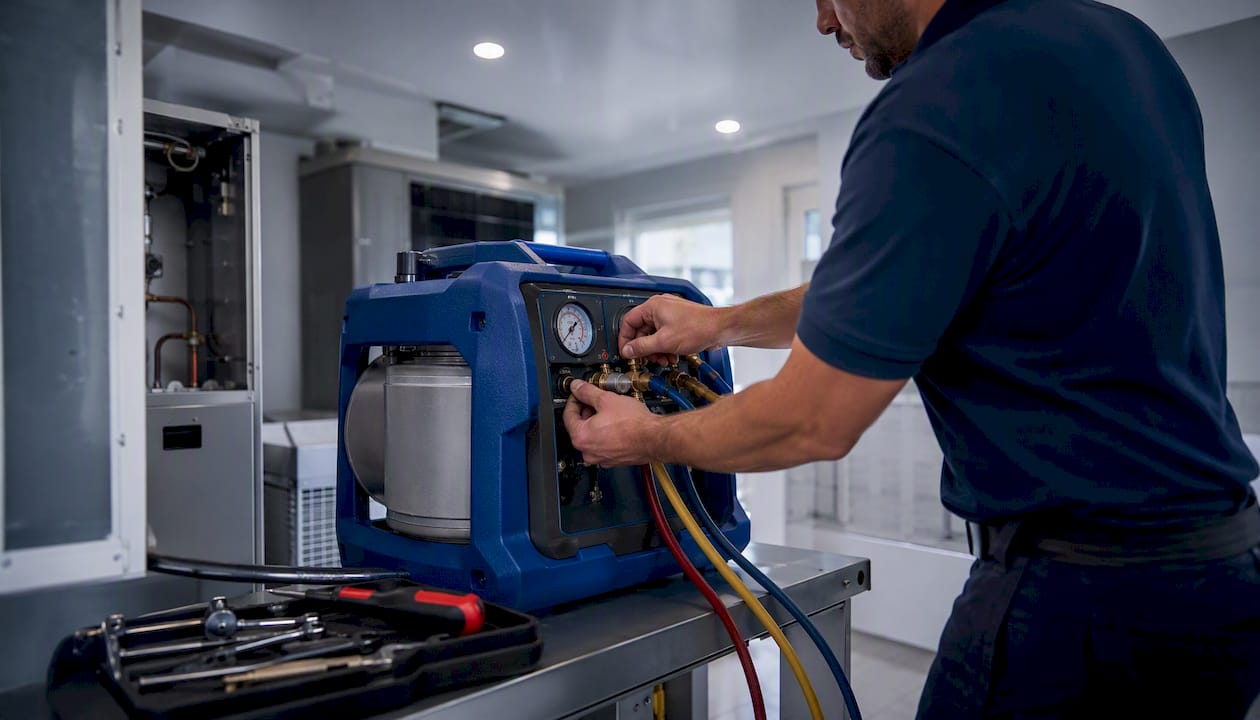
- Refrigerant recovery. Any remaining refrigerant is recovered into certified cylinders using specialist equipment. Venting refrigerant to atmosphere is illegal under F-Gas rules.
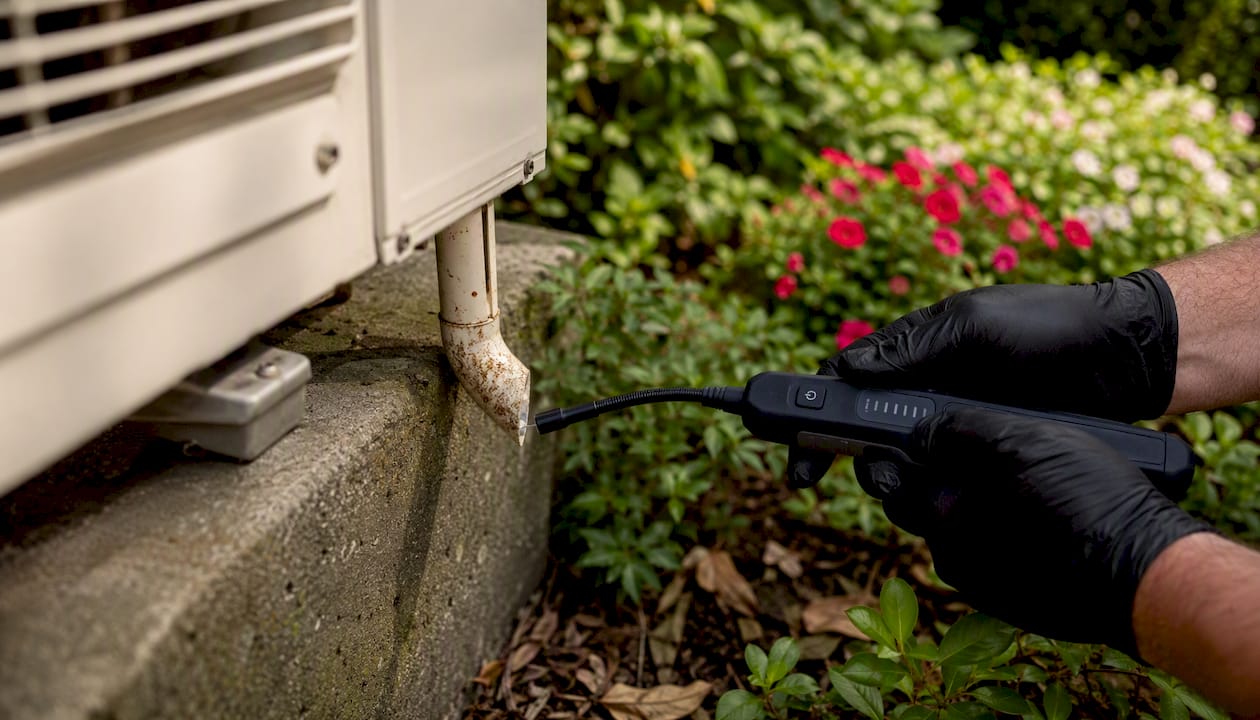
- Leak detection. The engineer uses electronic detectors, UV dye, or pressure testing to find the source of the leak. No recharge happens until the leak is confirmed and repaired.
- Repair. Depending on the fault, this might mean replacing a valve, brazed joint, or component. Some repairs are straightforward; others require parts and additional labour.
- Evacuation (deep vacuum). The system is evacuated to a deep vacuum, typically held for a set period to confirm there are no remaining leaks and to remove moisture.
- Recharge. The correct refrigerant is added by weight to the manufacturer's specification. Oil is topped up if required, using the correct type and grade.
- Commissioning and record-keeping. The engineer verifies system performance, checks pressures and temperatures against design data, and completes the F-Gas logbook entry. For systems above the threshold charge weight, this record is a legal requirement.
Cost drivers for a professional re-gas in the UK:
- Refrigerant type and price. R-22 reclaimed stock is expensive. R-1234yf for modern vehicles costs more per kilogram than R-134a. R-32 and R-454B for domestic systems are more accessible but still a significant cost per kilogram.
- Extent of the leak and repair needed. A simple valve replacement is far cheaper than a brazed joint repair or a component swap.
- Labour and equipment. Recovery machines, vacuum pumps, and calibrated charging equipment represent a significant overhead for certified engineers.
- System size. A large commercial system holds far more refrigerant than a domestic split, and the recharge cost scales accordingly.
- Disposal and certification. Recovered refrigerant must be handled and disposed of correctly, which adds to the overall cost.
Timelines vary. A straightforward automotive re-gas at a garage typically takes under an hour. A domestic split system re-gas with a minor repair might take two to three hours. A larger commercial system with a difficult-to-locate leak can take considerably longer. For practical aftercare once the system is back in service, the homeowner's aftercare guide covers what to check between service visits.
Where you can buy refrigerant or recharge kits in the UK
Retail availability of refrigerant in the UK is deliberately limited by regulation, and what you can legally buy depends on the application and the refrigerant involved.
What is available at retail:
- Automotive recharge kits (R-134a or R-1234yf) are sold at motor factors and national parts retailers such as Halfords. These are small canisters designed for consumer use in vehicle AC systems.
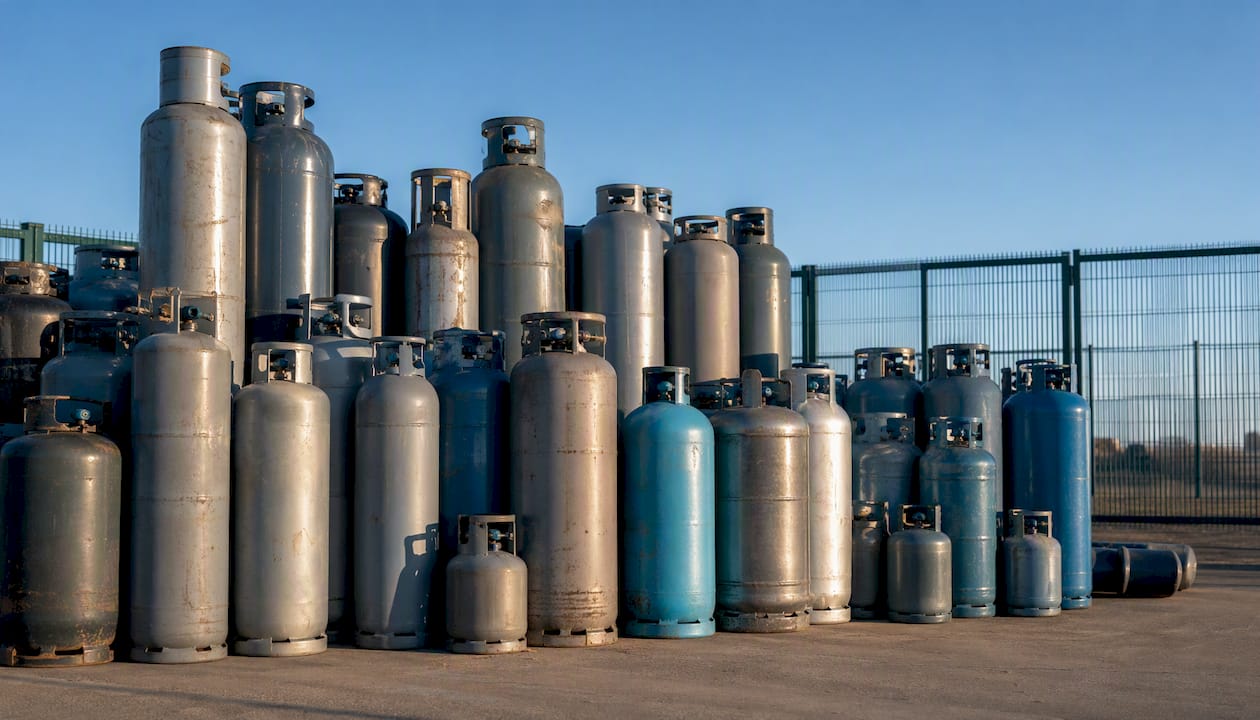
- Some online platforms list refrigerant canisters, but bulk cylinders of HFC refrigerants for stationary equipment are restricted to F-Gas certified purchasers.
- Refrigerant oils, including PAG variants, are available at motor factors and online for automotive use.
Dos and don'ts when buying:
- Check the refrigerant type your system uses before purchasing anything. R-134a and R-1234yf are not interchangeable, and using the wrong one can damage the compressor.
- Never add an unfamiliar oil to a system. If you do not know the oil type already in the system, do not add anything.
- Do not mix refrigerants. Topping up an R-134a system with R-1234yf, or vice versa, creates a contaminated blend that requires full recovery and recharge by a professional.
- Check whether the kit contains sealant. Sealants can clog recovery equipment and may invalidate a professional's ability to service the system later.
Regulatory limits:
Certain refrigerant cylinders, particularly those containing high-GWP HFCs above a set threshold, can only be sold to F-Gas certified businesses. Consumer automotive kits are a specific exception, but they are scoped narrowly. If you are unsure whether a product is legal for you to purchase and use, the safest step is to contact a certified engineer rather than assume retail availability implies unrestricted use.
How a certified installer handles refrigerant safely and legally
Certified installers follow a regulated workflow that goes well beyond what any retail kit can replicate. The difference is not just technical competence; it is legal accountability.
F-Gas regulations in the UK require that engineers working on stationary refrigeration and air conditioning equipment hold a recognised qualification. REFCOM is the UK's leading F-Gas certification body, and its register is publicly searchable. Certified companies must keep records of refrigerant purchases, recoveries, and charges for each system they work on. For larger systems, those records must be retained and made available for inspection.
Frostairconditioning's engineers are F-Gas certified and REFCOM-registered, covering domestic and commercial installations across Exeter and the South West. The process they follow for a refrigerant service:
- System inspection: Visual check of pipework, joints, and components for signs of oil staining, corrosion, or physical damage.
- Electronic and UV leak detection: Using calibrated detectors and UV lamps to locate refrigerant escape points precisely.
- Refrigerant recovery: All existing refrigerant is recovered into certified cylinders before the system is opened.
- Deep vacuum: The system is evacuated and held under vacuum to confirm integrity and remove moisture.
- Correct recharge: Refrigerant is added by weight to the manufacturer's specification, with the correct oil type and quantity.
- F-Gas paperwork: Every service is logged, with refrigerant type, quantity, and engineer details recorded as required by law.
Customer benefits of using a certified installer:
- Manufacturer warranties remain valid. Many warranties are voided by non-certified service work.
- The correct refrigerant and oil match protects the compressor and extends system life.
- Recovered refrigerant is disposed of or reclaimed correctly, meeting environmental obligations.
- Official paperwork provides a service history that supports future maintenance, resale, or insurance claims.
Certified engineers do not just recharge a system. They find out why it lost refrigerant in the first place, fix that, and then recharge it. Skipping the diagnosis step is the single most common reason a system loses refrigerant again within months.
What installers see go wrong: a perspective on refrigerant mistakes
The most preventable refrigerant problems come down to three recurring mistakes, and none of them are complicated to avoid.
The first is adding refrigerant without finding the leak. A system that is low on refrigerant has a leak somewhere. Topping it up without locating and repairing the source means the refrigerant escapes again, the system underperforms, and the owner pays twice. The second mistake is using the wrong oil. PAG oil grades are matched to specific compressors, and the difference between a grade 46 and a grade 100 is not trivial at operating temperatures. Putting the wrong oil in, or mixing oil types, accelerates compressor wear in a way that does not show up immediately but shortens the unit's life considerably. The third is moisture contamination, usually from leaving a system open to atmosphere for too long during a DIY repair attempt or from using an unsealed oil container. Moisture and refrigerant form acids. Acids corrode the compressor internals. By the time the damage is visible, the compressor often needs replacing.
The practical takeaway is straightforward: if your system is not cooling as it should, get a certified engineer to diagnose it before anything is added or removed. The industry standards and certification background explains what those qualifications actually mean in practice.
Certified refrigerant services across the South West
Frostairconditioning offers certified re-gas, maintenance, and emergency repair for domestic and commercial AC systems across Exeter and the wider South West. Every engineer holds F-Gas certification and is REFCOM-registered, so every service is fully compliant and properly documented.

What the service includes: leak detection and repair, full refrigerant recovery and recharge to manufacturer specification, correct oil top-up, deep vacuum, and F-Gas paperwork. All service work is carried out in a way that protects existing manufacturer warranties.
For a domestic installation or re-gas quote, or to book a service and maintenance visit, contact Frostairconditioning directly. Get your certified quote here.
Key takeaways
Refrigerant is a regulated substance in the UK, and a system that needs topping up almost always has a leak that must be found and repaired before any recharge takes place.
| Point | Details |
|---|---|
| Refrigerant is not a generic fluid | It is a specific chemical matched to each system; using the wrong type damages compressors and voids warranties. |
| UK F-Gas rules restrict DIY | Handling refrigerant in stationary HVAC systems requires F-Gas certification; automotive kits are a narrow exception with real limits. |
| Low refrigerant means a leak | A sealed system does not lose refrigerant in normal use; low levels always indicate a fault requiring professional diagnosis. |
| Oil type matters as much as refrigerant | PAG oil for automotive systems and POE for domestic HVAC are not interchangeable; the wrong grade accelerates compressor wear. |
| Frostairconditioning covers the South West | F-Gas certified, REFCOM-registered engineers offering same-day response, finance options, and full documentation for every service. |
Sources
- A Complete Guide to HVAC Refrigerants - Trane®
- AC Refrigerant Guide: Types, Regulations & R-454B Updates | Carrier
- UNEP - ASHRAE factsheet -- English - April 2023
- PAG Air Conditioning Oil 100 | LIQUI MOLY
- Does Your Car’s A/C System Have Fluid? - KAMS Auto Service Center
This article is general information, not a substitute for advice from a qualified lawyer. Consult a qualified legal professional about your own circumstances before acting on anything here.