
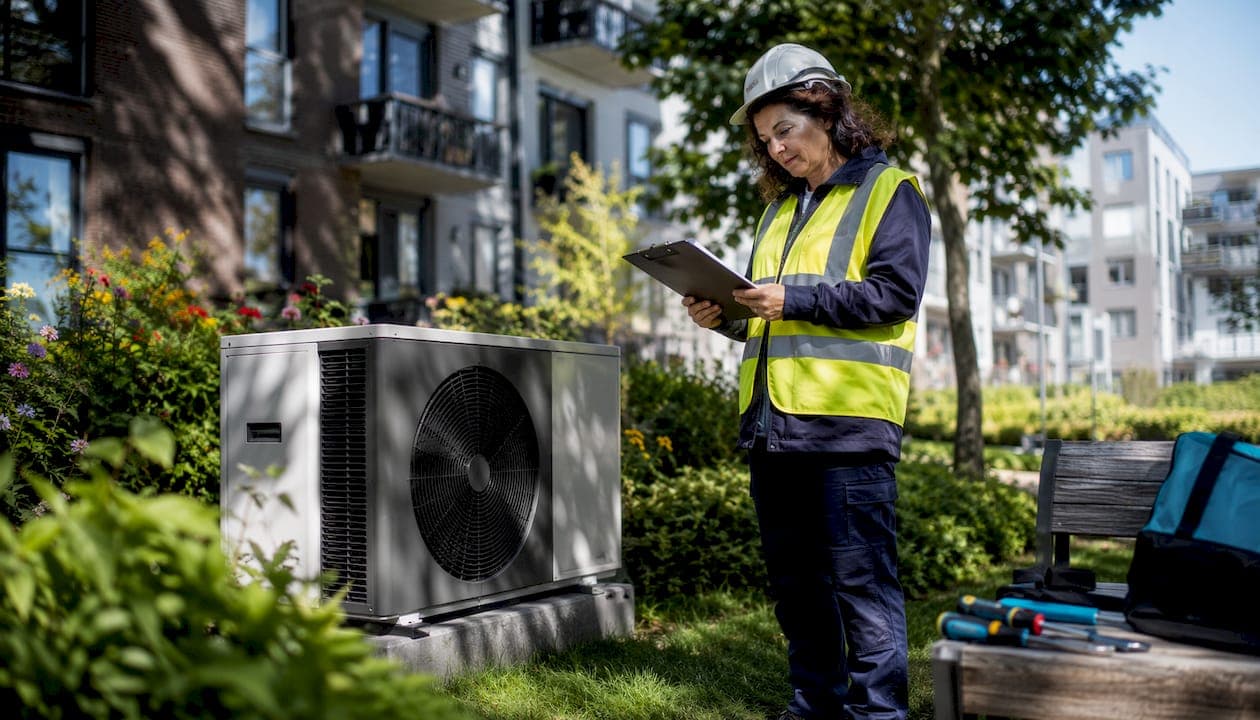
The most practical examples of green cooling solutions available in the UK today include natural refrigerants such as ammonia and carbon dioxide, energy-efficient heat pumps paired with solar PV, evaporative cooling systems, and passive building design. Each of these approaches cuts emissions from two directions: by replacing synthetic refrigerants with substances that have near-zero global warming potential, and by reducing the electricity demand that drives indirect carbon output. Conventional refrigerants can be up to 4,000 times more climate-damaging than CO2, which puts the refrigerant choice alone at the centre of any serious green cooling strategy.
Here is a quick overview of the main categories:
- Natural refrigerants (ammonia, CO2, hydrocarbons, air, water): very low or zero global warming potential
- Energy-efficient heat pumps: provide both heating and cooling with high seasonal efficiency ratings
- Evaporative cooling: uses water evaporation instead of vapour compression, consuming far less electricity
- Passive cooling design: shading, natural ventilation, reflective surfaces, and insulation that reduce mechanical cooling load before it starts
- Ground-source heat pumps: extract stable ground temperatures to deliver efficient cooling year-round
- Absorption chillers: use waste heat or solar thermal energy rather than electricity to drive the cooling cycle
- Alternative cooling technologies (ACTs): emerging solid-state and radiative systems that bypass refrigerants entirely
What role do natural refrigerants play in green cooling?
Natural refrigerants sit at the heart of sustainable cooling technologies because they occur in nature and carry a fraction of the climate impact of synthetic alternatives. The Natural 5 are CO2, ammonia, air, water, and hydrocarbons such as propane. Synthetic HFCs, by contrast, can have global warming potentials in the thousands, meaning even small leaks cause outsized damage.
The table below compares the main natural refrigerants on the properties that matter most for environmental and safety assessment.
| Refrigerant | Global warming potential | Ozone depletion | Typical application | Key safety note |
|---|---|---|---|---|
| Ammonia | 0 | 0 | Industrial refrigeration, large chillers | Toxic; requires trained handling |
| Carbon dioxide | 1 | 0 | Supermarket refrigeration, heat pumps | High operating pressure |
| Propane | 3 | 0 | Domestic fridges, small AC units | Flammable; charge limits apply |
| Water | 0 | 0 | Absorption chillers, large-scale systems | Low efficiency at small scale |
| Air | 0 | 0 | Aircraft cooling, cryogenic systems | Very low efficiency for buildings |
Ammonia has been used in industrial refrigeration for well over a century and remains the benchmark for large-scale efficiency. Its toxicity demands F-Gas-style competency and leak detection, but its zero global warming potential and zero ozone depletion potential make it irreplaceable in cold-chain logistics. CO2 operates at higher pressures than most synthetic refrigerants, which requires purpose-built pipework, yet its adoption in UK supermarket refrigeration has grown steadily since the F-Gas Regulation began tightening HFC quotas. Propane is the natural refrigerant most likely to appear in a domestic setting, used in small split units and portable coolers where charge sizes stay within safe limits.
How does energy efficiency underpin green HVAC options?
Energy efficiency is not a secondary concern in green cooling. It is the mechanism through which most emissions reductions actually happen, because the electricity powering a cooling system carries its own carbon footprint from the grid.
Inverter-driven compressors are the clearest example of this. A fixed-speed compressor runs at full power until the target temperature is reached, then switches off entirely, cycling repeatedly. An inverter compressor modulates its speed continuously, maintaining temperature with far less energy wasted on start-stop cycles. ENERGY STAR-certified air source heat pumps consume approximately 15% less energy than standard units, and that gap widens further when smart controls are added.
Key efficiency strategies for green cooling systems:
- Inverter technology: variable-speed compressors that match output to demand rather than cycling on and off
- Smart thermostats and controls: systems such as those compatible with Nest or Hive that learn occupancy patterns and pre-cool spaces efficiently
- Solar PV integration: pairing a heat pump with rooftop solar so that peak cooling demand coincides with peak generation
- High-performance insulation: reducing heat ingress so the mechanical system works less hard
- Passive pre-cooling: using thermal mass, shading, and night purge ventilation to lower the baseline temperature before the system activates
- Regular maintenance: dirty filters and low refrigerant charge can increase energy consumption by a measurable margin
Statistic: Geothermal heat pumps can reduce cooling costs by up to 70% compared with conventional air conditioning systems.
The renewable energy integration argument is particularly strong in the UK right now. As the grid decarbonises, every unit of electricity consumed by a heat pump carries less carbon than it did five years ago, and pairing that with solar PV pushes the effective emissions per unit of cooling close to zero on sunny days.
Industry experts consistently highlight passive cooling as the essential first step: reduce the mechanical cooling load through building design before sizing any active system. A well-insulated, well-shaded building needs a smaller heat pump, which costs less to run and produces fewer emissions across its lifetime.
Which green cooling technologies are being used in practice?
The range of climate-friendly cooling systems in active use today is wider than most people realise, spanning everything from ancient passive principles to laboratory-stage solid-state physics.
Evaporative cooling works by passing warm air over a wet medium, transferring heat into water vapour rather than compressing a refrigerant. Direct evaporative cooling adds moisture to the supply air, limiting its use to dry climates. Indirect evaporative cooling keeps the supply air separate from the wet side, avoiding the humidity problem. A Norway data centre using indirect evaporative cooling cut its energy use by 65%, a figure that illustrates why large facilities are adopting this approach. The cSNAP technology developed at Harvard's Wyss Institute takes this further, using 3D-printed ceramic coated with a nanoscale hydrophobic material to isolate water vapour from the cooled air, making evaporative cooling viable in humid climates where it would normally fail.

Ground-source heat pumps exploit the fact that ground temperature at a depth of around 10 metres stays relatively constant throughout the year in the UK, typically between 10°C and 13°C. In summer, the building's heat is rejected into the ground rather than into the outdoor air, which is more efficient than conventional air-source systems when temperatures are high.
Absorption chillers replace the electrical compressor with a heat-driven cycle, usually powered by waste heat, gas, or solar thermal collectors. They are most cost-effective at scale, in commercial buildings or district energy schemes, where a reliable heat source is available.
"Alternative cooling technologies such as thermoelectric, elastocaloric, magnetocaloric, thermoacoustic, and radiative cooling systems eliminate the need for traditional refrigerants entirely, bypassing the vapour compression cycle and enabling zero or near-zero emissions cooling." UNEP Ozone Secretariat, OEWG47 Issue Brief on Alternative Cooling Technologies
Radiative cooling is worth singling out. Specially engineered surfaces emit heat directly to the sky as infrared radiation, achieving sub-ambient cooling with no electricity input at all. Applied as roof coatings or building façade panels, radiative cooling can reduce the heat load on a building before any mechanical system is needed.
- District cooling networks: centralised chilled water distributed to multiple buildings, far more efficient than individual units
- Seawater or lake cooling: drawing cold water from natural sources to serve district systems
- Thermoacoustic coolers: use sound waves to drive a cooling cycle, with no moving parts and no refrigerant
- Phase-change materials: store and release thermal energy to buffer peak cooling demand
How does green cooling tackle the 'cooling conundrum'?
The cooling conundrum is the uncomfortable fact that as the climate warms, demand for cooling rises, and conventional cooling systems then accelerate the warming that created the demand in the first place. Green cooling addresses this from both ends simultaneously.
Direct emissions come from refrigerant leaks. When a conventional system loses HFC refrigerant, those molecules enter the atmosphere and trap heat at rates far exceeding CO2. Switching to natural refrigerants with a global warming potential of 1 or below eliminates this pathway almost entirely. Refrigerant leakage accounts for roughly one third of the cooling sector's greenhouse gas emissions, so this is not a marginal gain.
Indirect emissions come from the electricity used to run the system. A heat pump running on grid electricity still produces carbon, just at the power station rather than on-site. Efficiency improvements, renewable integration, and passive design all reduce the electricity consumed per unit of cooling, cutting indirect emissions proportionally.
"A circular cooling economy spanning responsible manufacture, use of low global warming potential refrigerants, and end-of-life recovery can prevent up to 0.4°C of global temperature rise by 2100." UNDP Sustainable Cooling programme
The integrated approach matters because addressing only one side of the equation is insufficient. A highly efficient system running on HFC refrigerant still leaks. A natural-refrigerant system with poor insulation and no smart controls still draws excessive electricity. Green cooling solutions work by combining low-GWP refrigerants, high-efficiency equipment, and passive building measures into a single strategy.
What barriers slow the adoption of green cooling in the UK?
Green cooling faces real obstacles in the UK, and acknowledging them is more useful than pretending the transition is straightforward.
Cost is the most immediate barrier. Heat pumps and ground-source systems carry higher upfront costs than conventional split units. Natural refrigerant systems often require purpose-built components, specialist installation, and more rigorous leak detection infrastructure, all of which add to the initial outlay.
Technical complexity is a genuine constraint, particularly for ammonia. Handling ammonia safely requires specific training, ventilation design, and emergency protocols. The pool of F-Gas-certified engineers with ammonia competency in the UK is smaller than demand would ideally require, and that skills gap slows commercial uptake.
Key barriers to adoption:
- Higher capital costs compared with conventional systems
- Limited availability of engineers trained in natural refrigerant handling
- Awareness gaps among building owners and facilities managers
- Regulatory complexity around refrigerant phase-down schedules under the UK F-Gas Regulation
- Supply chain constraints for specialist components, particularly for CO2 and ammonia systems
- Infrastructure requirements for ground loops, district networks, or solar integration
- Risk aversion among specifiers and contractors unfamiliar with newer technologies
The regulatory picture is improving but uneven. The UK F-Gas Regulation, retained post-Brexit and subject to ongoing review, is progressively restricting high-GWP refrigerants, which creates a commercial incentive to switch. However, the phase-down schedule gives some sectors more time than others, and enforcement capacity varies. Awareness among smaller commercial operators and homeowners remains patchy, meaning many people who could benefit from green cooling options simply do not know they exist.
Practical steps for UK homeowners adopting green cooling
The most effective starting point for a UK homeowner is not choosing a technology. It is reducing the cooling load the technology needs to handle. Insulation, draught-proofing, external shading, and reflective window films all cut the amount of heat entering the building, which means a smaller, cheaper system can do the job.
Once the building fabric is addressed, an air source heat pump is the most accessible green HVAC option for most UK homes. Modern units use refrigerants with low global warming potential, deliver both heating and cooling from a single system, and integrate readily with solar PV. Pairing a heat pump with a smart thermostat such as Nest or Hive allows the system to pre-cool the building during off-peak or high-generation periods, reducing both cost and carbon output.
Steps for effective implementation:
- Assess and improve building insulation and draught-proofing before sizing any active system
- Install external shading such as blinds, awnings, or deciduous planting on south and west-facing windows
- Choose a heat pump with a low-GWP refrigerant, ideally R32 or a natural alternative where available
- Integrate with solar PV to align peak cooling demand with peak renewable generation
- Fit a smart thermostat to manage operation around occupancy and tariff periods
- Schedule annual maintenance checks to keep the system running at rated efficiency
- Explore the Boiler Upgrade Scheme grant, which currently offers £7,500 towards air source heat pump installation
Pro Tip: Set your heat pump to begin cooling the building an hour before you need it, using a smart schedule rather than reactive control. Pre-cooling with solar generation in the morning costs less and produces fewer emissions than reactive cooling during peak afternoon demand.
The home cooling solutions available to UK homeowners have expanded considerably, and the combination of a well-insulated building, a low-GWP heat pump, and solar PV now represents a genuinely low-carbon cooling strategy rather than a compromise.
Green cooling in practice: UK real-world examples
Real-world deployments show that green cooling is not theoretical. Copenhagen's district cooling facility uses seawater drawn from the harbour alongside natural refrigerants to serve multiple buildings from a single centralised plant. The system saves 7 GWh of power and 3,000 tonnes of CO2 per year, a 66% annual reduction compared with equivalent individual cooling plants. While Copenhagen is not the UK, the technology is directly applicable to British coastal cities and river-adjacent urban areas, and the model informs ongoing district energy planning in cities such as Bristol and Glasgow.
UK supermarket chains have led domestic adoption of CO2 refrigeration systems. Major retailers have retrofitted distribution centres and large stores with transcritical CO2 systems, replacing HFC-based plant and eliminating the refrigerant-leak emissions that previously represented a significant share of their Scope 1 carbon footprint.
At the residential scale, the Boiler Upgrade Scheme has driven thousands of air source heat pump installations across England and Wales since its launch. Many of these use R32 refrigerant, which has a global warming potential of 675, far below the HFCs it replaces, though still above natural alternatives. The trajectory is clearly towards lower-GWP options as supply chains mature.
Cooling as a Service models are also gaining traction in the UK commercial sector. Under a CaaS arrangement, the provider retains ownership of the equipment and is paid per unit of cooling delivered, creating a direct financial incentive to keep systems running efficiently. This aligns provider and environmental interests in a way that a straightforward equipment sale does not.
How do different green cooling solutions compare on environmental impact?
Not all sustainable cooling technologies deliver the same environmental benefit, and the differences are worth understanding before committing to a system.
Natural refrigerant systems eliminate direct emissions from refrigerant leaks almost entirely. A CO2 system has a global warming potential of 1 per kilogram leaked; an HFC-410A system has a global warming potential of 2,088 per kilogram. The gap is stark. However, if a CO2 system runs on grid electricity from a carbon-intensive source, its indirect emissions can still be substantial.
Heat pumps score well on both counts when paired with low-carbon electricity. Their coefficient of performance means they deliver more cooling energy than the electrical energy they consume, so even on a partially fossil-fuelled grid they outperform direct electric cooling. As the UK grid continues to decarbonise, this advantage compounds over time.
Passive cooling has the lowest lifecycle environmental impact of any approach because it consumes no energy and uses no refrigerant. The embodied carbon in insulation materials and shading structures is typically recovered within a few years of operation. The limitation is that passive measures alone are insufficient during UK heatwaves, which are becoming more frequent and intense.
Evaporative cooling sits between passive and active systems. It uses water rather than refrigerant and consumes far less electricity than vapour compression, but it does consume water, which carries its own environmental cost in water-stressed regions. Indirect evaporative systems reduce water consumption compared with direct systems and avoid the humidity penalty.
Ground-source heat pumps have higher embodied carbon from ground loop installation but deliver lower operational emissions than air-source systems in most scenarios, because ground temperature is more stable than air temperature and the system works less hard.
What UK government policies support green cooling adoption?
UK policy has moved from passive acknowledgement of the cooling problem to active incentive structures, though the picture remains fragmented across different sectors and building types.
The Boiler Upgrade Scheme is the most direct residential incentive, offering £7,500 towards the cost of an air source heat pump and £7,500 for a ground source heat pump for eligible properties in England and Wales. The scheme is administered by Ofgem and has been extended beyond its original end date, reflecting government commitment to heat pump uptake.
The UK F-Gas Regulation restricts the use and supply of high-GWP fluorinated gases, with a phase-down schedule that progressively tightens HFC quotas. This creates a regulatory push away from conventional refrigerants and towards natural alternatives, even where financial incentives are absent.
Part L of the Building Regulations sets minimum energy efficiency standards for new buildings and major renovations, which indirectly drives adoption of more efficient cooling systems. The Future Homes Standard, expected to come into force for new builds, will tighten these requirements further and effectively mandate low-carbon heating and cooling in new residential construction.
The Energy Company Obligation (ECO4) scheme funds insulation and energy efficiency improvements for lower-income households, which reduces cooling load and makes green cooling systems more viable. While ECO4 focuses primarily on heating, the building fabric improvements it funds benefit cooling performance directly.
At the commercial level, the UK Emissions Trading Scheme puts a price on carbon that makes energy-efficient cooling financially attractive for large operators. Combined with the Climate Change Levy on business energy use, there is a meaningful cost incentive to reduce electricity consumption through more efficient cooling systems.
Key takeaways
Green cooling solutions combine natural refrigerants, high-efficiency equipment, and passive building design to cut both direct refrigerant emissions and indirect electricity-related carbon output simultaneously.
| Point | Details |
|---|---|
| Natural refrigerants eliminate leak emissions | CO2, ammonia, and propane have near-zero global warming potential versus HFCs at up to 4,000 times CO2 equivalent. |
| Efficiency gains are substantial | Geothermal heat pumps can reduce cooling costs by up to 70%. ENERGY STAR-certified units use approximately 15% less energy than standard models. |
| Passive design comes first | Reducing heat ingress through insulation and shading lowers the mechanical cooling load before any active system is sized. |
| Real-world results are proven | Copenhagen's seawater district cooling saves 3,000 tonnes of CO2 and 7 GWh of power per year versus individual cooling plants. |
| UK incentives exist now | The Boiler Upgrade Scheme offers £7,500 towards air source heat pump installation for eligible properties in England and Wales. |
Ready to install a green cooling system in your home?
Frostairconditioning installs energy-efficient air conditioning and heat pump systems across Exeter and the wider South West, with F-Gas certification, same-day installs available, and 0% finance options. Whether you are upgrading an existing system to a low-GWP refrigerant unit or fitting a new heat pump alongside solar PV, the team can advise on the right solution for your property and budget.

Get a no-obligation quote or book a domestic installation consultation directly with Frostairconditioning. If you already have a system and want to keep it running at peak efficiency, the service and maintenance programme covers annual checks, refrigerant top-ups, and compliance documentation.