
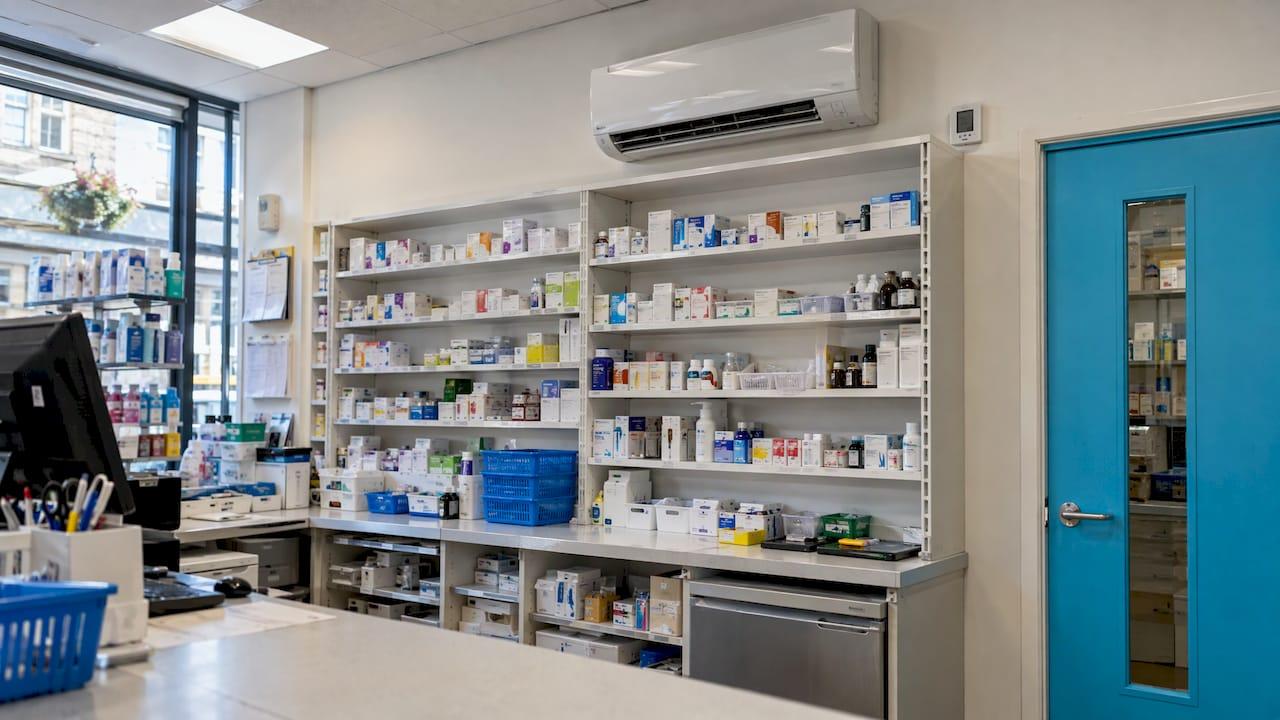
A UK pharmacy needs its dispensary and stockroom held between 15°C and 25°C, and air conditioning is the most dependable way to do that through a South West summer. NHS guidance names it as the first measure to install where possible. We are an Exeter-based installer, and our F-Gas certified engineers fit systems for shops and commercial premises across Devon and Cornwall. This guide explains the temperature rules, what inspectors look for, and how to plan a system that suits a pharmacy.
TL;DR
- Ambient medicines should be stored at 15°C to 25°C. Fridge lines stay at 2°C to 8°C. Staff areas are best at 18°C to 22°C, according to the General Pharmaceutical Council (GPhC).
- The NHS Specialist Pharmacy Service advises installing air conditioning where possible to keep ambient storage in range.
- A system only protects stock if it is sized for the room, monitored with alarms, and serviced before the warm months.
- Our engineers are F-Gas certified and REFCOM registered, we offer free surveys, and installations are typically completed in 1 to 2 days.
Table of Contents
- What temperatures a pharmacy has to hold
- What UK guidance says about air conditioning
- Do you need air conditioning in your pharmacy?
- Choosing a system for a pharmacy
- Monitoring, alarms and what inspectors check
- Keeping the system reliable
- Planning the project around a working pharmacy
- Fit your pharmacy with air conditioning
- Our view
- FAQ
- Sources
What temperatures a pharmacy has to hold
There are three separate targets in a pharmacy, and each is controlled differently.
| Area | Target range | Source |
|---|---|---|
| Ambient medicines (dispensary shelves, stockroom) | 15°C to 25°C | GPhC, April 2025 |
| Refrigerated medicines | 2°C to 8°C | GPhC, April 2025 |
| Staff working areas | Ideally 18°C to 22°C | GPhC, April 2025 |
The GPhC is the regulator for pharmacies in Great Britain. It also tells pharmacy teams to follow the manufacturer's guidance on the packaging, because some products carry their own limits.
The ambient range matters most for air conditioning. The GPhC notes that prolonged exposure above 25°C can degrade many medicines and reduce how well they work. It also says that heat makes the working environment harder for staff. A south-facing dispensary behind a glass shopfront, with a hot stockroom and a busy counter, can pass 25°C on a sunny day in Exeter, Plymouth or Truro without anyone noticing.
Fridges are a separate matter. Air conditioning does not replace a pharmaceutical fridge. But a cooler room helps the fridge cope, and it reduces the risk of door-open warm-ups during a heatwave.
What UK guidance says about air conditioning
No single rule says every community pharmacy must have air conditioning. What exists is a set of standards and guidance that, taken together, make temperature control the pharmacy's responsibility.
GPhC standards. Inspectors assess storage under standard 4.3. In the review of inspections published in April 2025, 86 pharmacies failed standard 4.3 for reasons connected with medicines storage. Nearly 1 in 20 pharmacies (4.3%) failed because they could not show that refrigerated medicines were stored properly.
NHS Specialist Pharmacy Service (SPS). Its guidance says that ideally all medicines storage areas would be controlled between 15°C and 25°C, and it advises installing air conditioning, if possible, to achieve this. It also lists simple supporting measures: keep medicines away from radiators and warm-air inlets, keep windows and doors closed as much as possible, and monitor the storage-area temperature.
NHS Health Building Note 14-01. This is the design guidance for hospital pharmacies. It says a controllable environment is required so that pharmaceutical products and raw materials are stored at no more than 25°C, with all storage raised off the floor. It was written for NHS buildings, but it shows the standard that a well-run pharmacy is measured against.
The practical reading for a pharmacy owner is simple. If your premises cannot reliably stay under 25°C without help, you need a way to prove control and a plan to fix it. Mechanical cooling is the most direct fix.

Do you need air conditioning in your pharmacy?
The Pharmacists' Defence Association says the right measures depend on the size and layout of the premises, patient footfall, existing ventilation and the types of medicines stored. That is a good checklist for deciding.
Air conditioning is usually the right answer when:
- the dispensary or stockroom regularly records readings near or above 25°C in your daily min/max log;
- the room has large south or west-facing glazing, a flat roof above, or no opening windows;
- equipment such as a robot dispenser, PCs, printers and a fridge adds heat to a small room;
- the pharmacy has a consultation room, where patients and staff expect comfort as well as stable conditions;
- you offer services such as vaccinations or blood pressure checks that lengthen the time people spend inside.
South West premises add their own factors. Coastal towns such as Newquay, Falmouth and Exmouth can be humid, and many pharmacies sit in older buildings with thick walls, awkward plant locations and listed or conservation-area restrictions on external units. A survey should address all of this before a system is specified.
Choosing a system for a pharmacy
Most community pharmacies are served well by a ductless split or multi-split system: an outdoor unit linked by refrigerant pipework to one or more indoor units. This keeps installation short and disruption low. It gives separate control for the dispensary, the shop floor and the back room.
Things to settle at design stage:
- Cooling load. The size of each room, glazing, orientation, the number of people and the heat from equipment all add to the load. A unit that is too small will run flat out and still miss 25°C. A unit that is too large will cycle on and off and control the room poorly. Our guide to retail air conditioning design walks through how load is worked out for shops, which applies to the shop floor of a pharmacy too.
- Heating and cooling together. Heat pump systems that cool in summer can also heat in winter, so the dispensary stays above the 15°C lower limit in cold weather. This comparison of heat pumps and furnaces for commercial space shows how building size and layout drive the choice.
- Indoor unit position. Place units so cold air does not blow directly onto shelving, dispensing benches or staff at the counter, and so that medicines are not sited close to warm-air outlets, as SPS advises.
- Noise. Consultation rooms need a quiet indoor unit. Outdoor units need a position that respects neighbours.
- Resilience. If the dispensary relies on one unit, think about what happens when it fails. Two smaller indoor units on separate circuits, or a service agreement with a fast response, reduce that exposure.
- Brand and warranty. We supply and fit systems from Samsung, Mitsubishi, Toshiba and Daikin, and design each job to the premises rather than offering a one-size package.
For a wider look at how we plan layouts, see our air conditioning design process article.
A worked example
Take a small high-street pharmacy in a Devon market town. It has a 25 m² shop floor with a glazed frontage, a 12 m² dispensary behind the counter and a 8 m² stockroom with no window. The stockroom stays cool but the dispensary, with two PCs, a label printer and a fridge, climbs through the afternoon. The daily log shows maximum readings of 26°C to 27°C through July.
The sensible design is a multi-split system: one indoor unit for the shop floor, one for the dispensary, with the stockroom checked by the survey to see whether it needs cooling too. Both indoor units connect to a single outdoor unit placed at the rear. The engineer positions the dispensary unit so air does not blow across the shelving. The system is then commissioned, and the pharmacist confirms that the min/max readings now stay within 15°C to 25°C. This is an illustration of how a job is approached, not a quote.
Monitoring, alarms and what inspectors check
Air conditioning keeps temperatures down. Records show that it is working. The GPhC listed common themes in failed inspections, and most are about monitoring rather than equipment:
- not checking and recording maximum and minimum temperatures daily;
- recording an out-of-range temperature without telling the pharmacist;
- staff not knowing how to reset the thermometer;
- overstocked fridges, or fridges with ice compartments;
- mercury thermometers, or thermometers with low batteries;
- the thermometer probe positioned incorrectly.
So pair the system with a simple routine. Read and reset the min/max thermometer every day, write it down, and make sure every team member knows who to tell when a reading is out of range. Extreme weather justifies more frequent checks, as the Oxford Health formulary SOP specifies for clinic rooms.
Where you use electronic sensors, the SPS says they should be calibrated annually to within 0.5°C by a UKAS-accredited service. An audible alarm that warns of a deviation is worth having, particularly if the pharmacy is empty overnight and at weekends.
If the temperature goes out of range
The SPS guidance on temperature excursions starts with the obvious causes: air conditioning switched off, a door left open, or blinds left open during a heatwave. It also says a fridge should go back into use only once it is confirmed to be working correctly at 2°C to 8°C. Record what happened, tell the responsible pharmacist, and follow the manufacturer's advice for the affected stock. If you are unsure whether stock is still usable, ask the manufacturer's medical information team or your superintendent pharmacist.
Keeping the system reliable
A cooling system that fails on the hottest weekend of the year is worse than none, because the team assumes the room is safe. Reliability comes from three habits.
Service before summer. Filters clog, coils gather dust and refrigerant levels drift. A pre-season service catches this. Our commercial AC maintenance checklist sets out what a visit covers and the UK TM44 rules that apply to larger systems. For the wider principles, a commercial preventive maintenance plan shows how to schedule checks, record faults and respond to them.
Keep a fault route. Everyone on the team should know how to report a fault, and the first check is the simple one: is the unit switched on, and is the remote on the right mode? If not, report it. You can use our fault report page to log a problem.
Have an agreement. We offer annual service contracts and an emergency breakdown response for commercial customers, so that a failure in the dispensary is a call to engineers who already know the site. Details are on our service and maintenance page.
F-Gas matters here. Air conditioning uses fluorinated refrigerant gases, and the people who install and service the equipment must be certified to handle them. Our engineers are F-Gas certified and REFCOM registered, and our local team does the work without subcontractors.

Planning the project around a working pharmacy
A pharmacy cannot close for a week. The aim is to fit the system with as little interruption as possible.
- Free survey. An engineer visits, looks at each room, notes glazing, equipment and pipe routes, and talks to you about where the units can go.
- Design and quote. You receive a system designed for the premises, with the brands and capacities set out.
- Installation. Our installations are typically completed in 1 to 2 days, and same-day and next-day installs are available. Work can be sequenced so the dispensary is out of use for the shortest time, for example by fitting the shop floor first or working in the stockroom while the pharmacy trades.
- Commissioning and handover. The engineer tests each unit, shows your team the controls and sets sensible temperature targets, so that nobody has to adjust the system from day to day.
- Ongoing care. A service contract keeps the system checked each year.
We also offer 0% finance, which helps spread the cost of the equipment. If you rent the premises, check your lease for landlord consent on outdoor units and pipework before work starts.
Fit your pharmacy with air conditioning
If your dispensary or stockroom struggles to stay below 25°C, we can survey the premises and design a system around it. We supply and install Samsung, Mitsubishi, Toshiba and Daikin systems for shops and commercial premises across Exeter, Devon, Cornwall and the wider South West, and we back them with maintenance and emergency cover.

See our shop fitting and commercial installation page or our commercial services, and ask for a free survey.
Our view
Most pharmacies we would speak to do not have a cooling problem every day. They have one on the five or six hottest days of the year, and that is exactly when stock is most exposed and the team is busiest.
Our view is that the right moment to install is before that week, not during it. A system designed for the actual rooms, with each indoor unit placed away from shelving and benches, is a quiet, steady piece of equipment that your team stops thinking about.
We design each job around the premises, fit it with our own F-Gas certified, REFCOM registered engineers, and keep it running through a service contract with emergency cover. For a regulated business where records matter, that continuity is the point: a system you can rely on, and an engineer who knows the site.
James
FAQ
What temperature should a pharmacy be?
Ambient medicines should be kept between 15°C and 25°C, and refrigerated medicines between 2°C and 8°C, according to the GPhC. For staff comfort, the GPhC suggests working areas between 18°C and 22°C. Always check the packaging for any product-specific limit.
Is air conditioning a legal requirement for a pharmacy?
No single rule orders every community pharmacy to install it. However, you must be able to show that medicines are stored correctly, and NHS SPS guidance advises installing air conditioning where possible to hold 15°C to 25°C. If your premises regularly exceed 25°C, cooling is the most direct way to meet that expectation.
What should I do if the dispensary gets too hot?
First check the obvious causes: the air conditioning switched off, a door propped open or blinds left up in a heatwave. Tell the responsible pharmacist, record the reading and the action taken, and seek the manufacturer's advice on the affected stock. If it keeps happening, book a survey so the cooling can be sized to the room.
How long does installation take?
Our installations are typically completed within 1 to 2 days, and same-day or next-day installation is available. The survey is free, and the engineer can plan the work around your opening hours.
Sources
- Storing medicines safely and appropriately, General Pharmaceutical Council
- Storing medicines at ambient temperatures, NHS SPS
- Medicines management Health Building Note 14-01, NHS England
- Using temperature sensors in medicines storage areas, NHS SPS
- Managing temperature excursions, NHS SPS
- MMP1: Temperature Monitoring in Clinic Rooms, Oxford Health Formulary
- Should pharmacies invest in air conditioning?, The Pharmacist