
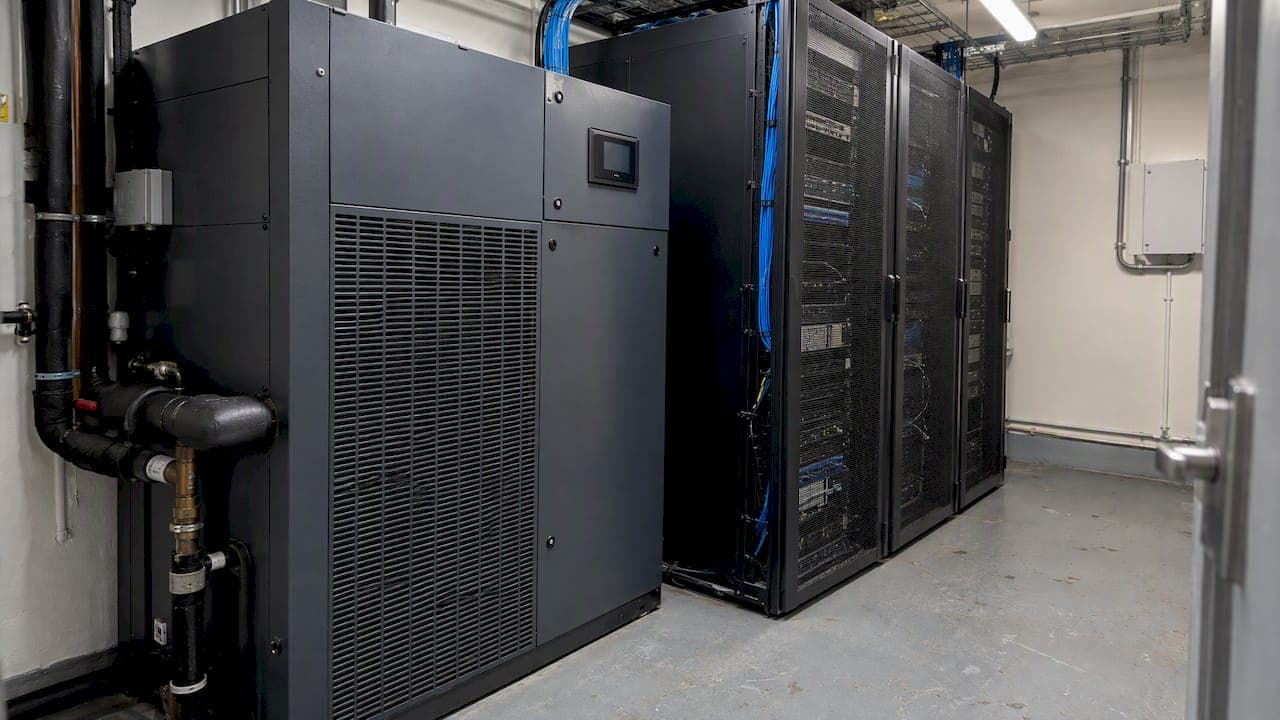
Precision (close-control) cooling is the right choice for any space housing servers, telecom gear or other heat-sensitive electronics, because it holds tight temperature and humidity tolerances and runs continuously. Comfort cooling, built for occupied rooms, suits low-density spaces with no critical equipment but cannot meet the stability that standards like ETL's close-control criteria demand.
TL;DR:
- Choose precision cooling when rack loads exceed roughly 3 to 5 kW per rack, uptime commitments are strict, hot spots recur, or rooms run unattended.
- Measure actual rack power before sizing: real draw often runs 30% to 40% below component nameplate totals, so ratings can lead to unused capacity.
- A small office network cabinet may use building air conditioning if the room shares general airflow and someone monitors its temperature.
- Specify N+1 for one spare unit beyond peak demand; 2N duplicates the whole cooling system, costs more, and removes nearly all single points of failure.
- Confirm installers hold REFCOM registration and required refrigerant handling certification, and check maintenance terms, response times, and delivery estimates before approving the project.
Table of Contents
- At-a-glance comparison of precision and comfort cooling
- How precision cooling works: temperature, humidity and efficiency metrics
- When precision cooling is necessary and when comfort cooling may suffice
- Practical considerations for specifying and operating equipment cooling
- How an experienced installer approaches cooling for equipment rooms
- Installation complexity and typical timelines
- Common use cases beyond data centres
- Impact of refrigerant choices on performance and compliance
- Balancing reliability and cost for long-term operations
- How Frost Air Conditioning can help with your cooling project
- FAQ
- Sources
At-a-glance comparison of precision and comfort cooling
The two approaches solve different problems. Precision cooling exists to protect equipment reliability: it removes heat generated by racks and cabinets while holding temperature and relative humidity inside a narrowband. Comfort cooling exists to keep people comfortable, which means wider acceptable swings and intermittent operation tied to occupancy.
That difference in objective shapes everything else about how the systems are built and run. A close control explainer from LAC Ltd notes that precision systems are designed around equipment needs such as stability and humidity control, while comfort systems are designed for occupied spaces and typically cannot maintain the tolerances a server room requires.
- Objective: equipment reliability and uptime versus human thermal comfort.
- Control tolerances: precision units hold tight temperature deadbands and active humidity control; comfort units allow wider temperature swings and rarely manage humidity directly.
- Operating mode: precision cooling runs continuously with variable capacity to match heat load; comfort cooling cycles on and off as occupancy and thermostat settings dictate.
- Unit types: precision deployments use CRAC or CRAH units, in-row coolers and containment strategies; comfort deployments use air handling units, split systems and packaged rooftop units.
- Energy and maintenance profile: precision systems are specified for part-load efficiency and often support free-cooling economiser cycles; comfort systems are sized for peak occupancy loads and serviced on a simpler seasonal schedule.
Facility teams often default to whatever cooling already exists in a building, which is how comfort units end up cooling comms cabinets. The mismatch tends to surface as intermittent faults rather than an obvious failure, which makes it harder to diagnose until downtime has already occurred.
How precision cooling works: temperature, humidity and efficiency metrics
The clearest technical marker separating the two categories is sensible heat ratio, or SHR: the proportion of a cooling unit's total capacity spent removing sensible heat (temperature) rather than latent heat (moisture). Equipment rooms generate almost entirely sensible heat, so close-control units are built to deliver a high SHR, while comfort systems are designed to also strip humidity from occupied, human-breathing spaces.
Close-control equipment on the UK's Energy Technology List must achieve a sensible heat ratio at or above a high threshold, alongside minimum EER and free-cooling capacity thresholds set for each product category. That single figure explains why a precision unit can hold a room at a steady temperature without constantly wringing moisture from the air, something a typical comfort system, running at an SHR closer to 0.65 to 0.7, isn't built to do.

Temperature stability matters as much as the ratio itself. Equipment rooms are typically specified with a tight deadband, often within a degree or two of setpoint, because repeated thermal cycling stresses components and solder joints over time. Humidity control matters for the same reason from a different angle: too dry and static risk rises, too humid and condensation or corrosion risk rises.
The ETL criteria also set EER and free-cooling thresholds, which matter at specification stage because they let a buyer compare quoted units on efficiency rather than on nameplate capacity alone.
In hardware terms, precision cooling usually means a choice between CRAC units (direct expansion, air-cooled) and CRAH units (chilled water coils fed from a central plant), distributed either through raised-floor or overhead ductwork, or via in-row coolers placed directly within a hot aisle. Continuous operation is supported by variable-capacity compressors and finer control modulation than a comfort unit's simple on/off thermostat ever needs to offer.
When precision cooling is necessary and when comfort cooling may suffice
Not every room with a server in it needs a full close-control installation, but several conditions make precision cooling the only sensible option.
- Rack power density above roughly 3 to 5kW per rack generates concentrated heat loads that comfort systems, designed for diffuse occupant loads, struggle to remove evenly.
- Strict uptime commitments or SLAs mean any thermal shutdown has a cost that outweighs the price difference between system types.
- A history of hot spots, nuisance shutdowns or visible condensation signals that existing cooling, usually comfort-grade, is already out of its depth.
- Continuous, unattended operation such as a telecom hut or unmanned comms room removes the option of relying on occupant awareness to flag a problem.
Low-density scenarios, such as a small network cabinet in an office that already benefits from building-wide air conditioning, may run safely on comfort cooling provided temperature is monitored and the room isn't sealed off from general airflow.
Pro Tip: Before specifying anything, measure actual rack kilowatt load rather than relying on nameplate ratings: real-world draw is often 30 to 40% below the sum of component maximums, and sizing against it avoids paying for capacity you'll never use.
A short checklist helps at the decision stage: What's the kW per rack today, and in three years? What redundancy level does the business actually need? Is humidity currently monitored at all? Those three answers usually settle the precision-versus-comfort question on their own.
Practical considerations for specifying and operating equipment cooling
Getting the hardware right is only half the job.
- Redundancy: N+1 means one spare unit beyond what's needed to handle peak load, protecting against a single failure; 2N duplicates the entire cooling system, which costs more but removes almost all single points of failure.
- Controls and monitoring: humidity sensors, building management system (BMS) integration and alarm thresholds catch drift before it becomes downtime.
- Maintenance and compliance: service contracts, coil and filter cleaning, and F-Gas/REFCOM-compliant refrigerant handling all belong in a planned schedule rather than a reactive one.
- Energy optimisation: free-cooling and economiser cycles cut running costs in temperate climates, and liquid cooling becomes worth considering once rack density climbs into very high ranges.
Our guide to server room air conditioning requirements covers sizing and controls in more depth for anyone specifying a new room from scratch.
How an experienced installer approaches cooling for equipment rooms
A typical project runs through a consistent sequence: a free site survey, specification against the room's actual heat load, equipment selection, installation, commissioning, and then an ongoing service contract to keep performance in line with design.
- We work as engineers who cover legally required refrigerant handling and reporting.
- We offer a fast response for urgent commercial and domestic call-outs.
- We provide finance options on qualifying installations.
- We install and support systems from premium brands.
Before appointing any installer, ask about certifications, warranty terms, maintenance contract details and realistic delivery timescales.
Installation complexity and typical timelines
Comfort cooling installs are usually the simpler job: a single split or packaged unit, standard electrical connection, and a day or two of work for most domestic or small commercial sites. Precision cooling projects involve more design work upfront, since capacity, redundancy and distribution strategy (raised floor, overhead ducting or in-row units) all need to be settled before anything is ordered.
That extra design stage doesn't necessarily mean a long installation. For a single equipment room with one or two close-control units, installation itself can often still be completed within a day or two once equipment is on site, similar to a comfort job. What extends the overall timeline is lead time on chilled-water plant, bespoke containment, or commissioning against tight tolerances, which takes longer than switching on a comfort unit and checking the thermostat responds.
Retrofitting precision cooling into an existing comms room, rather than building it in from the start, tends to add time because power, drainage and ducting routes often need adapting to fit a space that wasn't designed for equipment cooling. Planning for this at survey stage, rather than discovering it mid-install, keeps a precision project close to the same turnaround as a comfort job for smaller sites.
Common use cases beyond data centres
Precision cooling isn't only a data-centre concern. Any space where equipment reliability, not human comfort, is the priority can justify the same approach.
Telecom and comms rooms, including unmanned roadside cabinets and exchange buildings, run continuously and tolerate no more humidity swing than a server rack does. Hospital imaging and diagnostic equipment rooms often carry manufacturer-specified temperature and humidity ranges that comfort cooling simply isn't built to hold. Laboratory environments with sensitive instrumentation, and industrial control rooms housing PLCs and switchgear, face the same exposure: a thermal shutdown stops production, not just a meeting.
Retail and hospitality back-of-house comms cupboards are a smaller-scale but common example, where a card payment system or EPOS server sits in an unventilated cupboard that was never designed to remove its heat output. In these cases, the equipment load is modest, but the space is often sealed and unmonitored, which is exactly the combination that produces unnoticed overheating. Recognising these scenarios early, rather than treating precision cooling as something only large data halls need, avoids a class of failures that are cheap to prevent and expensive to fix after the fact.

Impact of refrigerant choices on performance and compliance
Refrigerant choice affects both how efficiently a system runs and whether it meets current environmental rules. Older refrigerants with high global warming potential are being phased down under F-Gas regulations, which pushes new installations towards lower-GWP alternatives.
For precision cooling, refrigerant choice also interacts directly with the SHR and EER figures discussed earlier: a refrigerant's thermodynamic properties influence how effectively a unit sheds sensible heat at a given compressor size, which is part of why the ETL close-control criteria tie SHR and EER thresholds to specific product categories rather than treating all refrigerants as interchangeable.
Compliance isn't optional background detail. Refrigerant handling, recovery and reporting fall under F-Gas regulations, and installers working on close-control or comfort systems alike need REFCOM registration to handle these refrigerants legally. Specifying a system without checking which refrigerant it uses, and whether the installer is certified to work with it, risks both a compliance gap and a less efficient long-term running cost.
Balancing reliability and cost for long-term operations
Precision cooling is the prudent default wherever equipment, not people, sets the temperature requirement. The upfront cost is higher than a comfort system, but the comparison that matters is total cost of ownership: downtime, hardware damage and emergency call-outs from an undersized comfort unit tend to outweigh the capital difference within a few years.
Planned maintenance is what protects that investment. A system specified correctly but left unserviced drifts out of tolerance just as readily as an undersized one, so a maintenance contract is as much a reliability decision as a compliance one.
— James
How Frost Air Conditioning can help with your cooling project
Whether you're specifying a new server room or replacing an underperforming comfort unit in a comms cupboard, we start with a free site survey and build a specification around your actual heat load and growth plans.
We cover everything from domestic installation to larger shop fitting and commercial projects, fitting premium systems from Samsung, Mitsubishi, Toshiba and Daikin. Once a system is installed, our service and maintenance plans keep it running inside spec with scheduled visits and emergency breakdown cover.
Get in touch for a free survey and a specification built around your room, not a generic template.
FAQ
What are the four types of cooling?
Cooling systems are commonly grouped into air-cooled, water-cooled, evaporative and close-control (precision) categories, though some classifications split this differently by equipment type. For equipment rooms, the relevant distinction in practice is usually precision versus comfort cooling rather than the broader four-type split.
Which type of cooling system is better for equipment rooms?
Precision cooling is better suited to equipment rooms because it holds tighter temperature and humidity tolerances and runs continuously, matching how close-control systems are designed around equipment needs rather than occupant comfort. Comfort cooling remains appropriate for general office and living spaces where human comfort, not equipment reliability, is the priority.
What is the difference between AC and comfort cooling?
"AC" is a general term covering any air conditioning system, while comfort cooling refers specifically to AC designed for occupied, human-comfort spaces rather than equipment rooms. Precision or close-control AC is a separate category built to the tighter tolerances electronics require.
What should I check before choosing a cooling installer?
Confirm the installer holds REFCOM registration and F-Gas certification, since these cover legally required refrigerant handling. Also ask about typical response times, what's included in a maintenance contract, and realistic delivery timescales for your specific project.
How does comfort cooling work?
Comfort cooling removes heat and some humidity from an occupied space using a thermostat-controlled cycle that switches on and off to maintain a comfortable range for people. It isn't built for the continuous operation or tight humidity control that equipment-critical spaces require.