
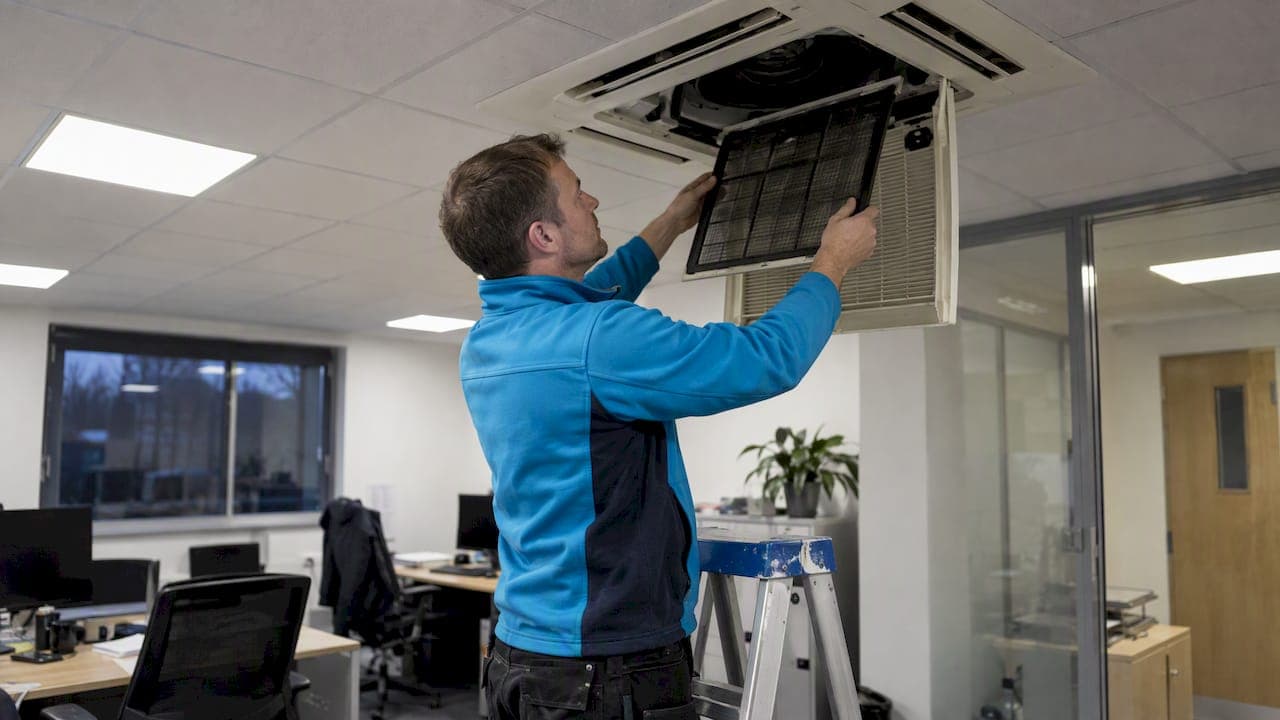
A complete commercial AC maintenance checklist covers filters, coils, fans and belts, condensate drains, refrigerant lines, electrical connections, controls and a written record of every finding. The immediate next step is to book a planned service before the cooling season starts and confirm that any refrigerant work goes to an F-Gas certified engineer, since UK rules on leak-check frequency and TM44 inspections may apply to your system.
TL;DR:
- F Gas checks are due every 12 months at 5 to under 50 tonnes CO2e, every 6 months at 50 to under 500, and every 3 months from 500, with automatic leak detection.
- Systems above 12 kW need a TM44 energy inspection at intervals no longer than a few years, separate from routine servicing.
- Facilities staff should make monthly visual checks, while most sites need one professional service yearly; dusty, coastal, and critical sites need more frequent attention.
- Only appropriately certified contractors should handle refrigerant recovery, leak repairs, or sealed system work; verify both company and engineer credentials before booking.
Table of Contents
- Component checklist: what to inspect on every service visit
- Seasonal schedule: pre-summer, peak season and pre-winter checks
- UK compliance: F-Gas leak checks and TM44 inspections
- Turning checks into action: recording, prioritising and handover
- Who checks what: facilities staff versus qualified contractors
- Why local, certified expertise matters for commercial sites
- Step-by-step procedure for each checklist item
- Tools and materials for a thorough service visit
- Documenting and reporting maintenance work
- Early warning signs between scheduled checks
- Keeping energy efficiency steady between services
- Scheduling to minimise disruption
- What matters most when you walk into a plant room
- Planned servicing and emergency cover from Frost Air Conditioning
- FAQ
- Sources
Component checklist: what to inspect on every service visit
A thorough visit works through the system in order, recording a result for every item rather than a single tick for "serviced".
Start by confirming the asset identity: note the make, model and serial number against your equipment register before any work begins. This stops findings being logged against the wrong unit on larger sites with several systems.
- Filters: inspect for dust loading, measure pressure drop where you have the tools for it, then replace or record the condition.
- Coils and fins: clean the evaporator and condenser coils and check for bent fins, corrosion or blockages, without relying on a fixed pressure target since readings vary by refrigerant and equipment.
- Fans, blowers, belts and pulleys: check belt tension and wear, confirm bearings are lubricated and listen for noise that suggests misalignment.
- Condensate pans and drains: look for standing water, algae or blockages and arrange a drain treatment where buildup is recurring.
- Refrigerant lines: note any visual signs of oil staining or frost and record readings, but leave recovery, topping up or leak repair to a qualified technician.
- Electrical connections: tighten terminals, record voltage and amperage where practical, and flag any motor running hot or drawing unusual current.
- Controls and sensors: verify setpoints, calibrate thermostats and confirm the building management system is receiving accurate inputs.
- Ducts and grilles: check for dust, mould or obstructions that would restrict airflow to occupied spaces.
- Outdoor unit: clear leaves and debris from around the condenser, confirm the mounting is secure and check the fan guard is intact.
Pro Tip: Keep a laminated copy of this checklist on the plant room wall so contractors and in-house staff always work from the same list of items.
Seasonal schedule: pre-summer, peak season and pre-winter checks
Spreading tasks across the year keeps the workload predictable and avoids a rush when the weather turns.
- Pre-summer: clean coils, verify airflow across each zone, check for refrigerant leak evidence and book a compressor and full-service check ahead of the first warm spell.
- Peak season: run monthly visual rounds looking for alarms, unusual noise, blocked grilles and debris around outdoor units, escalating anything unexpected to a contractor.
- Pre-winter: inspect any associated heating elements, protect exposed outdoor components from weather damage and clear drains before the system sits idle.
- Adjust frequency for site conditions: dusty workshops, coastal buildings and spaces housing mission-critical equipment such as server rooms usually need more frequent checks than a typical office.
Use these seasonal entries to build a yearly service calendar and book contractor slots early, since reputable engineers get booked up fast in the weeks before summer.
UK compliance: F-Gas leak checks and TM44 inspections
Commercial AC maintenance in the UK sits inside a legal framework that goes beyond good practice, and missing it can mean penalties as well as breakdowns.
- F-Gas leak-check frequency is set by the CO2-equivalent charge of the system: at least every 12 months for 5 to less than 50 tonnes CO2e, every 6 months for 50 to less than 500 tonnes, and every 3 months at 500 tonnes or more, with automatic leak detection required at 500 tonnes CO2e or above.
- Company and engineer certification matters because covered F-Gas work must be carried out by a certified company using appropriately qualified personnel, and you should retain records that demonstrate this.
- TM44 inspections apply to systems with an effective rated output above 12 kW and are required at regular intervals no longer than a few years, assessing energy efficiency rather than general condition. CIBSE's TM44 guidance is explicit that this inspection does not replace routine servicing.
F-Gas leak-check intervals scale with the system's CO2-equivalent charge, from annual checks at the lower bands to quarterly checks plus automatic detection at 500 tonnes CO2e or more, according to Gov. That single fact explains why a generic "annual F-Gas check" line on a maintenance sheet can understate what a larger system actually needs.
Practical actions that support compliance include recording the refrigerant charge, logging every leak-check date and keeping copies of engineer certificates on file. TM44 reports for properties in England, Wales and Northern Ireland are lodged on the Landmark register, and our guide on UK commercial aircon compliance walks through the 12 kW threshold and reporting steps in more detail.

Turning checks into action: recording, prioritising and handover
A checklist only earns its keep when a failed item becomes a tracked task rather than a tick mark.
- Record these fields for every check: date, inspector, readings taken, condition observed, priority, remedial action, responsible owner and completion date.
- Prioritise in this order: safety or health issues first, suspected refrigerant leaks second, then efficiency losses such as a dirty filter or a drifting setpoint.
- Capture a baseline of normal readings for each system so you can spot drift over time, rather than comparing everything against a single fixed pressure figure.
- Brief contractors properly: hand over the asset list, previous service records, TM44 status and F-Gas leak-check history before any work starts.
Pro Tip: A digital log beats paper for multi-site portfolios because it timestamps entries automatically and makes trend comparison far quicker than flicking through old service sheets.
Simple categorical labels, such as "pass", "monitor" or "action required", keep records consistent across different inspectors and sites.
Who checks what: facilities staff versus qualified contractors
Clear boundaries stop small issues turning into breakdowns and keep refrigerant work in the hands of people legally allowed to do it.
- Facilities staff can run monthly visual checks covering alarms, unusual noise, airflow complaints, blocked grilles and visible leaks around indoor and outdoor units.
- Qualified contractors should handle refrigerant recovery, leak repair and any work inside the sealed system, and you should ask to see current F-Gas company certification and the attending engineer's qualifications before work begins.
- Escalate immediately if you see a sudden loss of cooling, a tripped electrical protection device, visible oil residue near pipework or a strong burning smell.
- A minimal cadence for most sites is monthly visual checks, a biannual review for busy, coastal or dusty locations, and one full professional service each year as the baseline.
Why local, certified expertise matters for commercial sites
This checklist works best alongside engineers who can verify findings and act on them without delay. We operate as an air conditioning installer based in Exeter, covering the South West of the UK, with F-Gas certified engineers and same-day installs available where the job allows it. For deeper reading on the regulatory side, our pieces on F-Gas compliance before you hire and legal maintenance requirements cover the paperwork in more depth. James, the author of this guide, draws on practical knowledge of commercial AC servicing across the region.
Step-by-step procedure for each checklist item
Working through the checklist in a fixed sequence avoids missed steps and keeps records consistent between visits.
Begin with the system powered down where safe to do so: note the asset tag, then inspect filters first since restricted airflow affects every reading taken afterwards. Remove the filter, check it against the light for dust loading, and either clean, replace or log it as acceptable.
Move to the coils next: visually inspect both evaporator and condenser coils for debris, bent fins or corrosion, and clean gently with the appropriate brush or low-pressure wash before checking fan and blower operation, belt tension and bearing lubrication. With the fan safely guarded, check for abnormal vibration or noise.
Inspect the condensate pan and drain line for standing water or blockage, treating or clearing it as needed before moving to refrigerant lines, where you record visual condition only unless you hold the right qualification to go further. Finish with electrical connections, tightening as required and recording voltage and amperage, then verify controls, setpoints and BMS inputs before a final outdoor unit clearance check and sign-off.
Tools and materials for a thorough service visit
Having the right kit on hand turns a rushed inspection into a proper one.
A basic toolkit includes an adjustable spanner and screwdriver set, a multimeter for voltage and amperage checks, a torch, a soft brush and coil cleaning solution, a condensate pan treatment tablet or solution, and a digital camera or phone for photographing defects. A manifold gauge set and refrigerant recovery equipment are reserved for F-Gas certified technicians, since using them without the right qualification is not permitted.
Facilities staff running monthly visual checks need far less: a torch, a notepad or tablet for logging, and basic PPE such as gloves and eye protection when opening panels. Keeping a small stock of standard filter sizes on site means a worn filter can be swapped immediately rather than left until the next scheduled contractor visit.
Documenting and reporting maintenance work
Every visit should leave behind a written record, not just a verbal "it's fine".
Log the date, technician name, asset identified, each checklist item's condition, any readings taken, defects found, remedial action completed or recommended, and a sign-off signature. Photographs of coil condition, drain blockages or corrosion add useful evidence for warranty claims or insurance purposes. Keep refrigerant-specific records separately, since F-Gas rules require documentation of leak checks and any refrigerant added or recovered, tied to the specific appliance.
Store records centrally, whether in a digital maintenance system or a site logbook, and make sure TM44 reports, F-Gas certificates and annual service records are all filed together against the relevant asset. This matters most when a system changes hands, when a local authority requests evidence, or when you are comparing quotes from a new contractor.
Early warning signs between scheduled checks
Routine visits catch most issues, but a few signs are worth watching for day to day.
Rising energy bills without a change in usage patterns often point to a coil needing attention or a refrigerant issue developing gradually. Uneven cooling between rooms served by the same system can suggest duct blockages, damper faults or a failing zone control. Short cycling, where the unit switches on and off more frequently than usual, often signals an electrical or sensor fault rather than a refrigerant problem. A musty smell from grilles usually means moisture sitting in ducts or drains, which is worth checking before mould becomes established.
Any of these signs between scheduled services is a reason to bring the check forward rather than waiting for the next calendar slot.
Keeping energy efficiency steady between services
A system running efficiently costs less to run and puts less strain on components between services.
Clean filters and coils are the single biggest factor in efficiency, since restricted airflow forces the compressor to work harder for the same result. Setpoints matter too: a one or two degree adjustment on thermostats across a building can make a noticeable difference to running costs without affecting comfort. Keeping outdoor units clear of debris and direct sun exposure where practical helps heat exchange work as designed. Our partners at Switch and Save cover wider energy-saving steps for UK small businesses that complement a well-maintained AC system.
Scheduling servicing before peak season, rather than after a fault appears, keeps the system working at its intended efficiency through the months it matters most.
Scheduling to minimise disruption
Commercial sites rarely have a convenient moment for maintenance, so planning around operating hours pays off.
Book routine servicing outside trading hours or during planned closures where possible, and agree access arrangements with the contractor in advance so there is no delay on the day. Stagger servicing across multiple units in a large building rather than taking every system offline at once, keeping at least partial cooling available throughout. Our guide on condensate pan hygiene and grille cleaning is a useful cross-reference when coordinating AC servicing with a wider building cleaning schedule, since both teams sometimes need access to the same spaces.
Confirm response times for emergency breakdown cover separately from planned servicing, so a mid-summer failure does not wait behind a routine booking queue.
What matters most when you walk into a plant room
On arrival, check for alarms, unusual noise and anything blocking airflow before touching a single filter. Fix what threatens safety or comfort first, document everything, and let the rest wait for the scheduled visit.
— James
Planned servicing and emergency cover from Frost Air Conditioning
Booking a planned service is far simpler than managing a breakdown mid-summer, and we offer local engineers to make that happen without a long wait for an appointment. Our Service & Maintenance work covers routine checks, annual service contracts and emergency breakdown response, all carried out by certified engineers.

- Annual service contracts keep your system on a planned schedule rather than a reactive one.
- Emergency breakdown response covers the moments a planned visit cannot wait for.
- F-Gas certified engineers handle refrigerant work to the standard UK regulations require.
| Service | What it covers |
|---|---|
| Service & Maintenance | Routine checks, filter and coil servicing, electrical and control checks |
| Annual service contracts | Scheduled visits planned across the year |
| Emergency breakdown response | Rapid attendance when a system fails unexpectedly |
Ask to see company certification and the attending engineer's qualifications when you book, as you would with any contractor handling refrigerant. Request a free survey or quote for service and maintenance and get a planned schedule in place before the next busy season arrives.
FAQ
How often should a commercial AC system be serviced?
A full professional service is typically recommended at least once a year, timed before the cooling season, with more frequent visits for busy, dusty or coastal sites. Monthly visual checks by facilities staff between professional visits help catch issues early.
What are the F-Gas leak-check requirements for UK businesses?
Leak-check frequency depends on the system's CO2-equivalent charge: at least every 12 months for 5 to less than 50 tonnes CO2e, every 6 months for 50 to less than 500 tonnes, and every 3 months at 500 tonnes or more, with automatic leak detection required above 500 tonnes. These checks must be carried out by an appropriately qualified, F-Gas certified technician.
Does my commercial AC system need a TM44 inspection?
Systems with an effective rated output above 12 kW need a TM44 inspection at regular intervals no longer than a few years. TM44 assesses energy efficiency and is separate from routine servicing, so both are needed on a qualifying system.
What should I ask a contractor before booking AC maintenance?
Ask to see current F-Gas company certification and the qualifications of the engineer attending site, along with evidence of previous maintenance records for your system. We provide this documentation as standard when booking Service & Maintenance work.
What records should I keep for commercial AC maintenance?
Keep a log of every service date, inspector, readings taken, defects found and remedial action, alongside refrigerant leak-check dates and TM44 reports where applicable. These records support compliance checks and make handovers to new contractors far smoother.