

Comparing air conditioning quotes correctly means evaluating equipment specifications, labour warranties, permit responsibilities, and installation scope, not just the headline price. Homeowners in the South West who treat quote comparison as a price race routinely end up with undersized systems, voided warranties, or unexpected costs that dwarf any initial saving. The industry best practice is to obtain at least three written quotes before committing, and to assess each one against the same detailed criteria. This guide gives you a practical framework to do exactly that.
How to compare air conditioning quotes: what to look for first
The single most important rule in any air conditioning quote comparison is this: a quote without line-by-line itemisation is not a quote worth considering. A transparent quote lists the equipment brand and model number, labour scope, materials, permit fees, disposal of the old unit, and warranty terms as separate line items. Lump-sum quotes without breakdowns are a major red flag because they make it impossible to compare bids fairly or challenge costs later.
Equipment details matter as much as price. A proper quote names the specific unit, its efficiency rating, and confirms it meets current standards. Checking equipment and labour breakdowns across every quote you receive gives you a clear basis for comparison and protects you legally if a dispute arises.

Two warranties appear in every installation: the manufacturer parts warranty and the contractor labour warranty. These are entirely separate. The manufacturer covers the physical components of the unit. The contractor covers the quality of the installation work itself. Both must appear explicitly in the quote. Manufacturer and labour warranties differ in scope, duration, and who is responsible for honouring them, so never assume one covers the other.
Permit handling is another non-negotiable detail. The contractor must pull permits in their own name. If a quote asks you, the homeowner, to arrange permits yourself, walk away. Permit fees in the UK vary by local authority, but the responsibility for compliance sits firmly with the installer, not the homeowner.
Pro Tip: Ask each contractor to confirm in writing who registers the manufacturer warranty after installation. Failure to register within the required window can significantly reduce your coverage.
- Equipment brand, model number, and efficiency rating listed explicitly
- Labour scope described in plain language (what is and is not included)
- Permit fees itemised separately, with the contractor named as responsible
- Disposal of the existing unit confirmed and costed
- Manufacturer parts warranty and contractor labour warranty both stated
- Payment terms and any finance options clearly set out
How do you normalise multiple quotes for a fair comparison?
Fair comparison starts before you request quotes. Write a standard job description covering your property type, the rooms you want cooled, any existing ductwork, and your preferred installation timeline. Give every contractor the same document. This removes the most common source of price variation, which is contractors quoting for different scopes of work.
Aim to receive at least three written quotes. First quotes typically arrive within a few hours, and a full set of three usually lands within 24 hours under normal conditions. That turnaround means you do not need to rush or accept pressure to decide on the day.
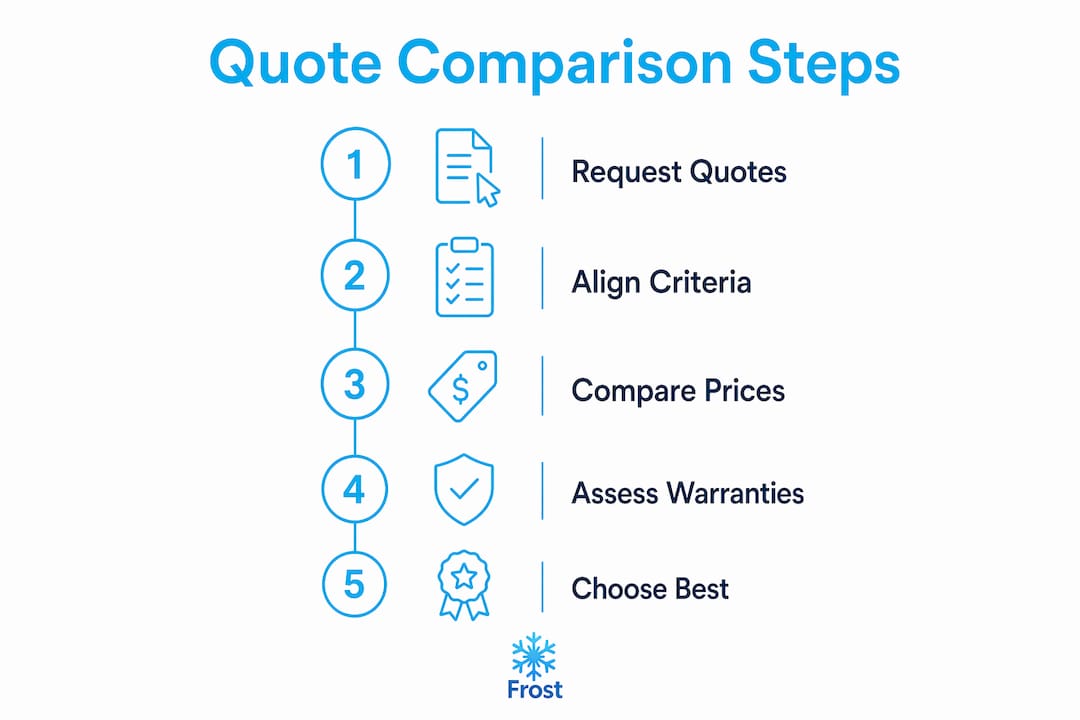
Once quotes arrive, build a simple comparison table. Align each bid against the same criteria: equipment model and efficiency rating, labour warranty length, permit fees, disposal costs, and whether duct inspection is included. Scope omissions in cheaper bids such as missing duct sealing, permits, or disposal can add significant costs not visible in the headline figure. A quote that looks £400 cheaper may actually cost more once you account for what it leaves out.
The Manual J calculation: why it matters
Every quote should reference a Manual J load calculation or its UK equivalent, a full heat load assessment based on your home's dimensions, insulation, window area, and orientation. Proper load calculations prevent oversized or undersized units that short-cycle, wear out faster, and fail to control humidity properly. If a contractor sizes the new unit by simply copying the old one, that is a problem. Old units are frequently the wrong size to begin with.
Pro Tip: Ask each contractor directly: "Have you carried out a heat load calculation for this property?" A confident, detailed answer separates professionals from those guessing.
- Write a standard scope document and share it with all contractors
- Request a minimum of three written, itemised quotes
- Build a comparison table aligning equipment, warranties, permits, and disposal
- Confirm each quote includes a heat load assessment, not a copied unit size
- Check whether available rebates or finance options are factored into the total
- Verify contractor licensing, F-Gas certification, and insurance before proceeding
For guidance on choosing the right system before you even request quotes, reviewing equipment types and efficiency ratings first puts you in a stronger position when assessing bids.
What factors beyond price determine long-term value?
Installation quality outweighs brand prestige when the price difference between two quotes is small. A premium unit fitted poorly on leaking or damaged ductwork will underperform regardless of brand. Every quote should explicitly state whether a duct inspection is included and what assumptions the contractor is making about duct condition.
Labour warranties vary considerably between contractors. Labour warranties range from one year standard to up to ten years for premium plans. An 8–12% higher price for a longer labour warranty typically offsets repair costs over the system's lifetime. That premium is usually worth paying, particularly for a property where the system will run year-round.
Manufacturer warranties require registration, often within 60–90 days of installation. Failure to register can halve the warranty duration. Confirm in writing which party, you or the contractor, is responsible for completing that registration before work begins.
Financing and rebates belong in your total cost calculation, not as afterthoughts. Frostairconditioning offers 0% finance on installations, which changes the effective cost comparison significantly when set against a cheaper upfront quote that carries no finance option. Understanding available rebates for energy-efficient systems can also shift the true cost of a higher-specification unit in your favour.
Permit compliance has a direct impact on your home insurance and warranty validity. An installation completed without the correct permits may invalidate your buildings insurance claim if a fault causes damage. The contractor's responsibility to pull permits is not a formality. It is a legal and financial protection for you.
- Duct inspection: confirm it is included and what remedial work is costed
- Labour warranty length: prioritise longer cover when price difference is within 10%
- Manufacturer warranty registration: confirm responsibility in writing before signing
- Permit compliance: verify the contractor pulls permits in their own name
- Finance options: factor 0% finance into the true cost of each bid
- Sizing method: confirm a heat load assessment, not a copied unit size
For a detailed breakdown of what air conditioning warranties actually cover and how to read the small print, reviewing the terms before you sign any quote is time well spent.
What are the biggest red flags in AC quotes?
The most common mistake homeowners make is choosing the lowest price without checking what that price actually covers. A quote that omits permits, disposal, or duct inspection is not a lower price. It is an incomplete price.
Pressure sales tactics are a reliable warning sign. High-pressure same-day pricing or "today-only" discounts are designed to prevent you from comparing bids properly. A legitimate contractor provides a quote that remains valid for a reasonable period. Any urgency manufactured by the salesperson is a reason to pause, not to sign.
Pro Tip: If a contractor asks you to pull the permits yourself, decline and move on. This shifts legal liability onto you and can void both your warranty and your home insurance.
- Lump-sum totals with no line-item breakdown
- No mention of permits or the contractor asking you to handle them
- No heat load calculation or sizing justification
- Vague labour scope with no defined warranty period
- Pressure to decide on the day or within hours
- No confirmation of F-Gas certification or contractor insurance
- Missing disposal costs for the existing unit or refrigerant recovery
When you spot these issues, the correct response is straightforward. Request a revised, itemised quote in writing. If the contractor refuses or dismisses the request, that tells you everything you need to know about how they will handle problems after installation.
Key takeaways
Comparing air conditioning quotes fairly requires aligning equipment specifications, labour warranties, permit responsibilities, and installation scope across every bid before price becomes the deciding factor.
| Point | Details |
|---|---|
| Insist on itemised quotes | Reject any quote that provides only a lump-sum total without line-by-line breakdowns. |
| Get at least three bids | Three written quotes give you a reliable market range and expose scope omissions in cheaper offers. |
| Check both warranty types | Manufacturer parts warranty and contractor labour warranty are separate; both must appear in writing. |
| Confirm permit responsibility | The contractor must pull permits in their own name to protect your insurance and warranty coverage. |
| Factor in total cost | Include finance options, rebates, and potential hidden costs when comparing the true value of each bid. |
Why patience is the most underrated tool in this process
Most homeowners I speak to have made the same mistake: they accepted the first or second quote because the process felt complicated and they wanted it done. That instinct is understandable. Air conditioning is not a purchase most people make more than once or twice in a lifetime, and the technical language can feel off-putting.
The reality is that the comparison process is not complicated once you know what to look for. The contractors who provide clear, itemised quotes with defined warranty terms and confirmed permit handling are not harder to find. They are simply easier to identify when you know the right questions to ask.
What I have seen repeatedly is that the cheapest quote rarely stays cheapest once you add the missing costs back in. Duct work that was not inspected. Permits that were never pulled. A warranty that was never registered. These are not edge cases. They are common outcomes when homeowners prioritise headline price over scope and compliance.
My honest advice is to treat the quote comparison process as a filter, not a negotiation. The goal is not to drive every contractor to their lowest number. The goal is to find the contractor whose quote is complete, whose warranty terms are strong, and whose sizing method is based on your actual property. That contractor is worth paying a fair price for.
Working with a certified installer like Frostairconditioning, which holds F-Gas certification and offers transparent pricing from the outset, removes much of the uncertainty from this process. But even with a trusted installer, you should still ask the same questions and expect the same level of detail in writing.
— James
Frostairconditioning: transparent quotes for South West homeowners
Frostairconditioning is based in Exeter and covers the South West, providing domestic air conditioning installations with fully itemised quotes, confirmed permit handling, and F-Gas certified engineers. Every quote includes equipment specifications, labour scope, warranty terms, and disposal costs as standard.

0% finance is available on qualifying installations, making it straightforward to compare the true cost of a Frostairconditioning quote against any other bid. Same-day installations are available for eligible properties. Request a free quote through the Frostairconditioning website and receive a detailed, no-obligation estimate you can use directly in your comparison.
FAQ
How many quotes should I get for air conditioning installation?
The industry best practice is to obtain at least three written, itemised quotes. This gives you a reliable market range and makes it easier to spot scope omissions in cheaper bids.
What should an air conditioning quote always include?
A complete quote lists the equipment brand, model number, efficiency rating, labour scope, permit fees, disposal costs, and both manufacturer and contractor warranty terms as separate line items.
Why does permit handling matter in an AC quote?
The contractor must pull permits in their own name. If you pull permits as the homeowner, you assume legal liability and risk voiding both your installation warranty and your home insurance coverage.
What is a Manual J calculation and should it be in my quote?
A Manual J calculation is a heat load assessment based on your home's size, insulation, and orientation. Quotes that size the unit by copying the old system risk installing an inefficient or incorrectly sized unit.
Is a higher-priced quote ever better value?
A quote priced 8–12% higher that includes a longer labour warranty, confirmed permit handling, and a full duct inspection typically delivers better long-term value than a cheaper bid with an incomplete scope.