

The pace of change in air conditioning has accelerated sharply, and if you are buying or specifying a system for a home or development this year, keeping up with air conditioning trends 2026 is not optional. It is the difference between a system that saves you money for the next decade and one that feels outdated within three years. From smarter controls to low-impact refrigerants and heat pump technology, 2026 brings a genuinely different set of options to the market. This article breaks down what matters, what to ignore, and how to choose well.
Table of Contents
- Key takeaways
- 1. How to evaluate air conditioning trends 2026 for your home
- 2. Smart air conditioning solutions in 2026
- 3. Heat pumps as the dominant 2026 HVAC innovation
- 4. Emerging refrigerants and solid-state cooling
- 5. Comparing the top AC system types for 2026
- 6. Practical steps for choosing and maintaining your 2026 system
- My honest view on the 2026 AC market
- How Frostairconditioning can help you get it right
- FAQ
Key takeaways
| Point | Details |
|---|---|
| Sizing still trumps specs | An oversized unit cools poorly and dehumidifies badly, regardless of how advanced its technology is. |
| EER2 is the standard to use | Always compare systems using EER2 ratings, not older metrics, for accurate efficiency estimates. |
| Heat pumps are mainstream | Heat pump adoption is rising fast, offering both cooling and heating from a single, efficient unit. |
| Smart controls pay for themselves | Demand-responsive thermostats reduce energy bills and protect you during unexpected peak periods. |
| New refrigerants are arriving | Solid-state and low-GWP options are moving from lab to market, and future-proofing now avoids costly retrofits later. |
1. How to evaluate air conditioning trends 2026 for your home
Before you get drawn in by any headline technology, you need a clear framework for what actually matters in a system. The air conditioning market trends of 2026 reward buyers who do their homework on fundamentals.
Energy efficiency ratings should be your starting point. The EER2 standard, which has been in use since 2023, is now the reliable benchmark. Do not let a supplier quote older EER figures and present them as equivalent. They are not directly comparable, and the difference matters when you are projecting energy bills over ten years.
Sizing is where most homeowners and developers go wrong. A useful rule of thumb is roughly 20 BTU per square foot of space, but a proper load calculation accounts for ceiling height, insulation, window area, and orientation. Oversized units short-cycle constantly. They reach the set temperature too quickly, switch off, and then cycle back on, which burns energy and, crucially, does not run long enough to properly remove moisture from the air. In a South West summer, that matters a great deal.
Refrigerant type is increasingly a specification decision, not just a background detail. Systems using R-32 or R-454B have a significantly lower global warming potential than the R-410A units that dominated the previous decade. Planning regulations are tightening on high-GWP refrigerants across the UK, so buying a compatible system now avoids an expensive swap later.
Smart controls and demand management should be treated as standard, not optional extras. Look for units with programmable setpoints, occupancy detection, and ideally demand-response capability.
Pro Tip: Filter management is not glamorous, but a blocked filter can cut a system's efficiency by 15% or more. Set a calendar reminder to check filters monthly during heavy use periods.
Check out how to choose an air conditioner for a deeper look at matching specifications to your specific property.
2. Smart air conditioning solutions in 2026
Smart air conditioning solutions have moved well beyond a Wi-Fi thermostat you can control from your phone. The 2026 generation of systems is genuinely intelligent in ways that affect your energy bill and comfort.
Modern smart units integrate occupancy sensors, humidity monitoring, outdoor temperature feeds, and in some cases machine learning that adapts setpoints based on your typical patterns. The result is a system that pre-cools a space before you arrive home and scales back when it detects an empty room, without you lifting a finger.
Demand response is the feature most likely to become mandatory in new builds within a few years. Utility peak events are now occurring earlier in the year than historical models predicted, which means systems that can receive a signal from the grid and temporarily modulate their output are increasingly valuable. For developers building properties that must meet future-ready energy standards, demand-response compatibility is worth specifying today.
Connectivity standards are also maturing. Systems that support Matter or BACnet can integrate with whole-home energy management platforms, solar inverters, and battery storage. For a new build with solar panels, an air conditioner that knows when the panels are generating excess electricity and uses that energy first is not a novelty. It is a practical cost-saving mechanism.
3. Heat pumps as the dominant 2026 HVAC innovation
Heat pumps have shifted from a niche choice to the dominant thread running through 2026 HVAC innovations. The reason is straightforward. A heat pump uses electricity to move heat rather than generate it, which means for every unit of electricity consumed, you typically get two to four units of useful cooling or heating.
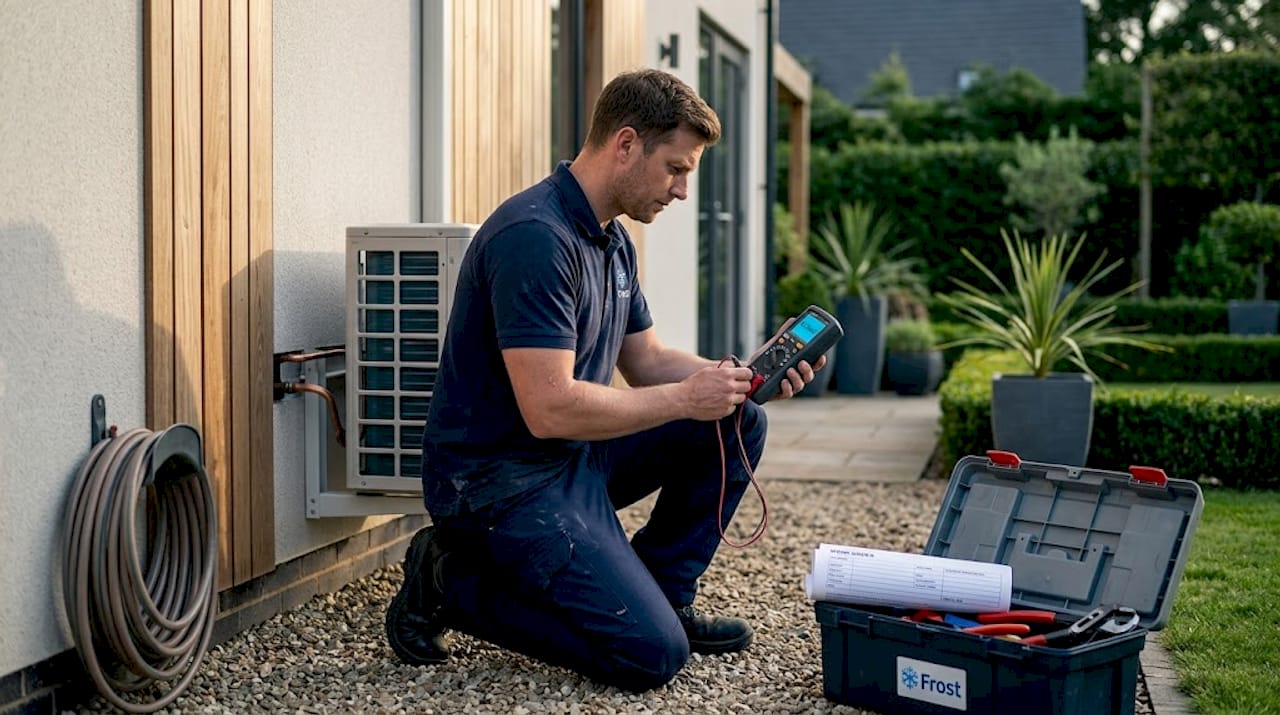
Nearly 70% of households in some regions now have AC, with heat pumps growing as a share of that total. In the UK context, this matters because a single unit replaces both the air conditioner and a significant portion of your heating load. For a South West property that needs cooling in summer and heating in the shoulder seasons, the case for a heat pump over a cooling-only unit is compelling.
Modern air source heat pumps operate efficiently down to outdoor temperatures of around minus 15°C, which is well below anything Exeter or the South West typically experiences. The concern that heat pumps struggle in cold climates simply does not apply to most of the UK.
For developers: specifying heat pumps in new builds supports compliance with Part L of the Building Regulations and aligns with Future Homes Standard requirements. It also makes the properties more attractive to buyers who are increasingly energy-conscious.
4. Emerging refrigerants and solid-state cooling
One of the more striking future air conditioning technology developments involves getting rid of refrigerant gases altogether. Barocal is developing solid-state refrigerants based on plastic crystal materials that use the barocaloric effect, generating cooling through pressure changes rather than vapour compression cycles. The potential reduction in greenhouse gas emissions is significant, and the technology is progressing beyond the laboratory stage.
In parallel, sorption-driven dissolution refrigeration with integrated thermal storage has demonstrated cooling capacities reaching minus 25.4°C using medium or low-grade heat sources. This approach is particularly interesting for developments with solar thermal collectors, where waste heat can drive the cooling process directly.
These are not systems you will be buying off the shelf today, but they are relevant for anyone specifying a major development with a ten to fifteen year horizon. By the time you are planning your next project, at least one of these technologies will likely be commercially available in a form suitable for residential use.
For everyday 2026 purchases, the practical shift is towards lower-GWP refrigerants like R-32 and R-454B. These are widely available now, perform excellently, and position you well ahead of the regulatory changes coming to high-GWP refrigerants.
5. Comparing the top AC system types for 2026
Understanding the options side by side helps enormously when you are weighing up a decision. Here is how the main system types compare on the factors that matter most to homeowners and developers this year.
| System type | Efficiency | Upfront cost | Best suited to | Environmental impact |
|---|---|---|---|---|
| Traditional central AC | Moderate | Moderate | Larger homes with existing ductwork | Higher (R-410A common) |
| Ductless mini-split | High | Low to moderate | Retrofits, room-by-room control | Moderate to low |
| Air source heat pump | Very high | Moderate to high | Whole-property heating and cooling | Low |
| Smart-enabled unit | Varies by base system | Moderate premium | Any property with grid or solar integration | Depends on refrigerant |
| Emerging solid-state | Very high (projected) | High (currently) | Future developments | Very low |
Ductless mini-splits remain the go-to recommendation for most South West homes that are retrofitting. They do not require ductwork, they allow independent zone control for different rooms, and they are available with R-32 refrigerant as standard from most reputable manufacturers.
Pro Tip: When comparing quotes for different system types, always ask suppliers to provide the EER2 figure for each unit, not just the output capacity. Two systems with identical output can have very different running costs depending on their efficiency rating.
For a full comparison of your real options in a residential context, the home air conditioning guide is worth reading before you commit.
6. Practical steps for choosing and maintaining your 2026 system
Once you have a shortlist of system types, translating that into a sound purchase and long-term performance requires a few specific steps.
-
Get a proper load calculation done. Do not accept a sizing recommendation based only on floor area. A credible installer will account for insulation, glazing, room orientation, and occupancy. Correct sizing is the single biggest factor in whether your system delivers on its promises.
-
Specify R-32 or R-454B as a minimum. If a quote is based on an R-410A unit, ask for an equivalent R-32 model. The performance is comparable and you avoid a future refrigerant swap.
-
Install a smart thermostat at the same time. Adding one retroactively costs more and is sometimes awkward with certain systems. Demand-responsive controls are increasingly important as grid peaks arrive unpredictably.
-
Set a maintenance schedule. Filter cleaning monthly during heavy use, a professional service check annually. A well-maintained system running at full efficiency uses measurably less energy than a neglected one. Read the maintenance tips to build a practical routine.
-
Understand your refrigerant regulations. F-Gas regulations in the UK are tightening. Any engineer working on your system must hold a valid F-Gas certificate. Check this before work begins.
-
Plan for future-proofing. Global AC energy demand is rising alongside incomes and longer heatwave seasons. A system installed today should be able to run efficiently in conditions 10% to 15% warmer than today's average summer.
My honest view on the 2026 AC market
I have been involved in AC installations across the South West for long enough to see a pattern. The clients who end up happiest are not the ones who bought the most advanced system. They are the ones who got the sizing right.
In my experience, the biggest mistake I see is developers or homeowners specifying a unit based on maximum output, thinking bigger means safer. What it usually means is a system that short-cycles, fails to dehumidify properly, and delivers a cold, clammy room rather than genuine comfort.
I am genuinely excited about where solid-state cooling technology is heading. But I would caution anyone against waiting for it when their current system needs replacing. The best AC systems for 2026 available right now, correctly sized and paired with smart controls, will outperform an oversized future-tech unit every time.
The demand management piece is underappreciated too. We are seeing heat events earlier in the calendar year than we used to, and unexpected peak demand is becoming a real grid challenge. A system that can respond intelligently to those peaks is not a luxury. It is sensible risk management for any property.
My advice: invest in getting the specification right, use current best-in-class refrigerants, and add smart controls from day one. The technology will keep improving, but those fundamentals will serve you well regardless of what comes next.
— James
How Frostairconditioning can help you get it right
If the range of options feels like a lot to navigate, that is where working with the right installer makes all the difference.

Frostairconditioning is based in Exeter and covers the whole of the South West, with F-Gas certified engineers who understand both the technical standards and the practical realities of cooling homes in this region. Whether you are a homeowner looking to install a single room unit or a developer specifying systems for multiple properties, the team offers same-day installs where possible and 0% finance options to spread the cost.
Frostairconditioning works with systems that meet current refrigerant regulations and efficiency standards, and can advise on smart control integration for new builds and retrofit projects. Visit Frostairconditioning to discuss your project and get a sizing assessment before you commit to any system.
FAQ
What are the biggest air conditioning trends in 2026?
The major trends are heat pump adoption, smart demand-responsive controls, and the shift to lower-GWP refrigerants such as R-32 and R-454B. Solid-state cooling is emerging as a future technology but is not yet widely available for residential purchase.
Is a heat pump better than a standard air conditioner in 2026?
For most UK homes, yes. A heat pump provides both cooling and heating from one unit at significantly higher efficiency than a cooling-only system, and it aligns with current and upcoming UK building regulations.
How important is EER2 when comparing AC units?
Very. The EER2 rating has been the standardised efficiency metric since 2023, and it is the only reliable way to compare running costs across different systems. Older EER figures are not directly equivalent and should not be used for project estimates.
Can my air conditioner be too large for my home?
Yes, and it is a common problem. Oversized units short-cycle and fail to dehumidify properly, leaving rooms feeling cool but damp. Always get a proper load calculation before purchasing.
What refrigerant should I look for in a new AC system?
Look for systems using R-32 or R-454B, both of which have a much lower global warming potential than R-410A. These are widely available, perform well, and are positioned ahead of future UK refrigerant regulations.