
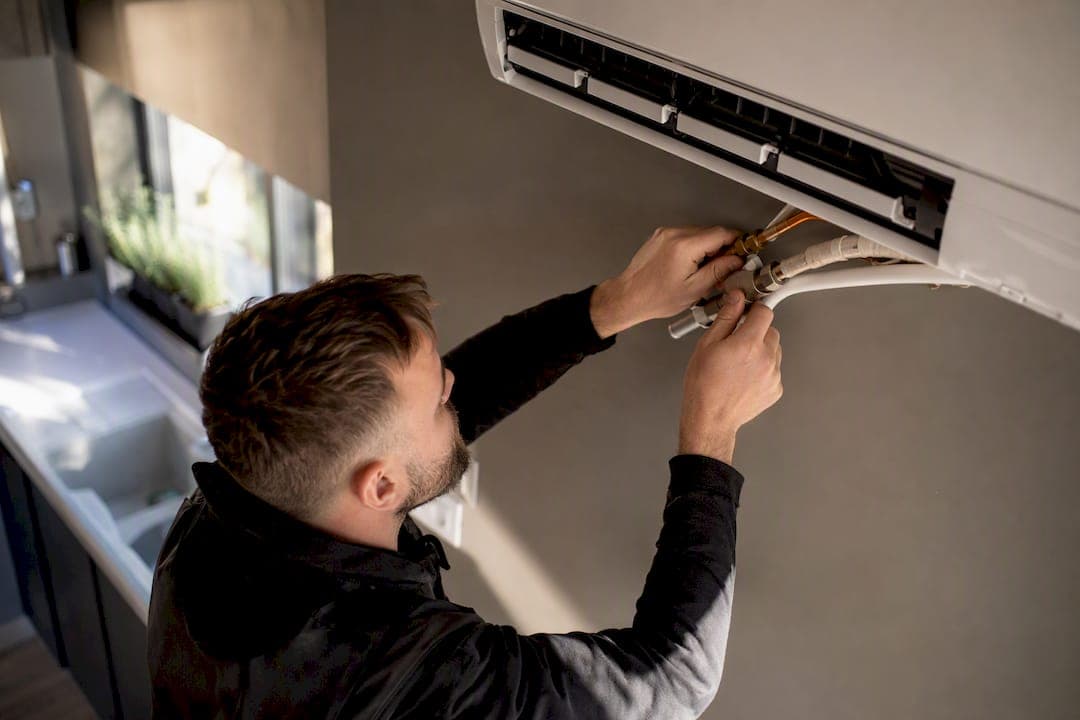
Reverse cycle air conditioning, properly called an air to air heat pump, heats UK homes efficiently and is genuinely one of the cheapest ways to warm a room. It moves roughly multiple units of heat into your home for every unit of electricity it consumes. The catch is that most systems don't produce hot water, so they work best as supplemental heating for the rooms you actually live in, not a wholesale replacement for your boiler.
TL;DR:
- Air to air heat pumps are most effective in small homes or flats, especially in the rooms people occupy most, and less so for whole-house heating without hot water.
- Installation costs vary from a few thousand pounds for single-room setups to over £6,000 for multi-room or ducted systems, with proper sizing and siting critical for efficiency and noise control.
- Running costs are significantly lower than gas boilers, thanks to the five-to-one heat to electricity ratio, but depend on insulation, outdoor temperature, and smart controls.
- Certified installers with F-Gas and MCS certification and a proper site survey are essential to ensure system performance, safety, and adherence to regulations.
- Regular maintenance, proper siting of outdoor units, and improved home insulation maximize performance and lifespan, while the environmental impact decreases as the UK’s grid becomes greener.
Table of Contents
- How does air conditioning heat a home in the UK?
- When does it make sense to heat with air conditioning?
- What does it cost to install air conditioning heating in the UK?
- How much does it cost to run air conditioning as heating?
- Which installer certifications should you check for?
- How long do air conditioning heating systems last, and what maintenance do they need?
- Does the UK climate actually suit air conditioning for heating?
- Is air conditioning heating noisy?
- What misconceptions do people have about AC heating in the UK?
- How can you get the most efficient performance from AC heating?
- What's the environmental impact of heating with air conditioning?
- Our take on air conditioning as a UK heating solution
- Get a survey from a local, certified installer
- Sources
How does air conditioning heat a home in the UK?
An air conditioner already moves heat, it just usually moves it the wrong way for winter. Flick it into heating mode and the refrigeration cycle runs in reverse: the unit pulls latent heat out of the outside air, even when it's cold, compresses the refrigerant to raise its temperature further, and releases that heat indoors through the fan coil. It's the same principle as a fridge, just working backwards to warm your living room instead of chilling your milk.
Two distinct product types get lumped under "AC heating," and mixing them up leads to disappointment.
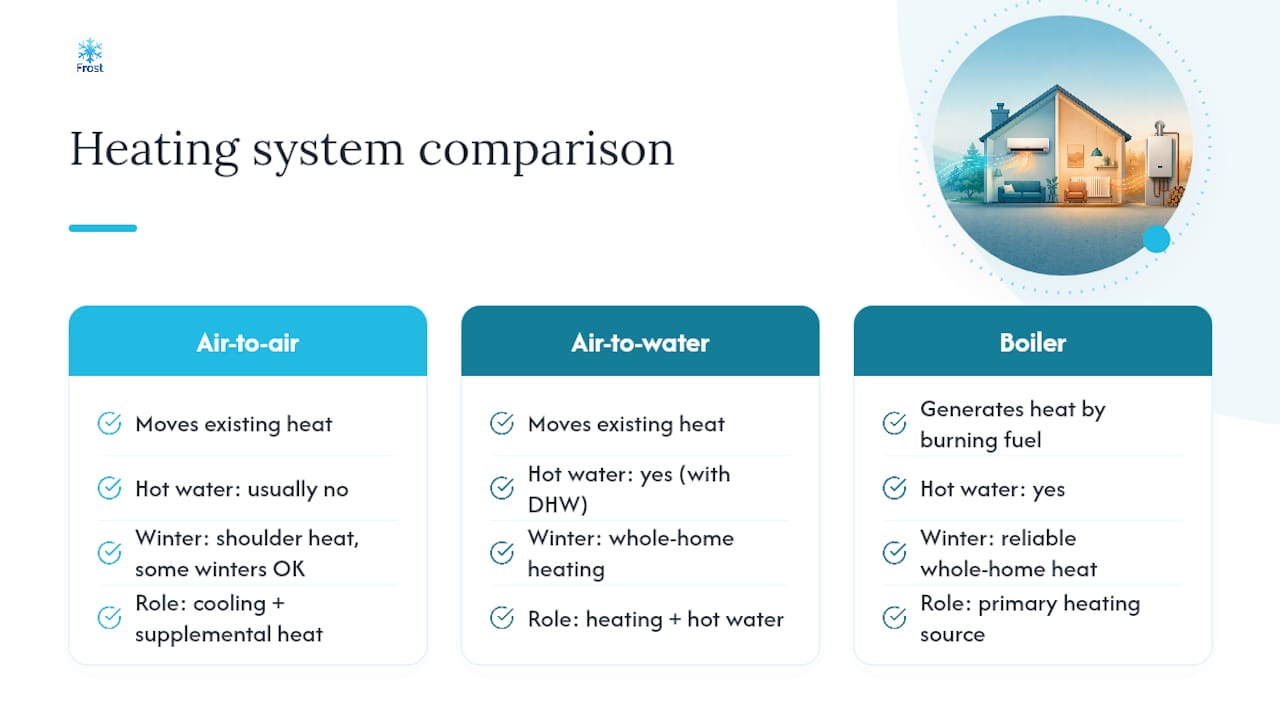
- Air to air systems heat and cool individual rooms through wall or ceiling units, similar to the split systems you've likely seen in shops and offices.
- Air to water systems feed a wet central heating circuit and hot water cylinder, effectively replacing a gas boiler across the whole house.
When comparing units, three efficiency figures actually matter. COP (Coefficient of Performance) tells you the ratio of heat output to electricity input at a single test condition. SCOP (Seasonal COP) averages that ratio across a typical UK heating season, which is far more useful for real bills. SEER measures cooling efficiency in summer. A modern air to air heat pump can deliver around 5 kW of heat for every 1 kW of electricity it uses, a ratio no gas boiler comes close to matching.
When does it make sense to heat with air conditioning?
Air to air heating shines in specific situations and struggles in others, so matching the technology to your home matters more than marketing suggests.
- Flats and smaller homes suit air to air particularly well, since one or two units can cover the whole living space without extensive pipework.
- Rooms you occupy most (a lounge, home office, or open plan kitchen diner) get the biggest return, because you're heating the space you're actually in rather than an empty hallway.
- Whole house primary heating is a harder sell unless you also have a plan for hot water, since most air to air units don't heat water for taps and showers.
- Properties without existing insulation upgrades may see disappointing results, as heat escapes faster than a single unit can replace it.
A hybrid approach works well for many households: keep your gas boiler and radiators for background heat and hot water, then use an air to air unit in the rooms where you spend most evenings. Replacing radiator use with air conditioning in your main living space can cut your reliance on the boiler considerably without ripping out your existing system. It's a low-risk way to test whether AC heating suits your lifestyle before committing to anything larger. For a broader look at how different setups fit different properties, our guide to air conditioning solutions for new builds covers integration options worth knowing about.
What does it cost to install air conditioning heating in the UK?
Budgets vary enormously depending on how many rooms you want covered and how much electrical work the job needs. A single room installation typically runs in the lower thousands of pounds, while a three bed semi with multiple rooms covered costs several thousand pounds. Larger multi-room or whole-home installs, particularly ducted systems, can exceed £6,000 once you factor in ductwork, extra electrical capacity, and more complex controls.
Homeowners who compare a £350 portable unit against a professionally installed split system are often comparing apples to oranges. Portable units retail from roughly a few hundred pounds to slightly more, but they're noisy, inefficient, and nowhere near as effective as a properly sited split system with a certified installer behind it.
A typical quote should itemise:
- The indoor and outdoor unit cost, which varies by brand and output capacity.
- Labour for mounting, pipework, and commissioning.
- Any electrical upgrades needed to support the new circuit.
- Controls, including smart thermostats or app-based scheduling.
- Refrigerant pipe capping and insulation work around the property.
The Boiler Upgrade Scheme was expanded to include air to air heat pumps, offering a grant for eligible homeowners. Eligibility rules are still bedding in, so confirm your property qualifies with a certified installer before assuming the grant applies to your quote. For a deeper cost breakdown across unit types, see our guide on whether air conditioning is expensive to run and install.
How much does it cost to run air conditioning as heating?
The 5:1 heat to electricity ratio mentioned earlier isn't a lab curiosity, it's the figure that actually shows up on your meter. A gas boiler, by contrast, rarely exceeds a 1:1 ratio of useful heat to fuel input once flue losses are accounted for. That gap is why swapping radiator use for air conditioning in your most-used room can meaningfully reduce running costs, even with electricity priced higher per unit than gas.
Your actual per-hour cost depends on three things: your electricity tariff, how well insulated the room is, and how cold it is outside, since COP drops as the outdoor temperature falls. A well-insulated lounge on a mild December evening will cost noticeably less to heat than a draughty conservatory in a January cold snap.
A few practical levers bring costs down further:
- Use smart controls to schedule heating around when rooms are actually occupied, rather than running units all day.
- Set a sensible target temperature (around 19 to 21°C) rather than cranking the thermostat higher for a faster warm-up, which wastes energy without much benefit.
- Pair the system with solar PV where you can, since summer cooling demand aligns neatly with peak solar generation, trimming your net electricity cost across the year.
Our guide on boosting air conditioning energy efficiency at home covers control settings and habits worth adopting from day one.
Which installer certifications should you check for?
Not every tradesperson who advertises "air con installed" is qualified to handle refrigerant safely or size a system correctly. Here's what to verify before booking a survey:
- F-Gas certification (often via REFCOM) confirms the engineer is legally permitted to handle refrigerant gases, a non-negotiable requirement under UK law.
- MCS certification matters specifically if you're applying for Boiler Upgrade Scheme funding, since grant eligibility is typically tied to MCS-registered installers and products.
- A proper site survey, which should cover room dimensions, where the outdoor condenser will sit, noise implications for neighbours, electrical supply capacity, and whether the installation affects the building's external appearance enough to need planning permission.
- A written, itemised quote rather than a single lump-sum figure, so you can see exactly what you're paying for.
Ask directly: which brand and model are you quoting, what's its rated SCOP, and where exactly will the outdoor unit sit? Planning permission usually isn't required if the installation doesn't materially change how the property looks from outside, but a good installer should still confirm that with you rather than assume it.
Pro Tip: If a quote arrives suspiciously cheap and doesn't mention unit output in kW or list a specific model number, treat it as underspecced. A vague quote usually means the installer hasn't actually sized the system to your room, which leads to poor performance and higher bills later.
How long do air conditioning heating systems last, and what maintenance do they need?
A well-installed split system typically lasts 12 to 15 years, though that range shrinks fast if the outdoor unit is poorly sited (jammed against a wall with no airflow, for instance) or if maintenance gets skipped for years at a stretch.
Annual servicing should cover:
- Cleaning or replacing filters, since blocked filters force the unit to work harder for less output.
- Checking refrigerant levels and looking for leaks, which quietly tank efficiency long before the system fails outright.
- Inspecting the outdoor condenser for debris, corrosion, or obstructed airflow.
- Testing controls and sensors to confirm the unit is actually hitting its target temperature efficiently.
If you notice rising bills without any change in usage, uneven heating between rooms, or a unit that's suddenly noisier than usual, those are signs worth booking a service call for rather than waiting for a full breakdown.
Does the UK climate actually suit air conditioning for heating?
This is where a lot of scepticism about AC heating in Britain comes from, and it's a fair question. Heat pump technology, including the air to air kind, does lose some efficiency as outdoor temperatures drop, because there's simply less ambient heat in the air to extract. A unit rated at a 5:1 ratio on a mild fifteen degree autumn day won't hit quite the same figure during a hard frost.
That said, the UK's climate is milder than many homeowners assume. Genuinely severe cold snaps, the kind that would seriously challenge a heat pump's performance, are relatively rare and short-lived across most of England and Wales. Average winter temperatures across the South West, where Frostairconditioning operates, rarely drop far below freezing for extended periods, which keeps SCOP figures respectable across a typical heating season.
The bigger climate factor isn't temperature extremes, it's humidity and insulation. Poorly insulated homes lose heat faster than any heating system, air conditioning included, can comfortably replace it, which is why pairing AC heating with decent loft and wall insulation matters more than obsessing over a cold week in February. A property with reasonable insulation and an air to air unit sized correctly for the room will perform reliably through a normal UK winter. One struggling to hold heat at all will disappoint regardless of what's heating it.
Is air conditioning heating noisy?
Modern split system indoor units are genuinely quiet in normal operation, typically producing noise levels comparable to a quiet conversation or less, especially on lower fan settings. Most homeowners report the indoor unit is far less intrusive than they expected, often quieter than an old style storage heater clicking as it cools.
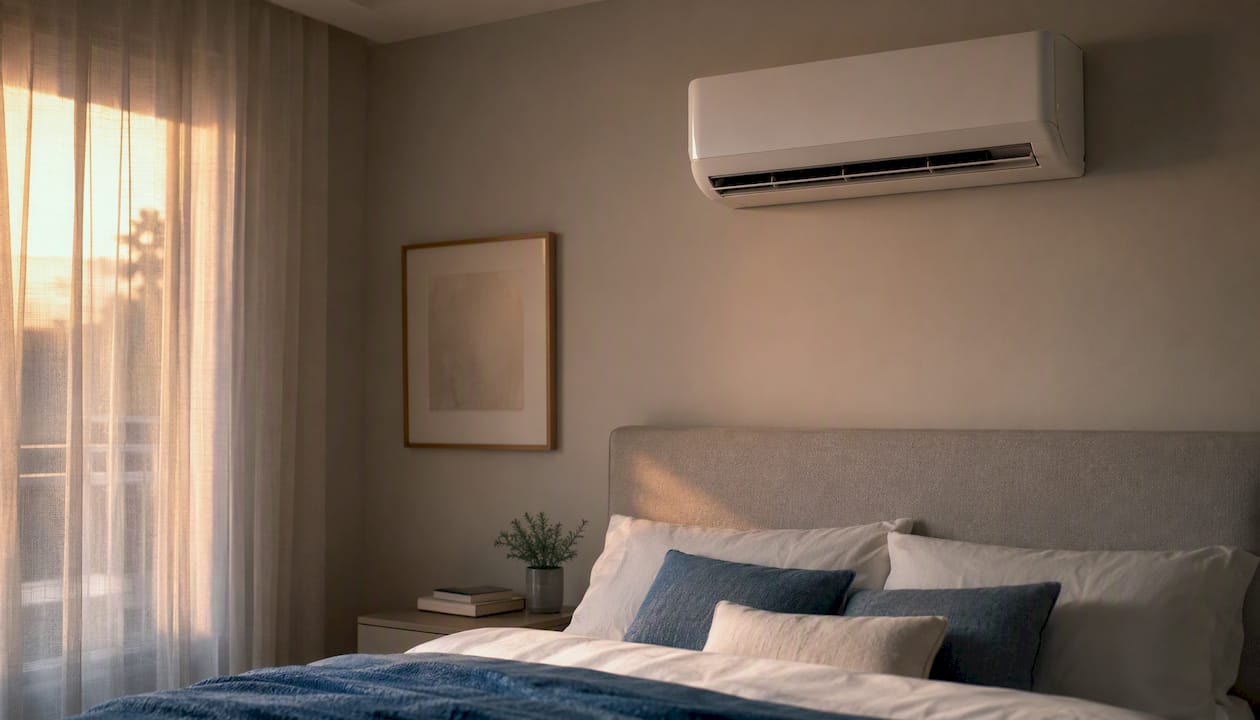
The outdoor condenser is where noise complaints tend to originate, and it's almost always down to poor siting rather than a flaw in the technology itself. A unit mounted too close to a bedroom window, or fixed to a wall in a way that transmits vibration into the building structure, will be noticeably more disruptive than one properly positioned on a bracket away from living spaces. This is precisely why correct siting of the outdoor unit is considered one of the biggest factors in overall homeowner satisfaction with these systems.
Neighbours can also be affected if the outdoor unit sits close to a boundary fence, so a good installer will factor that into the survey rather than leaving you to find out after the fact. If you're in a terrace or semi-detached property, raise this directly during your site visit. Asking an installer to walk you through expected decibel levels and unit placement before work starts avoids most noise complaints that crop up after installation, and it costs nothing to ask.
What misconceptions do people have about AC heating in the UK?
The biggest misconception is that air conditioning "isn't real heating," as if it's some inferior stopgap compared to a boiler. In practice, the physics work in its favour: moving existing heat is inherently more efficient than generating new heat by burning fuel, which is exactly why the running cost comparisons favour AC heating so heavily.
A second common mix-up is assuming any air conditioning unit will also heat your water. As covered earlier, most air to air systems don't provide hot water at all, and homeowners who install one expecting to ditch their boiler entirely are usually disappointed. If heating and hot water from a single system is the goal, an air to water heat pump is the correct product, and it typically involves a different installation process and a separate grant pathway.
There's also a persistent belief that AC heating won't cope with a "proper" British winter, which the climate section above should put to rest for all but the most exposed or poorly insulated properties. And some homeowners assume that because a unit is cheap to buy, it'll be cheap to run. That's backwards. A cheap, undersized unit works harder and less efficiently, often costing more over a winter than a correctly sized system from a reputable installer would have. As one industry view puts it, air to air units are best understood as covering summer cooling plus shoulder season heating, while air to water heat pumps handle whole home heating and hot water, and plenty of homes end up using both technologies to cover every base.
How can you get the most efficient performance from AC heating?
Getting genuinely low running costs out of an air to air system isn't about the unit alone, it's about how you use it and what surrounds it.
Set a consistent, moderate temperature rather than switching the system on and off dramatically, since heat pumps generally perform better maintaining a steady state than repeatedly ramping from cold. Clean or replace filters regularly, since a clogged filter forces the fan to work harder for the same output, quietly inflating your electricity use.
Improving your home's fabric pays off more than any control tweak. Draught-proofing, loft insulation, and decent curtains all reduce the heat loss your AC unit has to fight against, and small efficiency upgrades around the home compound with a heat pump's existing efficiency advantage rather than working against it. Use zone controls to heat only occupied rooms, since running a unit in an empty bedroom all day is pure waste regardless of how efficient the technology is. Finally, get your unit serviced annually. A neglected system with low refrigerant or a dirty coil will quietly underperform for months before anyone notices the bill creeping up.
What's the environmental impact of heating with air conditioning?
Because heat pump technology moves heat rather than generating it by combustion, air to air systems produce no direct carbon emissions at the point of use, unlike a gas boiler burning fossil fuel in your home. The emissions that do exist come from generating the electricity that powers the unit, and as the UK's grid continues shifting toward renewable generation, the carbon footprint of running an air to air system keeps falling year on year without you having to do anything differently.
The 5:1 efficiency ratio matters here too, not just for your wallet but for your carbon footprint. Using a fifth of the energy to produce the same heat output means a fraction of the associated emissions compared with resistive electric heating, and a meaningfully smaller footprint than gas in most grid scenarios.
There's a refrigerant consideration worth knowing about as well. Modern systems use F-Gas refrigerants, which is precisely why installers handling them must hold F-Gas certification, since these substances can have a high global warming potential if they leak into the atmosphere. A properly installed and maintained system, checked annually for leaks, keeps that risk minimal. It's another reason hiring a certified engineer isn't just about compliance, it's about genuinely lowering the environmental impact of your heating choice over the system's lifetime.
Our take on air conditioning as a UK heating solution
The conventional wisdom that air conditioning is a "summer only" purchase is outdated, and frankly it costs homeowners money every winter it persists. The efficiency numbers aren't close: a heat pump moving five units of heat per unit of electricity beats a gas boiler on pure physics, not marketing spin. What's often missing from that conversation is honesty about scope. Air to air heating is brilliant for the rooms you live in. It is not, in most homes, a wholesale boiler replacement, and any installer who tells you otherwise without mentioning hot water is doing you a disservice.
The Boiler Upgrade Scheme expansion is a genuine turning point, but grant rules shift, and eligibility isn't guaranteed just because you've read about the £2,500 figure online. What actually determines whether you're happy with the system in three years' time isn't the brand on the indoor unit, it's whether the installer sized the room correctly and sited the outdoor condenser sensibly. That's a survey problem, not a spec sheet problem, and it's worth choosing an installer on that basis rather than price alone.
For readers weighing this up, request a proper site survey, get eligibility confirmed in writing before you budget around a grant, and ask pointed questions about siting and noise before signing anything. If you want a deeper dive into system types before that survey, our complete UK buying guide is a sensible starting point.
— James
Get a survey from a local, certified installer
If you've read this far, you're likely weighing up whether AC heating is worth it for your specific home, not just the technology in general.

That local presence matters more than it sounds. A South West based team knows the housing stock, from Victorian terraces in Exeter to newer builds further along the coast, and can advise honestly on whether your property suits an air to air system, needs a hybrid setup alongside your existing boiler, or would benefit more from an air to water solution. Frostairconditioning fits premium systems from Samsung, Mitsubishi, Toshiba, and Daikin, so you're not locked into a single brand regardless of what your home actually needs. If you're running a commercial premises, our shop fitting service covers that side of the business too. Once you've got a system installed, ongoing service and maintenance keeps it running at its rated efficiency for years rather than months.
The next step is straightforward: book a domestic installation survey or request a quote directly, and get a proper answer on cost, grant eligibility, and system sizing for your specific home before you commit to anything.
Sources
- Replacing radiators with air conditioners for home heating | Daikin
- Air-to-air heat pumps | Energy Saving Trust
- How can you get air conditioning in your home and how much does it cost? | BBC