

Yes, for most commercial premises with mounted split or multi-split systems, an aircon maintenance contract earns its cost, but not automatically for every site. If your systems run cooling-critical processes, sit under warranty conditions, or you can't afford unplanned downtime, a contract is the right call. If you're running a single domestic-style unit in a low-traffic back office, a one-off annual checkup might suffice.
The strongest immediate benefit is priority response paired with compliance evidence. Anyone managing server rooms, retail floors, kitchens, or multi-tenant buildings needs the F-Gas paper trail a contract generates as much as the callout speed.
Your next move, before comparing prices, is straightforward:
- Request a site survey so any quote reflects your actual unit count and access constraints, rather than guesswork.
- Ask for a written scope of works listing exactly which visits, parts, and response times are included.
- Demand evidence of F-Gas certification and REFCOM registration for the engineers who'll be on your roof or in your plant room.
Key Takeaways
An aircon maintenance contract works best when its scope is itemised, its exclusions are explicit, and its response times are contractually guaranteed rather than implied.
| Point | Details |
|---|---|
| Get evidence before signing | Insist on F-Gas and REFCOM certification proof, not just a verbal assurance. |
| Match frequency to usage | Quarterly suits critical or high-use systems; biannual or annual fits standard offices. |
| Compare exposure, not just price | Weigh the annual fee against likely repair costs on excluded major components. |
| Demand paperwork every visit | A written engineer report and F-Gas log entry should follow every planned visit. |
| Frost Air Conditioning offers verified cover | Frostairconditioning provides REFCOM/F-Gas certified engineers, planned visits, priority response, and 0% finance for South West businesses. |
Table of Contents
- What is an aircon maintenance contract and what does it cover for businesses?
- What does a typical aircon maintenance contract include?
- How often should a commercial aircon system be serviced?
- How much does an aircon maintenance contract cost?
- How do you choose the right aircon maintenance contract?
- What UK facility managers get wrong about maintenance contracts
- Frost Air Conditioning's approach to commercial maintenance contracts
- Frequently asked questions
- Sources
What is an aircon maintenance contract and what does it cover for businesses?
An air conditioning maintenance contract is a fixed-term agreement between a business and a servicing company that guarantees a set number of planned visits, defined response times, and (usually) some level of parts cover, in exchange for a regular fee. Think of it as the commercial equivalent of a car service plan: you're not just buying labour, you're buying predictability.
For UK business owners, that predictability shows up in four concrete ways.
- Priority response cuts disruption. A contracted client typically jumps the queue ahead of one-off callers when a unit fails, which matters enormously if you're running a server room, a commercial kitchen, or a retail floor on a hot Saturday.
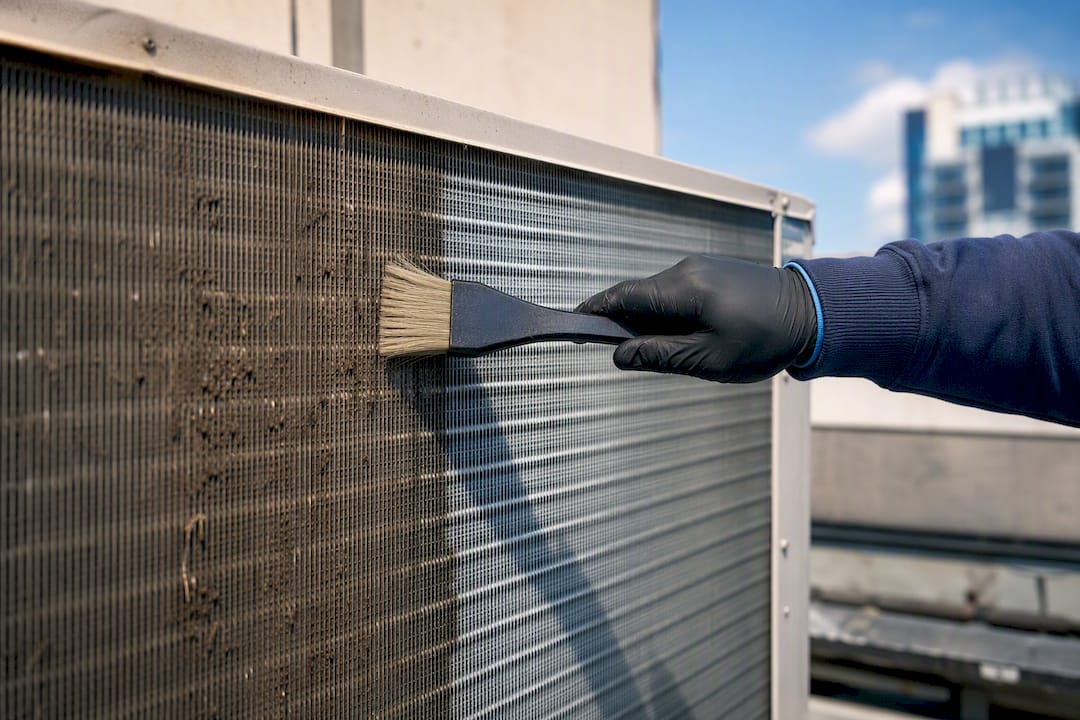
- Routine servicing keeps energy bills down. A clogged filter or a coil caked in dust forces a compressor to work harder for the same output, and that inefficiency compounds month on month until someone notices the bill.
- Regular checks protect the equipment's working life. Manufacturers like Samsung, Mitsubishi, Toshiba, and Daikin design their systems around scheduled maintenance, and warranty terms often assume it's happening.
- Documentation supports insurance and audits. When an insurer or an auditor asks for proof that your cooling systems were properly maintained, a stack of dated service reports answers the question in seconds.
Preventative maintenance consistently outperforms reactive repair for uptime and running costs, according to industry analysis on HVAC service contracts. That's not a controversial claim in the trade. The businesses that skip planned visits tend to be the ones calling engineers out in July, paying emergency rates, and losing a day of trading while a part gets sourced.
Budget certainty matters here too. A contract converts an unpredictable repair bill into a known annual line item, which is a genuinely useful thing to hand your finance team at year-end. It won't eliminate every surprise repair, since major component failure usually sits outside standard cover, but it flattens the curve considerably.
What does a typical aircon maintenance contract include?
Contracts vary more than most buyers expect, and the gap between a decent one and a thin one is usually hidden in the small print rather than the headline price. Here's what a properly structured planned visit should cover.
- Filter cleaning or replacement, since a blocked filter is the single most common cause of poor airflow.
- Coil inspection where physically accessible, checking for dirt build-up or corrosion that reduces heat exchange.
- Condensate drain clearing, because a blocked drain is what causes those unexplained ceiling stains in offices.
- Electrical and controls check, covering wiring integrity, thermostat calibration, and safety cut-outs.
- Refrigerant leak detection, which matters both for performance and for F-Gas compliance reporting.
Every visit should generate a written report and feed into an F-Gas log for the site, an inventory of findings that shows what was checked, what was found, and what (if anything) needs following up. A service agreement template used across the HVAC trade typically defines preventive visit contents in exactly this format, and you should expect nothing less from a UK supplier.
Where contracts genuinely diverge is parts cover. You'll usually see three structures on offer:
- Labour-only: visits and diagnostics included, but every part is charged separately.
- Labour plus selected parts: consumables like filters and minor components covered, bigger items charged.
- Labour plus parts with caps: a defined allowance per year, after which you pay the difference.
Out-of-hours and emergency terms also need scrutiny. Ask what counts as "priority" (same day? Four hours? Next business day?) and whether a diagnostic or travel fee applies even when the fault turns out to be minor.
Pro Tip: Get the exclusions list in writing before you sign, not just the inclusions. Major component replacement, deep coil cleaning beyond a basic wipe-down, and consumables beyond the first filter change are the three items most commonly excluded, and the three that cause the most disputes later.
How often should a commercial aircon system be serviced?
Most commercial air conditioning systems in the UK need servicing every three to six months, with the exact interval driven by usage intensity, occupancy levels, and how demanding the operating environment is, according to industry guidance on servicing frequency. That's a wider range than most people assume, and the right answer for your business depends on what the units are actually doing.
- Quarterly servicing suits high-use or business-critical systems: server rooms, commercial kitchens, retail units with constant footfall, or any site where a failure stops trading.
- Biannual servicing fits typical office environments running standard hours, five days a week, without extreme heat loads.
- Annual servicing can work for low-use spaces, storage areas, or systems that run only seasonally.
Frequency and compliance sit closer together than most buyers realise. F-Gas regulations require certified engineers to carry out leak checks at intervals tied to the refrigerant charge size in a system, and REFCOM registration is the industry's way of proving an engineer holds the right qualifications to do that work legally. Insist on seeing that certification before anyone touches your plant, not after.
Insist on three pieces of paperwork from every visit: an updated F-Gas log entry, a written engineer report with findings and recommendations, and a copy stored against the site (not just emailed and forgotten). If you ever need to check a building's broader energy and compliance history, the government's Find an energy certificate service is a useful cross-reference point.

Warranty and insurance terms increasingly assume this cadence. Manufacturers can, and do, refuse warranty claims where a business can't produce evidence of scheduled maintenance, and some commercial insurers now ask the same question after a cooling-related claim.
How much does an aircon maintenance contract cost?
Pricing for commercial contracts is structured in a handful of common ways, and understanding the model matters as much as the headline number. You'll typically encounter a per-unit annual fee, a tiered package (often labelled something like gold, silver, or bronze), straight per-visit charging, or a monthly payment spread across the year.
Tiered contracts are widespread in the trade, with visit frequency, reporting depth, and response priority all varying by tier, as seen in commercial maintenance packages offered across the UK, such as those structured by region. The trap here is buying a tier by name rather than by deliverable. "Gold" means whatever the supplier decides it means unless you make them spell it out.
As a rough steer, independent air conditioning engineers in the UK charge between £30 and £60 per hour for servicing or regassing work, according to cost data from Checkatrade, though a full commercial contract's total cost depends heavily on unit count, site complexity, and access difficulty. A single small commercial unit on an easy-access wall bracket costs far less to maintain than a multi-unit VRF system serving several floors.
What pushes the price up:
- Parts inclusion, especially anything beyond basic filters and consumables.
- Faster SLA commitments, since guaranteeing a four-hour emergency response costs the supplier more to staff than a next-day promise.
- Visit frequency, with quarterly contracts naturally costing more than annual ones.
- Multi-site coverage, which adds travel and scheduling overhead even at volume discount rates.
The comparison that actually matters isn't "which quote is cheapest" but annual fee versus per-visit cost plus your likely repair exposure. A cheap contract that excludes every part that commonly fails isn't really cheap, it's just deferring the cost to the moment something breaks. Consumer analysis of HVAC service contracts has flagged this pattern repeatedly: the priciest agreements often still exclude major component replacement, which means you're paying for peace of mind you don't fully have. Read the caps and exclusions before you read the price.
How do you choose the right aircon maintenance contract?
Vendor meetings go better when you arrive with specific questions rather than a general sense you should "get some quotes." Here's the checklist worth working through before you sign anything.
- What's your guaranteed response time, and does it change out of hours? Get a number, not a description like "prompt" or "as soon as possible."
- What exactly is covered under parts, and what's capped or excluded? Ask for the exclusions list specifically, not just the headline inclusions.
- Can you show me F-Gas and REFCOM certification for the engineers who'll attend my site? Any reputable supplier will produce this without hesitation.
- Can I see a sample service report from an existing client? This tells you more about the quality of documentation than any brochure will.
- What are your insurance limits for liability and property damage? Especially relevant if the units sit above trading floors or stock.
Legal guidance for UK businesses is consistent on one point: clarify parts cover, refrigerant top-ups, and emergency response times before signing, because these are exactly where disputes surface after a system fails, according to contract guidance for UK businesses. Push for those tiered offers to be converted into exact deliverables too: how many filter changes per year, which reports you'll receive, and what response time is contractually guaranteed rather than aspirational.
Watch for these red flags:
- Vague exclusion wording ("major components" without a defined list).
- Automatic renewal clauses with no advance notice window.
- Unclear or steep cancellation fees buried in a contract's later clauses.
- No sample reports or references available on request.
Pro Tip: Negotiate a trial period, even a single quarter, before committing to a multi-year term. A supplier confident in their service quality won't object, and it gives you a genuine test of response times and report quality before you're locked into anything longer.
Push for itemised pricing rather than a bundled figure, and ask whether basic consumables (filters, minor fixings) are genuinely included or quietly re-charged per visit.
What UK facility managers get wrong about maintenance contracts
The conventional advice treats contracts as a binary: get one, tick the box, move on. That undersells how much the value swings on scope, not signature. Two businesses can pay near-identical annual fees and end up with wildly different outcomes, one with a genuinely protective agreement, the other with a document that mostly protects the supplier.
Where the standard advice falls shortest is on exclusions. Most guides tell you to "check what's covered" and leave it there. The sharper question is what's excluded, because that's where the financial exposure actually sits. A contract that covers filters and basic diagnostics but excludes compressor failure isn't offering much protection on the one component most likely to bankrupt your repair budget.
If there's one thing worth prioritising above price, it's evidence. Certification, sample reports, and a clearly itemised scope tell you more about a supplier's reliability than any tier name ever will. Facility managers who ask for proof before signing tend to have far fewer surprises at renewal time than those who ask for a quote and assume the rest.
Frost Air Conditioning's approach to commercial maintenance contracts
Frostairconditioning runs maintenance contracts the way this article suggests you should evaluate them: with certification you can verify, response times you can pin down, and paperwork that actually turns up.
Every engineer working under a Frostairconditioning contract holds F-Gas and REFCOM certification, and that evidence is available before you sign, not after something goes wrong. Contracts are built around planned visits scheduled to your site's actual usage pattern rather than a generic tier, with each visit producing a written report and an F-Gas log entry you keep on file. Priority response is built into the agreement, so contracted clients aren't waiting behind one-off callers during a heatwave. For businesses installing new systems or refitting a shop unit, 0% finance is available, which helps spread the cost of getting a site properly set up before the maintenance schedule even begins.
If you're weighing up a first contract or reviewing one due for renewal, the practical next step is a site survey and written scope tailored to your unit count and access. You can also request a quote directly and get a bespoke figure rather than guessing from a generic price list.
Frequently asked questions
Is an aircon maintenance contract worth it for a small business? If your business relies on cooling for trading, storage, or customer comfort, yes. A single small unit in a low-traffic space might get by on an annual checkup instead, but anything customer-facing benefits from the priority response a contract provides.
What's the difference between an aircon service plan and a one-off service? A one-off service is a single visit with no ongoing commitment or guaranteed response time. An air conditioning service plan locks in a set number of visits per year, defined response times, and usually some parts cover, all for a fixed recurring fee.
How much does a commercial aircon maintenance contract cost in the UK? Costs vary by unit count, system complexity, and coverage level, with independent engineers charging £30 to £60 per hour for standalone servicing work. A full contract's annual cost depends on how many units are covered and how comprehensive the parts cover is.
Can I cancel an aircon maintenance contract early? Most contracts include a notice period and may charge an early termination fee, so check the cancellation clause before signing. Avoid any agreement with vague or undefined cancellation costs.
Does a maintenance contract affect my equipment's warranty? Often, yes. Many manufacturers, including Samsung, Mitsubishi, Toshiba, and Daikin, expect documented scheduled maintenance as a condition of warranty validity, so keeping your service reports on file matters beyond day-to-day running costs.