

Sizing an air conditioner is the process of matching a unit's cooling capacity to the specific heat load of your home, so it runs efficiently without wasting energy or leaving you in a clammy, uncomfortable room. The standard unit of measurement is the BTU (British Thermal Unit), and 12,000 BTU equals one ton of cooling capacity. Get the size wrong and you will either overspend on running costs or find the unit struggling to cope on the hottest days. This guide covers the key factors, the calculation methods, and the mistakes to avoid, with a focus on UK homes and the specific conditions they present.
How to size an air conditioner: the key factors beyond floor area
Floor area is the starting point for any air conditioner sizing guide, but it accounts for only 60 to 70% of actual cooling load. The remaining 30 to 40% comes from variables that most online calculators either underweight or ignore entirely. Two identical terraced houses on the same street can require meaningfully different unit sizes depending on how they are built, occupied, and oriented.
Ceiling height and room volume
Ceiling height directly affects the volume of air a unit must cool. For every extra foot above 8 feet, cooling load increases by approximately 10 to 15%. Many older UK properties, particularly Victorian and Edwardian terraces, have ceiling heights of 9 to 10 feet, which means a straightforward square footage calculation will underestimate the true load.

Insulation, windows, and solar gain
Insulation quality has a direct and measurable effect on sizing. Poor insulation increases cooling requirements by 20 to 30%, while good insulation reduces them by 10 to 15%. That is a swing of up to 45% from insulation alone. South and west-facing windows compound this further. Heavy sun exposure through glazing can add 10% or more to capacity needs, which matters considerably for UK homes where south-facing rooms receive the most solar gain during summer afternoons.
Occupants and internal heat sources
People and appliances generate heat that the air conditioner must remove. Each additional occupant beyond two adds roughly 600 BTU per hour, and heat-generating electronics contribute around 400 BTU per hour each. A gaming PC alone can add 1,500 BTU per hour of heat load. A home office with multiple monitors, a printer, and a gaming setup in a south-facing room is a very different sizing challenge from a lightly furnished bedroom.
UK climate and regional variation
The UK is not a single climate zone. A property in Exeter or Plymouth experiences meaningfully warmer summers than one in Aberdeen or Edinburgh. Local climate data is a critical variable in any accurate load calculation, because sensible and latent heat demands shift with regional design temperatures. Factors like roof colour, nearby tree shading, and local microclimates also influence load but are frequently missed in DIY estimates.
- Floor area: starting baseline, not the full picture
- Ceiling height: add 10 to 15% per foot above 8 feet
- Insulation: poor insulation adds 20 to 30% to cooling needs
- Window orientation: south and west-facing glazing increases load by 10% or more
- Occupants: 600 BTU per hour per person beyond two
- Electronics: 400 BTU per hour per device, up to 1,500 BTU for high-powered PCs
- Local climate: regional UK temperatures affect sensible and latent heat demands
Pro Tip: If your property has been recently re-insulated, had new double glazing fitted, or had a loft conversion added, do not assume the previous unit size is still correct. Upgrades change the cooling load significantly.
How do you calculate the correct air conditioner size?
The industry-standard method for residential load calculation is Manual J, developed by the Air Conditioning Contractors of America. Manual J considers wall assembly, window orientation, duct conditions, and local climate zones rather than relying on floor area alone. It is the most accurate tool available for determining what size AC your home genuinely needs, and any reputable installer should be able to produce one.
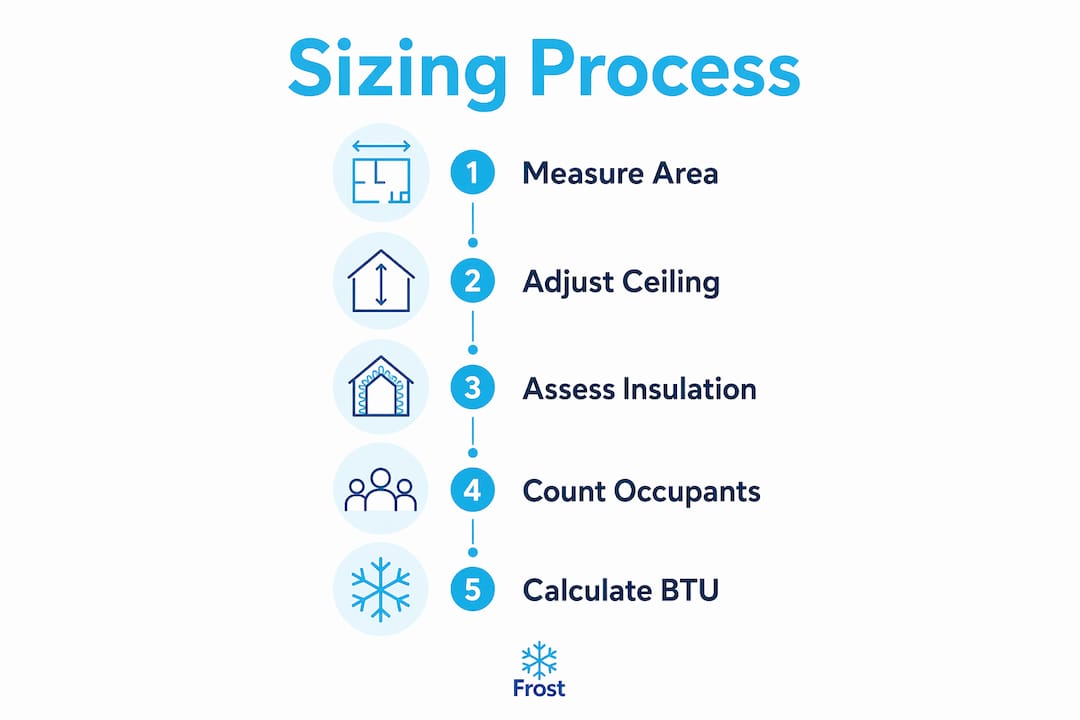
Step-by-step sizing process
- Measure your floor area in square metres and convert to square feet (multiply by 10.76). Apply the rough baseline of 20 BTU per square foot as a starting estimate.
- Adjust for ceiling height. If your ceilings exceed 8 feet, increase your estimate by 10 to 15% for each additional foot.
- Assess insulation quality. If your home has poor or no loft insulation, add 20 to 30% to your estimate. If insulation is modern and well-fitted, reduce by 10 to 15%.
- Account for windows. South or west-facing rooms with large glazed areas need an additional 10% or more added to the load.
- Count occupants and appliances. Add 600 BTU per person beyond two, and 400 BTU per significant heat-generating device.
- Apply local climate data. Use regional UK design temperatures rather than national averages. Exeter summers differ from those in Manchester.
- Verify with a professional. Use your estimate as a reference point, then ask your installer to run a full Manual J calculation to confirm.
Pro Tip: Online air conditioning size calculators can give you a useful ballpark figure before speaking to an installer. Use them to sense-check quotes, not to replace professional assessment.
The table below shows how capacity requirements shift with common UK room types.
| Room type | Approximate floor area | Estimated BTU range |
|---|---|---|
| Single bedroom | 100 to 130 sq ft | 5,000 to 7,000 BTU |
| Double bedroom | 130 to 180 sq ft | 7,000 to 9,000 BTU |
| Living room | 180 to 280 sq ft | 9,000 to 14,000 BTU |
| Open-plan kitchen/diner | 280 to 400 sq ft | 14,000 to 18,000 BTU |
| Large open-plan space | 400 sq ft and above | 18,000 BTU and above |
These figures assume average ceiling heights and moderate insulation. Adjust upward for the factors covered above. Residential central AC systems typically range from 1.5 tons to 5 tons of capacity, giving you a useful sanity check against any quote you receive.
What are the most common air conditioner sizing mistakes?
Oversizing is the single most widespread error in the UK market. A unit that is too large for the space will short-cycle, switching on and off repeatedly rather than running at a steady pace. Oversized units short-cycle and reduce dehumidification effectiveness, leaving rooms feeling cold but clammy. That combination of lower temperature and high humidity is uncomfortable and can encourage mould growth in poorly ventilated UK homes.
Undersizing creates the opposite problem. The unit runs continuously, never quite reaching the set temperature, wearing out faster and driving up electricity bills. Neither outcome is acceptable, and both are avoidable with proper calculation.
"Choosing a unit within 10% of the required capacity is often better for humidity control, encouraging longer, effective run times that remove moisture properly." Source: Precision Air
The most common mistakes to watch for include:
- Using square footage alone. Square footage accounts for only 60 to 70% of actual cooling load. Ignoring the rest guarantees an inaccurate result.
- Replacing like for like. Relying on existing unit size often repeats past mistakes. If the previous unit was incorrectly sized, copying it compounds the error. Homes also change over time with new insulation, windows, or extensions.
- Ignoring ductwork. Duct leakages can reduce delivered cooling capacity by up to 30%, sometimes requiring slightly larger equipment or duct improvements before a new unit performs correctly.
- Skipping professional verification. Fewer than 20% of HVAC contractors perform a proper Manual J calculation. Many rely on square footage or simply match the existing unit, which is how oversizing becomes the norm.
For a broader look at how to choose the right system type alongside sizing, it helps to understand what options are available before committing to a unit.
How do you verify your air conditioner is correctly sized?
Correct sizing shows up clearly in how a unit behaves day to day. A properly sized air conditioner runs in steady, consistent cycles rather than switching on and off every few minutes. Longer consistent runtimes improve indoor air quality and comfort by removing humidity gradually and maintaining an even temperature throughout the space.
Follow these steps after installation to confirm your unit is performing as expected:
- Check cycle times. A correctly sized unit should run for 15 to 20 minutes per cycle under normal conditions. Cycles shorter than 10 minutes suggest oversizing.
- Monitor humidity levels. A hygrometer is inexpensive and tells you whether the unit is removing moisture effectively. Target indoor relative humidity of 40 to 60%.
- Assess temperature consistency. The room should reach the set temperature within a reasonable time and hold it without large fluctuations.
- Request the Manual J report. Ask your installer for the full calculation document. A reputable installer will provide this without hesitation. If they cannot, that is a warning sign.
- Check ductwork and insulation. If performance falls short of expectations, have ductwork inspected for leaks before assuming the unit is undersized.
For ongoing performance, keeping filters clean and scheduling annual servicing preserves the efficiency of a correctly sized system. You can find practical guidance on improving energy efficiency once your unit is installed and running well.
Key takeaways
Accurate air conditioner sizing requires Manual J load calculation, not square footage alone, because insulation, ceiling height, window orientation, occupancy, and local UK climate together account for 30 to 40% of the true cooling load.
| Point | Details |
|---|---|
| Start with BTU per square foot | Use 20 BTU per square foot as a baseline, then adjust for all other variables. |
| Manual J is the gold standard | Request a full Manual J report from any installer before agreeing to a unit size. |
| Oversizing causes humidity problems | Short-cycling units fail to remove moisture, leaving rooms cold and clammy. |
| UK climate varies significantly | Regional design temperatures in Exeter differ from those in Manchester or Aberdeen. |
| Replacing like for like is risky | Previous unit size may have been wrong; always recalculate based on current home conditions. |
Why I think most UK homeowners are sold the wrong size unit
In my experience working with homeowners across the South West, oversizing is far more common than undersizing. Installers who skip Manual J calculations tend to round up, reasoning that a bigger unit gives the customer confidence. The result is a unit that blasts cold air for eight minutes, switches off, and leaves the room feeling damp rather than comfortable.
The UK climate makes this worse than it sounds. Our summers are humid. Dehumidification is not a secondary benefit of air conditioning here. It is often the primary reason people feel uncomfortable. A correctly sized unit running for 20 minutes removes far more moisture than an oversized unit cycling on and off every 10 minutes, even if both reach the same temperature on the thermostat.
My advice is straightforward. Ask any installer you speak to how they arrived at their sizing recommendation. If the answer is "based on the room size" or "we matched your old unit," push back. A good installer will welcome the question and walk you through their calculation. One who cannot explain their methodology is not someone you want commissioning a system that will run in your home for 15 years.
The homeowner's guide to sizing air conditioners covers what to expect from a professional sizing consultation in more detail, and it is worth reading before you take any quotes.
— James
Get the right size fitted by Frostairconditioning

Frostairconditioning is based in Exeter and covers the South West, offering domestic air conditioning installation for homeowners and renters who want the job done properly from the start. Every installation begins with a thorough assessment of your home's cooling load, not a guess based on floor area. Frostairconditioning is F-Gas certified, offers 0% finance, and can arrange same-day installs where required. If you want a unit sized correctly for your specific property, request a quote and one of the team will walk you through the calculation before any commitment is made.
FAQ
What does BTU mean in air conditioning?
BTU stands for British Thermal Unit and measures the cooling capacity of an air conditioner. 12,000 BTU equals one ton of cooling capacity, and most domestic units in the UK range from 9,000 to 24,000 BTU.
How do I calculate what size AC I need for my room?
Start with 20 BTU per square foot of floor area, then adjust upward for poor insulation, high ceilings, south-facing windows, and additional occupants or heat-generating appliances. A professional Manual J calculation gives the most accurate result.
What happens if my air conditioner is too big?
An oversized unit short-cycles, switching on and off too frequently to remove humidity effectively. This leaves rooms feeling cold but clammy and increases wear on the system over time.
How do I know if my air conditioner is correctly sized?
A correctly sized unit runs in steady cycles of 15 to 20 minutes, maintains consistent temperatures, and keeps indoor humidity between 40 and 60%. Cycles shorter than 10 minutes are a sign the unit is too large for the space.
Should I use an online air conditioning size calculator?
Online calculators provide a useful starting estimate but cannot replace a full Manual J load calculation. Use them to sense-check installer quotes, and always ask your installer to show their sizing methodology before agreeing to a unit.