

Cooling technology is defined as any system or method that removes heat from indoor spaces to maintain a safe and comfortable temperature. It does not create cold air. It transfers heat from inside your home to outside, leaving cooler air behind. Understanding this single principle makes every other aspect of cooling systems far easier to grasp, from why your unit struggles on humid days to why a poorly fitted system wastes money regardless of its efficiency rating.
What is cooling technology and how does it work?
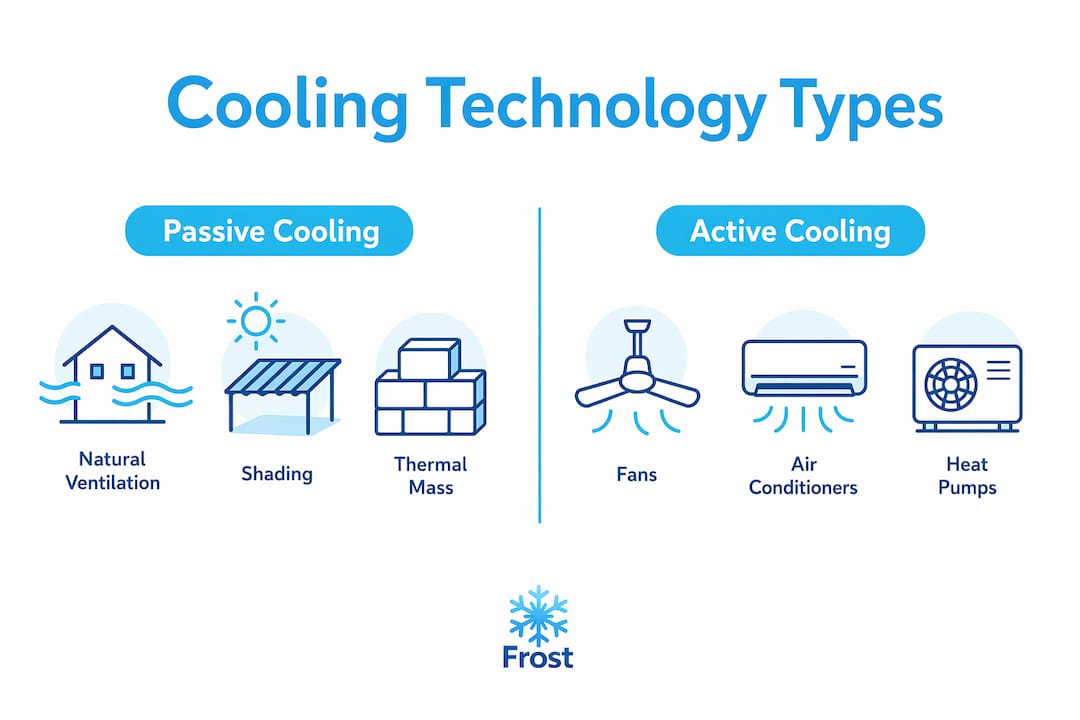
Explaining cooling technology starts with one fact: heat always moves from warmer areas to cooler ones. Every cooling system exploits this natural behaviour by creating a temperature difference that draws heat out of your living space. The two broad categories are passive cooling and active cooling methods, and understanding the difference shapes every decision you make about your home.
Passive cooling uses no external energy source. It relies on natural ventilation, shading, thermal mass, and cross-breezes to reduce indoor temperatures. Opening windows on opposite sides of a room to create airflow, fitting external blinds, or using thick stone walls that absorb heat during the day and release it at night are all passive techniques. These work well in mild climates but have clear limits when outdoor temperatures are high.
Active cooling uses external energy, typically electricity, to drive fans, compressors, or pumps that accelerate heat transfer. This category includes everything from a basic desk fan to a full central air conditioning system. The refrigeration cycle is the engine behind most active residential cooling, and it is what makes modern air conditioning so effective even in extreme heat.
What are the main types of cooling technology for homes?
Residential cooling covers a wider range of options than most homeowners realise. Choosing the right type depends on your home's layout, your climate, and your budget for both installation and running costs. The table below summarises the most common options.
| Technology | Best suited for | Key advantage | Main drawback |
|---|---|---|---|
| Natural ventilation | Mild climates, well-positioned homes | Zero running cost | Ineffective in high heat or humidity |
| Ceiling and portable fans | Supplementary cooling | Low cost, easy to install | Does not lower air temperature |
| Portable air conditioners | Renters, single rooms | No permanent installation | Less efficient, noisy |
| Ductless mini-split systems | Homes without existing ductwork | Precise room-by-room control | Higher upfront cost |
| Central air conditioning | Larger homes with existing ducts | Whole-home coverage | Requires ductwork, higher install cost |
The types of air conditioning available in the UK have expanded considerably in recent years. Ductless mini-split systems in particular have become the most practical choice for the majority of British homes, which were not built with ducted systems in mind. They allow you to cool individual rooms or zones without major building work, and modern inverter-driven models are highly efficient.
Key points to weigh when comparing options:
- Fans move air but do not reduce temperature. They make you feel cooler through evaporation from your skin, which is useful but limited.
- Portable units are accessible for tenants but typically carry lower efficiency ratings and require a window vent hose.
- Mini-splits offer the best balance of performance and installation simplicity for most UK properties.
- Central systems suit larger homes where whole-house coverage justifies the installation complexity.
How does a home cooling system actually work?
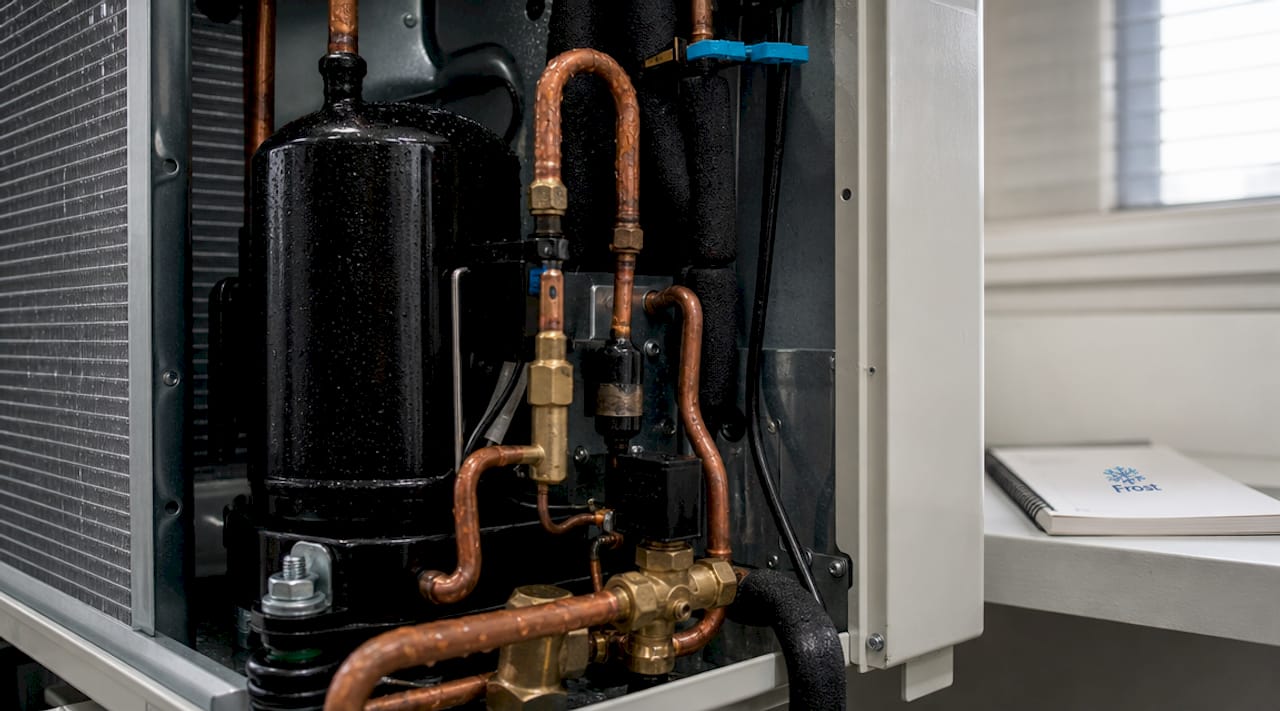
The refrigeration cycle is the core of almost every active cooling system. Heat is absorbed indoors by a refrigerant fluid passing through an evaporator coil, and that heat is then carried outside and released through a condenser coil. The cycle repeats continuously until your thermostat signals that the target temperature has been reached.
The main components work together as follows:
- Compressor: Pressurises the refrigerant, raising its temperature so it can release heat outdoors. This is the heart of the system and the component that uses the most electricity.
- Evaporator coil: Located indoors, this coil absorbs heat from your room air as warm air passes over it. The refrigerant inside evaporates and carries the heat away.
- Condenser coil: Located in the outdoor unit, this coil releases the absorbed heat into the outside air. A fan blows air across it to speed up the process.
- Air handler or blower: Circulates indoor air across the evaporator coil and distributes cooled air through your rooms.
- Thermostat: Monitors room temperature and signals the system to run or stop, keeping your home at a consistent temperature.
One aspect that surprises many homeowners is the role of humidity. Cooling systems remove two types of heat: sensible heat, which is the temperature you feel, and latent heat from moisture in the air. When warm, humid air passes over the cold evaporator coil, moisture condenses and drains away. This dehumidification is a major part of why air conditioning feels so comfortable, not just the lower temperature.
Pro Tip: If your home feels clammy even when the air conditioning is running, the system may be oversized. A unit that is too large cools the air quickly but does not run long enough to remove adequate moisture. Correct sizing matters as much as efficiency rating.
What are the benefits and trade-offs of different cooling systems?
Energy efficiency is the most discussed factor when comparing cooling technologies, and the metric used in 2026 is SEER2. SEER2 ratings reflect real-world pressure losses more accurately than the older SEER standard, with SEER2 values running approximately 4.7% lower. This means a system that looked impressive under the old rating may be slightly less impressive under the current standard. Always compare systems using the same rating scale.
Beyond efficiency numbers, practical benefits and trade-offs break down like this:
- Humidity control: Systems that run longer at lower capacity manage moisture better than oversized units that cycle on and off rapidly. Ignoring latent load in system design is one of the most common causes of persistent indoor humidity problems and mould risk.
- Installation cost: A 3-ton central AC replacement typically costs between £2,800 and £6,400 and takes roughly one day to complete. Ductless mini-splits cost more and take longer depending on the number of indoor units required.
- Running costs: Inverter-driven mini-splits adjust their output continuously rather than switching on and off at full power, which reduces electricity consumption significantly over a season.
- Lifespan: Well-maintained split systems typically last 15 to 20 years. Portable units have a shorter lifespan and higher long-term cost per year of use.
- Environmental impact: Newer refrigerants such as R-32 have a lower global warming potential than older R-410A systems. If you are replacing an older unit, ask your installer about refrigerant type.
The role of humidity in HVAC is consistently underestimated by homeowners. A system that controls temperature but not moisture will leave a room feeling uncomfortable even at 22°C. Choosing a system with adequate latent capacity for your climate is as important as choosing one with a high SEER2 rating.
How can you implement and optimise cooling technology at home?
Selecting the right system is the first step, but getting the most from it requires attention to installation quality, thermostat habits, and regular maintenance. These practical steps make a measurable difference to both comfort and running costs.
- Size the system correctly. A professional load calculation accounts for your room dimensions, insulation, window area, and local climate. Guessing based on room size alone leads to oversized or undersized units.
- Set your thermostat to around 26°C when at home. Moving from 22°C to 26°C can reduce cooling energy use by 18 to 30%. Set it higher when the property is empty.
- Check airflow regularly. Duct leakage and poor airflow distribution are among the most common causes of underperformance, even in high-rated systems. Clean or replace filters every one to three months.
- Inspect the outdoor unit. Keep the condenser coil clear of leaves, dirt, and obstructions. Restricted airflow forces the compressor to work harder and shortens its lifespan.
- Book an annual service. A qualified engineer checks refrigerant levels, electrical connections, and coil condition. Catching small issues early prevents expensive failures during the hottest weeks of the year.
Pro Tip: Combine your cooling system with external shading such as blinds or awnings on south and west-facing windows. Reducing solar gain before it enters the room means your system has less work to do, which cuts running costs and improves comfort.
For guidance on choosing the right air conditioner for your specific property, a detailed comparison of options by home type is worth reading before you commit to a purchase.
Key takeaways
Cooling technology works by removing heat from indoor air, and the quality of that process depends on correct sizing, proper installation, and consistent maintenance rather than efficiency ratings alone.
| Point | Details |
|---|---|
| Cooling removes heat, not creates cold | Every system transfers heat outdoors; understanding this helps you diagnose problems faster. |
| System type must match your home | Mini-splits suit most UK homes; central systems suit larger properties with existing ductwork. |
| Humidity control is non-negotiable | A system that ignores latent load leaves rooms feeling damp even at low temperatures. |
| SEER2 is the current efficiency standard | Compare all systems using SEER2 in 2026 to get an accurate picture of real-world performance. |
| Thermostat and maintenance drive savings | Setting 26°C when occupied and servicing annually delivers the biggest return on your investment. |
What I have learned from years of cooling system installations
After working with cooling systems across hundreds of homes in the South West, the pattern I see most often is this: homeowners spend time comparing efficiency ratings and almost no time thinking about airflow or moisture. A beautifully rated system installed with leaky connections or blocked returns will underperform a modest system that is correctly fitted and properly maintained every single time.
The other thing I would push back on is the assumption that newer always means better. Heat pump technology and smart thermostats are genuinely useful, but I have seen homeowners spend significantly more on complex systems that they never configure correctly. A well-sized, well-installed inverter mini-split with a basic programmable thermostat will outperform an over-engineered system that nobody understands how to operate.
Humidity is the hidden variable that most people only notice when it goes wrong. Mould on walls, condensation on windows, and that persistent stuffy feeling despite the air conditioning running are almost always moisture problems, not temperature problems. If you are replacing or upgrading a system, ask specifically about latent load capacity and dehumidification performance, not just the headline cooling output.
My honest advice: invest in the installation as much as the equipment. The best unit on the market will disappoint you if it is fitted poorly. Choose an F-Gas certified installer, get a proper load calculation done, and treat annual servicing as a fixed cost rather than an optional extra.
— James
How Frostairconditioning can help you get cooling right
If you are ready to move from understanding cooling technology to actually implementing it, Frostairconditioning works with homeowners and tenants across Exeter and the South West to specify, install, and maintain the right system for each property.
Frostairconditioning offers domestic air conditioning installation with same-day installs available, 0% finance options, and full F-Gas certification on every job. Whether you are cooling a single room or planning a whole-home solution, the team carries out a proper assessment before recommending any equipment. Ongoing service and maintenance packages keep your system running at peak efficiency year after year. Request a personalised quote to get started.
FAQ
What is cooling technology in simple terms?
Cooling technology is any system that removes heat from an indoor space to lower the temperature and improve comfort. It does not generate cold air. It transfers existing heat to the outside.
What are the main types of cooling technology for homes?
The main types are natural ventilation, ceiling and portable fans, portable air conditioners, ductless mini-split systems, and central air conditioning. Mini-splits are the most practical choice for most UK homes due to the absence of existing ductwork.
How does a home air conditioning system remove humidity?
As warm, humid air passes over the cold evaporator coil inside the unit, moisture condenses on the coil surface and drains away. This latent heat removal is a core function of air conditioning, not a side effect.
What thermostat setting saves the most energy?
Setting your thermostat to around 26°C when the property is occupied and higher when it is empty delivers the best balance of comfort and efficiency. Research indicates this approach can reduce cooling energy use by 18 to 30% compared to lower settings.
Why does my air conditioning run but the room still feels humid?
This is usually caused by an oversized system that cools the air too quickly and shuts off before removing adequate moisture. It can also result from duct leakage or a dirty evaporator coil. A qualified engineer can diagnose and correct the issue during a service visit.