

Air conditioning retrofitting is the process of upgrading or modifying your existing home cooling system to improve efficiency, reliability, and comfort without replacing the entire installation. Industry professionals refer to this as an HVAC retrofit, and it covers everything from swapping a single condenser unit to overhauling ductwork and electrical panels. For many homeowners across the South West, retrofitting offers a practical middle ground between patching an ageing system and committing to a full replacement. The core appeal is straightforward: you get modern performance at a fraction of the cost, with far less disruption to your home.
What does air conditioning retrofitting involve?
Air conditioning retrofitting covers a broader scope of work than most homeowners expect. At its simplest, it means replacing worn or outdated components within your existing system. At its most involved, it means rethinking how cool air is delivered throughout your home entirely.
The most common retrofit tasks include:
- Replacing the condenser or evaporator coil to match a more efficient modern unit, which immediately improves cooling output and reduces running costs.
- Assessing and sealing ductwork, or replacing sections that leak conditioned air into wall cavities rather than into living spaces.
- Upgrading the electrical panel, since older homes may need 200-amp service to support a modern AC system safely.
- Switching refrigerants, as new 2026 refrigerants R-32 and R-454B require installers certified for handling mildly flammable A2L refrigerants. Compliance adds cost but protects your warranty and your household.
- Installing ductless solutions where running new ductwork is impractical or too disruptive.
Timeline expectations matter here. Straightforward equipment swaps take one to two days, while projects involving duct modifications or electrical upgrades can run three to five days or longer. Planning for the longer end avoids frustration if complications arise behind walls or in the loft space.
Permitting is also part of the picture. Most local authorities require sign-off on refrigerant handling, electrical changes, and structural modifications. Under UL 60335-2-40 standards, equipment room clearances may need to be modified to accommodate new refrigerant types safely. A reputable installer handles this paperwork as standard, not as an optional extra.

Pro Tip: Ask your installer to provide a Manual J load calculation before any work begins. This calculation confirms your new or upgraded equipment is correctly sized for your home, preventing the common problem of an oversized unit that short-cycles and fails prematurely. Frostairconditioning carries out this assessment as part of every domestic installation survey.
What are the benefits of retrofitting versus full replacement?
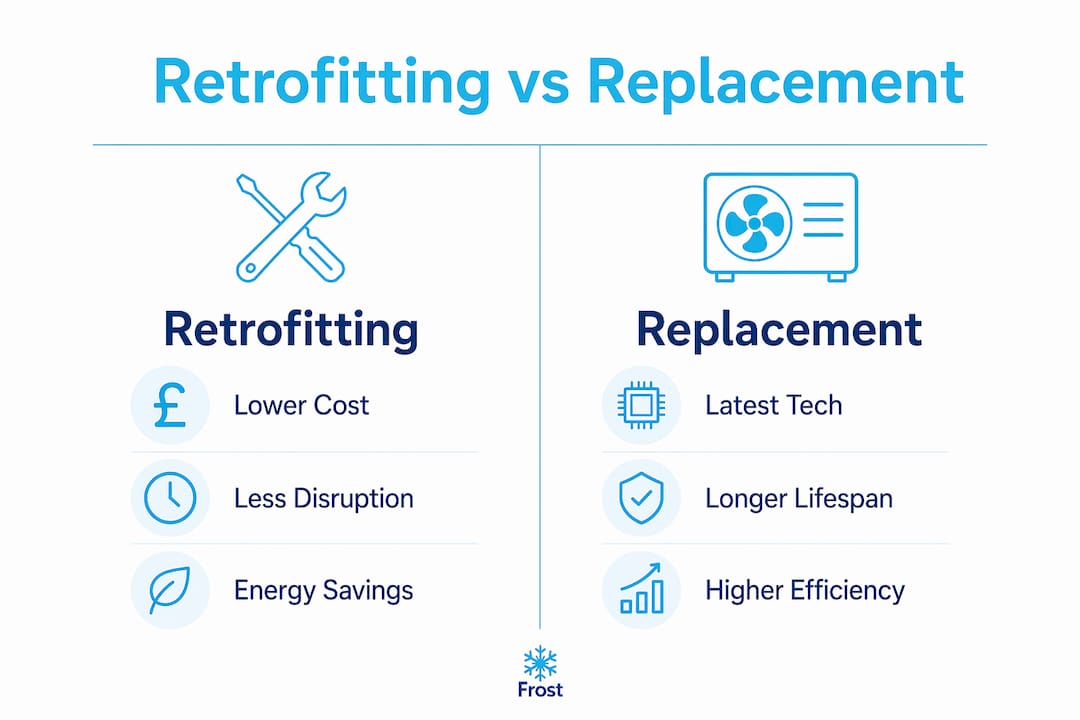
Retrofitting offers a middle-ground solution that balances cost, comfort, and energy savings for homes where full replacement is impractical or unnecessary. The financial case alone is compelling, but the practical benefits extend well beyond the initial invoice.
Key advantages include:
- Lower upfront cost. Replacing only what needs replacing means you are not paying for components that still have years of life left in them.
- Improved energy efficiency. Upgrading to a higher-rated unit or sealing leaking ducts can meaningfully reduce your electricity bills, particularly over a full cooling season.
- Extended system lifespan. Retrofitting reduces system stress, prevents mechanical failures, and minimises repair costs, meaning your overall installation lasts longer before a full replacement becomes necessary.
- Less invasive installation. A targeted retrofit preserves your home's structure, décor, and layout far better than ripping out an entire system.
- Better indoor air quality. Replacing filters, coils, and sealing duct joints removes sources of dust, mould spores, and stale air that degrade the air you breathe daily.
"Retrofitting is not a compromise. When planned properly, it delivers the same comfort improvements as a full replacement at a significantly lower cost and with far less disruption to your home."
Bundling your heating system upgrade with an AC retrofit is worth serious consideration. Combined upgrades improve overall home climate efficiency across seasons, and the labour costs of doing both at once are lower than scheduling two separate projects. If your boiler is also approaching the end of its life, the timing can work strongly in your favour. Read more about simultaneous heating and cooling upgrades and why they make financial sense.
How much does air conditioning retrofitting cost?
Cost is the question most homeowners ask first, and the honest answer is that it varies considerably depending on your home's existing infrastructure and the scope of work required.
| Cost factor | Typical range (approximate GBP equivalent) |
|---|---|
| Central AC retrofit (2,000 sq ft home) | £4,300 to £6,700 |
| Major duct repair or replacement | £1,600 to £5,500 |
| Electrical panel upgrade | £800 to £2,500 |
| Permits and compliance sign-off | £80 to £320 |
| Ductless mini-split installation | £1,500 to £4,000 per zone |
Retrofitting a central AC system in a 2,000-square-foot home costs between $5,500 and $8,500, with major duct repairs adding $2,000 to $7,000 on top. These figures reflect US market pricing, but they illustrate the proportional relationship between scope and cost that applies equally in the UK. The ductwork and electrical elements are where budgets most commonly overrun.
Home size drives cost significantly. A two-bedroom semi-detached property in Exeter will cost considerably less to retrofit than a five-bedroom detached house with multiple zones and ageing ductwork throughout. The condition of your existing system matters just as much as its size.
Pro Tip: Get at least three written quotes and check that each one itemises ductwork inspection, electrical assessment, and refrigerant compliance separately. A quote that bundles everything into a single line is hiding something. Frostairconditioning offers a free no-obligation quote with full itemisation, and 0% finance is available to spread the cost.
Understanding how AC upgrades affect property value can also help you frame the investment correctly. A well-documented retrofit adds measurable value to your home, particularly if you plan to sell within the next five to ten years.
Which AC technologies work best for retrofitting existing homes?
Not every system suits every home, and the right technology for your retrofit depends on what infrastructure already exists and how much disruption you are willing to accept.
| System type | Best suited for | Key consideration |
|---|---|---|
| Central air (ducted) | Homes with existing ductwork in good condition | Duct sealing and load calculation are non-negotiable |
| Ductless mini-split | Older homes without ductwork, listed buildings | Higher per-room cost but no duct installation required |
| High-velocity HVAC | Period properties with narrow wall cavities | Preserves architectural features; specialist installation |
| Air source heat pump | Homes wanting combined heating and cooling | Eligible for UK government incentives in 2026 |
Ductless mini-split systems are the preferred retrofit solution for older homes lacking ductwork, delivering zoned cooling without the need to cut through walls or floors for ducting. This makes them particularly well suited to period properties common across Devon and the wider South West, where preserving original features is a priority.
Central air systems remain the most cost-effective option where good ductwork already exists. The key is having that ductwork professionally inspected and sealed before the new equipment goes in. Leaking ducts can waste 20 to 30 per cent of conditioned air before it reaches the room, which defeats the purpose of upgrading the unit itself.
Heat pumps deserve a mention here because they handle both heating and cooling from a single installation. For homeowners considering an air conditioning upgrade alongside a heating improvement, a heat pump retrofit can be the most cost-effective long-term choice. Refrigerant compliance applies here too. R-32 and R-454B are now standard in new equipment, and your installer must hold the appropriate F-Gas certification to handle them legally. Frostairconditioning is fully F-Gas certified, which matters both for safety and for your warranty to remain valid.
Key takeaways
Air conditioning retrofitting delivers modern efficiency and comfort by upgrading targeted components rather than replacing an entire system, making it the most cost-effective route for most existing UK homes.
| Point | Details |
|---|---|
| Retrofitting targets specific components | Replacing coils, sealing ducts, or upgrading electrics costs far less than a full system replacement. |
| Timeline is one to five days | Simple swaps take one to two days; duct or electrical work extends the project to five days or more. |
| Ductless mini-splits suit older homes | Homes without existing ductwork benefit most from mini-split systems that require no invasive duct installation. |
| Hidden costs catch homeowners out | Electrical panel upgrades, permits, and duct repairs are the most common sources of budget overrun. |
| F-Gas certification is non-negotiable | Any installer handling R-32 or R-454B refrigerants must hold current certification for legal and warranty compliance. |
What I've learned from retrofitting homes across the South West
The most common mistake I see homeowners make is choosing the cheapest quote without checking what it actually includes. A low bid that skips duct sealing, omits a load calculation, or glosses over electrical compliance will cost you more within two years than the money you saved upfront. Overlooking duct sealing, electrical upgrades, or load calculations risks inefficient operation and premature system failure. I have seen this play out repeatedly, and it is entirely avoidable.
My strongest practical advice is to keep a homeowner binder after any retrofit. Commissioning reports, AHRI certificates, and permit closeouts are not just paperwork. They are what protect your warranty and what buyers will ask for when you sell. Most homeowners file them once and never look at them again, which is exactly right. The problems come when they were never created in the first place.
One more thing worth saying plainly: if your heating system is also ageing, do not retrofit your AC in isolation. The labour overlap between the two jobs is significant, and a combined project almost always works out cheaper per unit of improvement than two separate visits. Think about your home's climate control as a single system, not two separate problems.
— James
How Frostairconditioning can help with your retrofit
Frostairconditioning is based in Exeter and covers the South West, carrying out domestic AC retrofits for homeowners who want modern efficiency without the cost and disruption of a full system replacement.

Every survey includes a full assessment of your existing ductwork, electrical supply, and cooling load before any work is quoted. Frostairconditioning is F-Gas certified, meaning all refrigerant handling meets current UK regulations. Same-day installs are available for straightforward projects, and 0% finance is on offer to spread the cost of larger retrofits. Visit the domestic installation page to see what is covered, or request a quote for a fully itemised estimate with no obligation.
FAQ
What is the difference between AC retrofitting and full replacement?
Retrofitting upgrades or replaces specific components within your existing system, such as the condenser, coils, or ductwork, rather than removing and replacing the entire installation. It costs significantly less and causes less disruption, making it the preferred option when the core infrastructure is still sound.
How long does an AC retrofit take?
Installation typically takes one to five days, depending on the scope of work. A straightforward component swap takes one to two days, while projects involving duct modifications or electrical upgrades run longer.
Do I need planning permission for an AC retrofit in the UK?
Most domestic AC retrofits fall under permitted development rights and do not require full planning permission, but electrical and refrigerant work requires compliance sign-off and permits. Your installer should handle this as part of the project.
What refrigerants are used in 2026 AC retrofits?
R-32 and R-454B are the standard refrigerants in new and retrofitted systems as of 2026. Both are classified as mildly flammable A2L refrigerants, which means only F-Gas certified installers can legally handle them.
Is retrofitting worth it for an older home without ductwork?
Yes. Ductless mini-split systems are specifically designed for this situation, delivering zoned cooling without any duct installation. They are the most practical and least invasive retrofit option for period properties and older homes across the South West.