
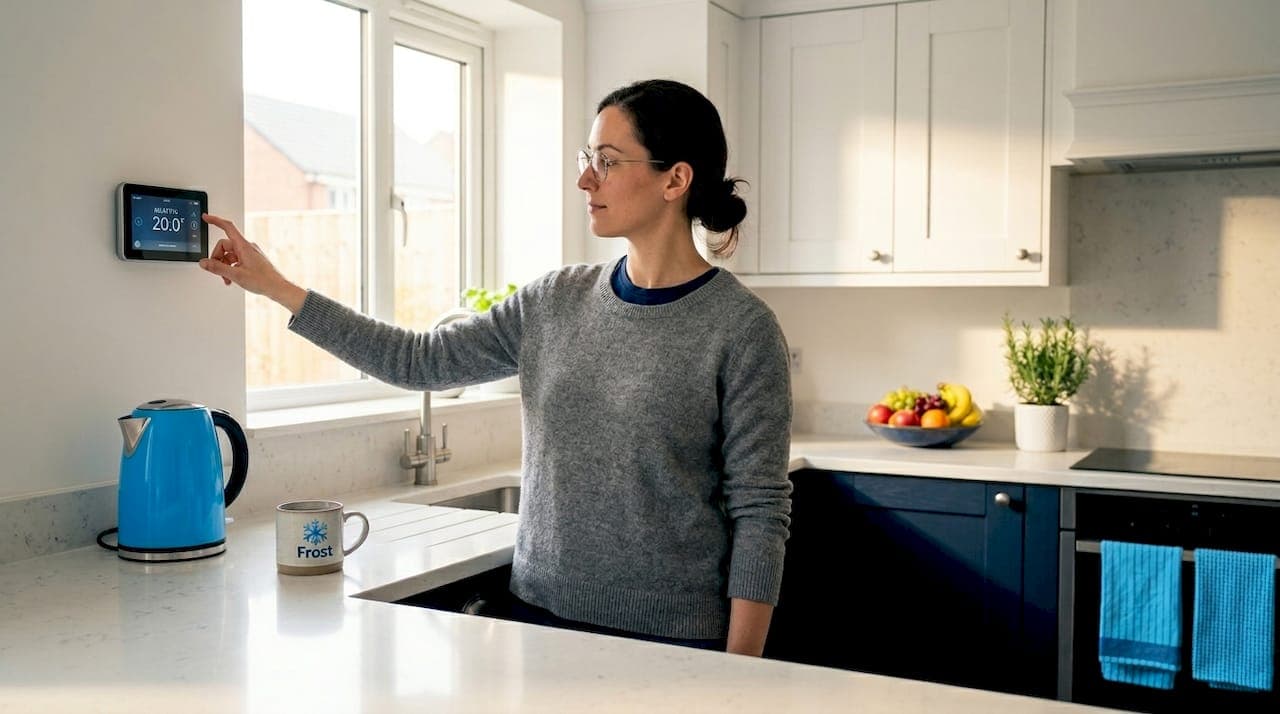
Most people assume their air conditioning unit is either on or off, and that adjusting the temperature is the whole story. But what are AC controls, really? The truth is that the controls governing your system are far more layered than a simple dial or button. Understanding them properly can mean the difference between a home that feels consistently comfortable and one that swings between too hot and too cold, while quietly running up your energy bills at the same time.
Table of Contents
- Key takeaways
- What are AC controls and how do they work?
- Types of air conditioning controls explained
- Why sensor placement changes everything
- Understanding your AC control panel settings
- My honest take on AC controls for UK homes
- How Frostairconditioning can help you get it right
- FAQ
Key takeaways
| Point | Details |
|---|---|
| AC controls do more than set temperature | They manage fan speed, mode, humidity response, and timing to maintain consistent comfort. |
| Thermostat placement matters enormously | A poorly placed thermostat misleads the system, causing discomfort and wasted energy. |
| Smart controls are not plug-and-play | They need correct setup and sensor placement to deliver real efficiency gains. |
| Programmable scheduling saves real money | Scheduling temperature changes correctly can cut heating and cooling costs by around 10% annually. |
| Professional installation makes the difference | Correct control configuration from the start prevents years of inefficiency and frustration. |
What are AC controls and how do they work?
AC controls are the set of devices and mechanisms that tell your air conditioning system what to do, when to do it, and to what degree. At their most basic level, they translate your comfort preferences into electrical signals that switch your system's components on or off. But that is only the beginning.
The central component in most homes is the thermostat. It reads the air temperature in your room, compares it to the temperature you have set (called the setpoint), and triggers the system to run until the gap is closed. What most people do not realise is that thermostats refresh readings every few seconds to one minute using thermistors and microcontrollers, making the process far more active than it appears from the outside.
There is also an important concept called a deadband or hysteresis buffer at work behind the scenes. Rather than switching your system on the moment the temperature drifts by even a fraction of a degree, thermostats use hysteresis to avoid rapid on/off cycling. This protects your compressor from wearing out prematurely and keeps conditions stable rather than constantly fluctuating.
The core components working together in a typical home AC control setup include:
- The thermostat: reads room temperature and communicates the user's setpoint to the system
- Temperature and humidity sensors: measure actual conditions in the space being controlled
- Switching mechanisms: send low-voltage signals (typically 24V) to activate cooling, heating, or fan modes
- User interface: buttons, dials, or touchscreens where you input your preferences
- Control logic: the programming inside the unit that interprets all of the above
Pro Tip: If your system feels like it is constantly hunting for the right temperature, the deadband setting may be too narrow. A good installer can adjust this to suit your home's thermal characteristics.
Types of air conditioning controls explained
Not all AC controls are the same, and the type installed in your home has a big impact on how well it performs. Understanding types of air conditioning controls helps you make better decisions about upgrades.
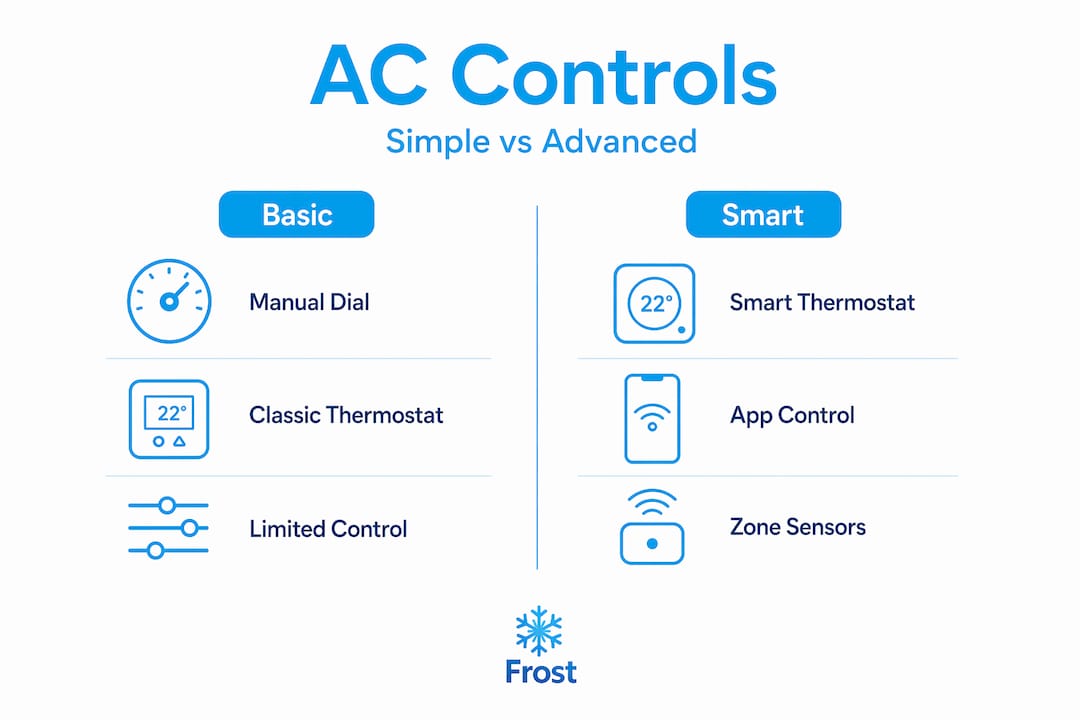
Here is a comparison of the main types available to UK homeowners:
| Type | How it works | Best for | Drawback |
|---|---|---|---|
| Mechanical thermostat | Bimetallic strip bends with temperature changes to open/close a circuit | Budget installs, simple systems | Limited precision, no scheduling |
| Digital thermostat | Uses thermistors and a microcontroller for accurate digital readings | Most UK homes | No remote access or learning |
| Programmable thermostat | Digital with timed schedules you set manually | Households with regular routines | Needs user input to stay effective |
| Smart Wi-Fi thermostat | Connects to your home network; controllable via smartphone app | Tech-savvy homeowners | Requires good Wi-Fi and correct setup |
| Direct Digital Control (DDC) | Processor-driven control of individual HVAC components with modulation | Larger or commercial buildings | Higher cost; overkill for small homes |
Smart thermostats deserve special mention. Rather than simply switching your system on at a set time, smart thermostats use learning algorithms to adapt to your home's thermal behaviour over time. They factor in how quickly your home heats up or cools down and adjust the start time accordingly, so your target temperature is reached exactly when you need it, not ten minutes after.
At the more advanced end, Direct Digital Control technology enables precise modulation of HVAC components rather than simple on/off switching, which is particularly useful in larger properties or those with multi-room systems.
The analogy to automotive climate control is worth considering here. Just as automatic climate control in vehicles uses a closed-loop sensor system to continuously adjust fan speed, heating, and cooling without manual input, modern smart home AC controls are moving in exactly the same direction. The goal is a system that manages itself around your life, not one that needs constant manual adjustment.
Why sensor placement changes everything
Here is something that surprises most homeowners. You can have the most advanced thermostat on the market, and it will still perform poorly if it is placed in the wrong spot. Sensor placement is arguably the single most impactful factor in how well your AC controls actually work in practice.
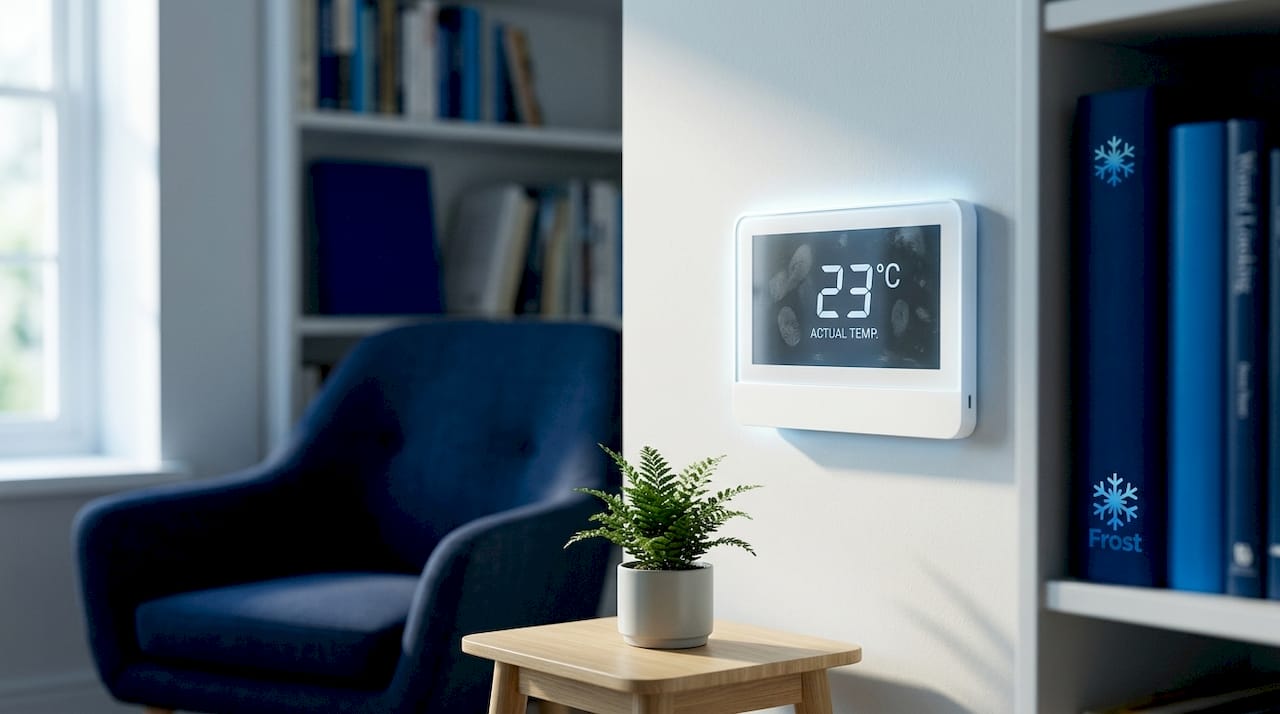
The physics are straightforward. If your thermostat sits in direct sunlight for part of the day, it reads a higher temperature than the rest of the room. The system then overcools your home to compensate, wasting energy and leaving you reaching for a jumper. Similarly, a sensor placed near a supply vent will be hit with already-conditioned air, tricking it into thinking the job is done before the room is actually comfortable.
Proper sensor placement away from direct sunlight, heat sources, and vents can improve HVAC efficiency by up to 15%. That is a significant saving for something that costs nothing except careful positioning. HVAC specialist Tony Marino makes a point that resonates strongly here: thermostat location should prioritise stable humidity as well as temperature, because humidity is what most people actually feel when they say a room is uncomfortable.
The ideal placement for a thermostat or remote sensor follows a few clear rules:
- Mount it on an interior wall, roughly 1.5 metres from the floor
- Keep it away from windows, external doors, and direct sunlight
- Avoid placing it near the kitchen, utility room, or any consistent heat source
- Do not position it directly above or below a supply or return air vent
- In multi-room systems, consider remote sensors in the rooms you use most
Pro Tip: Smart AC systems can use multiple remote sensors placed in different zones to send averaged or prioritised readings back to the thermostat. This is far more accurate than relying on a single fixed sensor in the hallway.
Understanding your AC control panel settings
The function of an AC control panel is to give you direct, immediate control over your system's behaviour. Yet many people use only a fraction of what is available, defaulting to the same temperature setting year-round. Here is how to actually use what you have.
-
Mode selection (Cool, Heat, Fan, Auto, Dry): Auto mode is usually the most efficient choice for UK homes. It allows the system to decide whether cooling or heating is needed based on the current conditions. Dry mode reduces humidity without aggressive cooling, which is genuinely useful during Britain's damp summers.
-
Fan speed settings: Most units offer low, medium, high, and auto fan speeds. Auto fan speed lets the system increase airflow when there is a large gap between current and target temperature, then drop to low once it is nearly there. This is quieter and more efficient than running at full power constantly.
-
Temperature setpoint: Setting your temperature between 20°C and 22°C is the sweet spot for most UK homes. Every degree lower in summer increases energy use noticeably. If you are managing your home's energy use, resist the temptation to set it five degrees below what you actually want hoping it cools faster. It does not work that way.
-
Eco or energy-saving mode: This slightly widens the acceptable temperature range, allowing the system to run less frequently. You might not notice the difference in comfort, but you will notice the difference on your bill.
-
Programmable scheduling: Set your system to reach your preferred temperature just before you arrive home rather than running all day. This is where programmable thermostat savings of around 10% annually become achievable in the real world.
If your control panel is unresponsive or behaving unexpectedly, the first step is to check whether the unit has lost its settings after a power cut. Many systems reset to factory defaults when power is interrupted. A full reset followed by reprogramming usually resolves this without needing a call-out.
My honest take on AC controls for UK homes
I have been around enough residential AC installations across the South West to say with confidence that most homeowners are getting far less out of their system than they should be, and the controls are almost always the reason.
The mistake I see most often is not about the type of thermostat chosen. It is about where it ends up on the wall and how it is set up after installation. A smart thermostat placed on an east-facing wall that catches morning sun is going to make your system work against you every single morning, regardless of how clever the software is.
I am also cautious about overselling smart thermostats as an automatic solution. They are genuinely impressive when configured properly and paired with the right system. But if someone buys one, sticks it where the old thermostat was without questioning the placement, and never adjusts the schedules beyond the default settings, they will wonder what they paid for. The technology is only as good as the thinking behind the setup.
What I have found actually works is straightforward. Get the placement right first. Understand the two or three settings you will actually use daily. Then consider whether a smart or programmable controller makes sense for your household's routine. That sequence matters. Most people try to do it in reverse.
The balance between comfort and energy savings is also more personal than any guide can fully prescribe. Some households genuinely run warm; others are more sensitive to humidity than temperature. Once you understand how your AC system works for your specific home, the controls stop feeling like guesswork.
— James
How Frostairconditioning can help you get it right
If you have read this far and realised your current setup is not working as well as it should, you are not alone. Most of the homes we visit across Exeter and the South West have at least one control-related issue that is quietly costing money or reducing comfort.

At Frostairconditioning, we assess your home properly before recommending any system or control upgrade. That means checking sensor placement, discussing your routine, and making sure the controls we install actually suit how you live. We are F-Gas certified, offer same-day installs in many cases, and have 0% finance available so the upfront cost does not have to be a barrier. If you are ready to find out what the right setup looks like for your home, request a quote and we will take it from there.
FAQ
What are AC controls in a home system?
AC controls are the devices that manage your air conditioning system's operation, including when it runs, at what temperature, and in which mode. The thermostat is the primary control device in most homes.
How do AC controls work to maintain temperature?
The thermostat reads the room temperature, compares it to your setpoint, and sends a low-voltage signal to activate cooling or heating. A hysteresis buffer prevents the system from switching on and off too frequently.
What types of air conditioning controls are available?
The main types are mechanical, digital, programmable, smart Wi-Fi, and Direct Digital Control systems. Each offers a different level of precision, scheduling capability, and remote access.
Where should an AC thermostat be placed?
Mount it on an interior wall at roughly 1.5 metres from the floor, away from windows, direct sunlight, heat sources, and air vents. Poor placement is one of the most common causes of inefficient AC operation.
Can upgrading AC controls reduce my energy bills?
Yes. Using programmable scheduling correctly can save around 10% on annual heating and cooling costs. Smart thermostats with learning algorithms can improve on this further when set up correctly.