
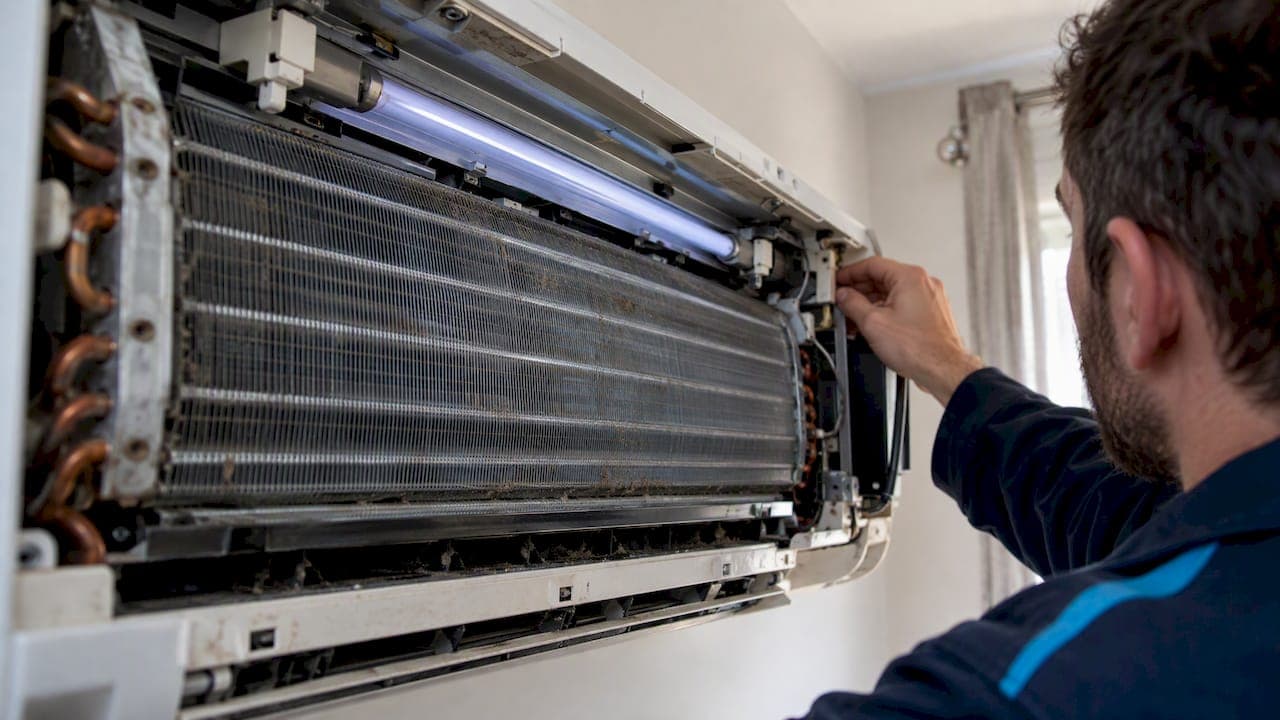
UVC (UVGI) is an engineering control that inactivates airborne and surface microbes and helps keep coils cleaner when it's professionally designed, sized and installed. It works alongside ventilation and filtration rather than replacing them, and UK workplaces must run a documented risk assessment under optical radiation safety rules before fitting it. If you're weighing it up, start with a site survey from a qualified installer who can calculate UV dose and provide appropriate documentation.
TL;DR:
- Effective treatment depends on calculated UV dose, which falls with fast airflow, poor lamp placement, low operating temperatures, and lamp ageing.
- Homes usually benefit most from coil and drain pan irradiation, while higher occupancy commercial buildings may justify in duct treatment sized to airflow.
- UK employers need a documented optical radiation risk assessment tailored to the site, enclosed lamps, access interlocks, warning signs, and written proof that controls work.
- Lamps can glow after losing germicidal output, so schedule replacements by operating hours and request periodic radiometer checks or documented output verification.
- Before retrofitting, have the installer check duct space, electrical supply, maintenance access, and nearby plastics or rubber that prolonged UVC can degrade.
Table of Contents
- How UVC works in HVAC systems and why dose matters
- Benefits for air quality and HVAC performance
- Installation approaches: in-duct, coil irradiation and upper-air fixtures
- Safety and UK regulatory requirements owners must check
- Maintenance, verification and expected lifecycle of UVC systems
- A practical installer perspective: what to ask and what to expect from a UK supplier
- Choosing the right UVC system for your building type
- Does UVC damage HVAC components or materials?
- Best practices for integrating UVC into an existing system
- Seasonal considerations for UVC use in HVAC systems
- Where the UVC conversation gets overcomplicated
- FAQ
- Sources
How UVC works in HVAC systems and why dose matters
Germicidal UVC disrupts the nucleic acids inside bacteria, viruses and mould spores, stopping them reproducing. Commercial lamps used in HVAC systems are mostly low pressure mercury lamps emitting near 254 nanometres, even though germicidal effectiveness peaks closer to 265 nanometres, according to ASHRAE's technical guidance on UV air and surface treatment.
What actually determines whether a system works is dose: irradiance multiplied by exposure time. A lamp fitted in the wrong spot, facing the wrong way, or in a duct with fast moving air can deliver a fraction of the dose a designer assumed, even when it's switched on and glowing.
Several factors change effective dose in a working system:
- Air velocity through the duct, which shortens how long microbes sit in the UV field.
- Duct geometry and lamp placement, since reflective surfaces and lamp arrays spread or concentrate the dose unevenly.
- Operating temperature and airflow around the lamp, often called wind chill, which can reduce lamp output below its rated figure.
- Lamp ageing, which lowers UV output well before the lamp visibly dims or fails.
This is why a competent installer sizes a system around measured or modelled dose, not just a lamp count.
Benefits for air quality and HVAC performance
A correctly designed UVC installation delivers two separate wins: cleaner equipment and a reduction in airborne microbial load. Coil and drain pan irradiation targets the wet surfaces where biofilm and mould naturally build up, keeping fins cleaner for longer.
- Cleaner coils reduce air side pressure drop, which means the fan works less hard to push air through the system.
- Better heat transfer across a clean coil improves cooling efficiency and can lower running costs over time.
- Airborne pathogen reduction supports, rather than replaces, good ventilation and filtration as part of a wider indoor air quality strategy.
- Healthcare, high occupancy and commercial settings remain the most common applications, where occupant density and infection control matter most.
A hospital HVAC duct installation measured marked reductions in culturable microorganisms once UVGI lamps were switched on, compared with the same duct with lamps off, according to a field study of UVGI installation effectiveness. That kind of real world verification, rather than lamp specification sheets alone, is what separates a properly commissioned system from a token fitting. For homeowners thinking about broader indoor air quality, it's worth reading how air conditioning supports your home's air quality before adding UVC on top.
Installation approaches: in-duct, coil irradiation and upper-air fixtures
UVC systems in HVAC fall into three broad configurations, each suited to a different job.
- In-duct UVGI fits lamps and sometimes reflectors inside air handling units or ductwork, aiming to treat air as it passes through. Getting sufficient dose here usually needs a lamp array and reflective surfaces designed around duct width and airflow speed, not a single lamp dropped into a convenient gap.
- Coil and drain pan irradiation points lamps directly at wet surfaces inside the unit where biofilm forms. This is a surface control measure first and an air treatment measure second, and it's one of the more reliable ways to protect coil efficiency over the system's life.
- Upper-air fixtures sit in occupied rooms and irradiate the air above head height, relying on room air mixing to carry treated air downward. These need careful shielding and mounting height to stop UV exposure reaching people below, and they're less common in typical UK domestic or small commercial fit outs than the first two options.
Each approach solves a different problem, so the right choice depends on whether you're protecting equipment, treating supply air, or managing a specific occupied space.
Safety and UK regulatory requirements owners must check
UVC is an optical radiation hazard, and UK employers have a legal duty to manage it. The Control of Artificial Optical Radiation at Work Regulations 2010 require a documented risk assessment and control measures wherever a workplace introduces a source of hazardous artificial optical radiation, which includes germicidal UVC lamps.
Before signing off any installation, check that your installer has covered the basics:
- Lamps fully enclosed within ducts or sealed housings, with no line of sight for occupants or maintenance staff.
- Interlocks that cut power automatically when an access panel is opened.
- Clear warning signage at access points and isolation switches.
- A written risk assessment specific to the installation, not a generic template.
- Evidence that anyone servicing the system has had appropriate training.
Pro Tip: Ask your installer for the written risk assessment and interlock test certificate before the job is signed off, not after.
Verifying installer competence matters as much as the hardware itself: ask for evidence of relevant training and request the control measures in writing rather than taking a verbal assurance.
Maintenance, verification and expected lifecycle of UVC systems
UVC lamps lose germicidal output long before they stop glowing, so a visible light is not proof the system is working. Most lamps need replacing on a fixed schedule based on run hours, not on appearance.
- Build lamp replacement and cleaning into your annual maintenance contract rather than treating UVC as fit and forget.
- Where feasible, ask for periodic radiometer checks or manufacturer-specified verification to confirm output is still within range.
- Watch for common failure signs: lamps that stay lit but no longer reduce odours or visible biofilm, or ballasts that trip repeatedly.
Pro Tip: If nobody can tell you when the lamps were last tested for output, treat the system as unverified, however new it looks.
A dead or underperforming lamp left in place gives a false sense of protection, which is worse than having no UVC at all.
A practical installer perspective: what to ask and what to expect from a UK supplier
A proper UVC quote should read like an engineering proposal, not a parts list. Before you commit, ask for:
- A site survey that measures duct dimensions, airflow and existing coil condition.
- A dose calculation or design justification, not just a statement that lamps are included.
- Written compliance documentation covering risk assessment and interlocks.
- A maintenance plan that specifies lamp replacement intervals and who carries them out.
- Safety interlocks fitted and tested before handover, with a written commissioning report.
Our engineers can usually carry out a site survey and, where appropriate, a same day installation without subcontracting the work out. We also offer 0% finance on qualifying installations, which is worth asking about if you're weighing UVC alongside a wider system upgrade. Whoever you use, insist on a written handover pack: commissioning results, warranty terms and a maintenance schedule, not a verbal promise that "it's all covered".
Choosing the right UVC system for your building type
Domestic properties rarely need the same specification as a hospital ward, and matching the system to the building avoids paying for capability you won't use. A typical UK home benefits most from coil and drain pan irradiation fitted inside the indoor unit, protecting against the mould and biofilm that build up in a humid coil, with upper-air or heavy in-duct arrays rarely justified for a single household.
Commercial premises with higher occupancy, such as offices or leisure facilities, often justify a fuller in-duct installation sized to the building's air handling units, since more people sharing recirculated air raises the value of treating the air stream itself.
Retail spaces sit somewhere between the two: footfall varies through the day, ceiling heights and duct runs differ from a domestic install, and the priority is usually a system that protects equipment and supports general air quality without the complexity of a hospital-grade array. In every case, the right specification comes from a survey of the specific ductwork, occupancy pattern and existing system, not a generic package applied regardless of building type.

Does UVC damage HVAC components or materials?
UVC light degrades some plastics and rubbers over sustained exposure, which matters for anything inside the direct beam path of a lamp, including gaskets, wiring insulation and certain duct liners. A competent designer accounts for this by choosing UV-resistant materials for components near the lamp or by positioning lamps so the beam doesn't fall directly on vulnerable parts.
Metal coils, fins and drain pans aren't damaged by UVC exposure in the way organic materials can be, which is part of why coil irradiation is considered a low-risk, high-value application. Where an installation reuses existing ductwork, it's worth checking what liner material is fitted, since some foam and fibre linings degrade faster under prolonged UV exposure than bare metal duct. This is a specification detail your installer should flag during the survey rather than something you need to diagnose yourself, but it's a fair question to ask before work begins.
Best practices for integrating UVC into an existing system
Retrofitting UVC into a system that's already running calls for the same rigour as a new design. Start with an assessment of the existing air handling unit or duct run so the installer can confirm there's enough straight duct length and accessible space to fit lamps without obstructing airflow or maintenance access.
Electrical supply needs checking too, since UVC lamps and their ballasts typically need a dedicated, properly isolated circuit rather than being spliced into existing control wiring. Interlocks should be commissioned and tested as part of the same visit, not left as a follow-up job, and the installer should confirm the fan and lamp are coordinated so the system isn't drawing air past dead lamps during a fault.
Finally, integration should be documented: as-fitted drawings, lamp positions and the dose calculation used to size the array all belong in the handover pack, so that whoever services the system in future, including during a routine professional AC service visit, knows exactly what they're working with.
Seasonal considerations for UVC use in HVAC systems
UVC lamps run continuously in most designs, but how well they perform can shift with the seasons. In summer, higher cooling loads mean coils stay wetter for longer, which is exactly when coil irradiation earns its keep by limiting biofilm growth before it affects airflow. UK homeowners dealing with recurring coil mould, something we've covered in detail in our guide to stopping aircon mould with a short dry cycle, often find UVC coil treatment works well alongside that routine.
Winter brings a different challenge: lower ambient temperatures around the air handling unit can reduce lamp output through the wind chill effect mentioned earlier, so a system sized tightly for summer conditions may underperform in cold plant rooms. Humidity swings across the year also affect how quickly biofilm regrows after a dry period, meaning the busiest season for a UVC system isn't always the one you'd expect. None of this changes the maintenance schedule, but it's worth asking your installer whether the design accounts for year-round temperature range rather than a single assumed operating condition.

Where the UVC conversation gets overcomplicated
The received wisdom on UVC in air conditioning tends to swing between two extremes: treating it as a near-magical disinfection layer, or dismissing it as marketing dressed up as engineering. Neither holds up. The evidence, including the hospital duct study showing real reductions in culturable microorganisms once lamps were switched on, supports UVC as a genuinely useful engineering control, but only when dose is calculated rather than assumed.
What's underrated is how much the value depends on boring details: duct geometry, lamp placement, and whether anyone ever checks the lamps are still putting out useful UV once installed. A system with the right certificate on day one but no verification plan afterwards is barely better than no system at all. If you take one thing from this, prioritise the maintenance and verification conversation before the lamp brand. Ask what happens in month eighteen, not just what's included on installation day, and treat a supplier who can't answer that as a warning sign rather than a minor gap.
— James
FAQ
What are the regulations for air conditioning in the UK?
Air conditioning installations must comply with F-Gas regulations covering refrigerant handling, alongside building regulations for electrical and ventilation work. Where UVC lamps are fitted, employers also have duties under the Control of Artificial Optical Radiation at Work Regulations 2010 to assess and control optical radiation risks.
What is UV-C on an air filter?
UV-C on an air filter or within an air handling unit refers to germicidal ultraviolet lamps, typically emitting around 253.7 nanometres, positioned to irradiate air or surfaces as they pass through the system, according to ASHRAE's UV treatment guidance. It's designed to inactivate bacteria, viruses and mould spores rather than trap particles the way a mechanical filter does.
What UV does the UK get in summer?
This question usually relates to natural sunlight rather than HVAC systems, and UK summer UV levels vary by region and weather, with no fixed figure applying everywhere. For UVC used inside air conditioning equipment, output is set by the lamp and system design rather than outdoor sunlight levels.
What are the three most common types of HVAC systems?
UK buildings typically use split systems, which separate an indoor and outdoor unit, packaged or rooftop units that house all components together, and ducted central systems that distribute conditioned air through ductwork to multiple rooms. The right choice depends on building size, layout and whether ductwork already exists.
Does adding UVC increase my HVAC running costs?
UVC lamps themselves draw a modest amount of electricity, but cleaner coils reduce the fan power needed to push air through the system, which can offset part of that cost. The net effect depends on system design, so ask your installer for a running cost estimate as part of the proposal.
Sources
- Ultraviolet air and surface treatment (ASHRAE)
- Guidance for employers on the Control of Artificial Optical Radiation at Work Regulations (HSE)
- UVGI installation and effectiveness study (PMC article)