

An integrated HVAC system is defined as a single, coordinated platform that manages heating, cooling, ventilation, and domestic hot water through unified controls and shared components. Rather than running separate boilers, air conditioning units, and ventilation systems independently, an integrated approach treats the whole building as one thermal system. Explaining integrated heating and cooling matters now more than ever, because UK building standards and low-carbon targets are pushing homeowners and property developers toward whole-building thinking. The shift is not just technical. It changes how you specify, install, and maintain climate control from the ground up.
How does an integrated heating and cooling system work?

An integrated HVAC system uses a reversible refrigeration cycle as its core mechanism, which means the same equipment that cools your home in summer can heat it in winter. The heat pump sits at the heart of this process, moving thermal energy rather than generating it by burning fuel. That distinction matters because moving heat is far more efficient than creating it.
The system's performance is measured using three key metrics:
- SEER (Seasonal Energy Efficiency Ratio): measures cooling efficiency across a full season
- HSPF (Heating Seasonal Performance Factor): measures heating efficiency over a heating season
- COP (Coefficient of Performance): a real-time cross-check of how much heat energy the system delivers per unit of electricity consumed
Efficiency is measured by SEER, HSPF, and COP as performance indicators across different operating conditions. A higher COP means the system delivers more heat for every kilowatt of electricity it draws.
Unified control interfaces coordinate all outputs, including heating, cooling, and ventilation, from a single interface. The controller reads outdoor temperature, indoor conditions, and occupancy signals, then decides which mode to run and at what output level. This dynamic response is what separates a true integrated system from a collection of independently operated appliances.
Pro Tip: Ask your installer to show you the control logic settings before handover. Understanding how your system switches between heating and cooling modes helps you spot problems early and avoid unnecessary service calls.
Inverter compressors allow variable output, so the system ramps up or down rather than switching fully on or off. This prevents the energy waste and temperature swings that fixed-speed systems produce. Ducted and ductless options cater to different property types, with ducted systems suiting new builds and ductless multi-split configurations working well in retrofits.
What are the benefits of combined heating and cooling?
The clearest benefit of a combined system is energy efficiency. Integrated systems treat heating, cooling, and hot water as a single coordinated strategy, which produces better operational synergy than running separate systems that cannot communicate with each other. When your heating and cooling share a control brain, the system avoids the contradictory behaviour you sometimes see in older properties where a boiler and a standalone air conditioning unit work against each other.
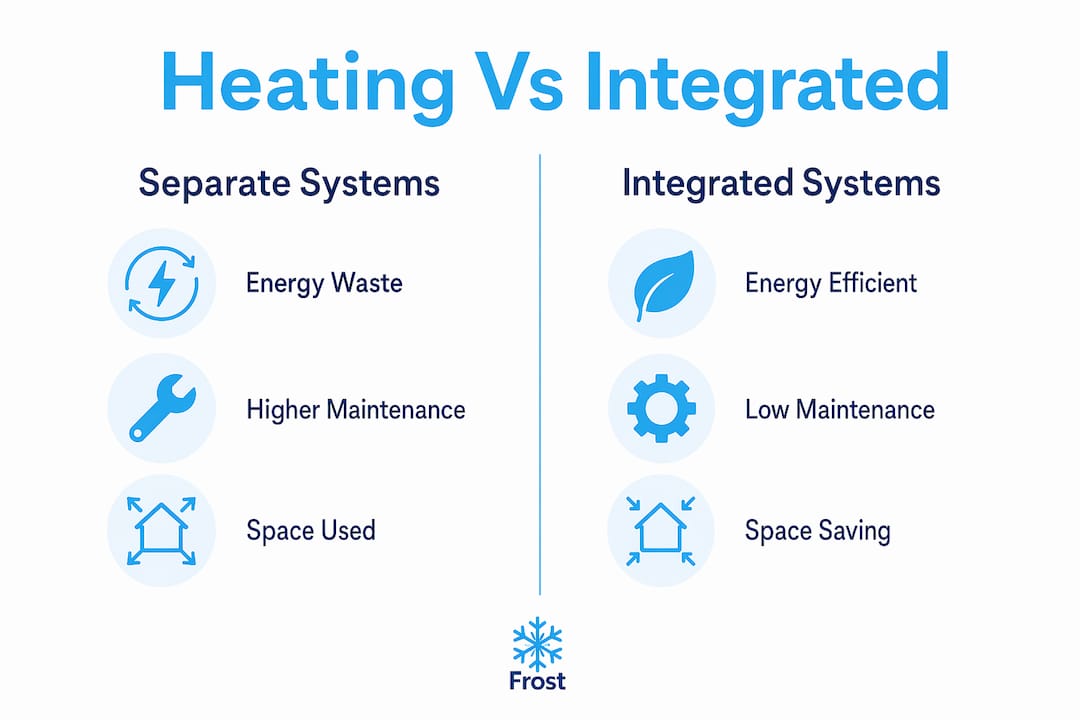
Space saving is a genuine practical advantage. A single outdoor unit and a compact indoor unit replace what might otherwise be a boiler, a separate air conditioning condenser, and additional ventilation equipment. For flats, smaller new builds, and properties where plant room space is limited, this matters considerably.
Maintenance becomes simpler too. A unified platform reduces maintenance complexity compared to managing separate contracts and service schedules for disparate equipment. One engineer, one annual service, one system log.
The comfort benefit is often underestimated. Consistent environmental control across seasons means the indoor temperature does not swing dramatically between a cold January morning and a warm July afternoon. Inverter-driven systems modulate output continuously, which keeps conditions stable rather than cycling between too hot and too cold.
| Benefit | Separate systems | Integrated system |
|---|---|---|
| Energy management | Each unit operates independently | Coordinated to avoid conflicting operation |
| Space requirement | Multiple outdoor and indoor units | Single outdoor unit in most configurations |
| Maintenance | Multiple service contracts | Single unified service platform |
| Comfort consistency | Variable, dependent on each system | Stable, modulated by unified controls |
| Carbon footprint | Higher, especially with gas boilers | Lower, particularly with heat pump integration |
Smart HVAC controls add a further layer of efficiency by adapting operation dynamically to occupancy patterns and weather forecasts, reducing energy use without sacrificing comfort.
Key technical considerations when designing an integrated system
The most common installation mistake is ignoring hydraulic design. Hydraulic decoupling is essential to prevent flow issues and compressor damage in integrated systems. A hydraulic separator or low-loss header sits between the heat pump circuit and the distribution circuit, ensuring each side maintains the correct flow rate independently. Without it, the compressor can starve of flow under partial load conditions, shortening its life significantly.
Sizing is equally critical. Heat pump sizing relies on detailed heat loss surveys and hydraulic interface design, not simply on the maximum heat load of the building. An oversized heat pump short cycles, running in brief bursts that waste energy and wear components faster than a correctly sized unit running steadily.
Commissioning is where many otherwise well-designed systems fail to deliver their potential. The process involves several non-negotiable steps:
- Identify index circuits: locate the emitter circuits with the highest resistance to flow, as these set the pressure requirement for the whole system.
- Adjust lockshield valves: balance flow across all circuits so each emitter receives its design flow rate.
- Programme control logic: set operating modes, temperature thresholds, and bivalence points to match the building's actual heat loss profile.
- Test under load: verify performance across heating and cooling modes before signing off the installation.
Without proper commissioning, systems may short cycle or waste energy, negating the efficiency benefits that justified the investment. This step is not optional, yet it is frequently rushed or skipped entirely on budget-driven projects.
Bivalent configurations, where a heat pump works alongside a secondary heat source such as a gas boiler or electric immersion, require particularly careful control programming. Bivalent setups use coordinated control to meet peak demands efficiently, with the controller switching between sources based on outdoor temperature thresholds. Setting the bivalence point incorrectly means either the heat pump runs inefficiently in very cold weather or the backup source fires unnecessarily on mild days.
Pro Tip: Request a full commissioning report from your installer. It should include flow rates, temperature differentials, and control settings. If they cannot provide one, the system has not been properly commissioned.
Integrated HVAC control logic acts as the system's brain, arbitrating between energy sources and preventing inefficiencies. The sophistication of that control logic ultimately determines whether the system achieves its anticipated savings or falls short.
Practical guidance for homeowners and property developers
Choosing the right system type depends on the property. New builds offer the most flexibility because the distribution system, whether underfloor heating, fan coils, or low-temperature radiators, can be designed from scratch to match the heat pump's output characteristics. Retrofits require more careful assessment.
Key considerations before specifying or purchasing:
- Assess the existing distribution system: older high-temperature radiators may need upgrading to work efficiently with a heat pump operating at lower flow temperatures
- Commission a heat loss survey: this is the only reliable basis for sizing the system correctly; rule-of-thumb estimates lead to oversized equipment and poor performance
- Understand your subsidy options: the UK Boiler Upgrade Scheme currently offers grants for heat pump installations, reducing upfront costs for eligible properties
- Plan for air conditioning retrofitting: integrating cooling into an existing heating system requires careful planning around pipework, electrical supply, and control compatibility
- Clarify maintenance responsibilities: confirm whether your installer offers a service contract and what it covers, including refrigerant checks under F-Gas regulations
For property developers, integrated air conditioning specified at design stage costs less to install and performs better than systems added as an afterthought. Building regulations in England and Wales increasingly favour low-carbon heating solutions, and integrated heat pump systems align directly with Part L compliance requirements.
Working with an F-Gas certified installer is not optional for any system containing refrigerant. F-Gas certification confirms the engineer is qualified to handle refrigerants safely and legally, which protects both the installation and the homeowner from liability.
Key takeaways
An integrated HVAC system delivers better energy efficiency, lower maintenance complexity, and more consistent comfort than separate heating and cooling systems, provided it is correctly sized, hydraulically designed, and commissioned.
| Point | Details |
|---|---|
| Unified control is the core advantage | Coordinated controls prevent heating and cooling from working against each other, saving energy. |
| Hydraulic design cannot be skipped | A hydraulic separator protects the compressor and maintains correct flow across all circuits. |
| Commissioning determines real-world performance | Balancing, programming, and load testing are required to achieve the efficiency the system was designed for. |
| Sizing must follow a heat loss survey | Oversized heat pumps short cycle and wear faster; correct sizing requires a proper survey, not estimates. |
| Retrofits need careful planning | Existing radiators, pipework, and electrical supply must be assessed before specifying an integrated system. |
What I have learned from integrated system installations
The biggest misconception I encounter is that integrated heating and cooling is simply a matter of swapping out a boiler for a heat pump. It is not. The equipment change is the easy part. The hard part is designing the hydraulic interface, programming the controls correctly, and commissioning the system properly before handing it over to the homeowner.
I have seen well-specified systems underperform because the commissioning was rushed. Flow rates were never balanced, the bivalence point was left at the factory default, and the homeowner spent the first winter wondering why their energy bills had not dropped. The equipment was fine. The installation was not.
The industry is moving in the right direction, but the gap between a good installation and a poor one is still wide. Homeowners who ask the right questions before signing a contract, including asking for a commissioning report and a heat loss calculation, are far more likely to end up with a system that performs as promised. The technology works. The process around it needs the same level of attention.
— James
Frostairconditioning: integrated heating and cooling installations in the South West
Frostairconditioning installs integrated heating and cooling systems for homeowners and property developers across Exeter and the wider South West. Every installation is carried out by F-Gas certified engineers, and same-day installs are available for qualifying projects.

Whether you are specifying a new build or assessing a retrofit, Frostairconditioning offers domestic installation services covering system selection, hydraulic design, and full commissioning. 0% finance options are available, making it straightforward to invest in an energy-efficient integrated system without a large upfront cost. Service maintenance packages keep your system running at peak efficiency year after year, with scheduled checks covering refrigerant levels, controls, and flow balancing.
FAQ
What is an integrated HVAC system?
An integrated HVAC system is a single coordinated platform that manages heating, cooling, ventilation, and often domestic hot water through shared components and unified controls. It treats the building as one thermal system rather than running separate appliances independently.
How does a heat pump provide both heating and cooling?
A heat pump uses a reversible refrigeration cycle, moving heat into the building in winter and extracting it in summer. The same refrigerant circuit handles both functions, which is why a single unit can replace both a boiler and a separate air conditioning system.
Why does commissioning matter so much for integrated systems?
Without proper commissioning, including hydraulic balancing and control programming, integrated systems can short cycle, waste energy, and fail to maintain consistent temperatures. Commissioning is what converts a correctly specified system into one that actually performs as designed.
What is a bivalent heat pump system?
A bivalent system pairs a heat pump with a secondary heat source, such as a gas boiler or electric heater, with a controller that switches between them based on outdoor temperature. This approach handles peak winter demand efficiently without oversizing the heat pump.
Do I need an F-Gas certified installer for an integrated system?
Any system containing refrigerant requires an F-Gas certified engineer for installation, servicing, and refrigerant handling. This is a legal requirement in the UK, and using an uncertified installer invalidates warranties and creates liability for the property owner.