
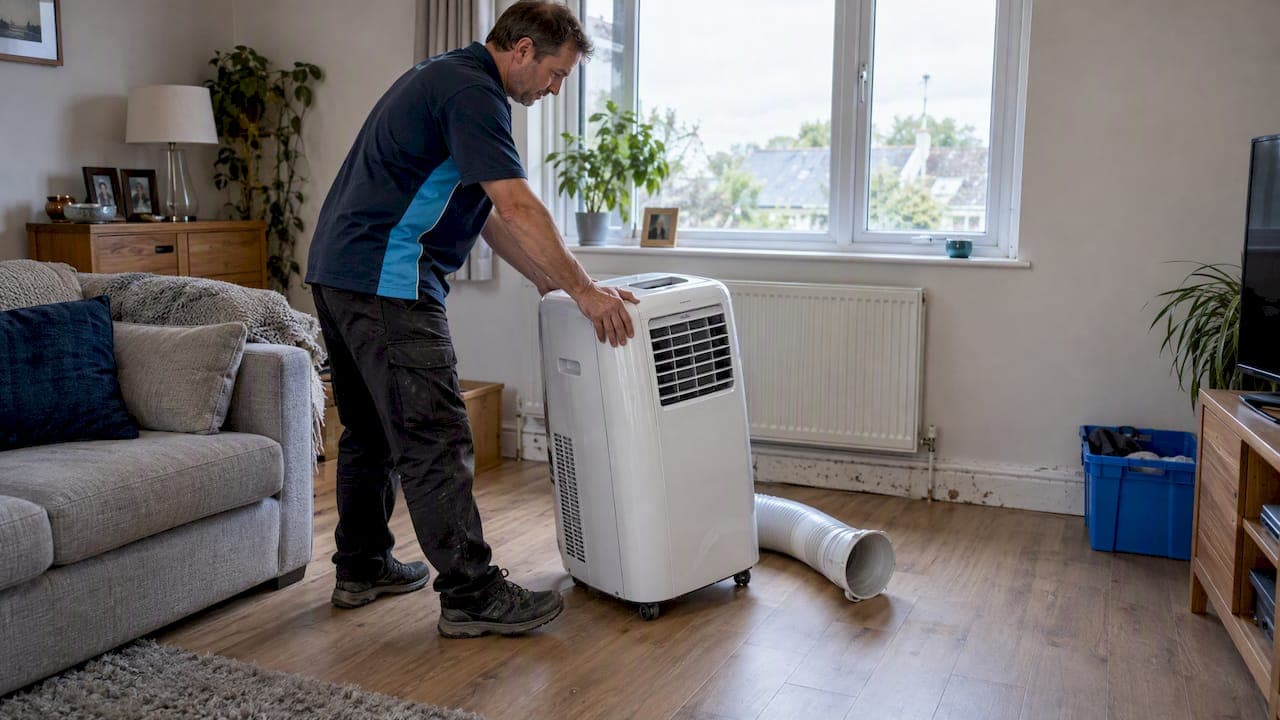
Yes, you can move a portable air conditioner yourself once it is unplugged, drained of condensate and kept sealed. The line you cannot cross is breaking into the refrigeration circuit on a fixed or split system, which requires an F-gas qualified engineer by law. Before relocating any outdoor unit, check siting and noise rules so your new spot does not land you in a dispute with neighbours.
TL;DR:
- Moving a portable air conditioner by yourself is safe if it is unplugged, drained, and kept upright, but refrigerant circuit work must be done by a certified engineer.
- Proper planning includes measuring routes, protecting floors, and ensuring the unit is in good condition before transport to avoid damage or leaks.
- Reconnecting or relocating split systems with refrigerant handling requires professional F-Gas qualified engineers due to legal and environmental risks.
- When siting outdoor units, consider noise regulations and avoid placing them near bedrooms or boundary lines to prevent neighbor disputes.
- Costs for DIY moves are minimal, but full professional relocations with refrigerant recovery can be expensive, depending on access, distance, and structural needs.
Table of Contents
- Quick pre-move checklist before you handle any air conditioner
- Moving a portable air conditioner safely, step by step
- When you need a certified engineer instead of doing it yourself
- Powering your unit safely after a move
- Choosing a new location without annoying your neighbours
- What a relocation typically costs and how to brief a trade
- Hands-on tips from James and Frost Air Conditioning
- Safety first: why refrigerant work is never worth the risk
- How Frost Air Conditioning can help with your move
- Sources
- FAQ
Quick pre-move checklist before you handle any air conditioner
Before you lift anything, work out what kind of unit you actually have. A self-contained portable unit on wheels is a different job from a fixed split system with an outdoor condenser connected by pipework, and mixing up the two is how people end up damaging equipment or breaking the law without realising.
Run through this short list first:
- Confirm whether the unit is portable or fixed, and check its weight on the data plate or manual.
- Read the manual to identify user-serviceable parts, and never open the refrigeration circuit yourself.
- Drain any condensate water, check your power lead length and socket access, and measure doorways and the route you will carry it through.
- Decide whether you need a second person, a trolley or an installer, and gather floor protection and basic PPE such as gloves.
A heavier unit, a tight staircase or a route through a narrow hallway usually tips the decision towards a two-person lift rather than going it alone.
Moving a portable air conditioner safely, step by step
Portable, self-contained units are the one type most owners can move without professional help. Treat the job with the same care you would give a washing machine or fridge freezer, since the internal components are just as sensitive to knocks and tilting.
- Switch the unit off at the wall and leave it for a few minutes so refrigerant pressure settles before you disturb it.
- Empty the condensate tank or tray completely, and remove or secure any hose fittings so stray water does not leak onto flooring or carpets.
- Measure your route in advance, clearing obstacles and laying down protective sheeting over hard floors and door thresholds.
- Use the built-in wheels where fitted, and keep the unit upright throughout. For heavier models, use a sack trolley with straps and get a second person to help on stairs or steps.
- Once in position, level the unit on a firm surface, reconnect the exhaust hose securely, and run it for a short test cycle to check for unusual noise, vibration or any sign of electrical fault.
Pro Tip: Let the unit stand upright for at least 15 to 20 minutes after moving before switching it on, giving any compressor oil time to settle back into place.
Keep the exhaust hose as short and straight as practical; excessive kinks or extensions reduce efficiency and can cause the unit to work harder than it needs to. If the test run throws up a strange smell, a tripped socket or odd rattling, stop and check the manual before running it again. Most problems at this stage come from a loose hose connection or water left in the tank during transit rather than anything mechanical, so it is worth rechecking those two things before assuming the unit is faulty.
When you need a certified engineer instead of doing it yourself
The moment a job involves disconnecting pipework, draining refrigerant or reconnecting a split system's outdoor and indoor units, it stops being a DIY task. Opening the refrigeration circuit on a fixed air conditioning system is work that UK law restricts to people holding the right qualifications, because refrigerant gases are controlled substances with environmental and safety implications if mishandled.

Gov sets out certificate categories for installing, servicing and recovering refrigerant from systems, and each category permits a different scope of work. An engineer handling a full split system relocation typically needs a category that covers installation, commissioning and refrigerant recovery, not just basic servicing.
Attempting refrigerant work without the right certification carries real legal exposure, on top of the risk of a poor reconnection leaking gas or failing outright.
GOV.UK's guidance on F-gas qualifications confirms that different certificate categories apply depending on whether the work is installation, servicing or refrigerant recovery, meaning the right engineer for one job is not automatically qualified for another.
To get a relocation quote moving quickly, owners can prepare a few things themselves:
- Take clear photos of the indoor and outdoor units, including the data plate.
- Measure the distance between the current and proposed locations.
- Note any access restrictions, such as narrow gates, upper-floor windows or shared walls.
- Check whether pipework will need extending or shortening for the new position.
Our guide to air conditioner gas and refrigerant handling goes into more detail on why this part of the job is never a DIY task.
Powering your unit safely after a move
Electrical safety matters just as much as lifting technique, particularly if you are running a portable unit from a temporary socket while you decide on its final spot. Air conditioners draw a steady, sometimes high current, and that makes them a poor match for improvised wiring setups.
Electrical Safety First's guidance on extension leads and cable reels warns against running cable reels while still wound up, since the coiled cable traps heat and can overheat under load. The same guidance advises against daisy-chaining extension leads together, which multiplies the risk of a socket being asked to carry more current than it is rated for.
Keep these points in mind when reconnecting a moved unit:
- Never daisy-chain extension leads; use one lead running directly from a wall socket to the appliance.
- Fully unwind any cable reel before use, and check the lead's rating covers the appliance's current draw.
- Where possible, plug directly into a wall socket rather than relying on an extension lead long term.
- Watch for a burning smell, a tripped RCD or a warm plug or socket, and stop using the circuit immediately if you notice any of these.
Pro Tip: Check the appliance's current draw on its rating plate against the extension lead's maximum rating before you plug in, not after.
If your new location genuinely needs a permanent socket, that is a job for a registered electrician rather than a long-term extension lead, however well-rated the cable is.
Choosing a new location without annoying your neighbours
Where you put an outdoor or fixed unit matters as much as how you move it, since poor siting is one of the most common causes of neighbour complaints and retrospective planning problems. MCS 020 guidance from GOV.UK sets out sound pressure requirements used in permitted development assessments, with recent guidance referencing an approximate 37 dB(A) threshold at the neighbour assessment position as a key figure installers work to.
Before you settle on a new spot, run through these checks:
- Avoid positioning the unit directly outside a neighbour's bedroom window.
- Keep reasonable distance from boundary lines, and consider anti-vibration mounts to reduce transmitted noise.
- Check whether the new position pushes the unit closer to a neighbouring property than its previous spot, which can trigger a fresh noise assessment.
- If in doubt, a formal noise assessment can confirm whether the position meets MCS 020 thresholds before installation.
Permitted development rights can also change the siting rules depending on distance from a boundary, so it is worth checking current thresholds rather than assuming what applied when the unit was first installed still holds. Our guide to the 1 metre rule and outdoor unit placement and our permitted development checklist for 2026 cover both in more detail.
What a relocation typically costs and how to brief a trade
Costs vary enormously depending on whether you are moving a portable unit yourself, paying for a local two-person lift, or commissioning a full engineer relocation involving refrigerant recovery and remounting.
A DIY move of a portable unit costs nothing beyond your own time and any floor protection you buy. A paid local move with two people to carry a heavier unit between rooms or floors is a modest job for most removal or handyman services. A full engineer-led relocation of a split system, including refrigerant recovery, new pipework and remounting the outdoor unit, is a different scale of job entirely and the price depends heavily on distance, access and whether new pipework or bracketry is needed.
To get an accurate quote quickly, send the trade:
- A photo of the unit's data plate showing model and refrigerant type.
- Photos of both the current and proposed locations, including access routes.
- The distance between the old and new positions, in metres if possible.
- Any access restrictions such as stairs, scaffolding needs or shared walls.
Be wary of a quote that skips any mention of F-gas qualification or gives a flat low price with no breakdown of what is included. A proper quote should separate labour, materials and any refrigerant handling charge.
Hands-on tips from James and Frost Air Conditioning
On site, we always protect flooring before moving anything, using mats, tape and corner protectors on doorframes, since scuffed skirting and dented plaster are the most common complaint after a rushed DIY move. We often get called out to fix leaking hose connections or re-level units that were put down on an uneven surface after an owner's own attempt.
If you want a same-day survey or quote, send clear photos of the unit's data plate plus the current and proposed locations with rough measurements. That alone usually tells us whether the job is a straightforward reposition or needs a full refrigerant handling visit.
Safety first: why refrigerant work is never worth the risk
My rule of thumb is simple: move a portable unit yourself if it is unplugged, drained and never opened, and call a certified engineer for anything that touches the refrigeration circuit. That line matters more than people think, because a badly resealed connection does not always fail immediately, it can leak slowly for weeks.
Take photos and measurements of the unit and its site before you move anything. It protects you if there is a dispute later, and it makes any follow-up engineer visit faster and cheaper.
— James
How Frost Air Conditioning can help with your move

If your relocation involves refrigerant handling, a tricky mounting position, or siting that needs checking against planning rules, that is exactly where a professional saves you time and risk rather than money alone — especially a home extension specialist if structural changes or mounting alterations are needed. Our engineers are F-Gas certified, work without subcontractors, and typically complete a domestic job within a day or two of the survey.
| Situation | Best route |
|---|---|
| Portable unit, same room or floor | DIY move, following the steps above |
| Split system relocation, refrigerant handling needed | F-Gas certified engineer |
| New outdoor siting near a boundary or window | Survey plus noise check before installation |
| Awkward access, mounting or structural changes | Site visit to assess before quoting |
Book a free survey for a domestic installation or relocation, or get in touch about our service and maintenance options if your move also needs an annual contract or emergency cover in place. Business premises relocating a system can also look at our commercial and shop fitting page.
Sources
FAQ
Is aircon illegal in UK houses?
No, air conditioning is legal in UK homes, though fixed systems may need planning consideration depending on siting, size and proximity to boundaries under permitted development rules. Portable units generally need no permission at all since there is no outdoor installation involved.
What is the 3 minute rule for aircon?
This usually refers to leaving a unit to settle for a short period after switching it off or moving it, before restarting it, to let internal pressure and any compressor oil settle. There is no single official UK standard length for this, so follow the manufacturer's manual for your specific model.
Why is AC not common in the UK?
Air conditioning has historically been less common in UK homes than in hotter climates, partly due to the country's cooler average temperatures and the added cost and planning considerations of fixed systems. That said, demand has grown as summers have become warmer and more households look for cooling options.
Is it possible to get AC in the UK?
Yes, both portable units and fixed split systems are widely available and legal to install in UK homes and businesses, subject to standard planning and noise rules for outdoor units. Air conditioning companies install systems from brands including Samsung, Mitsubishi, Toshiba and Daikin, with F-Gas certified engineers handling any refrigerant work.