
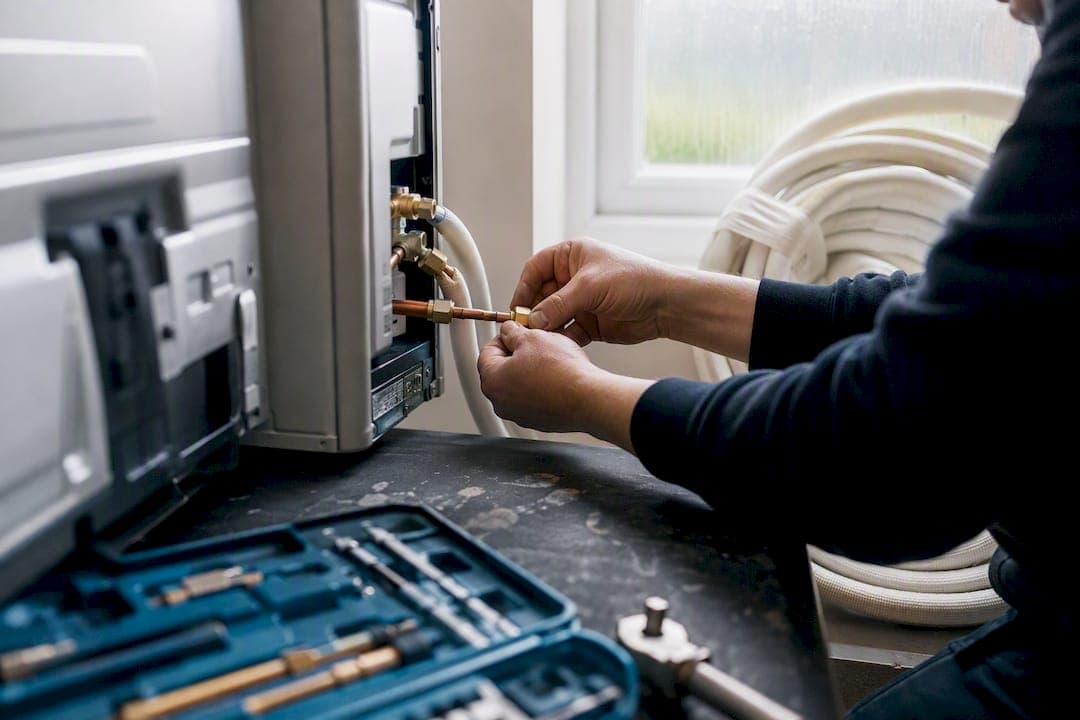
Yes, air conditioning can be eco friendly, but only if three things line up: the refrigerant has a low global warming potential, the system runs efficiently from correct sizing through to installation, and the power behind it comes from renewables or is offset by cutting demand elsewhere. Miss any one of these and you're just moving emissions around, not cutting them.
To get genuine eco friendly air conditioning, homeowners need to focus on:
- Refrigerant choice — low-GWP gases like R-290 (propane) instead of older high-GWP blends
- Efficiency features — inverter compressors, accurate sizing, and regular maintenance
- Power source — renewable electricity or passive measures that cut how hard the system has to work
The Kigali Amendment has already pushed the industry away from the worst refrigerants, but the equipment on the shelf is only half the story. What happens on installation day matters just as much.
Key Takeaways
Eco friendly air conditioning depends on combining a low-GWP refrigerant, an efficient and correctly sized system, and clean or reduced electricity demand.
| Point | Details |
|---|---|
| Refrigerant choice matters most | R-290 cuts leaked-gas impact from around 2,000 kg CO2e to roughly 0.3 kg CO2e per kilogram compared with older refrigerants. |
| Sizing beats spec sheets | An oversized or poorly installed unit can undo an advertised efficiency rating entirely. |
| Pair cooling with solar | Solar-assisted setups have shown reductions of up to 80% in some greenhouse gas impact categories. |
| Ask for certification in writing | F-gas and REFCOM certification confirms an installer can legally and safely handle your chosen refrigerant. |
| Frostairconditioning delivers certified installs | REFCOM/F-gas certified engineers, bespoke system design, and 0% finance are available across Exeter and the South West. |
Table of Contents
- What makes an air conditioning system eco friendly?
- Which cooling systems are the greenest for a UK home?
- Which refrigerants have the lowest environmental impact?
- Can solar power or passive cooling cut emissions further?
- What does eco friendly air conditioning actually cost to run?
- What should you ask an installer before choosing a system?
- Get a greener air conditioning system fitted properly
- Frequently asked questions
- Sources
What makes an air conditioning system eco friendly?
An eco friendly system is one with a low lifecycle carbon footprint. That means the emissions from making it, running it, and eventually disposing of its refrigerant all add up to less than a conventional alternative. Three things drive that number: the refrigerant's GWP, how much electricity it draws to deliver the heat or cooling you actually need, and how well it's built and serviced to avoid leaks.
Most homeowners assume the electricity a unit uses is the main environmental cost. For a well-sealed system with a modern low-GWP refrigerant, that's usually true. But refrigerant leakage flips the equation fast. A poorly maintained system using an older high-GWP gas can lose enough refrigerant over its lifetime that the leaked gas outweighs years of electricity use in carbon terms.
Efficiency features that genuinely reduce running impact include:
- Inverter compressors that modulate output instead of cycling on and off at full power
- Correct sizing — an oversized unit short-cycles, wastes energy, and struggles to dehumidify properly
- Zoning and smart controls that avoid cooling rooms nobody's using
- Scheduled maintenance to catch refrigerant leaks and dirty coils before they hurt performance
Pro Tip: An advertised SEER rating means almost nothing if the ductwork leaks or the refrigerant charge is wrong at handover. We've seen brand-new inverter systems performing worse than the old unit they replaced, purely because nobody checked the charge against the manufacturer's spec on install day. Always ask for the commissioning figures in writing.
If you want the fuller picture on how modern systems compare to what most people had installed a decade ago, this guide on why air conditioning can be sustainable covers the technology shift in more depth.
Which cooling systems are the greenest for a UK home?
The right system depends heavily on your home's layout, insulation, and how much cooling you actually need. Here's what's realistically on the table.
Ductless mini-split heat pumps suit most UK houses. They're inverter-driven, need no ductwork, and can heat as well as cool, which matters given how few UK homes need cooling as their primary demand. Whole-house air-source heat pumps or VRF systems work well for larger properties or where you're already replacing a gas boiler, since one system handles both jobs year-round.
High-efficiency split AC remains the standard choice for single rooms or home offices. It's cheaper to install than a full heat pump retrofit and, with a modern inverter and low-GWP refrigerant, performs respectably on lifecycle emissions.
Portable units are the least efficient option on this list. They're convenient for renters or short-term use, but single-hose models pull warm air from outside back into the room they're cooling, so they burn more electricity per degree of cooling delivered.
Evaporative, desiccant, and membrane systems are worth watching. Research from the Wyss Institute on membrane dehumidification shows these low-energy approaches can work in more climates than traditional evaporative coolers, and separate life-cycle analysis found membrane-based systems can halve the global warming impact compared with conventional split coolers. They're not yet mainstream for UK retrofits, but the direction of travel is clear.

| System type | Best suited for | Environmental trade-off |
|---|---|---|
| Ductless mini-split heat pump | Most homes, room-by-room | Low running emissions, moderate install complexity |
| Whole-house heat pump/VRF | Larger homes replacing gas heating | High upfront cost, strong lifecycle savings |
| High-efficiency split AC | Single rooms, offices | Solid efficiency, refrigerant choice is key |
| Portable AC | Renters, temporary cooling | Least efficient, higher running cost |
| Evaporative/membrane | Dry or moderate humidity climates | Very low energy, limited current availability |
If you're building or extending, it's worth reading how modern air conditioning fits into new UK builds before committing to a system type.
Which refrigerants have the lowest environmental impact?
This is where the biggest, least-discussed gains sit. Refrigerant choice can swing a system's climate impact by orders of magnitude, not by a few percentage points.
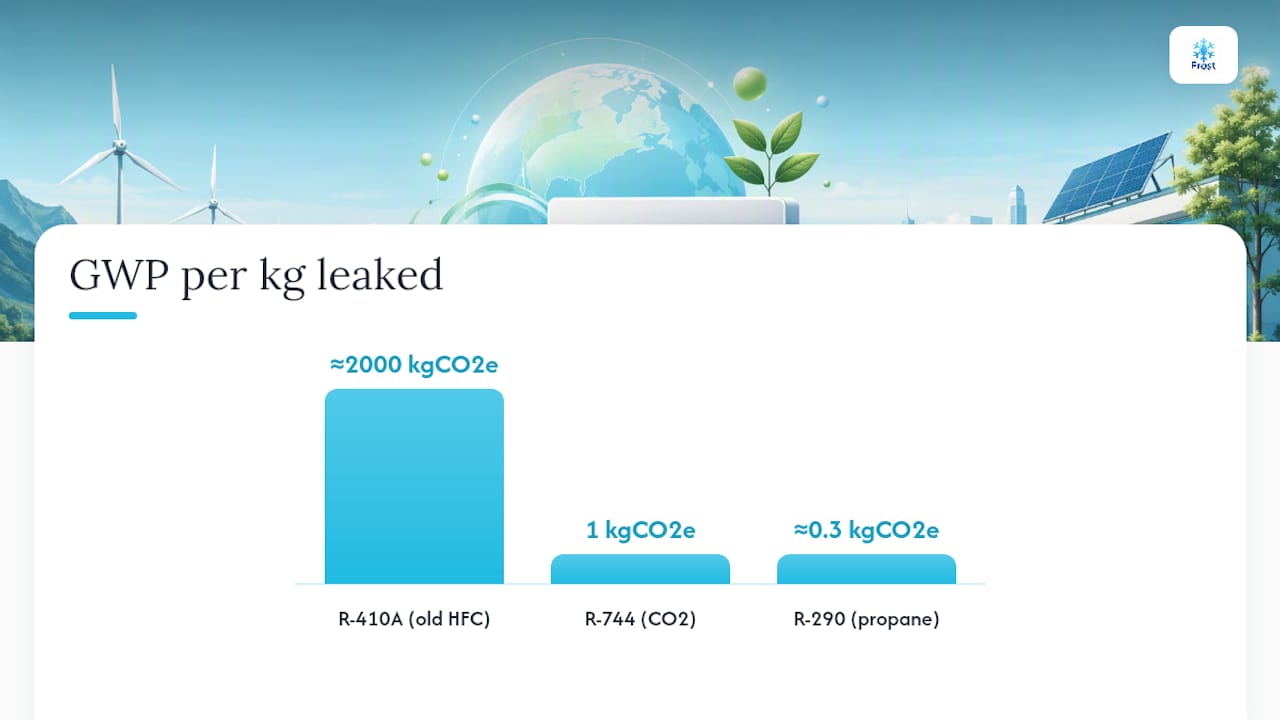
Switching from older R-410A refrigerant to R-290 (propane) cuts the equivalent CO2 impact of a leaked kilogram from around 2,000 kg CO2e down to roughly 0.3 kg CO2e. That's not a rounding error. It's the difference between a leak being a minor maintenance issue and a genuine environmental incident.
The main low-GWP options homeowners are likely to encounter:
- R-290 (propane) — very low GWP, but classed safety Group A3 (flammable), so it demands a competent, certified installer
- R-744 (CO2) — GWP of 1, safety Group A1 (non-flammable), but runs at much higher system pressures
- HFO blends — significantly lower GWP than older HFCs, generally A1 or mildly flammable A2L, increasingly common in new equipment
The European Commission's guidance on climate-friendly refrigerants sets out GWP and safety group data for each option, and it's worth a look if you want to check what your installer is proposing against the official figures.
Regulatory context: the Kigali Amendment and the UK's ongoing F-gas phase-down are steadily restricting high-GWP refrigerants from the market, which is why circular lifecycle management of refrigerants, not just efficient equipment, is becoming central to how the industry talks about sustainability.
Flammable refrigerants like R-290 aren't dangerous in a well-designed system, but they do mean the installer needs proper F-gas and REFCOM certification, and any old refrigerant needs recovering and recycling responsibly rather than vented. For more on what's actually inside your unit, see this explainer on air conditioner gas and what it means for UK homeowners.
Can solar power or passive cooling cut emissions further?
Pairing air conditioning with on-site solar generation is one of the most effective levers available to a homeowner, because it tackles the indirect emissions side of the equation that refrigerant choice can't touch.
Life-cycle work on solar-assisted cooling has found reductions of up to 80% in greenhouse gas impact for some setups, though the same research flags trade-offs in other impact categories like eutrophication, so it's not a free lunch across every metric.
A few passive measures worth doing regardless of what system you choose:
- Shade south and west-facing windows with external blinds or awnings, which block heat before it enters rather than fighting it once inside.
- Fit reflective or lighter roof finishes where practical; research on urban cooling has shown white and green roofs meaningfully cut building heat gain.
- Use night ventilation in summer to flush out heat before the day's cooling load builds.
- Add ceiling fans to rooms with AC, since moving air lets you raise the thermostat a degree or two without losing comfort.
- Improve loft and cavity insulation, which reduces both heating and cooling demand year-round.
Researchers reviewing global cooling demand have warned that efficiency gains alone may not be enough to keep pace with rising AC uptake unless renewables and demand reduction scale alongside it. For a deeper look at combining solar with cooling, see why renewable-paired air conditioning is gaining ground in UK homes.
What does eco friendly air conditioning actually cost to run?
Upfront costs vary with system type and complexity. A single-room split system with a straightforward install sits at the lower end; a whole-house heat pump with electrical upgrades and internal pipework costs considerably more, though it often replaces a heating system too, which changes the comparison.
Running costs come down to a handful of variables: the system's seasonal efficiency rating, how you set the thermostat, how much the home is occupied during peak heat, and the carbon intensity of the electricity grid at the time you're drawing power. As the UK grid gets cleaner, the same kilowatt-hour of electricity carries a shrinking carbon footprint each year, which quietly improves the case for electric cooling over time.
As an illustrative example only: a household replacing an old, inefficient single-speed unit with a modern inverter system and adding a modest solar PV array could realistically see both its electricity bill and its cooling-related CO2e fall by roughly a third to a half, depending on usage patterns and local sunshine hours. Real figures depend entirely on your specific setup.
Quick levers that reduce running costs without new equipment:
- Book annual servicing to catch refrigerant leaks and dirty filters early
- Fit a smart thermostat with scheduling rather than running on manual override
- Get sizing checked against a proper room-by-room load calculation, not a rule of thumb
The IEA's cooling outlook makes clear why efficiency matters at scale: global AC stock is set to grow sharply, and every inefficient unit added compounds electricity demand for decades. More on trimming your own running costs is in this guide to boosting air conditioning efficiency at home.
What should you ask an installer before choosing a system?
A good installer will welcome these questions. A vague or defensive answer to any of them is worth noting.
- Are you F-gas and REFCOM certified for the refrigerant you're proposing?
- Which refrigerant will you use, and why is it the right choice for this property?
- Can I see the room-by-room load calculation, not just a quote based on square footage?
- What's the manufacturer's warranty, and does it require annual servicing to stay valid?
- How will old refrigerant be recovered and disposed of at end of life?
Watch for these red flags:
- No written load calculation offered, just a verbal estimate
- A quote significantly below competitors with no explanation for the gap
- Reluctance to confirm F-gas or REFCOM certification in writing
- No mention of a maintenance plan or servicing schedule
An installer's view: two mistakes that undo the efficiency gains
The two issues we see most often on retrofits are incorrect sizing and poor ductwork sealing. An oversized unit short-cycles constantly, which hammers efficiency and struggles with humidity. Leaky ducting can lose a meaningful share of conditioned air before it even reaches the room. Both are entirely preventable with a proper survey before install day.
Get a greener air conditioning system fitted properly
Frostairconditioning is the practical alternative to guessing your way through refrigerant options and sizing calculations alone. Based in Exeter and covering the South West, our REFCOM and F-gas certified engineers handle everything from load calculations to responsible refrigerant recovery, with same-day installs available when you need cooling sorted quickly.

What that means for an eco friendly install:
- F-gas and REFCOM certified engineers on every job, so refrigerant handling is compliant and safe
- Bespoke system design based on your home's actual layout, not a generic price list
- 0% finance options to spread the cost of a higher-efficiency system
- Annual maintenance contracts to keep performance and refrigerant levels where they should be
If you're ready to see what a properly sized, low-GWP system would cost for your home, request a domestic installation quote and we'll arrange a survey.
Frequently asked questions
Is eco friendly air conditioning more expensive to install? Often slightly more upfront, particularly for heat pump systems, but lower refrigerant leakage risk and better efficiency tend to narrow or close that gap over the system's lifetime.
What is the most eco friendly refrigerant currently available? R-290 (propane) and R-744 (CO2) both carry very low global warming potential, though each comes with its own safety handling requirement that a certified installer manages.
Does an eco friendly air conditioner still need a certified installer? Yes. Flammable and high-pressure refrigerants require F-gas and REFCOM certified handling regardless of how efficient the equipment itself is rated.
Can solar panels fully power a home air conditioning system? Solar PV can offset a significant share of running costs and emissions, especially when paired with an inverter system, though full coverage depends on panel capacity, orientation, and how much cooling the home actually needs.
Sources
- Making leaps towards sustainable air conditioning
- Climate‑friendly alternatives for air conditioning (European Commission)
- CCSI HVAC circularity (policy and lifecycle management)
- An insight into environmental footprints of emerging air‑conditioning systems towards sustainable cities
- The future of cooling (IEA)