
If your building's air conditioning system has a combined effective rated output above the legal threshold of 12 kW, the answer is yes: you need a TM44 inspection carried out regularly, typically around every five years, by an accredited assessor. Skip it and you're operating outside the Energy Performance of Buildings Regulations, full stop.
Before you do anything else, run these checks:
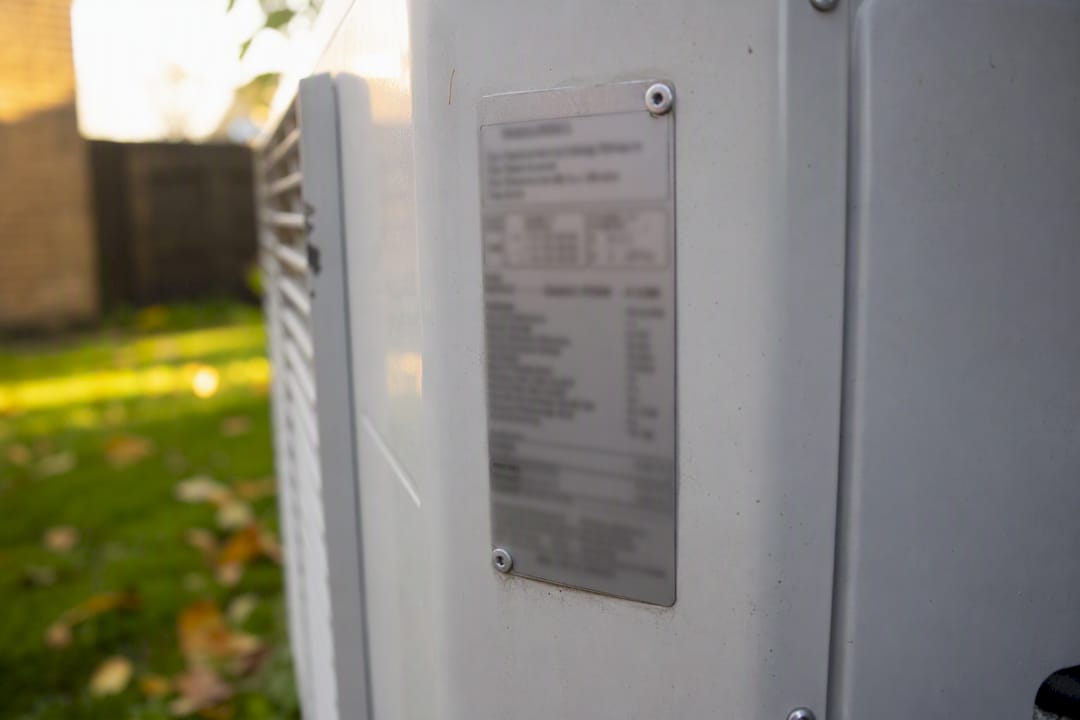
- Pull the rating plates off every indoor and outdoor unit and add up the outputs.
- Dig out your O&M manuals. They usually state effective rated output in kW.
- If the combined figure clears 12 kW, book a compliance check with a registered assessor rather than guessing.
Key Takeaways
TM44 compliance hinges on one number, one interval, and one document trail: 12 kW combined output, five years maximum between inspections, and a lodged report from an accredited assessor.
| Point | Details |
|---|---|
| Check the 12 kW threshold | Add up effective rated output across all units under one controller, not just individual systems. |
| Five-year maximum interval | Book a new inspection before the previous report's five-year window closes. |
| Three-month handover rule | New controllers without a valid report must arrange an inspection within three months of taking control. |
| Use an accredited assessor | Only a Level 3 or Level 4 accredited assessor can produce a report valid for lodgement on the register. |
| Prepare documentation in advance | Gather rating plates, O&M manuals, and maintenance records to cut inspection time and cost. |
Table of Contents
- What is a TM44 inspection and where does it come from legally?
- Who needs a TM44 inspection and how do you work out the 12 kW threshold?
- When must inspections happen, and what changes at handover?
- What happens during the inspection and what must the report include?
- Who can actually carry out a TM44 inspection?
- What are the penalties for skipping a TM44 inspection?
- How do you prepare for a TM44 inspection?
- How Frostairconditioning helps with TM44 compliance
- Where to check the official TM44 guidance
- The gap between the rule and how it's actually followed
- Frequently asked questions about TM44 inspections
- Sources
What is a TM44 inspection and where does it come from legally?
TM44 is the technical guidance CIBSE wrote to standardise how air conditioning systems get assessed for energy efficiency in the UK. It tells assessors what to inspect, how to grade findings, and what a valid report has to contain. On its own, TM44 is just a methodology document. What turns it into a legal obligation is the Energy Performance of Buildings Regulations, which implement the EU's Energy Performance of Buildings Directive in UK law.
The directive requires member states to set up regular inspection regimes for air conditioning above a defined size threshold. The UK chose 12 kW combined effective rated output as that line, and CIBSE TM44 became the accepted technical standard for meeting it. That's why you'll see two names attached to every TM44 conversation: CIBSE, because they wrote the inspection methodology and reporting templates, and GOV.UK, because the statutory guidance sets out who must comply, when, and what happens if they don't.
It's worth separating the two roles clearly. CIBSE TM44 tells an assessor how to check plant sizing, controls, and efficiency, and what format the report should follow. GOV.UK guidance tells building owners what the law actually requires: the 12 kW trigger, a maximum interval of five years, and the penalties for non-compliance. Later revisions to the TM44 methodology fed directly into the statutory lodgement templates now used across England and Wales, so the two documents have effectively merged into one compliance pathway.
If you own or manage a building with any mechanical cooling, this matters more than it sounds. A lot of building owners assume "air conditioning inspection" means a service visit from an engineer with a gauge and a hose. It doesn't. A TM44 assessment is an energy performance audit, closer in spirit to an energy performance certificate than to routine maintenance, and it carries its own legal weight independent of whether your system has been serviced recently.
Who needs a TM44 inspection and how do you work out the 12 kW threshold?
"Effective rated output" is the figure manufacturers stamp on the rating plate or list in the technical data sheet, usually expressed in kW of cooling capacity. It's not the electrical input power, and it's not the same as the compressor's motor rating, so check the plate carefully rather than reading off an invoice or a nameplate wattage figure that measures something else entirely.
The part that catches people out is aggregation. If you control several units, whether that's four splits scattered through an office or a dozen cassette units across a retail unit, you add their outputs together. A building with eight 2 kW wall splits under single ownership has a combined output of 16 kW, comfortably over the threshold, even though no individual unit looks remotely significant on its own. Controlled Climate's guidance on the 12 kW rule flags this as one of the most common reasons sites slip into scope without anyone noticing.
The rule of thumb is control, not location. If one person, company, or landlord is responsible for all the units, they get combined for the purposes of the threshold, regardless of whether they're in one room or spread across three floors.
Here's a short checklist to work out where you stand:
- List every air conditioning unit in the building and note who is responsible for it.
- Record the effective rated output from each rating plate or O&M manual.
- Group units by controller (landlord, tenant, or managing agent) rather than by room.
- Add up each group's total output.
- If any single controller's total exceeds 12 kW, that person needs a TM44 inspection.
Pro Tip: Keep a running spreadsheet of unit outputs and locations as part of your asset register. It turns a threshold calculation that takes half a day into a five-minute lookup next time you need it.
If a landlord controls the communal system and a tenant controls their own split units separately, you may end up with two distinct assessments rather than one combined figure. Check your lease and service agreements to confirm who legally controls what.
When must inspections happen, and what changes at handover?
The regulations set a maximum interval of five years between inspections. That's a ceiling, not a target: nothing stops you inspecting more often, and a system with recurring faults or heavy use is often better served by a shorter cycle.
The trickier trigger is a change of control. When responsibility for a system passes to someone else, such as a new owner, a new tenant, or a managing agent taking over a portfolio, the incoming controller must obtain a valid inspection report promptly when control changes and no valid report is available. This handover rule exists precisely because responsibility for compliance moves with control of the system, not with the original inspection date.
Handover checklist for anyone involved in a transfer:
- Outgoing party: hand over the most recent TM44 report, plus any O&M documentation, before completion or lease end.
- Incoming party: confirm the report's date and check it's within the five-year window.
- If no valid report exists, book an assessor within the three-month window rather than waiting for a scheduled review.
- Keep a dated paper trail of what was handed over and when, ideally referenced in the sale contract or lease.
Solicitors and letting agents don't always flag this during a transaction, so it tends to fall on the building owner or facilities manager to chase it up. Don't assume silence means it's been dealt with.
What happens during the inspection and what must the report include?
A TM44 assessment isn't a quick visual check. Assessors work through the system methodically, and a typical visit covers three broad stages.
- Documentation review. The assessor checks existing O&M manuals, previous inspection reports, and maintenance logs to understand system history and design intent.
- Plant inspection. This covers a physical walk-through of indoor and outdoor units, checking condition, accessibility, and whether installed equipment matches the documentation.
- Controls and sizing assessment. The assessor evaluates whether the system is correctly sized for the space it serves and whether controls are set up to run efficiently, rather than simply running flat out regardless of demand.
The finished report has to contain specific elements, not just a pass or fail. It must record the assessor's findings on overall system efficiency, an assessment of whether the plant is correctly sized for the building's actual cooling demand, and a set of recommendations for cost-effective improvements, ranging from control upgrades to full plant replacement where the case is strong enough. CIBSE's TM44 methodology sets the template these reports follow, which is why a report produced anywhere in the country should look broadly the same in structure.
What TM44 is not is a substitute for servicing. A service visit checks refrigerant levels, cleans filters, and keeps the system running day to day. A TM44 inspection asks a completely different question: is this system efficient, correctly sized, and worth the energy it's consuming? You can have a beautifully maintained system that still fails on sizing or efficiency grounds, and a report exists to say so.
One detail that surprises a lot of building owners: the EIC Partnership notes that enforcement bodies have issued fixed penalty notices issued for non-compliance, commonly around a few hundred pounds, and repeated failures can attract further penalties on top.
Who can actually carry out a TM44 inspection?
Not every heating and cooling engineer can produce a valid TM44 report. The assessor has to be a current member of an approved accreditation scheme, and the report only counts as valid once it's lodged on the national register.
- Accreditation runs across different levels, broadly split between Level 3 and Level 4 assessors, with Level 4 covering more complex or larger systems and typically requiring deeper technical qualification.
- Only an assessor accredited at the appropriate level for your system size and complexity can legally sign off the report.
- Approved schemes vet and monitor their members, which is the mechanism that gives the report legal standing rather than treating it as a private opinion.
- A report that isn't lodged doesn't count, even if a qualified assessor produced it. Lodgement is what makes it checkable and enforceable.
- You can verify a report's status by checking the register reference the assessor provides, rather than taking their word for it.
This matters because it's tempting to fold TM44 into a general maintenance contract and assume whoever services your units can also sign off the inspection. Some can. Many can't, particularly for larger or more complex systems that need Level 4 accreditation. Always ask directly whether the person quoting for the work holds current accreditation for the size of system you have, and ask for their scheme membership reference before they start. If you're reviewing standards across the industry more broadly, our guide to air conditioning industry standards covers how accreditation schemes fit into the wider compliance picture.
What are the penalties for skipping a TM44 inspection?
Enforcement typically works through fixed penalty notices, and non-compliance isn't a one-off risk that quietly goes away. Fines in the region of £300 have been recorded for individual breaches, and repeated or ongoing non-compliance can attract further penalties on separate occasions rather than a single fixed cost.
The compliance failures that come up again and again aren't exotic. They're the boring, avoidable ones:
- Treating multiple small units as individually exempt instead of aggregating their output under one controller.
- No record of a previous inspection, or a report that's quietly lapsed past the five-year mark without anyone noticing.
- Reports produced by someone without valid accreditation, making them worthless even though the work was done.
- No lodgement on the register, meaning the report can't be verified even if it exists somewhere on file.
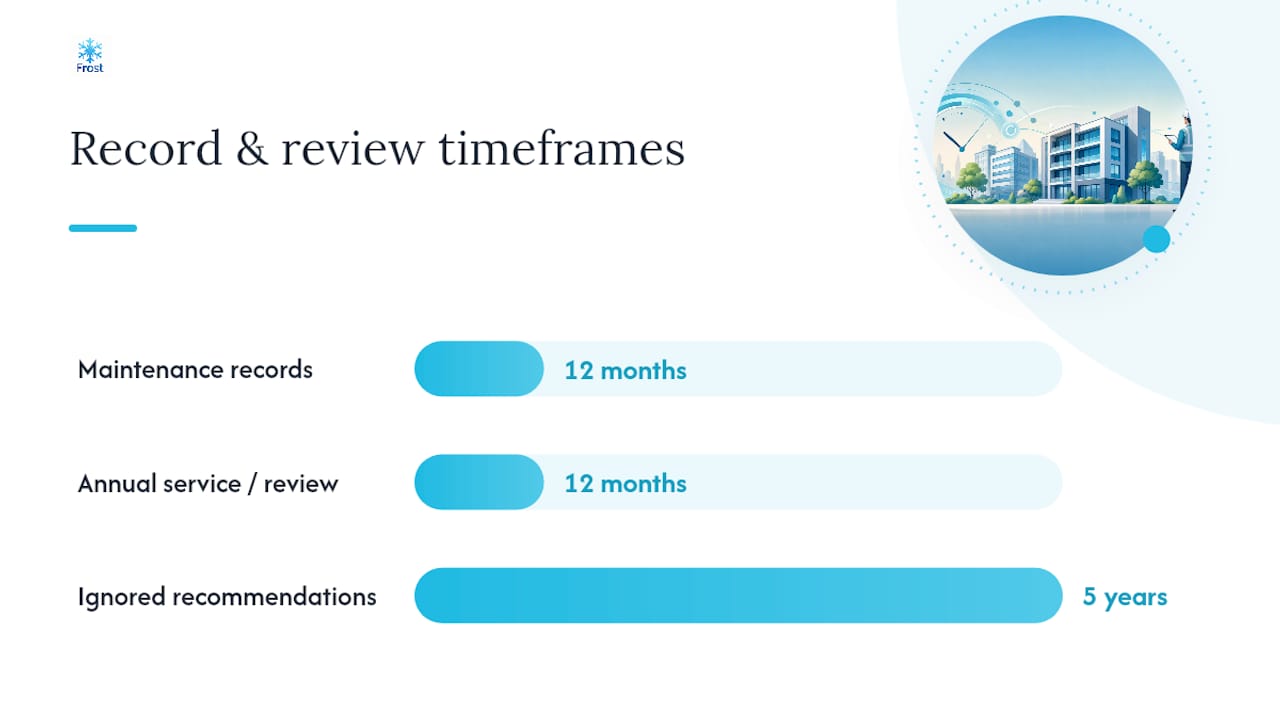
Most of this is a records problem rather than a technical one. A simple annual review of your air conditioning asset register, cross-checked against your last inspection date, closes off the majority of these risks before they become a fine.
How do you prepare for a TM44 inspection?
A well-organised site can shave real time off an assessor's visit, and a disorganised one can drag a straightforward inspection into a second trip. Preparation is mostly paperwork and access, not technical skill.
- Gather rating plates or photograph them clearly if the units are in awkward locations.
- Locate O&M manuals for every system component, including controls.
- Pull together maintenance records for at least the past twelve months.
- Find any previous TM44 report so the assessor has a baseline to compare against.
- Arrange basic servicing beforehand if units are overdue, since a poorly maintained system can generate more negative findings than necessary.
- Clear physical access to plant rooms, roof units, and any equipment behind locked doors or storage.
- Label assets clearly if you manage a large or multi-tenant site, so the assessor isn't hunting for which unit belongs to which area.
Pro Tip: Once you get the report, don't file it and forget it. Log every recommendation into your existing maintenance schedule with a target date, and revisit that list at your next annual service. Recommendations that sit untouched for five years tend to reappear, worded more urgently, in the next report.
Basic efficiency measures, such as improving how your system is used day to day, often address a chunk of an assessor's recommendations before you've even spent money on new equipment.
How Frostairconditioning helps with TM44 compliance
Frostairconditioning is an installation and maintenance specialist based in Exeter, covering Devon, Cornwall, and the wider South West, not an energy assessor. Where we come in is everything a TM44 report tends to recommend afterwards.
- Domestic and commercial installation of premium systems from Samsung, Mitsubishi, Toshiba, and Daikin, useful if a report flags an undersized or inefficient unit for replacement.
- Shop fitting and bespoke system design for retail premises that often fall into TM44 scope through aggregated unit outputs.
- Annual maintenance contracts that keep systems in the condition assessors expect to see, reducing the chance of adverse findings.
- REFCOM and F-Gas certified engineers, 0% finance on qualifying installations, and same-day or next-day response for urgent work.
If your last inspection flagged sizing or efficiency issues, our service and maintenance page is the natural next step, and our domestic installation service covers full system replacement where that's the recommended fix. Get in touch through our quote page and we'll talk through what a report actually means for your building in plain terms.
Where to check the official TM44 guidance
For anything you're unsure about, go straight to the primary sources rather than relying on secondhand summaries.
- Gov sets out the statutory requirements and threshold.
- CIBSE TM44 guidance covers the technical inspection methodology and reporting standards.
- The EPB Regulations implementation report explains timing rules and handover obligations in more detail.
If you're checking whether a specific report is valid, the national register is the authoritative source, not the assessor's own paperwork.
The gap between the rule and how it's actually followed
The 12 kW threshold reads like a simple test, and that's exactly why so many buildings fall foul of it. Nobody sits down and deliberately ignores a 20 kW rooftop chiller. What actually happens is quieter: eight small splits get installed over several years by different contractors, nobody adds up the total, and the building drifts into scope without a single decision being made.
Conventional advice treats TM44 as a paperwork exercise you deal with when a report is due. That's backwards. The report is the least useful part of the process if nothing changes afterwards. The buildings that get genuine value from TM44 are the ones that treat the assessor's recommendations as a maintenance plan, not a filing exercise.
If you manage a multi-unit site, spend an afternoon totting up your outputs by controller before you worry about anything else. That single calculation resolves more compliance uncertainty than any amount of reading about accreditation levels or lodgement processes.
Frequently asked questions about TM44 inspections
Do I need a TM44 inspection for a single small split unit? Only if its effective rated output, combined with any other units under the same controller, exceeds 12 kW. A single 3.5 kW domestic split on its own typically won't trigger the requirement.
How often does a TM44 inspection need renewing? At least once every five years, though a shorter interval is sensible for systems with recurring issues or heavy operational demand.
What's the difference between a TM44 inspection and a routine service? A service checks refrigerant levels, filters, and general condition. A TM44 inspection assesses energy efficiency, correct sizing, and produces formal recommendations, and it carries separate legal weight.
Who is legally responsible for booking the inspection? The "relevant person" or controller, typically the building owner, occupier, or whoever has operational control of the system, is responsible for arranging and paying for it.
Can any air conditioning engineer carry out a TM44 assessment? No. Only assessors who are current members of an approved accreditation scheme, at the appropriate level for the system's size, can produce a report valid for lodgement.
Sources
- Gov
- TM44 Inspection of air conditioning systems – CIBSE
- Implementation report – EPB Regulations (GOV.UK assets)
- TM44 air conditioning inspections | 12kW rules, frequency & compliance – Controlled Climate