
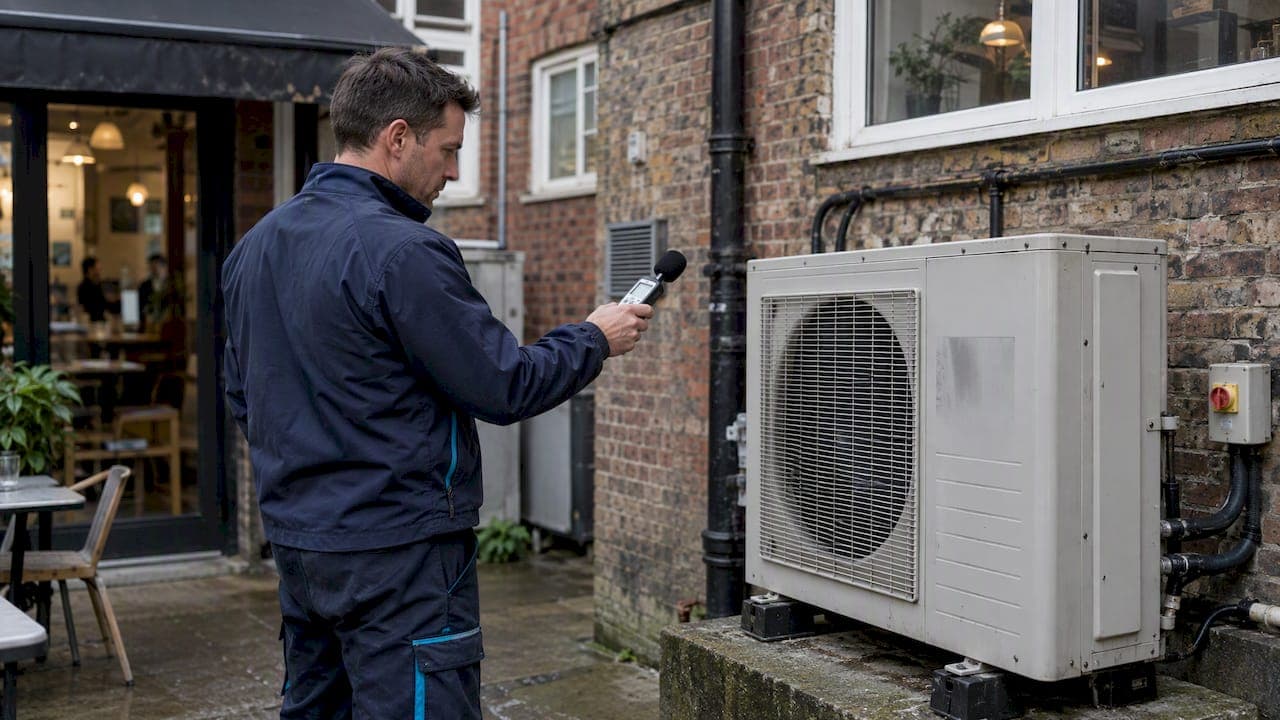
For most UK cafés, a professionally designed split or ducted system indoors, paired with a purpose-planned terrace solution such as misting or shaded fans, gives you the fastest reliable route to a comfortable room. Before anything goes on a wall or a condenser gets fixed outside, check HSE workplace temperature rules, F-Gas obligations and your council's planning and noise expectations. Book a site survey with an F-Gas certified installer as your first practical step.
TL;DR:
- Most café condensers need planning permission; town centre sites may need acoustic checks, with limits 10 dB below background or 15 dB for tonal noise.
- Use separate controls for kitchen and seating areas, and balance canopy extraction with replacement air; otherwise, conditioned air can escape through the canopy.
- High pressure misting with 10 to 20 micron droplets can cool terraces by around 10 to 12°C in dry weather, but works poorly in humidity.
- Keep refrigerant records for five years; leak checks are annual from 5 tonnes CO2e, every six months from 50 tonnes, and quarterly from 500 tonnes.
Table of Contents
- Indoor cooling options for cafés: split, multi-split, cassette and ducted explained
- Planning permission and noise limits for external plant in the UK
- Kitchen extraction, make-up air and how cooling interacts with your kitchen
- Outdoor terrace cooling: misting, fans and outdoor AC compared for UK terraces
- Decision checklist: commissioning, F-Gas obligations and service plans
- Practical perspective from an installer: why certification and local experience matter
- Installation, design and maintenance steps that keep a system working
- Cost overview of café cooling solutions including installation and ongoing maintenance
- Timeline from initial consultation to installation completion for café air conditioning
- Financing options available including details on 0% finance offers
- Criteria and questions to ask when selecting a commercial air conditioning installer
- Benefits of choosing F-Gas certified installers and certified maintenance contracts
- Same-day installation availability and its implications for business continuity
- What the industry gets wrong about cooling a café
- If you want help with a compliant cooling installation
- FAQ
- Sources
Indoor cooling options for cafés: split, multi-split, cassette and ducted explained
Most cafés fall into one of two layouts: a single open room, or a room with a counter zone, seating area and a small kitchen behind it. The system you choose should match that layout rather than the other way round.
A single split system, one outdoor condenser paired with one indoor unit, suits a small café with one open space and no need for separate temperature zones. A multi-split system runs several indoor heads from one outdoor condenser, which works well when you want to cool the seating area and counter separately, or keep noise and airflow low near a till point.
Ceiling cassette units sit flush in the ceiling and distribute air across an open-plan café, which can give more even coverage than a single wall-mounted unit. Concealed ducted systems hide the indoor unit above a suspended ceiling and distribute air through short duct runs and grilles, which keeps the visible footprint to a few discreet grilles, useful where the fit-out has a particular look to protect.
Portable units and small evaporative coolers rarely do a convincing job in a customer-facing café. They struggle with the heat load from coffee machines, ovens and a room full of people, and the hose or water tank becomes a practical nuisance in a working space.
- Avoid pointing supply grilles directly at seated tables or counter displays, since a stream of cold air on customers or cakes causes more complaints than warmth does.
- Match the system type to how the room is zoned, not just to its floor area.
- A measured survey before fit-out helps place units correctly first time, which matters more in a tight café layout than in an open warehouse.
Planning permission and noise limits for external plant in the UK
Most commercial condenser installations need planning permission, and town centre or high street premises often also need a noise impact assessment before the council will approve an external unit. This catches out operators who assume aircon is a straightforward "permitted development" job, when in practice a shop or café unit frequently is not.
A typical application includes site plans and elevations showing the condenser position, the manufacturer's sound data for the specific model, and an assessment carried out to BS 4142 methodology. Councils commonly set a condition that plant noise sits around 10 dB below the existing background level at the nearest noise-sensitive property, tightening to 15 dB where the noise has a tonal quality.
- Acoustic enclosures and anti-vibration mounts are the most common fixes when a condenser is too close to neighbouring premises.
- Restricting operating hours is a frequent planning condition on units near residential flats above or beside a café.
- Choosing a quieter model at the outset is cheaper than retrofitting an enclosure after a complaint.
Pro Tip: Get acoustic advice before you submit a planning application, not after a neighbour complains: enforcement action costs far more than a survey.
Kitchen extraction, make-up air and how cooling interacts with your kitchen
A café kitchen's canopy extraction exists to remove cooking fumes and heat at source, and that job has to keep working once cooling goes in. Installing air conditioning without checking the extraction balance can pull conditioned air straight out through the canopy, wasting capacity and leaving the room no cooler.
HSE ventilation guidance for catering kitchens sets out that extraction needs matching make-up air, rather than relying on open doors or a stray fan, and that this balance also protects the safe operation of any gas combustion appliances in the kitchen.
- Direct cooling towards the hot work area (griddles, coffee machines, ovens) rather than spreading capacity evenly across kitchen and front of house.
- Treat the kitchen and the customer seating area as separate cooling loads with their own controls, since their heat gains differ hugely through the day.
- Service the canopy and extraction system regularly, since a clogged filter forces both extraction and cooling to work harder for the same result.
Outdoor terrace cooling: misting, fans and outdoor AC compared for UK terraces
A terrace or outdoor seating area needs a different approach from the room indoors, and the right choice depends on how much shade, space and budget you have.
High-pressure misting systems use very fine droplets, typically 10 to 20 microns, that evaporate in the air rather than settling on tables, and when specified correctly they can cool a terrace zone by around 10 to 12°C. Cheaper low-pressure systems tend to produce larger droplets that wet surfaces and furniture, which is the most common complaint about misting done badly. Misting also loses effectiveness in already humid conditions, so it suits dry, warm spells rather than muggy UK summer days.
Fans are the lowest-cost option and genuinely improve perceived comfort by moving air across skin, but they do little to lower actual air temperature once it climbs well above normal UK summer highs. Outdoor air conditioning units exist and work, but they are energy intensive, visible, and almost always trigger the same planning and noise checks as an indoor system's condenser.
- Check water quality and filtration before installing misting, since hard water clogs the fine nozzles quickly.
- Treat misting as a seasonal system with a realistic payback over a handful of warm months rather than a year-round fixture.
- Pump reliability matters more than nozzle count: a cheap pump failing mid-service is worse than fewer, well-maintained nozzles.
Pro Tip: Trial misting on a small section of terrace first, since droplet size and coverage are easier to adjust before a full installation than after.
Decision checklist: commissioning, F-Gas obligations and service plans
A compliant café cooling project follows a fairly fixed sequence, and skipping steps tends to cost more later than it saves now.
- Commission a site survey and heat load calculation so the system is sized for your actual café, not a generic estimate.
- Check planning and noise requirements for any external condenser before ordering equipment.
- Get a detailed quote and installation schedule that states equipment, warranty and timescales in writing.
- Have a certified engineer install and commission the system, with proper documentation at handover.
Your F-Gas leak-check frequency depends on the refrigerant's CO2-equivalent load: systems holding 5 tonnes CO2e or more need annual checks, 50 tonnes or more need six-monthly checks, and 500 tonnes or more need quarterly checks, with automated leak detection allowed to double those intervals. You are also required to keep accurate refrigerant records, including gas type, quantities and check dates, for at least five years, so an informal breakdown-only approach leaves a compliance gap. Our F-Gas compliance guide covers the checks worth verifying before you commit to an installer.
An annual service contract and a clear emergency response plan reduce the chance of a mid-summer breakdown costing you trading days. Budget for landlord consent and, in listed or conservation-area buildings, extra planning scrutiny on where condensers and ductwork can go.
Pro Tip: Ask your installer to confirm the refrigerant charge and resulting leak-check interval in writing before signing, so you know your ongoing legal obligation from day one.

Practical perspective from an installer: why certification and local experience matter
Hiring an F-Gas certified, REFCOM-registered engineer is not a box-ticking exercise. It means your refrigerant handling, leak checks and record-keeping are legally sound, and it means whoever signs off your installation is accountable for the work.
Using one supplier for survey, planning input, acoustic mitigation and ongoing service cuts the number of parties who can point fingers when something does not line up on site.
Installation, design and maintenance steps that keep a system working
A good installation starts with a free site survey, where an engineer measures the room, checks available power and condenser positions, and calculates the heat load from equipment, glazing and footfall. That survey should also flag likely planning or noise issues before a quote is written, rather than after.
Placement decisions follow the survey: indoor units go where airflow reaches seating and counter areas evenly without blowing directly on customers, and outdoor condensers go where noise and visual impact are lowest. A detailed quote then sets out equipment, warranty terms and an installation date.
Once fitted, the system needs commissioning, checking refrigerant charge, airflow and controls match the design before engineers hand over documentation. From there, a service contract covering filter cleaning, refrigerant checks and performance testing keeps the system running efficiently and keeps your F-Gas records up to date. Our guide on recommended aircon service frequency sets out how often that servicing should happen for different system sizes.
Cost overview of café cooling solutions including installation and ongoing maintenance
Costs for café cooling vary with system type, café size and how much external work (planning, acoustic mitigation, ductwork) the job needs, so we do not quote a generic figure here: a free site survey and written quote is the only reliable way to know your number. What drives the price is consistent across jobs: the size and number of indoor units, the complexity of the condenser location, and whether ducting or cassette work is involved.
Ongoing costs centre on your service contract and any F-Gas leak checks your refrigerant charge requires by law. Budgeting for regular servicing rather than waiting for a breakdown tends to be the cheaper route over the life of a system, since a neglected filter or low refrigerant charge makes a unit work harder and wear out faster.
Financing is available to spread the upfront installation cost rather than paying it in one go, which we cover in the next section.
Timeline from initial consultation to installation completion for café air conditioning
A typical café project starts with a free site visit to survey the space and discuss layout, budget and timing. From there, you receive a written quote setting out the equipment, any planning or acoustic work needed, and a proposed installation date.
If planning permission or a noise assessment is required for an external condenser, that approval stage runs in parallel and can take longer than the physical installation itself, so it is worth starting early rather than leaving it until equipment has arrived. Where no planning application is needed, straightforward café installations can often be completed with same-day or next-day fitting, minimising disruption to trading.

Commissioning, checking the system performs as designed and handing over documentation, happens on completion, so you have a working system and the paperwork your F-Gas obligations require from day one.
Financing options available including details on 0% finance offers
We offer 0% finance on air conditioning installations, which lets you spread the cost of a new system without paying the full amount upfront. This matters for café owners weighing cooling against other seasonal costs, since it turns a large one-off expense into a predictable monthly commitment instead.
Current finance details are on our website, so the figure you are shown reflects your actual installation rather than a generic estimate. Combining finance with a service and maintenance plan means both the upfront and ongoing costs of keeping your café comfortable are planned for rather than left to chance.
Criteria and questions to ask when selecting a commercial air conditioning installer
Ask whether the installer and its engineers hold F-Gas certification and REFCOM registration, since this confirms they are legally qualified to handle refrigerant and carry out leak checks and records on your behalf. Ask whether they use their own engineers or subcontractors: a single accountable team tends to mean fewer gaps between survey, installation and aftercare.
Check whether a free site survey and written quote are included before you commit, and whether that quote covers planning or acoustic work if your premises needs it. Ask about installation timescales and what happens if planning approval is needed first.
Finally, ask what maintenance and emergency cover looks like after installation. A contract that includes servicing and breakdown response protects both your equipment and your legal F-Gas obligations over the system's working life.
Benefits of choosing F-Gas certified installers and certified maintenance contracts
F-Gas certification is a legal requirement for anyone handling refrigerant in stationary air conditioning systems in the UK, and it directly affects your café's own compliance. An installer who holds this certification, alongside REFCOM registration, can legally carry out the leak checks your system's refrigerant load requires and keep the records you are obliged to retain for at least five years.
A certified maintenance contract extends that benefit over the system's whole life rather than just at installation. Regular servicing catches refrigerant leaks, worn filters and failing components before they cause a breakdown, which matters most during a hot spell when your café most needs cooling to work. Our article on commercial aircon compliance for property managers sets out the F-Gas and TM44 thresholds that apply once a system passes a certain cooling capacity.
Same-day installation availability and its implications for business continuity
For some café layouts, particularly a straightforward split or multi-split system with no planning hurdle, installation may be completed promptly. That matters because a café cannot easily close for several days mid-season without losing trade, so minimising disruption is as important as the system itself.
Prompt fitting works best when the survey has already confirmed unit positions, power availability and that no planning or acoustic condition applies, since those checks can otherwise delay the job. Where planning approval is needed, the physical installation may still be completed promptly once approval comes through, even if the overall project timeline is longer.
Asking an installer directly whether same-day fitting suits your specific premises, rather than assuming it applies to every job, avoids a mismatch between expectation and what the survey actually finds.
What the industry gets wrong about cooling a café
Most advice on cooling a café treats it as a hardware decision: pick a system, get it fitted, done. The bigger risk sits in the steps either side of the hardware, the planning application nobody budgeted time for, the noise condition discovered after a neighbour complains, the F-Gas record that does not exist because nobody was told to keep one.
The conventional advice also tends to undersell terrace cooling, treating it as an afterthought when UK café trade increasingly depends on outdoor seating through the warmer months. A terrace that is unusable on a hot afternoon is lost revenue, not just lost comfort.
If there is one thing to prioritise, it is sequencing: survey and compliance checks first, equipment choice second. Get that order wrong and even a well-chosen system ends up delayed, modified after the fact, or in breach of a condition nobody checked for.
— James
If you want help with a compliant cooling installation
If you run a café in Exeter or the wider South West and want a cooling system that is correctly sized, properly planned and legally compliant from day one, our team can help.
- 0% finance to spread the cost of installation, and F-Gas certified engineers.
Get in touch to arrange a free site survey or request a quote for your café.
FAQ
Do I need planning permission for a café air conditioning unit?
Most commercial condenser installations on shops and cafés need planning permission, and town centre premises often also need a noise impact assessment. Check with your local planning authority before ordering equipment, since this stage can take longer than the installation itself.
How often do F-Gas leak checks need to happen?
Leak check frequency depends on your system's CO2-equivalent refrigerant load: 5 tonnes or more requires annual checks, 50 tonnes or more requires six-monthly checks, and 500 tonnes or more requires quarterly checks. Automated leak detection can double the interval between manual checks.
What minimum temperature does HSE require in a café workplace?
HSE guidance states employers must provide a reasonable working temperature, typically at least 16°C, or 13°C where the work is strenuous. There is no statutory upper limit, but employers must act when high temperatures create a health risk.
Will misting cool my café terrace in the UK climate?
Correctly specified high-pressure misting, using very fine droplets, can cool an outdoor seating area by around 10 to 12°C in warm, dry conditions. It loses effectiveness in humid weather and needs proper water filtration to avoid nozzle clogging.
Can air conditioning affect my kitchen's extraction system?
Yes, cooling that is not balanced against extraction can pull conditioned air straight out through the kitchen canopy, wasting capacity. HSE catering ventilation guidance recommends matching extraction with proper make-up air rather than relying on cooling or fans alone.