
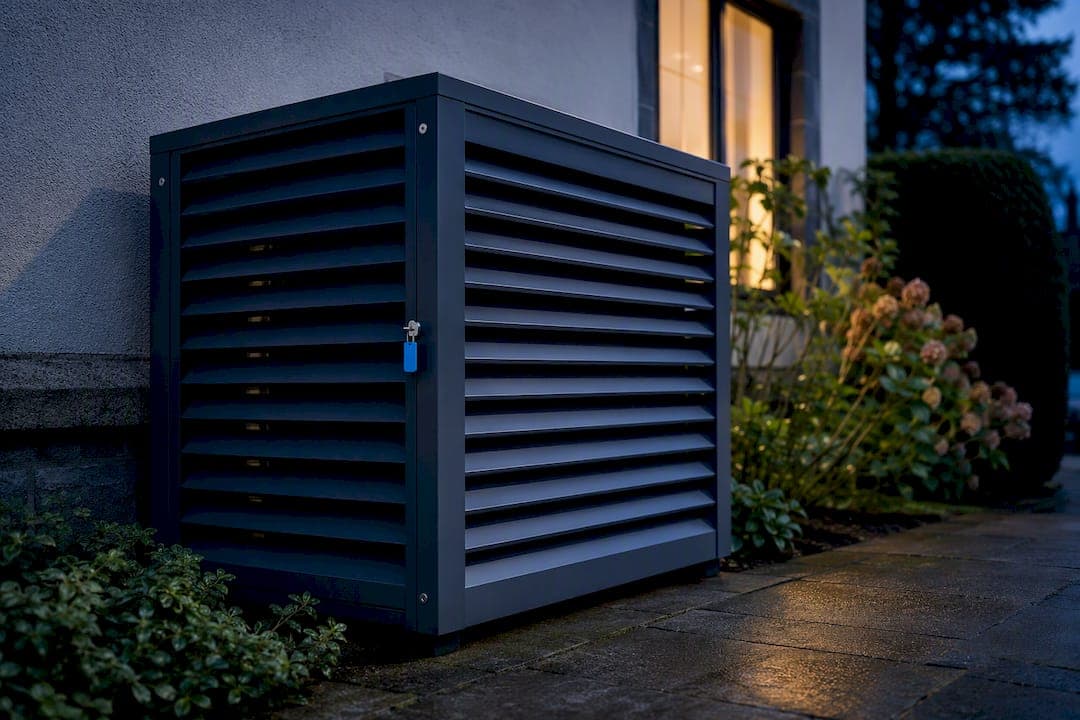
An acoustic enclosure can help, but not every option is safe for every home. Retail covers, engineered enclosures with manufacturer approval, freestanding barriers and vibration isolation each suit different situations, and using the wrong one can restrict airflow or void your warranty. If your unit sits near a neighbour's window or a bedroom, get a site survey before buying anything.
TL;DR:
- Retail covers are affordable and quick to install but lack standardized noise attenuation data and may trap heat, risking increased fan noise.
- Engineered enclosures, approved by manufacturers, offer better noise reduction but are more costly, complex to install, and require clearance checks.
- Freestanding barriers are effective when line of sight is the main noise source and generally easier to install without airflow restrictions.
- Proper acoustic enclosures must balance noise reduction with airflow, as sealing too tightly can increase heat and energy costs, potentially making the unit louder.
- An acoustic survey is essential when units are near neighbours' windows or during planning applications, ensuring solutions are tailored and effective.
Table of Contents
- Comparing your options for reducing aircon noise
- How acoustic enclosures work and where they can backfire
- When you need an acoustic survey and what councils expect
- What to give your installer for an accurate quote
- Local, F-Gas certified expertise behind this guidance
- Keeping an enclosure working for years, not months
- What installation looks like on a commercial site
- Does it matter which brand or unit type you have
- Will an enclosure change your running costs
- Why "just buy a cover" is the wrong first instinct
- How Frost Air Conditioning can help with noise problems
- Sources
- FAQ
Comparing your options for reducing aircon noise
Not every noise problem needs the same fix. A unit rattling against a wall bracket needs vibration isolation, not a cover; a unit facing straight at a neighbour's bedroom window may need a proper barrier or an engineered enclosure with manufacturer sign-off.
Retail covers are the cheapest and quickest option, and they are widely sold for mini split and heat pump condensers, marketed on noise reduction and weather protection. The trouble is that they carry no standardised attenuation data, so they are a poor choice where planning conditions or a difficult neighbour are involved. Engineered enclosures sit at the other end: they are designed around a specific model, tested for airflow, and approved by the manufacturer to preserve clearances. The Nuaire MRXBOXAB-ECO3-1Z is one example available with an acoustic enclosure in the UK market, illustrating what a purpose-built product looks like rather than a generic add-on.
Freestanding acoustic barriers work differently again: instead of wrapping the unit, they break the line of sight between the condenser and the affected window. Vibration isolation tackles a separate problem entirely, structure-borne noise transmitted through brackets, pipework or a solid wall.
- Retail covers: low cost, fast to fit, but no standard test data and a real risk of trapping heat.
- Engineered enclosures: manufacturer-approved, better attenuation potential, but higher cost and installation complexity.
- Freestanding barriers: effective where line of sight is the main issue, and relatively simple to install if there's space.
- Vibration isolation: cheap and effective for structure-borne noise, but does nothing for airborne fan noise.
| Solution | Typical attenuation | Airflow/thermal risk | Space needed | Installation complexity and cost |
|---|---|---|---|---|
| Retail cover | Unverified, variable | Moderate to high | Minimal | Low complexity, low cost |
| Engineered enclosure | Manufacturer-tested | Low, if clearances kept | Moderate | High complexity, higher cost |
| Freestanding barrier | Depends on placement | None | Moderate to large | Low to moderate complexity and cost |
| Vibration isolation | Not applicable to airborne noise | None | Minimal | Low complexity, low cost |
For a terraced house with a unit close to a boundary, either a barrier or an engineered enclosure tends to be the safer route. For a detached property with more garden space, a well-placed barrier alone may solve the problem without touching the unit itself.
How acoustic enclosures work and where they can backfire
An enclosure reduces noise through three mechanisms: adding mass to block sound transmission, adding absorbent lining to soak up reflections, and breaking the direct line of sight between the fan and the listener. Done properly, all three combine to cut what a neighbour actually hears.
The trade-off is airflow. Sealing a unit too tightly increases the work the fan has to do, raises the heat-exchanger temperature and can make the unit run louder rather than quieter, according to guidance from Heatscape on enclosure design. An engineered intake and exhaust path, rather than a fully sealed box, is what avoids this.
- Mass and absorption reduce airborne noise but must not block airflow paths.
- Breaking line of sight helps with reflected and directional noise.
- Structure-borne noise (through brackets or pipework) needs vibration isolation, not an enclosure.
Pro Tip: If the noise sounds different indoors than outdoors, structure-borne vibration is often the real culprit, and no enclosure will fix it.
When you need an acoustic survey and what councils expect
Catalogue decibel figures rarely tell you what a neighbour will actually experience. UK practice assesses plant noise against the background sound level using BS 4142, which accounts for tonality, reflections and impulsivity, not just a single dB number, as ACA Acoustics explains.
You should commission a professional survey when:
- The unit sits near a neighbour's window, bedroom or garden seating area.
- You are submitting a planning application and the council has asked for noise evidence.
- The boundary distance is tight and you cannot easily judge the impact yourself.
- A neighbour has already complained about noise or vibration.
A survey typically measures background sound levels on site, models the plant's contribution against BS 4142, and produces a written report. Councils can apply their own local criteria on top of BS 4142, and conditions attached to planning permission often cover operating hours and ongoing maintenance. Our guide to permitted development rules for UK air conditioning covers the wider planning checklist.
What to give your installer for an accurate quote
The quality of the quote you get depends entirely on the information you hand over. Vague requests get vague, often wrong, answers.
- Exact make and model of the outdoor unit, plus full dimensions including pipework and electrical routing.
- Intake and discharge direction, and how the unit is currently mounted.
- Site photos and measured distances to windows, boundaries and any sensitive receptor.
- Confirmation of service access points needed for future maintenance.
Ask the supplier directly for manufacturer approval of any enclosure product, their method for predicting attenuation, and a written statement on how it affects airflow and thermal performance. If they cannot answer these, treat that as a warning sign rather than a minor gap.
Pro Tip: Keep a copy of the manufacturer's clearance diagram and hand it to whoever designs the enclosure, it settles disputes about minimum spacing before they start.
Local, F-Gas certified expertise behind this guidance
This guidance reflects how REFCOM-registered, F-Gas certified engineers at Frost Air Conditioning approach noise problems across Devon, Cornwall and the wider South West: survey first, confirm manufacturer clearances, then specify a fix rather than reaching for an off-the-shelf cover. For more background reading, see our posts on air conditioning noise levels, what counts as a quiet AC unit, and noise reduction tips worth trying before you commit to an enclosure. A site visit typically checks siting against the 1 metre rule and MCS 020 guidance before any acoustic treatment is even discussed.
Keeping an enclosure working for years, not months
An enclosure fitted outdoors faces rain, UV exposure, condensation and vibration every day, so material choice matters as much as initial design. Powder-coated steel and marine-grade aluminium tend to hold up better than untreated timber, and any absorbent lining needs to be moisture-resistant or it will degrade and stop performing.
Maintenance access is not optional. If the enclosure blocks the panels an engineer needs to open for a service or refrigerant check, every future visit takes longer and costs more, and some engineers will refuse to work around a poorly designed box. Drainage matters too: any enclosure that traps water against the unit's casing risks corrosion long before the compressor itself fails.
Check enclosures at least once during your annual service for loose fixings, perished seals, or debris that has built up around the intake and discharge points. Vibration isolation pads and flexible connections wear over time and may need replacing years before the enclosure itself does. Treat the enclosure as part of the system's overall maintenance schedule, not a separate accessory, and it will keep pace with the unit it protects.
What installation looks like on a commercial site
Fitting an acoustic enclosure on a shop, restaurant or office is a different job to a domestic driveway install. Commercial sites usually involve multiple outdoor units, shared plant areas, and access constraints such as delivery yards, fire escapes or shared boundaries with other tenants.

A typical commercial project starts with a site visit to confirm unit positions, clearances and access for future servicing, followed by a written specification covering enclosure type, materials and any acoustic barrier needed. Once agreed, fabrication and installation for a straightforward commercial enclosure can often be completed within a matter of days, though multi-unit plant rooms or bespoke barrier work take longer. Work is usually scheduled outside trading hours where noise or access disruption would affect customers or neighbouring businesses.
Coordination matters more here than on a house. Electrical isolation, refrigerant pipework, and any structural fixings need sign-off from the site's facilities manager or landlord, particularly on leased premises where alterations to the building envelope require permission. Our shop fitting and commercial installation service covers this kind of coordination as standard.
Does it matter which brand or unit type you have
Acoustic enclosures are not one-size-fits-all, and compatibility depends heavily on the unit's dimensions, intake and discharge configuration, and mounting method. A split system condenser from Samsung, Mitsubishi, Toshiba or Daikin will each have different clearance requirements set by the manufacturer, and an enclosure designed for one model rarely transfers cleanly to another without redesign.
Multi-split and VRF systems, common in larger homes and commercial premises, often have larger outdoor units with higher airflow requirements, which makes sealing them tightly even riskier than with a small single-split condenser. Heat pumps generally run for longer periods, including overnight in colder months, so noise control matters more consistently across the day rather than only during peak summer use.
Before ordering any enclosure, confirm the exact unit specification with the manufacturer or your installer rather than assuming a generic product will fit. This is where an installer with experience across multiple brands earns its keep: matching an enclosure to the specific airflow pattern and clearance rules of your particular condenser, rather than treating all outdoor units as interchangeable boxes.
Will an enclosure change your running costs
A well-designed enclosure that preserves airflow and clearances should have little to no effect on energy efficiency, because the unit still breathes normally and the heat exchanger runs at its intended temperature. The risk sits entirely with poorly designed or overscaled enclosures, which force the fan to work harder and can raise the heat-exchanger temperature, according to Heatscape's guidance on enclosure design. That extra fan effort translates directly into higher electricity use over time, and in the worst cases, into a noisier unit than before you started.
Recirculation is the other cost risk: if warm exhaust air gets pulled back into the intake because the enclosure blocks proper separation between the two, the unit works harder to reach the same output. This shows up as longer run times and higher bills, quietly, without any obvious fault to point to.
The safest way to protect running costs is the same principle that protects noise performance: keep the manufacturer's clearances, separate intake from discharge, and choose an engineered product over a sealed box. Get a written statement from whoever installs the enclosure confirming it will not restrict airflow, and keep it with your service records in case a warranty question comes up later.

Why "just buy a cover" is the wrong first instinct
The most common mistake homeowners make is treating an acoustic enclosure as the default fix rather than the last resort it should be. Local authority guidance on acoustic design consistently places unit selection and site placement ahead of enclosures, and for good reason: a quieter unit sited well often solves the problem outright, at lower cost and with none of the airflow risk an enclosure introduces.
Where an enclosure genuinely is the right answer, the industry's own guidance is clear that it only works when manufacturer-approved and properly engineered around intake and exhaust paths, not simply wrapped tight around the unit. Retail covers marketed on noise reduction claims rarely meet that bar, and a planning officer assessing a neighbour complaint will want project-specific evidence, not a product description.
If you take one thing from this guide, let it be sequencing: diagnose the actual noise source first, check placement and unit choice second, and only reach for an enclosure once those earlier steps have been ruled out or exhausted.
— James
How Frost Air Conditioning can help with noise problems
If your outdoor unit is causing a genuine problem, whether that's a neighbour complaint, a planning condition, or simply a system that's noisier than it should be, a site visit settles the question quickly. Frost Air Conditioning's F-Gas certified engineers cover Exeter and the wider South West, working without subcontractors, which keeps the survey, design and installation with the same team throughout.
A typical visit includes:
- A site survey to identify whether the issue is airflow, vibration or placement.
- A written recommendation and quote, including manufacturer clearance checks where an enclosure is proposed.
- Access to servicing and finance options on installation work where applicable.
- Ongoing options including annual maintenance contracts and emergency breakdown response.
Book a domestic installation survey or check our service and maintenance options if your existing unit needs attention rather than a new install.
Sources
- Why does my condenser need an acoustic enclosure? (ACA Acoustics)
- Heatscape blog: acoustic enclosures and enclosure design considerations
FAQ
Does an acoustic enclosure always reduce aircon noise?
Not always. A well-engineered, manufacturer-approved enclosure that preserves airflow can reduce noise, but a sealed retail cover can trap heat, increase fan effort and sometimes make the unit louder, according to Heatscape's guidance on enclosure design.
When should I get a professional acoustic survey?
Get a survey when your unit sits near a neighbour's window, bedroom or garden, or when a planning application requires noise evidence. UK practice typically uses BS 4142 to assess plant noise against background sound rather than relying on catalogue figures, as explained by ACA Acoustics.
Can I fit a retail cover instead of an engineered enclosure?
Retail covers are cheaper and easier to fit, but they lack standardised attenuation test data, which makes them unsuitable where planning conditions or neighbour disputes are involved. An engineered enclosure with manufacturer approval, such as products like the Nuaire MRXBOXAB-ECO3-1Z, is the safer choice for these situations.
Will an enclosure affect my air conditioning warranty?
It can, if it restricts the clearances the manufacturer specifies for airflow and servicing. Always confirm manufacturer approval before fitting any enclosure, and get written confirmation that it will not affect performance or warranty terms.
Does Frost Air Conditioning install acoustic enclosures?
Frost Air Conditioning surveys sites, checks manufacturer clearances and can specify enclosure or barrier solutions as part of a domestic or commercial installation. Contact the team through the domestic installation page to arrange a site visit.