
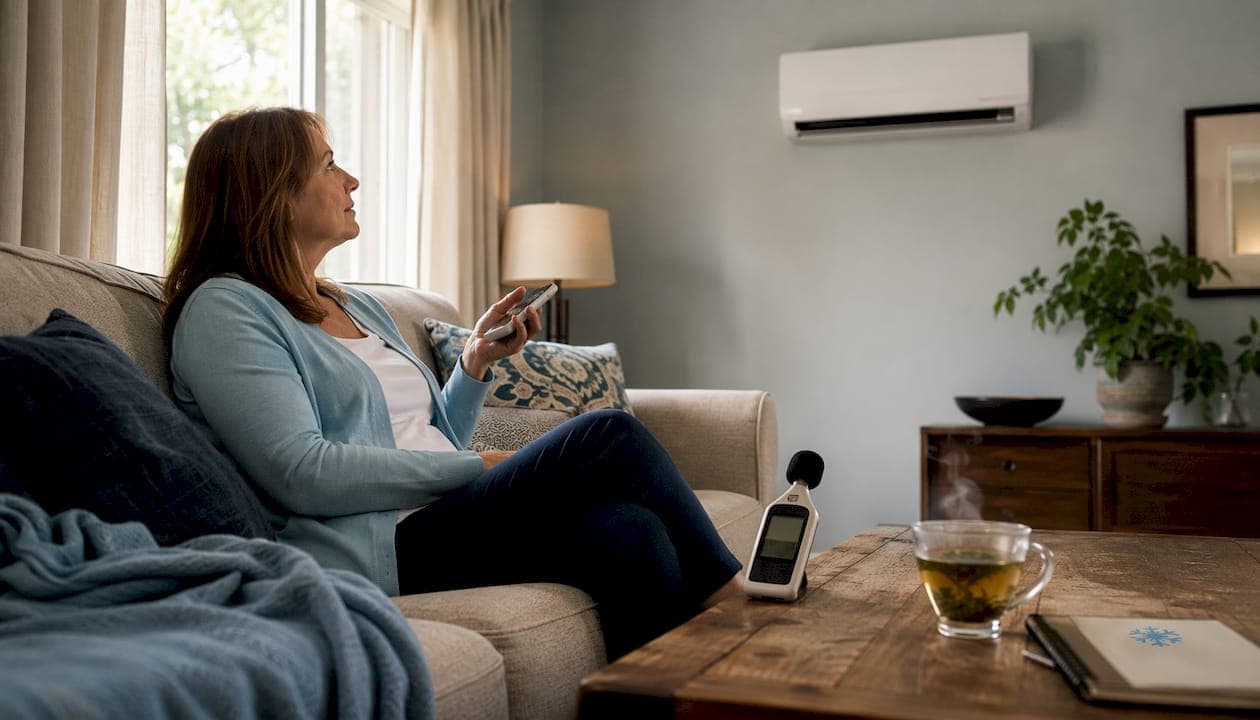
A quiet air conditioner is one whose indoor noise output is low enough that most people stop consciously noticing it during sleep or focused work. In practical terms, that means looking for units rated below 30 dBA for bedrooms, with the best ductless indoor heads reaching low levels on their quietest setting. For living rooms and home offices, moderate levels of noise are generally acceptable. Above a certain level, most people find the unit intrusive.
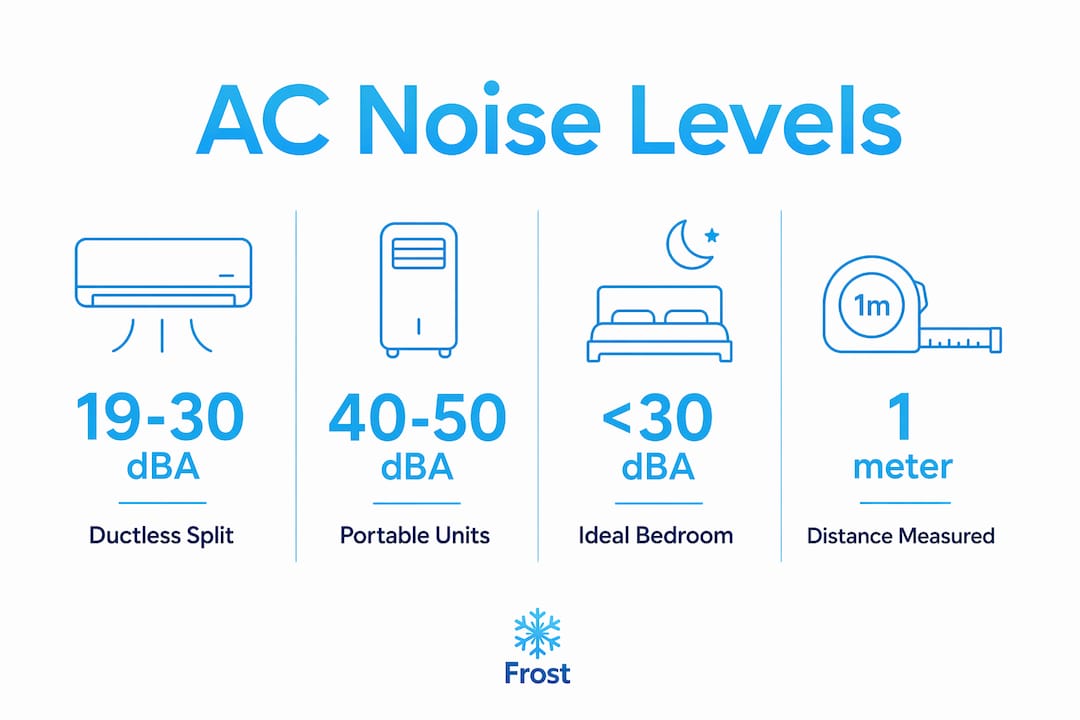
All manufacturer noise figures are expressed in dBA (A-weighted decibels), measured at a stated distance from the indoor unit, usually 1 metre. Always check the lowest-speed dBA figure, not the headline number, because that is what you will actually hear overnight.
- Under 20 dBA: whisper-quiet; barely perceptible even in a silent room
- 20–30 dBA: suitable for bedrooms; comparable to a library or soft rainfall
- 30–40 dBA: acceptable for living rooms and workspaces
- Above 40 dBA: typical of portable and older window units; noticeable in quiet rooms
Frostairconditioning installs F-Gas certified domestic systems across Exeter and the south-west. The guidance below reflects what actually matters on a real site survey.
Table of Contents
- How AC noise is measured: dB, dBA, and what the spec sheet means
- Typical noise ranges by system type
- Which design features actually reduce noise?
- How to choose a quiet AC for your room
- Quiet AC models available to UK buyers
- Installer tips for keeping noise low long term
- Is a quiet AC worth it? A short verdict
- Key takeaways
- The survey is the part most buyers skip
- A site survey costs nothing and changes everything
- Useful sources and further reading
How AC noise is measured: dB, dBA, and what the spec sheet means
The decibel (dB) scale measures sound intensity logarithmically, so a 10 dB increase represents roughly a doubling of perceived loudness. Manufacturers apply A-weighting (dBA) to filter out frequencies the human ear is least sensitive to, giving a figure that better reflects how loud a unit actually sounds in a room. That is why spec sheets use dBA rather than plain dB.
Two figures appear on some data sheets and it is worth knowing the difference:
- Sound pressure level (Lp): what you hear at a given distance from the unit, typically 1 metre for indoor heads. This is the figure to use when comparing products.
- Sound power level (Lw): the total acoustic energy the unit radiates, independent of distance. It is always higher than Lp and is less useful for room-level comparisons.
Most UK manufacturers publish indoor sound pressure in dBA at 1 metre on the lowest fan speed. Independent testing consistently shows that the low-speed dBA figure is the one that matters for bedroom suitability, because that is the setting the unit runs on for most of the night.
Two quick reference points: a modern ductless indoor head typically measures 19–30 dBA on low; a portable or window unit typically measures 40–50 dBA on low. That gap is not marginal.
Pro Tip: When reading a spec sheet, ignore the high-speed noise figure entirely for bedroom use. Find the lowest dBA value and confirm the test distance. If neither is stated, ask the supplier before buying.
Typical noise ranges by system type
The biggest driver of indoor noise is where the compressor sits. Split systems move it outside; portable units keep it in the room with you.
| System type | Typical lowest indoor dBA | Best for |
|---|---|---|
| Ductless split (single or multi) | 19–30 dBA | Bedrooms, living rooms |
| Ducted (ceiling cassette / concealed) | 30–45 dBA (at register) | Open-plan, whole-home |
| Window unit (standard) | 40–50 dBA | Small rooms, temporary use |
| Window unit (U-shaped / inverter) | 40–50 dBA on low | Bedrooms where a split is not possible |
| Portable unit | 45–55 dBA | Occasional use only |
Ductless split systems achieve those low figures because the noisy compressor and condenser fan sit in the outdoor unit. The indoor head only moves air, which is inherently quieter. U-shaped window designs close the gap somewhat by placing a pane of glass between the occupant and the compressor, but they still cannot match a well-installed split.
Portable units are the loudest class because the compressor, condenser fan, and evaporator fan all operate inside the room. They are convenient, but 45–55 dBA is audible in any quiet bedroom.
The lowest dBA figure on any spec sheet refers to the quietest fan speed. At higher speeds, every system type gets louder.
Which design features actually reduce noise?
Knowing what to look for on a product page saves time. Some features make a measurable difference; others are marketing language dressed up as engineering.
Features that genuinely reduce noise:
- Inverter compressor: modulates speed continuously rather than switching on and off. Inverter technology eliminates the abrupt startup spike that older fixed-speed compressors produce and keeps running noise steadier.
- Variable-speed EC fan motor: adjusts airflow in small increments, avoiding the step-change noise of switching between fixed fan speeds.
- Low-noise fan blade geometry: wider, swept blades at lower RPM move the same volume of air with less turbulence noise.
- Insulated cabinet panels: dampen mechanical vibration before it reaches the room air.
- Anti-vibration mounts and flexible refrigerant connections: prevent structure-borne noise travelling from the outdoor unit into the building fabric.
- Sleep mode: a measurable feature that lowers fan speed and compressor frequency for steady, low-volume overnight operation rather than peak cooling.
Marketing language to treat with scepticism:
Terms such as "noiseless", "silent", and "whisper-quiet" are not regulated. There is no truly silent air conditioner; the honest target is noise low enough that occupants stop focusing on it. Always verify emotive claims against the stated dBA figure and, where possible, independent test results.
Pro Tip: Installation quality affects noise as much as product specification. Anti-vibration pads under the outdoor unit and flexible pipe connections cost very little but prevent structure-borne noise that no spec sheet can predict. Ask your installer about vibration isolation before they start.
How to choose a quiet AC for your room
Step-by-step buyer checklist
- Measure the room in square metres and note ceiling height. Correct sizing prevents short-cycling, which is noisier and less efficient than steady running.
- Choose the right system type. For bedrooms, a ductless split is the quietest option. For rooms where a fixed installation is not possible, a U-shaped inverter window unit is the next best choice.
- Check the lowest indoor dBA at 1 metre on the spec sheet. For bedrooms, target below 30 dBA; for living rooms, below 40 dBA.
- Confirm inverter technology and a sleep mode are included, particularly for bedroom installations.
- Read independent test results rather than relying solely on manufacturer figures.
Questions to ask your installer before they start
- Will you carry out a full site survey before specifying the unit size?
- How will you isolate vibration between the outdoor unit and the building structure?
- Where will the outdoor unit be positioned relative to bedroom windows and neighbouring properties?
- Are your engineers F-Gas certified and fully insured?
Red flags to avoid
- No lowest-speed dBA figure listed anywhere on the product page or data sheet
- Only unverified marketing claims ("silent", "noiseless") with no supporting specification
- An oversized unit recommended without a room heat-load calculation
Indicative UK cost and timeline
A typical domestic fixed split installation in the UK currently costs in the region of £1,000–£2,500 all-in, depending on the unit capacity, access difficulty, and pipework run length. Most straightforward single-room installs take half a day to a full day. These figures are indicative; a site survey is the only reliable way to get an accurate quote.
Quiet AC models available to UK buyers
Rather than a ranked list, the following gives factual spec ranges for the main categories UK buyers will encounter.
- Daikin ductless indoor heads (e.g. Daikin Emura and Perfera series): typically quoted at 19–26 dBA on the lowest fan setting. Daikin's Streamer technology and low-noise fan design are well regarded by independent testers.
- Samsung WindFree series: the WindFree mode disperses air through thousands of micro-holes at very low velocity, with some indoor heads rated as low as 21 dBA. Suited to bedrooms where direct airflow is also unwanted.
- Worcester Bosch Climate series: positions itself at the quieter end of the domestic split market, with indoor units typically in the low-to-mid 20s dBA on quiet settings.
- Toshiba HAORI: a wall-mounted unit with a textile front panel designed for living spaces; indoor noise figures sit in the low-to-mid 20s dBA on low speed.
- Meaco portable units: among the quieter portable options available in the UK, though as a class portables still operate in the 40–50 dBA range on low, which is audible in a quiet bedroom.
- De'Longhi Pinguino portable units: a widely available portable option; low-mode figures are typically in the mid-to-upper 40s dBA, making them better suited to living rooms than bedrooms.
How to read the spec line: always look for sound pressure level (not sound power), at 1 metre, on the lowest fan speed. If a manufacturer only publishes a single noise figure without stating the fan speed or distance, treat it with caution. Cross-check with independent reviews where possible.
Installer tips for keeping noise low long term
The spec sheet tells you what a unit can do under controlled conditions. What happens on a real installation is a different matter.
Sizing and placement:
- An oversized unit short-cycles: it reaches the set temperature quickly, shuts off, then restarts minutes later. Each startup is a noise event. Correct sizing, based on a proper heat-load calculation, produces steady, quiet running.
- Position the outdoor unit away from bedroom windows and hard surfaces that reflect sound back into the building. Acoustic screening panels are worth considering where space is tight.
Anti-vibration measures:
- Anti-vibration pads under the outdoor unit absorb compressor vibration before it enters the wall or slab. Loose brackets and rigid line runs are among the most common causes of unexpected noise after installation, and they are inexpensive to fix if caught early.
- Flexible connections on refrigerant lines prevent structure-borne noise travelling through pipework into the building fabric. This is a detail that separates a careful installation from a rushed one.
Maintenance:
- Dust and debris on fan blades alter aerodynamics and generate turbulence noise. Routine coil and blade cleaning is one of the most effective ways to keep a unit as quiet as the day it was installed.
- Check mountings and flexible connectors annually. Brackets work loose over time, particularly on older buildings where fixings are into softer masonry.
For more detail on noise reduction after installation, the Frostairconditioning blog covers common site causes and practical fixes.
Pro Tip: Ask your installer to check all bracket fixings and pipe connections before they leave the site. A five-minute check at the end of the job prevents the most common post-install noise complaints.
Is a quiet AC worth it? A short verdict
Yes, without qualification, for bedrooms and home offices. The difference between a ductless split running at 20 dBA and a portable unit at 50 dBA is not a marginal comfort improvement; it is the difference between sleeping through the night and not.
Three immediate next steps:
- Measure your room and note the ceiling height before speaking to any supplier
- Find the lowest-speed dBA figure on any unit you are considering, and confirm it is sound pressure at 1 metre
- Arrange a site survey with an F-Gas certified installer before committing to a model or size
Correct sizing and installation matter as much as the product itself. A well-specified unit installed carelessly will disappoint; a mid-range unit installed properly will perform quietly for years.
Key takeaways
A ductless split system installed by a qualified engineer is the most reliable route to genuinely quiet air conditioning in a UK home.
| Point | Details |
|---|---|
| Bedroom noise threshold | Target below 30 dBA on the lowest fan speed; 18–25 dBA is ideal for light sleepers. |
| Quietest system type | Ductless split systems (19–30 dBA) are significantly quieter than portables (45–55 dBA) because the compressor is outside. |
| Key features to prioritise | Inverter compressor, sleep mode, and variable-speed fan reduce noise meaningfully; verify with dBA figures, not marketing terms. |
| Installation matters | Anti-vibration pads, secure brackets, and correct sizing prevent the most common post-install noise complaints. |
| Frostairconditioning | F-Gas certified domestic installs across Exeter and the south-west, with site surveys and 0% finance available. |
The survey is the part most buyers skip
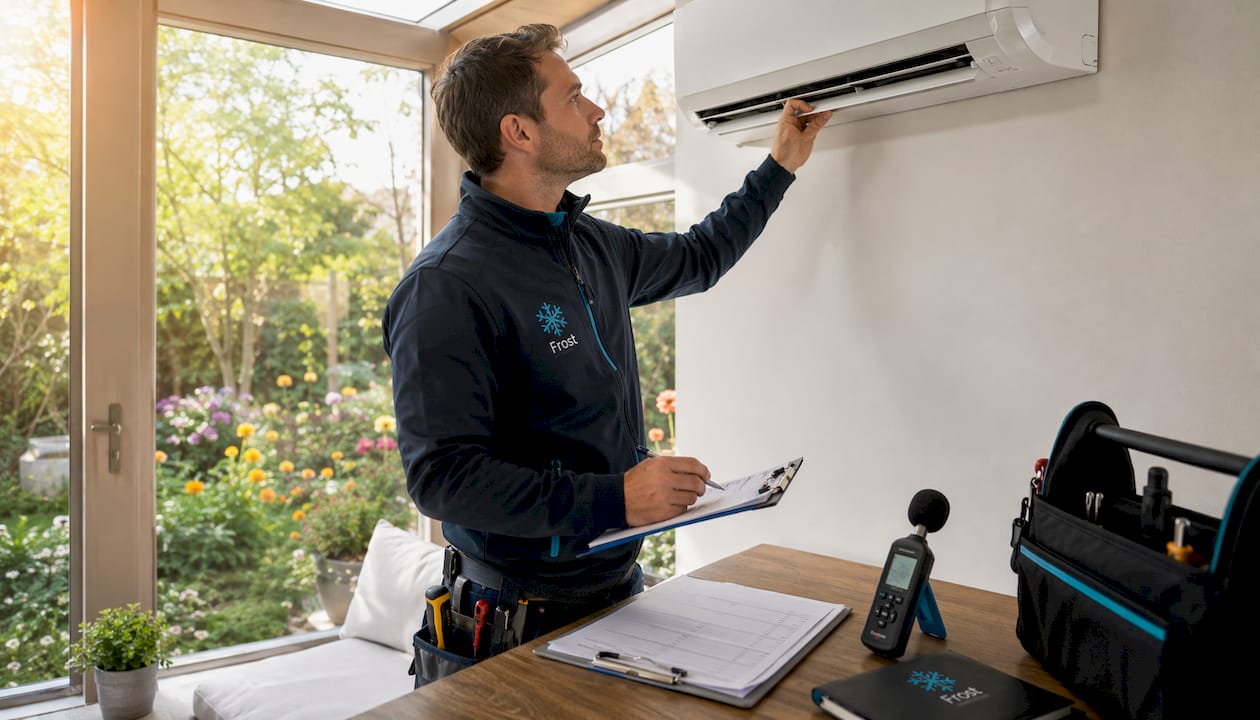
Most of the noise complaints I see on site come down to two things: a unit that is too large for the room, and an outdoor unit bolted to a wall with no vibration isolation. Neither problem shows up on a spec sheet.
The decibel figures manufacturers publish are real, but they are measured in controlled test chambers. On a real installation, the difference between 22 dBA and 35 dBA often comes down to whether the installer used anti-vibration pads, routed the refrigerant lines away from structural timbers, and positioned the outdoor unit sensibly. I have visited properties where a premium, low-noise split system was rattling the bedroom wall because the brackets were fixed directly to a timber stud with no isolation at all. A £10 set of pads and a return visit fixed it, but the homeowner had spent weeks assuming the unit was faulty.
The other thing worth saying: sleep mode is genuinely useful, not a gimmick. It does not just lower the fan speed; on a good inverter system it also reduces compressor frequency, which changes the character of the sound as much as the volume. A unit running in sleep mode at 22 dBA sounds different to a unit running at 22 dBA on its standard low setting. Quieter, yes, but also steadier and less intrusive.
If you are buying for a bedroom, the site survey is not optional. It is the only way to know whether the outdoor unit location, the pipework route, and the wall construction will actually deliver the quiet performance the spec sheet promises.
A site survey costs nothing and changes everything
Choosing a quiet air conditioner on paper is straightforward once you know what to look for. Getting that performance in your actual home is where a certified installer earns their keep.

Frostairconditioning offers domestic installation across Exeter and the south-west, carried out by F-Gas certified engineers who assess vibration isolation, outdoor unit placement, and correct sizing as standard. 0% finance is available on qualifying installations, and same-day installs are possible for straightforward jobs. If you already have a unit that has grown noisier over time, the service and maintenance team can clean coils, check mountings, and restore quiet performance without a full replacement.
Get in touch to arrange a no-obligation site survey and find out which system will genuinely work in your home.
Useful sources and further reading
- Air conditioning noise levels explained for UK homeowners — Frostairconditioning's own guide to decibel thresholds and what they mean in practice for UK homes.
- Quiet air conditioning systems explained for UK homes — a technical overview of system types and why split systems suit UK domestic use.
- Air conditioning noise reduction tips for UK homes — practical post-installation fixes for common noise problems.
- How to choose an air conditioner for your home — a broader buyer's guide covering capacity, efficiency, and room suitability.
- Aircon placement step by step: a homeowner's guide — detailed placement guidance including outdoor unit positioning and pipework routing.
- Daikin: how to choose a quiet air conditioner — manufacturer-level explanation of dBA, sleep mode, and what "quiet" means in engineering terms.
- Consumer Reports: quietest window air conditioners — independent lab test methodology and results for window and portable units, useful for cross-checking manufacturer claims.
- Noise reduction in stairlifts: comfort, privacy, and quiet — a useful parallel on vibration isolation and acoustic design in domestic installations, applicable to understanding anti-vibration principles in AC fitting.