

An inverter air conditioner uses an electronic inverter to run a variable-speed compressor, adjusting its output continuously to match the cooling demand in your room rather than switching fully on and off. That single distinction separates it from a conventional fixed-speed unit, and it has real consequences for your electricity bill, your comfort, and how much noise you hear at night. The main benefits are lower running costs, quieter operation, and steadier temperatures; the main caveat is a higher purchase price and the critical importance of correct sizing. If you use your air conditioning regularly, live somewhere humid, or want a bedroom system that does not wake you at 3 AM, an inverter model is almost certainly the right choice.
- Variable-speed compressor: adjusts output to match demand rather than cycling on and off
- Key benefits: lower running costs, quieter, steadier room temperature, better dehumidification
- Main caveat: higher upfront cost; sizing must be right or efficiency gains disappear
- Best for: frequent users, humid homes, bedrooms, year-round heating and cooling
Key takeaways
Inverter AC technology delivers real efficiency, comfort, and noise benefits over fixed-speed units, but only when correctly sized and professionally installed.
| Point | Details |
|---|---|
| What inverter AC is | A variable-speed compressor controlled by inverter electronics that modulates output to match demand. |
| Main benefits | Lower running costs, quieter operation, steadier temperature, and better dehumidification than fixed-speed units. |
| Critical caveat | Correct sizing is essential; an undersized inverter AC runs flat out and loses its efficiency advantage entirely. |
| Running cost savings | Savings depend on usage hours, electricity tariff, and sizing; the worked example above shows around £52 per year for a typical summer-use scenario. |
| Frostairconditioning | Offers REFCOM/F-Gas certified inverter AC installation across Exeter and the South West, with 0% finance and a no-obligation site survey. |
Table of Contents
- How do inverter air conditioners work?
- Inverter versus non-inverter AC: how do they compare?
- What are the practical benefits of inverter ACs for homeowners?
- What are the drawbacks and limitations to know about?
- How much could you save on running costs?
- How do you choose the right inverter model and size for your room?
- What does installation and maintenance involve for UK homeowners?
- When is an inverter AC the right choice?
- How do you find a trustworthy installer in the UK?
- Common myths and misconceptions about inverter ACs
- What is next for inverter AC technology?
- An honest view on inverter ACs
- Frostairconditioning: inverter AC installation across the South West
- Sources
How do inverter air conditioners work?
The word "inverter" refers to the electronics inside the unit, not some separate device bolted on. As Carrier's technical guidance explains, the inverter circuit takes incoming mains AC electricity, converts it to DC, then converts it back to AC at a variable frequency. Changing that frequency changes the speed of the compressor motor. The faster the compressor spins, the more refrigerant it pumps and the more cooling it delivers. Slow it down and output drops. The thermostat set point stays the same; what changes is how hard the compressor works to reach and hold it.
Think of it like cruise control on a motorway. A non-inverter AC is the driver who keeps pressing the accelerator to full and then lifting off completely. An inverter AC is cruise control: it makes small, continuous adjustments to maintain the speed you set, using only as much fuel as the road conditions demand. Panasonic's explainer uses exactly this analogy, and it holds up well.
The primary steps in inverter operation:
- Room temperature is read by the thermostat sensor
- The control board calculates the gap between current and target temperature
- The inverter adjusts compressor frequency (and therefore speed) to close that gap
- As the room approaches the set point, compressor speed reduces rather than stopping
- The system holds temperature within a narrow band by running continuously at low speed
A simple line diagram of compressor speed over time tells the story clearly: a non-inverter unit shows a square wave (full on, full off), while an inverter unit shows a curve that peaks on start-up, then settles to a low, steady hum.
Inverter versus non-inverter AC: how do they compare?
| Dimension | Inverter AC | Non-inverter (fixed-speed) AC |
|---|---|---|
| Energy use / running cost | Lower; compressor modulates to demand | Higher; full-power start-up cycles waste energy |
| Noise | Quieter at steady state; low-speed hum | Louder cycling; audible on/off switching |
| Upfront purchase price | Higher | Lower |
| Temperature stability | Steady; holds set point within a narrow band | Fluctuates; room warms before next cycle |
| Dehumidification | Better; longer low-speed runs remove more moisture | Less effective; shorter cycles remove less latent heat |
| Lifespan / wear | Less mechanical stress; fewer start-up surges | More wear from repeated full-power starts |
| Sizing / room suitability | More sensitive to correct sizing | More forgiving of slight oversizing |
Quick pros of inverter models:
- Lower electricity bills over the life of the unit
- Noticeably quieter, especially overnight
- More consistent comfort without temperature swings
- Superior humidity control in damp or coastal rooms
Quick cons:
- Higher purchase price
- More complex electronics mean specialist repair if something goes wrong
- Must be correctly sized; an undersized unit runs flat out and loses its efficiency advantage
What are the practical benefits of inverter ACs for homeowners?
Energy efficiency is the headline benefit, and it is backed by both manufacturer data and independent testing. Daikin UK's guidance confirms that variable-speed compressors maintain temperature more efficiently than fixed-speed units and improve dehumidification because the compressor runs more continuously at lower speeds. That continuous low-speed operation is the key: the system avoids the energy spike that happens every time a fixed-speed compressor restarts from cold.

Quieter running is the benefit homeowners notice first. Consumer Reports' independent testing found that inverter models dominate top comfort and quietness rankings, and that quieter operation can genuinely improve sleep quality. For a bedroom in a Devon home on a warm August night, that matters.
Dehumidification is the overlooked advantage. Because the compressor runs longer at lower speeds, it removes more latent heat from the air, pulling moisture out more effectively than a unit that cycles on and off. In a humid coastal home in Cornwall or a south-facing living room in summer, this translates to air that feels cooler than the thermometer suggests.
Reduced wear is a longer-term benefit. Every full-power start puts mechanical stress on the compressor. An inverter unit that modulates rather than cycles will typically experience fewer of those stress events over its working life, which supports a longer useful lifespan.
Efficiency note: Hvac notes that inverter and variable-speed are used interchangeably in the industry, and that these systems offer steadier comfort and better energy performance than single-speed units, though they cost more upfront.
For practical tips on getting the most from your system once it is installed, the guide to boosting air conditioning energy efficiency at home covers the habits and settings that make the biggest difference to running costs.
What are the drawbacks and limitations to know about?
The purchase price is the most obvious trade-off. Inverter models typically cost more than equivalent fixed-speed units, and that gap needs to be recovered through lower electricity bills before you break even. For someone who only runs an AC for a few weeks a year, the payback period stretches considerably.
Repair complexity is a real consideration. The inverter electronics add components that a standard refrigeration engineer may not be equipped to diagnose or replace. If the inverter board fails outside warranty, parts and specialist labour can be expensive. Checking warranty length and what it covers before you buy is worth the five minutes it takes.
Sizing sensitivity is the drawback that catches the most people out. An undersized inverter AC runs at maximum speed continuously, which means it behaves exactly like a fixed-speed unit, consuming peak power without the efficiency benefit. Consumer Reports' testing specifically highlights that correct sizing is more critical for inverter units than for fixed-speed models.
Pro Tip: When getting quotes, ask each installer: "What calculation method are you using to size this unit?" A professional will reference a heat load calculation based on your room dimensions, glazing, orientation, and occupancy. If the answer is a rough rule of thumb ("about 2.5 kW per room"), treat that as a warning sign and ask for a proper site survey.
How much could you save on running costs?
The calculation is straightforward. Running cost equals the unit's power draw in kilowatts multiplied by the number of hours it runs, multiplied by your electricity unit rate in pence per kilowatt-hour.
Worked example (illustrative):
Suppose you run a 2.5 kW-capacity inverter system that draws an average of 0.7 kW at part load (a reasonable modulated figure) for eight hours a day over 90 summer days. At an electricity rate of 24p per kWh (used here as an illustrative figure only):
- Annual consumption: 0.7 kW × 8 hours × 90 days = 504 kWh
- Annual cost: 504 × £0.24 = approximately £121
A comparable fixed-speed unit drawing 1.0 kW for the same hours would consume 720 kWh, costing approximately £173. The difference in this example is around £52 per year. Scale up for a larger system or longer usage and the saving grows.
Variables that shift this figure significantly include your local climate (more hours of use in a south-facing home), your actual electricity tariff, and how well the system is sized. The energy-efficient cooling guide covers how tariff choices and usage habits interact with system efficiency.
Savings context: Consumer Reports notes that in a window AC context, the US Department of Energy estimated a saving of around US$17 per year for a smaller unit. For a full split system used across a UK summer, real-world savings depend heavily on usage hours and correct sizing.
How do you choose the right inverter model and size for your room?
Correct sizing starts with the right data. An installer carrying out a proper heat load calculation will want:
- Floor area and ceiling height (to calculate room volume)
- Glazing area and orientation (south-facing glass adds significant heat gain)
- Insulation quality (older UK homes lose heat faster and need more capacity)
- Occupancy and heat sources (computers, ovens, and people all add to the load)
- Intended use (cooling only, or heating and cooling year-round)
For most UK living rooms and bedrooms, systems in the 2.5–5 kW capacity range cover the majority of installations, but the right figure for your room depends on the calculation above, not a generic estimate.
Single-split versus multi-split: a single-split system pairs one outdoor unit with one indoor unit and suits a single room. A multi-split system connects one outdoor unit to two or more indoor units, which is more cost-effective when you want to condition several rooms without multiple outdoor units on the wall. The guide to types of domestic AC units explains the options in more detail.
Questions to bring to every quote:
- What heat load calculation method are you using?
- What SEER or EER rating does this model carry?
- Is the outdoor unit sited for adequate airflow and minimal noise impact on neighbours?
- What is included in the commissioning process?
Pro Tip: Ask specifically about the unit's SEER2 (Seasonal Energy Efficiency Ratio) rating. A higher SEER2 means better real-world seasonal efficiency, not just peak performance. Manufacturers including Daikin, Mitsubishi Electric, Samsung, LG, Toshiba, and Hitachi publish these ratings in their product documentation; ask your installer to show you the figure for the specific model they are recommending.
What does installation and maintenance involve for UK homeowners?
A professional installation covers more than drilling a hole through the wall. The installer will assess the best position for the indoor unit (typically high on a wall for even air distribution), route the refrigerant pipework and condensate drain, site the outdoor unit on a suitable bracket or base with adequate clearance, and connect the electrical supply. Commissioning includes checking refrigerant charge, testing controls, and verifying the system reaches its rated output.
F-Gas and REFCOM certification: in the UK, anyone handling refrigerants must hold F-Gas certification. REFCOM is the UK's industry register of F-Gas certified engineers and companies. Before any work begins, ask to see the engineer's REFCOM registration or F-Gas certificate. This is not a bureaucratic nicety; it is a legal requirement, and an uncertified engineer handling refrigerant is breaking the law.
A simple maintenance schedule:
- Monthly: clean or check the indoor unit's air filter (most modern units have washable filters)
- Annually: book a professional service covering refrigerant pressure check, coil cleaning, drain inspection, and electrical checks
- As needed: call for a fault check if the unit trips, produces unusual noise, or stops cooling effectively
An annual maintenance contract takes the scheduling out of your hands and often includes priority response if something goes wrong. Frostairconditioning's service and maintenance contracts cover exactly this for homes and businesses across the South West.
Warranty terms vary by manufacturer. Daikin, Mitsubishi Electric, and Samsung typically offer extended warranties on registered products; confirm registration requirements at the point of installation rather than six months later.
When is an inverter AC the right choice?
Inverter models suit the majority of UK residential installations, but there are situations where a fixed-speed unit is a reasonable alternative.
Inverter AC suits you if:
- You use the system regularly (more than a few weeks per year)
- The room is a bedroom where noise matters
- You live in a humid or coastal location where dehumidification is as important as cooling
- You want year-round use as a heat pump (inverter technology is standard in reverse-cycle systems)
- You are planning a multi-room installation and want consistent comfort throughout
Non-inverter may be acceptable if:
- The system will be used infrequently (a holiday let that sits empty most of the year)
- Budget is the primary constraint and the payback period does not work for your situation
- The space is a utility or storage room where comfort precision is not a priority
Quick decision checklist:
- Do you use AC more than 30 days per year? → Inverter
- Is the room a bedroom or open-plan living space? → Inverter
- Is humidity a problem in summer? → Inverter
- Is this a rarely used secondary space? → Non-inverter may suffice
- Is upfront cost the binding constraint? → Weigh the payback period carefully
The homeowner's guide to choosing an air conditioner walks through this decision in more detail if you want a fuller framework.
How do you find a trustworthy installer in the UK?
The quality of the installation determines how much of the inverter's efficiency you actually get. A well-specified system fitted badly will underperform for its entire working life.
Credentials to verify before signing anything:
- REFCOM registration or F-Gas certificate (legal requirement for refrigerant handling)
- Public liability insurance (ask for the certificate, not just a verbal assurance)
- Membership of a trade body such as BESA (Building Engineering Services Association) or equivalent
What a professional quote should include:
- A room-by-room heat load calculation, not a rule-of-thumb estimate
- Proposed outdoor unit position with notes on airflow clearance and neighbour impact
- Specific model and capacity recommendation with the SEER/EER rating stated
- Warranty terms for both the equipment and the installation labour
- Commissioning procedure and what the handover includes
Comparing quotes:
- Check whether commissioning is included or charged separately
- Ask what aftercare looks like: is there a helpline, and how quickly do they respond to faults?
- Compare annual service contract options, not just the installation price
Pro Tip: Ask every installer for a written commissioning report at handover. This document should confirm refrigerant charge, electrical checks, and system performance at the time of installation. It is useful evidence if a warranty claim arises later, and a professional installer will produce one as standard.
The guide to choosing an AC installer covers the full evaluation process if you want a detailed checklist to take to quotes.
Common myths and misconceptions about inverter ACs
"Inverter AC" means the unit runs on a battery inverter. It does not. The "inverter" in inverter AC refers to the internal electronics that control compressor speed. Whether the unit can be powered from a battery backup or generator is a separate question entirely, and most domestic AC systems are designed for mains supply. Senergytec's FAQ on this point explains the distinction clearly.
"Bigger is always better." Oversizing an inverter AC is almost as damaging to efficiency as undersizing it. A unit that is too large for the room reaches the set point quickly, drops to minimum speed, and then cycles more than it should. You lose the steady-state efficiency that makes inverter technology worthwhile.
"Inverter ACs do not need servicing." The variable-speed compressor reduces mechanical wear, but the refrigerant circuit, coils, filters, and electrical components still need annual attention. Skipping servicing shortens the system's life and can void the manufacturer's warranty.
"All inverter ACs are the same." The inverter label covers a wide range of quality. Brands such as Daikin, Mitsubishi Electric, LG, Samsung, Toshiba, and Hitachi publish detailed technical specifications including SEER ratings, noise levels in decibels, and operating temperature ranges. These figures vary significantly between models and price points, so comparing specifications rather than brand names alone gives a more accurate picture.
"An inverter AC will always save money." It will save money compared with a fixed-speed unit of equivalent capacity, but only if it is correctly sized, properly installed, and used regularly enough for the efficiency gains to offset the higher purchase price.
What is next for inverter AC technology?
Inverter technology is already mature, but the systems being installed today are meaningfully different from those of a decade ago.
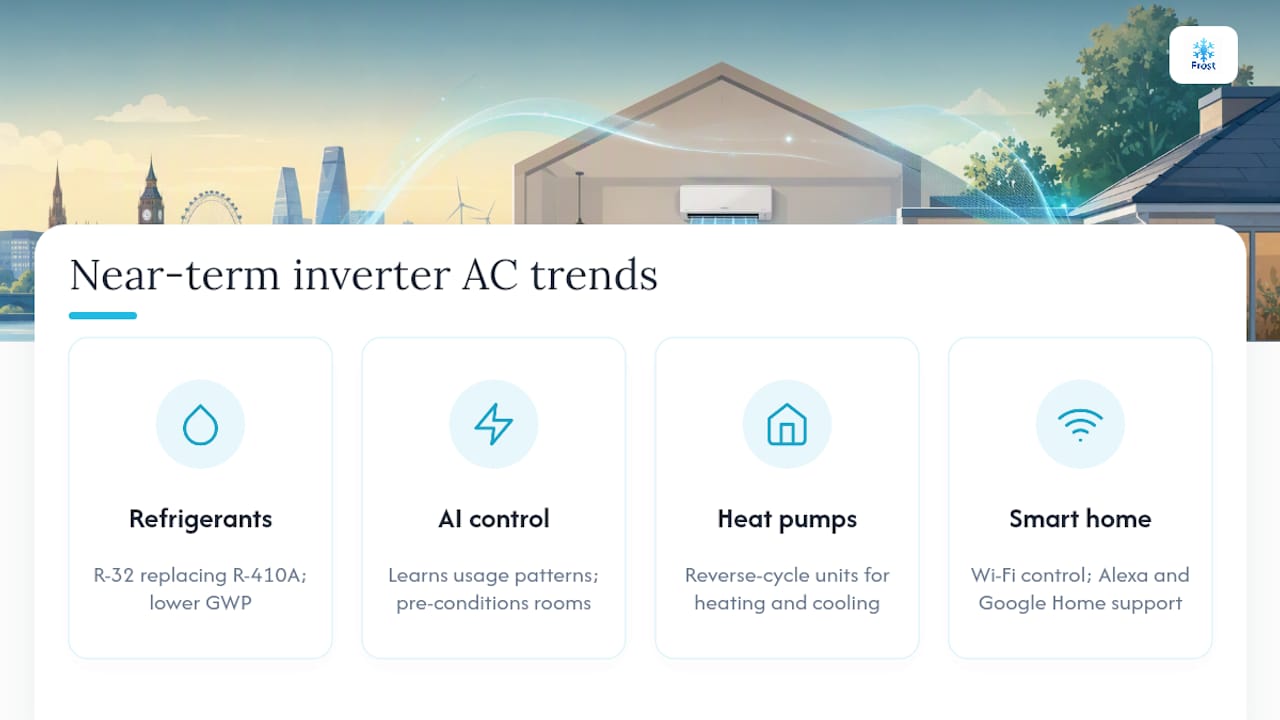
Refrigerant transition: the industry is moving away from older refrigerants with high global warming potential. R-32 has become the dominant refrigerant in residential split systems from manufacturers including Daikin, Mitsubishi Electric, and Samsung, offering lower environmental impact and slightly better thermodynamic efficiency than the R-410A it is replacing.
AI-assisted control: newer control boards from brands including LG and Daikin use pattern recognition to learn a household's usage habits and pre-condition rooms before occupants arrive, rather than reacting after the temperature has already risen. This reduces peak demand and improves comfort without any manual adjustment.
Heat pump integration: inverter technology is the foundation of modern air-to-air heat pumps. As UK homes move away from gas heating, reverse-cycle inverter systems that provide both cooling in summer and heating in winter are becoming a practical alternative to gas boilers for many properties, particularly in the South West where winter temperatures rarely drop to the extremes that challenge heat pump performance.
Higher SEER ratings: regulatory pressure in the UK and Europe is pushing minimum efficiency standards upward. The best residential inverter systems now carry SEER ratings that would have been considered exceptional five years ago, and the gap between entry-level and premium models on this metric is widening.
Smart home integration: most current inverter systems from the major manufacturers support Wi-Fi control via manufacturer apps, and integration with platforms such as Amazon Alexa and Google Home is now standard at mid-range price points. This makes scheduling and remote control straightforward without any additional hardware.
An honest view on inverter ACs
The efficiency argument for inverter ACs is real, but the industry sometimes oversells it. The savings figures manufacturers quote are calculated under controlled conditions that do not always reflect a draughty Victorian terrace in Exeter or a poorly insulated flat with single glazing. The technology genuinely works; the gap between the theoretical saving and the real-world saving is where homeowners get disappointed.
The more important variable is almost never the brand or the inverter specification. It is the quality of the sizing calculation and the installation. A premium Daikin or Mitsubishi Electric system fitted by someone who guessed the capacity will underperform a mid-range unit that was properly sized and commissioned. The inverter's efficiency benefit depends on the compressor spending most of its time modulating at low speed, and that only happens when the unit is the right size for the room.
The other underrated point is dehumidification. In a UK summer, the discomfort is often more about humidity than raw temperature. An inverter system running quietly at low speed for hours removes far more moisture from the air than a fixed-speed unit cycling on and off. That is the benefit that makes the biggest difference to how a room actually feels, and it rarely appears in the headline marketing.
If you are weighing up whether to spend the extra money on an inverter model, the question to ask is not "will I save money?" but "how often will I use this, and does the room have a humidity problem?" If the answer to either is yes, the inverter model pays for itself in comfort long before it pays for itself on the electricity bill.
Frostairconditioning: inverter AC installation across the South West
Frostairconditioning installs and maintains inverter air conditioning systems for homes and businesses across Exeter, Devon, Cornwall, and the wider South West. Every installation is carried out by REFCOM/F-Gas certified engineers, and the team supplies systems from Daikin, Mitsubishi Electric, Samsung, and Toshiba so the recommendation you receive is based on what suits your room rather than what is in stock.
If you have read this far and are still unsure whether an inverter system is right for your home, or which capacity you need, a no-obligation site survey is the practical next step. An engineer will assess your room, calculate the correct load, and give you a written quote with the specific model, capacity, and SEER rating clearly stated. Book your domestic installation survey to get started.
Sources
Daikin UK: inverter air conditioner explained covers how variable-speed compressors work and why they improve dehumidification, written for a UK residential audience.
Panasonic Australia: what is an inverter air conditioner? provides a clear technical explanation of the inverter electronics and the cruise-control analogy for non-technical readers.
Carrier: inverter air conditioner guide gives a detailed technical description of the AC-to-DC-to-variable-frequency conversion process and positions inverter systems in the context of energy efficiency.
Consumer Reports: inverter air conditioner testing and analysis offers independent test findings on noise, comfort, and energy performance, including commentary on sizing importance.
HVAC.com: what is an inverter air conditioner? explains the variable-speed concept in plain language and addresses the upfront cost versus long-term savings trade-off.
Daikin global: inverter technology knowledge page covers the technical benefits of inverter compressors including reduced wear and steadier control, with manufacturer-level detail.
- What Is An Inverter Air Conditioner And Why Choose One - Panasonic Australia
- Inverter air conditioner can keep you cool, save you money and maybe even help you sleep better - Consumer Reports
- Inverter air conditioner explained | Daikin UK
- Hvac
- Inverter air conditioner guide: Efficiency, benefits & how it works - Carrier