
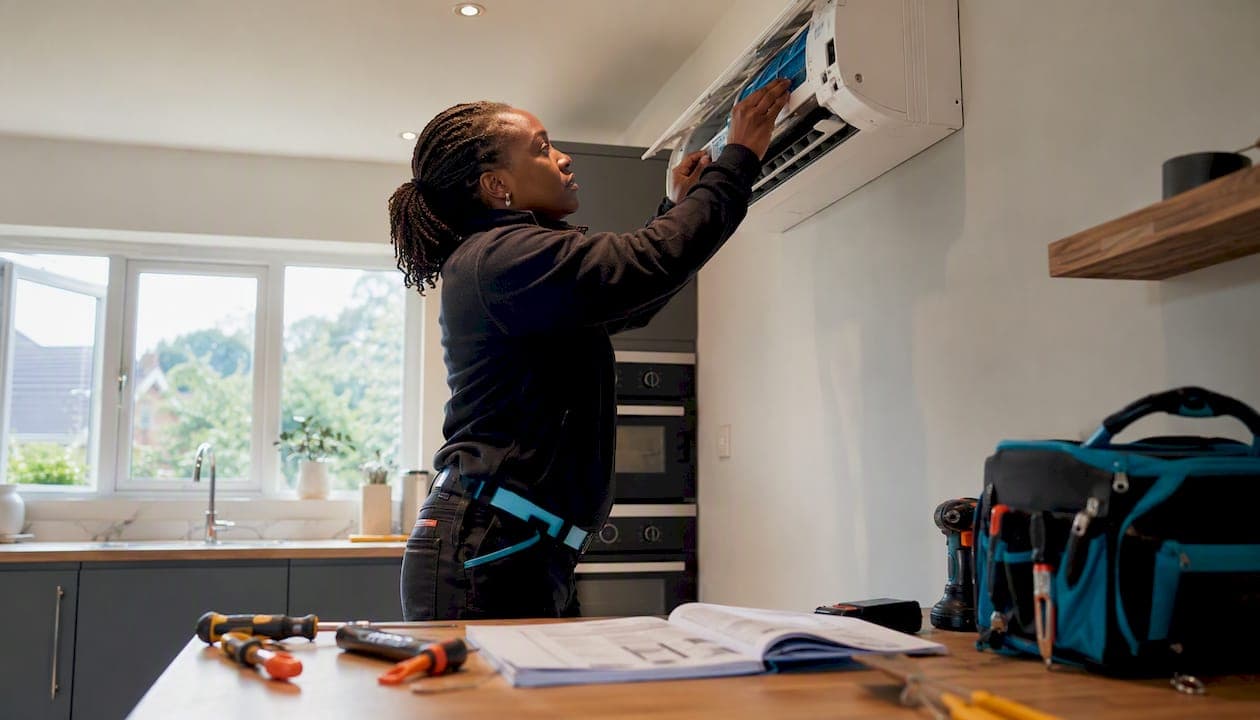
Local AC installation matters because the quality of the install, not the brand on the unit, determines how efficiently your system runs, how long it lasts, and whether your manufacturer warranty holds. A correctly sized, properly commissioned air conditioning system delivers reliable cooling, effective humidity control, and lower energy bills. A poorly installed one causes short-cycling, damp air, premature compressor failure, and costly remedial work.
The outcomes that hinge on getting this right are:
- Correct sizing and load calculation matched to your home's insulation, glazing, and orientation
- Proper commissioning covering refrigerant charge, airflow balance, electrical checks, and a documented handover
- Legal compliance under UK F-Gas regulations, with a REFCOM-certified engineer handling all refrigerant work
- Warranty protection requiring certified installation and documented annual servicing
- Faster local response for emergencies, aftercare, and annual maintenance
For homeowners in Devon, Cornwall, and the wider South West, Frostairconditioning provides REFCOM and F-Gas certified engineers, same-day installs, and 0% finance options. Request a quote or read on to understand exactly what to look for.
Table of Contents
- Why local AC installation matters: how it affects your home
- What a local installer brings that national chains rarely do
- Common problems caused by poor or incorrect installation
- UK legal and safety requirements you must check before signing anything
- What a professional installation should include, and what it costs
- How to tell if your AC was installed incorrectly
- How to choose the right local installer
- Why Frostairconditioning's credentials reduce the risks outlined above
- Key takeaways
- The thing most homeowners get wrong when buying a new AC system
- Get a certified local installation quote from Frostairconditioning
- Useful sources and further reading
Why local AC installation matters: how it affects your home
A professionally specified and installed air conditioning system delivers long-term comfort, humidity control, and property value. The mechanism is straightforward, even if the detail is not.
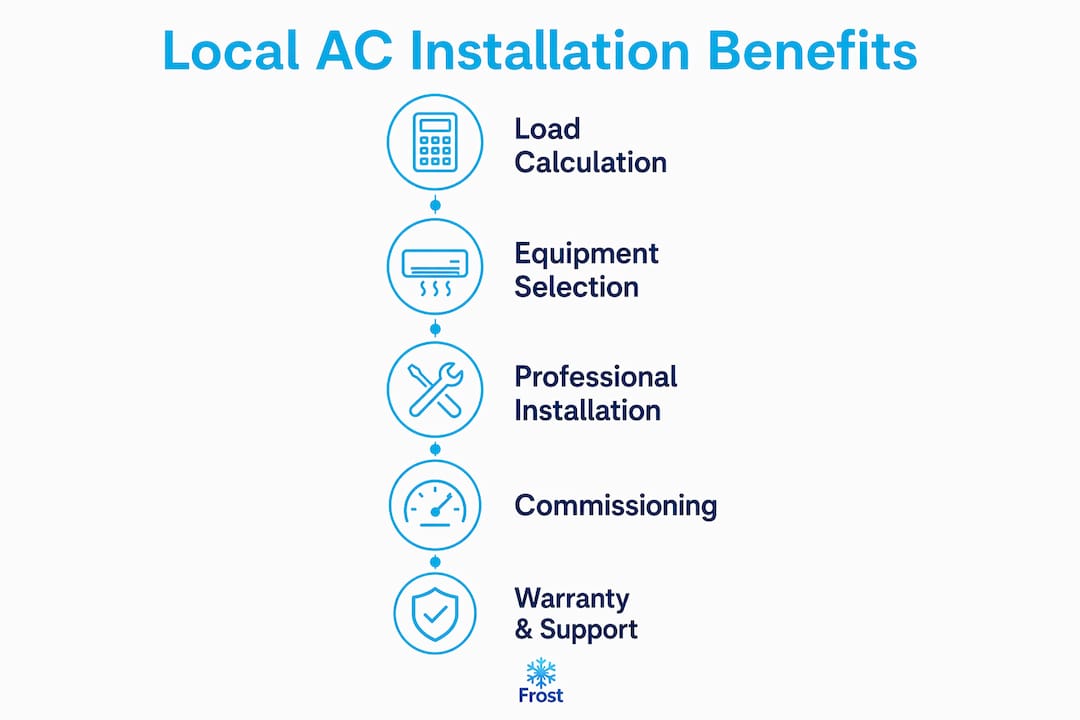
Load calculation is where it begins. A correctly sized unit must account for the home's thermal envelope, insulation, orientation, and internal heat gains. Oversized units short-cycle, switching on and off before completing a full cooling cycle. Short-cycling prevents effective dehumidification, leaves rooms feeling clammy, and shortens compressor life significantly. Undersized units run continuously, consuming more electricity and never quite reaching the set temperature. Neither outcome is acceptable, and both are avoidable with a proper pre-installation survey.
Commissioning is the quality checkpoint most discount installers skip. A thorough commissioning procedure involves measuring system pressures, checking superheat and subcool values, verifying airflow across multiple cycles, and recording electrical draw. Done correctly, it confirms the refrigerant charge is exact, the airflow is balanced, and the electrical connections are safe. Skip it, and you have no baseline to diagnose future faults against.
The financial case is clear. A system that runs at peak efficiency from day one costs less to operate every month and is far less likely to need expensive repairs in years two through five. The upfront cost of a professional install is not a premium; it is the price of avoiding a larger bill later.
- Correct sizing prevents short-cycling and poor dehumidification
- Full commissioning confirms refrigerant charge, airflow, and electrical safety
- Documented handover creates a baseline for future servicing and warranty claims
- Efficient operation reduces both energy bills and carbon footprint
What a local installer brings that national chains rarely do
The community-based accountability of a local firm is not a soft benefit. It is a structural incentive for better workmanship. A national chain's engineer moves on to the next job. A local installer's reputation lives in the same streets as their customers.

Emergency response is the most immediate practical difference. When a system fails during a July heatwave, same-day response from a local technician prevents secondary damage — water ingress from a blocked condensate line, mould growth, heat stress for vulnerable household members. A national call centre booking a technician from three counties away cannot offer that.
Regional climate knowledge changes equipment selection and settings in ways a generic specification cannot. The South West's combination of coastal humidity, high solar gain in summer, and mild but damp winters means system sizing and control strategies differ from, say, a draughty Victorian terrace in the Midlands. Local climate expertise translates directly into better equipment recommendations and settings that actually match how your home behaves through the seasons. Understanding how climate shapes your air conditioning choices is something a local installer applies instinctively.
Continuity of service matters more than most homeowners realise. When the same technician services your system year after year, they build a picture of its performance history. They notice a gradual drop in cooling capacity before it becomes a breakdown. They know which quirks are normal for your unit and which are warning signs. That institutional knowledge has real value.
Pro Tip: Ask any prospective installer for two or three references from jobs completed within five miles of your home in the past twelve months. A local firm with genuine community roots will provide them without hesitation.
- Faster emergency response, often same-day, during peak summer demand
- Climate-specific sizing and settings for South West humidity and solar gain
- Reputation incentives for thorough, tidy workmanship
- Continuity: same engineer, better system history, tailored maintenance plans
Common problems caused by poor or incorrect installation
Poor installation is the leading cause of premature system failure, and the faults are predictable. Knowing what they look like helps you spot them early.
Wrong sizing is the most common error. An oversized unit short-cycles: it cools the air temperature quickly but never runs long enough to remove humidity, leaving the room feeling cold and damp simultaneously. An undersized unit runs flat-out and still cannot hit the set temperature on a warm day. Both scenarios accelerate compressor wear. Remedial work to replace a wrongly sized unit typically costs several hundred pounds in labour alone, on top of the equipment.

Incorrect refrigerant charge is both a performance issue and a legal one. Too little refrigerant causes the evaporator coil to ice over; too much raises system pressures and risks compressor damage. Either way, the system runs inefficiently and the warranty is at risk. Refrigerant work must be carried out by a REFCOM/F-Gas certified engineer — uncertified handling is illegal under UK F-Gas regulations.
Poor condensate drainage is the fault most likely to cause property damage. A condensate pipe routed without adequate fall, or terminated incorrectly, will back up and overflow. Water damage to ceilings, walls, and flooring can run into thousands of pounds. The fix is straightforward when caught early; catastrophic when ignored.
Electrical and cabling issues from discount installations include undersized cable, missing earth bonds, and absent RCD protection. These are not just performance problems; they are fire and electrocution risks.
Airflow and placement errors produce uneven cooling, excessive noise, and recirculation of warm air. A unit mounted on the wrong wall, or with inadequate clearance, will never perform to specification regardless of how good the equipment is.
- Oversized unit: short-cycling, poor dehumidification, accelerated compressor wear
- Undersized unit: continuous running, failure to reach set temperature
- Incorrect refrigerant charge: icing, pressure faults, voided warranty
- Poor condensate routing: water damage to ceilings and walls
- Electrical faults: fire risk, tripped RCDs, absent earth bonds
- Placement errors: noise, uneven cooling, warm air recirculation
UK legal and safety requirements you must check before signing anything
UK law is unambiguous on refrigerant handling. Any engineer working with F-Gas refrigerants must hold a valid F-Gas qualification and be registered with REFCOM, the UK's official refrigerant competency register. Using an uncertified engineer is not just a warranty risk; it is a criminal offence under the F-Gas Regulation and can affect your home insurance.
REFCOM registration means the engineer has demonstrated competency in safe refrigerant handling, leak testing, and disposal. It is the minimum standard for any domestic installation in the UK. Ask to see the engineer's REFCOM card before work begins.
Manufacturer warranties for brands including Daikin, Mitsubishi, Samsung, and Toshiba typically require certified professional installation and documented annual servicing to remain valid. An uncertified installation voids that cover from day one. Given that a quality split system can cost several thousand pounds or more installed, losing warranty cover is a significant financial exposure.
Environmental obligations under UK F-Gas rules require that refrigerant removed during servicing or decommissioning is recovered and disposed of correctly. Venting refrigerant to atmosphere is illegal and carries substantial fines.
Documentation the installer must provide on completion:
- Commissioning sheet with measured pressures, airflow, and electrical readings
- Refrigerant log showing type, quantity installed, and engineer's REFCOM number
- Electrical installation certificate (where new circuits or consumer unit connections are made)
- Warranty registration confirmation from the manufacturer
- Any building regulations notification if structural work was involved
What a professional installation should include, and what it costs
A proper domestic installation follows a clear sequence. Shortcuts at any stage create problems that compound over the system's lifetime.
Site survey and load calculation come first. The engineer assesses room dimensions, insulation quality, glazing area, orientation, and internal heat sources. This is not a five-minute visit; a thorough survey takes 30–60 minutes and produces a written specification. Correct placement of both indoor and outdoor units is confirmed at this stage.
Equipment selection follows from the survey. Frostairconditioning supplies and installs systems from Daikin, Mitsubishi, Samsung, and Toshiba — brands with strong UK service networks and comprehensive warranty terms. The right brand and model for a South West home depends on room size, usage pattern, and whether heating as well as cooling is required. A complete guide to system types can help you understand the options before your survey.
On-site installation covers mounting the indoor and outdoor units, running refrigerant pipework and condensate drain, making electrical connections with correct earthing, and sealing all penetrations. The refrigerant circuit is pressure-tested for leaks before charging.
Commissioning and handover close the job. The engineer runs the system through multiple cycles, records all measured values on the commissioning sheet, registers the warranty, and walks you through the controls.
| Stage | Typical scope | Approximate cost | Usual timeline |
|---|---|---|---|
| Site survey | Load calculation, unit placement, specification | Often included in quote | 30–60 minutes |
| Equipment supply | Split system (e.g. Daikin, Mitsubishi, Samsung, Toshiba) | — | Pre-order 1–5 days |
| Installation labour | Mounting, pipework, electrical, condensate | — | Half to full day |
| Commissioning | Pressure test, charge, airflow, electrical checks, handover | Included in professional install | 1–2 hours |
| Annual service | Filter clean, leak check, performance check | — | 1–2 hours |
Cost ranges are indicative for a single-room domestic split system in the South West; multi-room or multi-split systems will vary. Frostairconditioning offers 0% finance on qualifying installations.
- Survey confirms sizing, placement, and specification in writing
- Certified refrigerant installation by REFCOM/F-Gas engineer
- Pressure test and leak check before charging
- Full commissioning with recorded measurements
- Warranty registration and written handover documentation
- Service maintenance contracts available for ongoing annual care
How to tell if your AC was installed incorrectly
You do not need specialist tools to spot most installation faults. These checks take minutes and can save you significant repair costs if acted on early.
Temperature and humidity checks: Walk between rooms with the system running. Uneven temperatures across a single zone suggest airflow problems or incorrect sizing. If the air feels cold but the room still feels clammy after 30 minutes of operation, the unit is short-cycling and not completing dehumidification cycles.
Operational signs: Frequent on-off cycling within short periods (less than five minutes per cycle) is a classic oversizing symptom. Unusual grinding, rattling, or hissing noises point to loose components, refrigerant issues, or poor mounting. Ice forming on the indoor unit or refrigerant pipework indicates either a blocked filter or an incorrect refrigerant charge.
Visual checks: Look at the pipework run between indoor and outdoor units. Kinked, unsupported, or poorly insulated pipes are a sign of rushed work. Check that the condensate pipe has a visible downward fall to its termination point. Absent or improvised wiring, exposed cable runs, and missing trunking all warrant a second opinion. For guidance on what a tidy installation looks like, the certified installation steps guide is a useful reference.
Red flags requiring immediate attention:
- A chemical or sweet smell near the indoor unit (possible refrigerant leak)
- RCDs tripping repeatedly when the system runs
- Warm air from the indoor unit when the compressor is audibly running outside
- No commissioning paperwork provided at handover
If you spot any of these, stop using the system and call a REFCOM-certified engineer before the fault worsens.
How to choose the right local installer
Pre-selection checks
Before requesting a quote, confirm:
- The company has a verifiable local address and phone number, not just a website
- Engineers hold current REFCOM registration (check the REFCOM register online)
- The business carries public liability insurance and employer's liability insurance
- They can provide references from recent installs within your area
Questions to ask on the quote
- Will you carry out a full site survey and load calculation before specifying equipment?
- Which engineer will do the refrigerant work, and can I see their REFCOM card?
- What does the commissioning process involve, and what documentation will I receive?
- Who supplies the parts, and what happens if a component fails within the first year?
- What are your emergency response times, and do you offer a maintenance contract?
Comparing quotes fairly
Compare scope for scope, not price alone. A quote that omits the site survey, uses a cheaper refrigerant pipe specification, or excludes commissioning documentation is not a like-for-like comparison with one that includes all three. Focus on lifetime cost: a system that runs 20% less efficiently for ten years costs far more than the saving on day one.
Local companies' familiarity with local building requirements also reduces the risk of non-compliant work that affects insurance and future inspections.
Red flags
- No commissioning sheet offered at handover
- Vague or verbal-only warranty terms
- Demand for full payment before work begins
- Unwillingness to register the manufacturer warranty on your behalf
- No REFCOM card produced when asked
Why Frostairconditioning's credentials reduce the risks outlined above
Frostairconditioning is a REFCOM and F-Gas certified installer based in Exeter, covering Devon, Cornwall, and the wider South West. Every engineer holds current F-Gas certification, which means refrigerant work is legal, documented, and covered by the manufacturer warranty from day one.
The specific credentials that map to the risks covered in this article:
- REFCOM/F-Gas certification: all refrigerant handling is compliant, documented, and warranty-safe
- Same-day and next-day installation: available across the South West, reducing downtime during peak summer demand
- 0% finance: available on qualifying domestic installations, making a correctly specified system accessible without compromising on equipment quality
- Premium brand supply: Daikin, Mitsubishi, Samsung, and Toshiba systems, selected and sized for South West conditions
- Bespoke system design: load calculation and site survey included, not an optional extra
- Annual maintenance contracts: documented servicing to keep manufacturer warranties valid
- Emergency breakdown service: local engineers, not a national call centre
For homeowners considering air conditioning's long-term role in property value, a certified, documented installation is the foundation. Frostairconditioning's domestic installation page covers the full scope of what is included in a South West residential install.
Key takeaways
Local, certified AC installation is the single factor that most determines whether your system delivers reliable comfort, preserves its warranty, and runs efficiently for its full lifespan.
| Point | Details |
|---|---|
| Hire a REFCOM/F-Gas certified installer | Uncertified refrigerant work is illegal in the UK and voids manufacturer warranties immediately. |
| Insist on commissioning paperwork | A commissioning sheet with measured pressures, airflow, and electrical readings is your proof of a correct install. |
| Correct sizing beats cheap hardware | An oversized or undersized unit causes short-cycling, poor dehumidification, and early compressor failure regardless of brand. |
| Compare quotes scope for scope | A quote missing the site survey, correct pipework, or commissioning documentation is not comparable to one that includes them. |
| Frostairconditioning for the South West | REFCOM/F-Gas certified, same-day installs available, 0% finance, covering Devon, Cornwall, and the South West — request a quote to arrange a site survey. |
The thing most homeowners get wrong when buying a new AC system
The conventional wisdom is that the brand of unit matters most. Pick a Daikin or a Mitsubishi, the thinking goes, and you are covered. That is half right. The brand determines the ceiling of what the system can achieve. The installation determines whether it gets anywhere near it.
The most expensive system I see fail early is almost never a cheap one. It is a premium unit fitted by whoever quoted lowest, with no site survey, no commissioning sheet, and refrigerant charged by eye rather than by measurement. The homeowner paid for a fifteen-year system and got five years of mediocre performance followed by a compressor replacement bill.
What I find consistently is that homeowners focus on the unit price and treat the installation as a commodity. It is not. The pipework run, the condensate route, the electrical connections, the refrigerant charge — these are the variables that determine whether a Samsung or a Toshiba runs at 95% efficiency or 70% efficiency for the next decade. A system running at 70% efficiency because of a poor install costs more to run every single month than a correctly installed mid-range unit would.
Brand choice does interact with local conditions in a meaningful way. In the South West, coastal humidity and the prevalence of older, less well-insulated housing stock means heat pump-capable systems from Daikin and Mitsubishi tend to perform particularly well across the full year. Samsung and Toshiba bring strong inverter technology and competitive warranty terms. The right choice depends on the specific property, not a generic ranking. That is precisely the conversation a local site survey is designed to have.
Get a certified local installation quote from Frostairconditioning
Frostairconditioning gives South West homeowners something that national chains structurally cannot: a REFCOM/F-Gas certified engineer who knows your area, arrives the same day when it matters, and produces a fully documented installation that keeps your manufacturer warranty intact.

The process is straightforward. Request a domestic installation quote and Frostairconditioning will arrange a site survey, carry out a proper load calculation, and specify the right system from its Daikin, Mitsubishi, Samsung, and Toshiba range for your home and budget. 0% finance is available on qualifying installations, so the correct system does not have to mean a larger upfront outlay. Same-day and next-day installs are available across Devon, Cornwall, and the South West.
Book your site survey today and get a written quote with full commissioning and warranty documentation included.
Useful sources and further reading
Authoritative UK and industry sources:
- REFCOM — the UK refrigerant competency register — verify your engineer's certification before work begins
- UK F-Gas Regulation guidance (GOV.UK) — the legal framework for refrigerant handling in the UK
- Why local matters: hiring a neighbourhood air conditioning company — practical overview of local installer advantages
Frostairconditioning blog resources:
- How climate shapes your air conditioning choices — South West climate considerations for system selection
- How to install air conditioning: certified steps and expert advice — step-by-step certified installation guidance
- Best air conditioning for your home: complete guide — system types, brands, and suitability for UK homes
- Aircon placement step by step: a homeowner's guide — placement checklist and finishing guidance
- Air conditioning's role in property value explained — long-term financial case for professional installation