
Air conditioning used to be something you associated with office buildings, hotels, or holidays abroad. But that thinking is shifting fast. Understanding why homeowners choose air conditioning has become genuinely relevant for millions of people across the UK, particularly as summers grow hotter and homes struggle to stay comfortable. AC ownership has surged sevenfold over the past decade, reaching 21% of UK homes. If you are weighing up whether it is worth it, this article gives you the honest picture.
Table of Contents
- Key takeaways
- Why homeowners choose air conditioning despite the British climate
- The real benefits: comfort, health, and sleep
- The economics: cost, value, and timing
- Choosing the right system for your home
- Making the switch practical: planning and maintenance
- My take: the tipping point has arrived
- Ready to find the right system for your home?
- FAQ
Key takeaways
| Point | Details |
|---|---|
| Climate is changing the calculus | UK homes built to retain heat now routinely overheat in summer, making passive cooling insufficient. |
| Health benefits go beyond temperature | AC reduces humidity, filters allergens, and improves sleep quality, especially for vulnerable households. |
| Economics favour efficiency | Homeowners increasingly prioritise lifetime running costs over upfront price when choosing a system. |
| Timing your install matters | Booking before peak summer avoids premium emergency pricing and gets you the system you actually want. |
| System choice is not one-size-fits-all | Single-room split units often meet UK homeowners' needs more cost-effectively than whole-house options. |
Why homeowners choose air conditioning despite the British climate
There is a persistent idea that the UK is too cool to need air conditioning. Spend one night in a south-facing bedroom during a July heatwave and that idea falls apart fairly quickly.
UK homes built to retain heat are part of the problem. Thick walls, limited ventilation, and loft insulation designed for warmth mean that once a home heats up, it stays hot well into the evening. Double-glazed windows trap solar gain beautifully. This is excellent in February and genuinely miserable in August.
The rooms that suffer most tend to follow a predictable pattern:
- Bedrooms on upper floors that absorb heat throughout the day
- South-facing home offices with direct afternoon sun
- Loft conversions where insulation works against you in summer
- Living rooms with large glazed areas or bi-fold doors
Working from home has made this far more pressing for many people. When your office is your spare bedroom and it regularly hits 30°C by early afternoon, this stops being a mild inconvenience and becomes a real problem for productivity and wellbeing.
The honest truth is that most homeowners try everything else first. Blackout blinds, desk fans, open windows at night, external shading. When those measures fail, AC stops feeling like a luxury and starts feeling like the sensible next step. That is the tipping point most people reach before they pick up the phone.
Pro Tip: If your bedroom temperature does not drop below 18°C overnight even with windows open, passive cooling is unlikely to solve your problem. That is the point at which a fixed AC system starts to make practical sense.
The real benefits: comfort, health, and sleep
A fan moves air around. Air conditioning actually changes the temperature and humidity of that air. The difference sounds simple but it matters enormously in practice.
Here is what a well-specified AC system genuinely delivers for most UK homeowners:
- Active temperature control. You set 22°C and the room reaches 22°C, regardless of what is happening outside. No guessing, no hoping.
- Dehumidification. AC reduces indoor humidity, which makes warm air feel significantly cooler. High humidity is also a key factor in damp and mould risk, so this benefit extends well beyond summer comfort.
- Cleaner air for allergy sufferers. AC filters remove allergens including pollen and dust from circulating air. For hay fever sufferers, being able to cool a room with windows closed during high pollen season is a significant quality-of-life improvement.
- Better sleep. Sleep quality drops sharply when bedroom temperatures stay above 18 to 19°C. For many people, a single summer of genuinely cool nights is enough to justify the entire investment.
- Protection during extreme heat. For older family members or anyone with a health condition, AC provides measurable safety benefits during heatwaves. This is not a trivial consideration given how frequently extreme heat events are occurring.
"Humidity management is critical to effective cooling. Removing moisture from the air, not just hitting a temperature target, is what makes a room genuinely comfortable." This is why simply blowing cold air without addressing humidity often leaves people disappointed with how the space feels.
Understanding how AC impacts home comfort goes deeper than most buyers initially realise. The health and sleep arguments alone often close the decision for households with young children or elderly residents.
The economics: cost, value, and timing

One of the most common reasons people hesitate is cost. And that is fair. AC is not a small purchase. But the economic conversation has changed significantly, and homeowners' priorities are shifting with it.
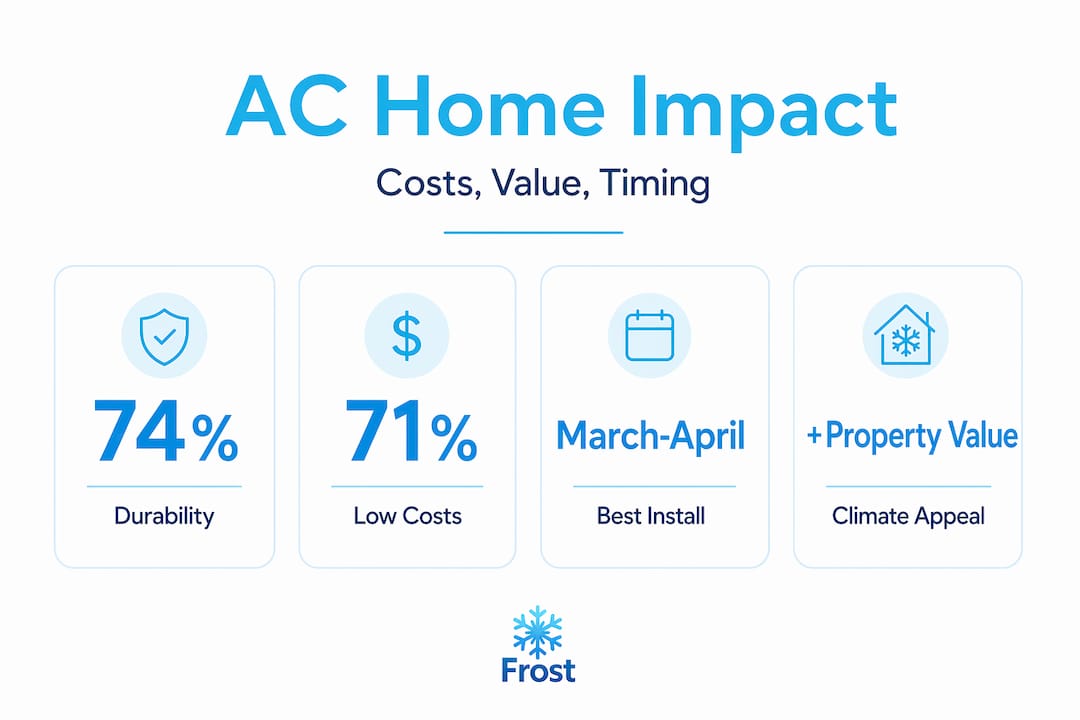
A 2026 survey found that 74% of homeowners prioritise durability and 71% prioritise lower running costs over the cheapest upfront price. People are thinking about lifetime value rather than the initial bill. A poorly sized or cheap unit that runs constantly will cost you more over five years than a well-specified system installed correctly first time.
| Factor | What to consider |
|---|---|
| Upfront cost | Varies by system type and home size; single-room split units are often more affordable than expected |
| Running costs | Modern inverter units are significantly more efficient than older fixed-speed systems |
| Installation quality | Correct sizing and professional fitting directly affect efficiency and system lifespan |
| Finance options | 0% finance from installers like Frostairconditioning makes spreading the cost straightforward |
| Timing of install | Booking before peak summer avoids emergency pricing premiums and supply delays |
Running costs are frequently overestimated. Modern AC systems, particularly inverter-driven split units, are highly efficient. The real savings come from using the system intelligently. Setting thermostat setpoints higher when you are out or asleep, even by a few degrees, can cut annual running costs by up to 10%.
Pro Tip: Book your installation in March or April rather than June. You will avoid the summer rush, get more installation slots to choose from, and typically pay standard rather than peak-season rates.
Homeowners are also increasingly aware that AC can add value to a property, particularly as buyers begin to factor climate resilience into purchasing decisions. This is no longer just a comfort upgrade. It is an infrastructure decision.
Choosing the right system for your home
Not every home needs the same solution, and getting this wrong is one of the most common and costly mistakes buyers make. The good news is that for most UK homeowners, the choices are simpler than they first appear.
The key questions to start with are: how many rooms need cooling, and how severe is your overheating problem? Single-room systems often meet needs more cost-effectively than whole-house installations for the majority of UK homes. Most people find that cooling one or two key rooms, typically the main bedroom and home office, resolves 80% of their comfort issues.
Here is a breakdown of the main options:
- Wall-mounted split units. The most common choice for UK homes. One indoor unit, one outdoor unit, quiet operation, and highly efficient. Ideal for single rooms or open-plan spaces.
- Multi-split systems. One outdoor unit connected to multiple indoor units across different rooms. More disruptive to install but cleaner aesthetically and efficient for multi-room cooling.
- Ducted systems. Hidden in the ceiling void with vents in each room. Excellent for new builds or major renovations but significantly more expensive and complex to retrofit.
- Portable units. No installation required but considerably less efficient, noisier, and limited in their cooling capacity. Worth considering only as a short-term measure.
| System type | Best suited for | Approx. disruption level |
|---|---|---|
| Wall-mounted split | Single rooms, home offices, bedrooms | Low |
| Multi-split | Two or more key rooms | Medium |
| Ducted | New builds or full renovations | High |
| Portable | Temporary or rental use | None |
Newer systems increasingly include features like variable-speed compressors, which ramp up and down rather than switching on and off entirely, and built-in air purification beyond basic filtration. If allergies or air quality are a priority, these features are worth asking about specifically when getting quotes. A good air conditioning buyer's guide will help you weigh these options against your actual needs.
Making the switch practical: planning and maintenance
Deciding to install AC is one thing. Getting the most from it is another. A few practical steps make a significant difference to both comfort and cost.
- Book early. Aim for spring installation. Early installs avoid premium costs and give you time to properly commission the system before you actually need it.
- Use it alongside shading. AC works hardest when rooms are already 35°C from unmanaged solar gain. External blinds or shutters reduce that load significantly and lower running costs.
- Set it intelligently. Keep the thermostat at a consistent temperature rather than cranking it to maximum then switching it off repeatedly. Inverter systems are far more efficient when maintaining a steady temperature.
- Schedule annual maintenance. Filters need cleaning, refrigerant levels checked, and coils inspected. A system that is not maintained loses efficiency year on year. Budget for a service visit annually.
- Raise the setpoint when away. Adjusting the thermostat when absent saves energy without letting the room get so hot that it creates humidity or mould problems.
Pro Tip: Do not switch the system off entirely when you leave for the day during a heatwave. Raising the setpoint by 4 or 5 degrees keeps humidity under control and means the room cools down quickly when you return, rather than having to work from an extreme starting temperature.
Integration matters too. AC performs best when it is part of a broader approach to managing your home's thermal environment, not the only measure you rely on.
My take: the tipping point has arrived
I have watched homeowners in Devon and across the South West go through the same pattern for years. They buy fans. They try better blinds. They accept that the loft conversion is only usable in the evenings. Then they hit a summer that genuinely does not let up for three weeks, and something clicks.
In my experience, the hesitation around AC in the UK has always been partly cultural and partly financial. We are not supposed to need it. It feels like admitting defeat to the weather. But that framing made more sense when UK summers were reliably mild. They are not anymore.
What I have found after working in this industry is that homeowners who install AC rarely regret it. The ones who do occasionally mention it tend to have chosen an undersized system, or had a poor installation that was never quite right from the start. The system itself is not the issue.
I would also push back on the assumption that AC is energy-hungry. A well-specified modern inverter system running a bedroom at 21°C overnight uses far less energy than people imagine, and far less than running fans in multiple rooms for hours on end.
My honest advice: if you have tried the alternatives and still find your home uncomfortably hot for six to eight weeks each year, stop treating AC as a luxury to be deferred. It is a home comfort upgrade with genuine health and productivity benefits, and the economics are more straightforward than most people think.
— James
Ready to find the right system for your home?
If you have been weighing up the reasons for installing AC and you are ready to move from thinking to doing, Frostairconditioning makes the process straightforward. Based in Exeter and covering the South West, Frostairconditioning is F-Gas certified and offers same-day installs on many systems. For homeowners who want to spread the cost, 0% finance is available.
Whether you need a single wall-mounted unit for a bedroom or a multi-split system to cover your whole ground floor, the team will help you find the right fit for your home and budget. Getting started is simple. Request your personalised installation quote today, or visit Frostairconditioning to explore the full range of options before making any commitment.
FAQ
Why do UK homeowners need air conditioning now?
UK homes are built to retain heat and struggle during increasingly frequent summer heatwaves. Passive cooling measures like fans and shading often prove insufficient, making AC a practical solution for persistent overheating.
What are the main reasons for installing AC at home?
Homeowners cite comfort, better sleep, improved air quality, and protection during heatwaves as the primary reasons. Health benefits for allergy sufferers and productivity in home offices are also significant drivers behind homeowner AC preferences.
Is air conditioning expensive to run in the UK?
Modern inverter-driven AC systems are considerably more efficient than older units. Running costs depend on usage habits, but raising thermostat setpoints when you are away can reduce annual energy use by up to 10%.
Which type of AC system suits most UK homes?
Wall-mounted split units are the most popular choice for UK homeowners. They cool individual rooms efficiently, are relatively straightforward to install, and suit the majority of home layouts without requiring major structural work.
When is the best time to install air conditioning?
Spring is the best time to book an installation. Scheduling before peak summer avoids emergency pricing premiums, gives you more flexibility on timing, and means the system is ready and tested before temperatures rise.