
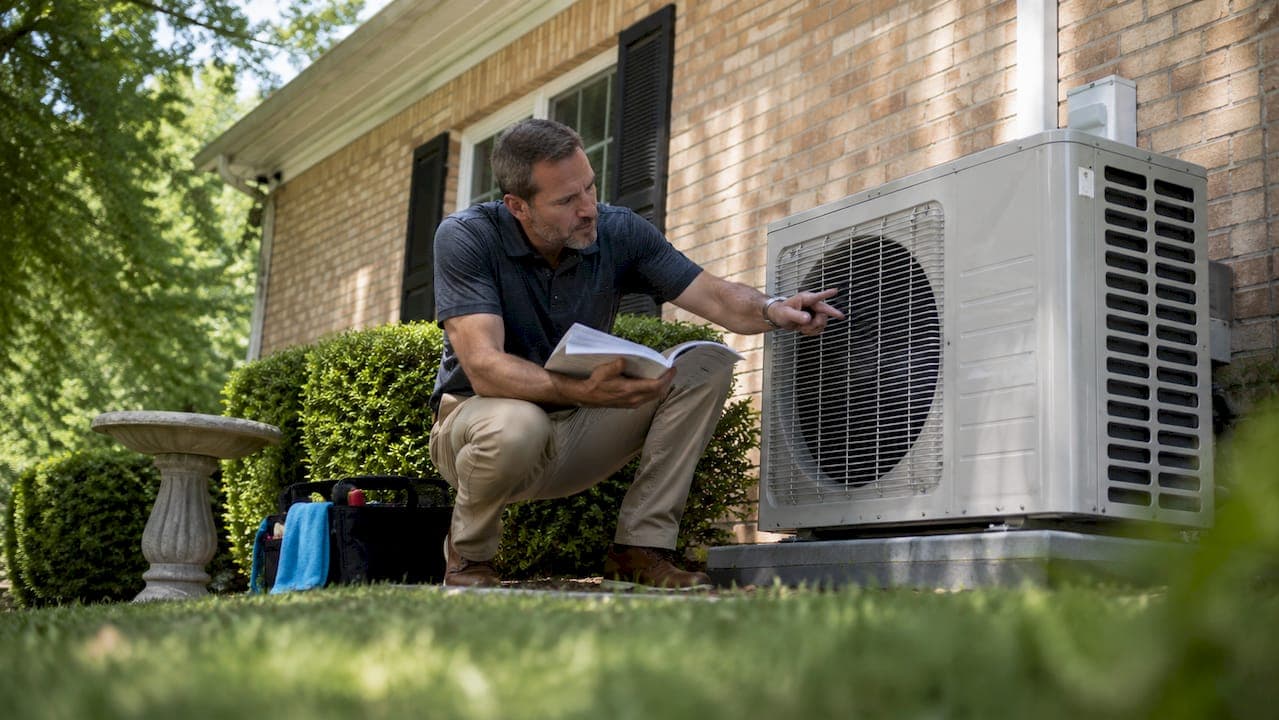
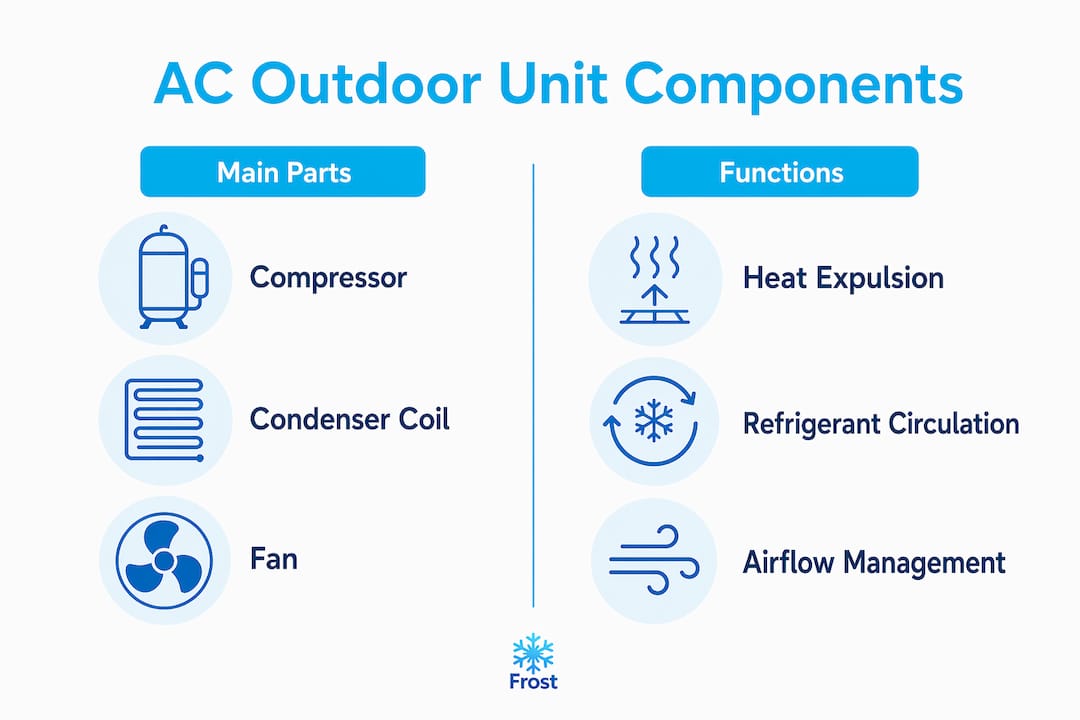
An AC outdoor unit is the external component of a split air conditioning system that expels heat from inside your home to the outside air, completing the refrigeration cycle. Known in the industry as the condenser unit, it houses three critical parts: the compressor, the condenser coil, and the outdoor fan. Without it, the indoor unit has nowhere to send the heat it absorbs. Understanding how it works helps you make better decisions about installation, maintenance, and the type of system that suits your home.
What is an AC outdoor unit and what does it contain?
The condenser unit is the box you see fixed to an outside wall or sitting on a concrete pad in your garden. It is the engine room of your air conditioning system. Every component inside it has one job: move heat from your living space to the outside world.
The four primary components are:
- Compressor: The heart of the system. It pressurises the refrigerant gas, raising its temperature so heat can be expelled efficiently. Many homeowners confuse the compressor with the condenser unit itself, but the compressor sits inside the larger condenser housing.
- Condenser coil: A network of metal tubes and fins through which hot refrigerant flows. Air passes over the coil and carries the heat away.
- Outdoor fan: Draws air across the condenser coil to speed up heat dissipation. Without it, the coil would overheat and the system would shut down.
- Refrigerant lines: Copper pipes connecting the outdoor unit to the indoor unit, carrying refrigerant back and forth between the two.
- Electrical components: The contactor and capacitor control when the compressor starts and how much power it draws. A failed capacitor is one of the most common causes of an outdoor unit not starting.
Pro Tip: If your outdoor unit hums but the fan does not spin, the capacitor is the first thing a qualified engineer will check. It is a cheap fix that prevents compressor damage if caught early.
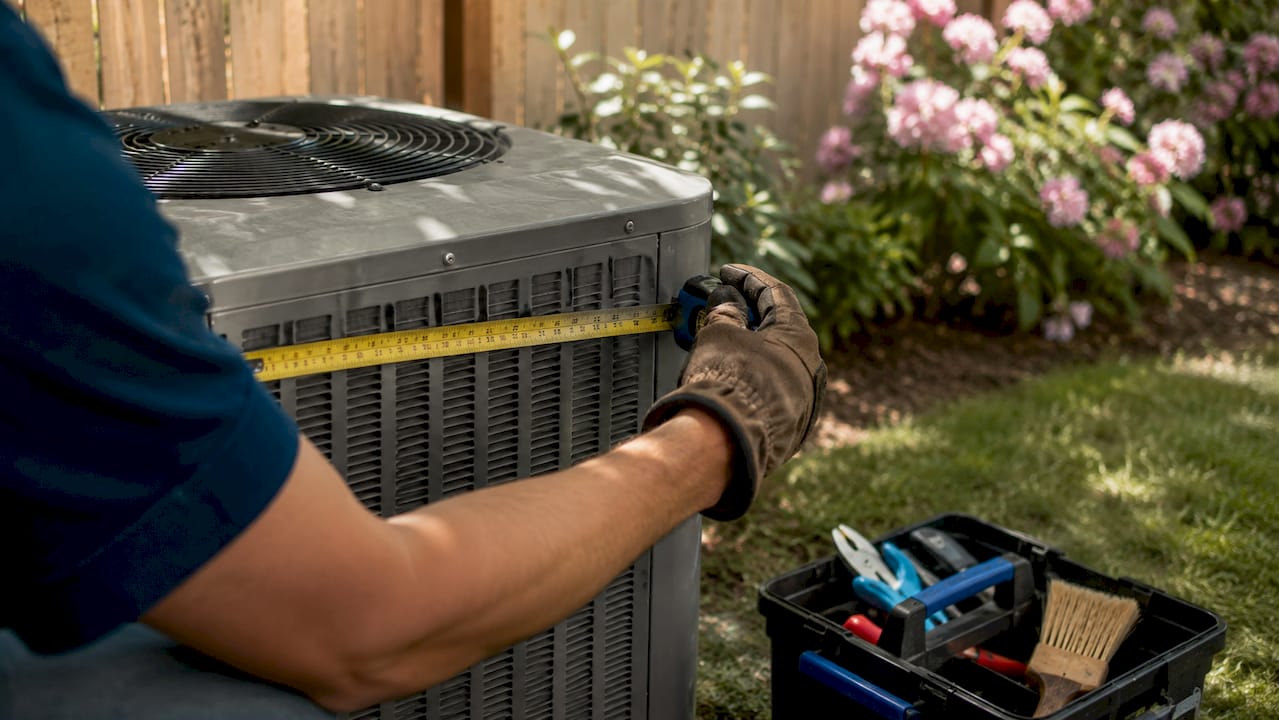
Typical outdoor units measure around 30–36 inches wide and roughly the size of a large suitcase. That physical footprint matters when you are planning where to site one.
How does the outdoor unit work with the indoor unit?
The outdoor and indoor units work as a single closed-loop system. Neither functions without the other. The indoor unit absorbs heat from your room air into the refrigerant, and the outdoor unit releases that heat outside. The cycle repeats continuously until your thermostat is satisfied.
The process runs in four stages:
- Heat absorption indoors. The indoor unit's evaporator coil absorbs warmth from your room air. The refrigerant inside the coil turns from liquid to gas as it soaks up that heat.
- Refrigerant travels outside. The warm refrigerant gas travels along the copper refrigerant lines to the outdoor unit.
- Compression. The compressor pressurises the gas, raising its temperature further. This makes it easier for the condenser coil to push the heat into the outside air.
- Heat release and reset. The condenser coil and fan expel the heat outdoors. The refrigerant cools, turns back into a liquid, and travels back indoors to start the cycle again.
This is the standard vapour compression refrigeration cycle, the same principle used in every domestic fridge. The key difference is scale and the fact that you can direct where the heat goes.
Modern inverter-driven outdoor units adjust compressor speed dynamically rather than switching fully on and off. That single change reduces energy consumption by 30–50% compared to conventional units. It also means the system maintains a steadier indoor temperature rather than swinging between too warm and too cold.
What to consider when installing or maintaining an outdoor unit
Getting the installation right from the start protects your investment and keeps the system running efficiently for years. There are several practical factors worth knowing before you commit to a position or a unit size.
Sizing matters more than most homeowners realise
Undersized units run constantly and never quite cool the space. Oversized units cycle on and off too frequently, wearing out components faster and leaving the air feeling clammy because the system does not run long enough to dehumidify properly. Getting the right size for your room is the single most important decision you will make. The homeowner's guide to sizing air conditioners covers this in detail if you want to go deeper.
Clearance and placement
- Outdoor units need at least 12–24 inches of clearance from walls, fences, and shrubbery on all sides. Restricted airflow is the leading cause of premature compressor failure.
- Avoid positioning the unit in direct sunlight if possible. A shaded north or east-facing wall reduces the workload on the condenser.
- For ductless mini-split systems, installation requires only a small 3-inch hole through the wall for the refrigerant lines and cables. That makes them far less disruptive to fit than ducted systems.
- Keep the area around the unit clear of leaves, grass clippings, and debris. Blockages reduce airflow and force the compressor to work harder.
Noise levels
Mini-split outdoor units operate at 19–30 dB, which is quieter than a whispered conversation. Standard split system condensers are louder. If the unit sits beneath a bedroom window or close to a neighbour's boundary, noise is worth factoring into your placement decision. Proper aircon placement planning can save you a costly relocation later.
Matching indoor and outdoor units
Mixing brands or model generations reduces system efficiency by up to 20% and voids most manufacturer warranties. Always use a matched pair from the same manufacturer and the same product generation. Your installer should confirm compatibility before any work begins.
Pro Tip: Ask your installer for the SEER or SCOP rating of the matched pair, not just the individual units. The combined rating tells you the real-world efficiency of the system as installed.
What are the main types of AC outdoor unit?
Not every outdoor unit is the same. The type you need depends on your home, your budget, and whether you want heating as well as cooling.
| Type | How it works | Best suited for |
|---|---|---|
| Split system condenser | Paired with a separate indoor air handler; standard setup for most homes | Homes with existing ductwork or single-room cooling |
| Heat pump | Identical in appearance to a condenser but uses a reversing valve to provide heating in winter as well as cooling in summer | Homeowners wanting year-round climate control from one unit |
| Mini-split outdoor unit | Smaller ductless unit connected to one or more indoor wall-mounted heads | Homes without ductwork, room additions, or zoned cooling |
| Packaged unit | All components (compressor, condenser, and evaporator) housed in a single outdoor cabinet | Properties with limited indoor plant room space |
Heat pumps are increasingly popular for their dual heating and cooling capability. They look identical to a standard condenser from the outside, which is why many homeowners do not realise they already have a unit capable of heating their home. The types of domestic AC units guide explains the full range of residential options if you are still deciding.
Key takeaways
The AC outdoor unit is the component that makes cooling possible by expelling heat outside, and its correct sizing, placement, and maintenance determine how efficiently and how long the whole system performs.
| Point | Details |
|---|---|
| Core function | The outdoor unit expels heat absorbed indoors, completing the refrigeration cycle. |
| Critical components | Compressor, condenser coil, outdoor fan, and refrigerant lines all work together inside the unit. |
| Sizing is non-negotiable | Both undersized and oversized units cause inefficiency, wear, and poor humidity control. |
| Clearance protects the compressor | Maintain at least 12–24 inches of clearance to prevent airflow restriction and premature failure. |
| Match indoor and outdoor units | Mismatched units reduce efficiency by up to 20% and void manufacturer warranties. |
Why the outdoor unit deserves more attention than it gets
Most homeowners focus entirely on the indoor unit because that is what they see and interact with every day. The outdoor unit sits outside, out of sight, and gets ignored until something goes wrong. That is a mistake I see play out repeatedly in homes across the South West.
The outdoor unit does the hardest physical work in the system. The compressor runs under high pressure and high temperature every time the system is on. When it fails, the repair bill is significant. When it fails because of poor placement, inadequate clearance, or a mismatched indoor unit, it is entirely avoidable.
Inverter technology changed the game for outdoor units. A conventional compressor runs at full speed or not at all. An inverter compressor ramps up and down to match demand. The result is quieter operation, lower electricity bills, and far less mechanical stress on the unit over its lifetime. If you are replacing an older system, specifying an inverter outdoor unit is the single best upgrade you can make.
The other thing I would stress is professional sizing. I have seen homeowners buy a unit online based on room square footage alone, only to find it short-cycles all summer because the room has high ceilings, poor insulation, or large south-facing windows. A proper heat load calculation takes all of that into account. It takes twenty minutes and saves years of frustration.
— James
Frostairconditioning: professional outdoor unit installation in the South West
Frostairconditioning installs and services residential air conditioning systems across Exeter and the wider South West. Every installation is carried out by F-Gas certified engineers, and same-day installs are available for homeowners who need a fast turnaround.

Whether you are fitting a new split system, upgrading to an inverter heat pump, or replacing an ageing outdoor unit, Frostairconditioning handles the full job from sizing through to commissioning. 0% finance is available, making it straightforward to spread the cost. Request a personalised installation quote or find out more about domestic installation services to get started.
FAQ
What is an AC outdoor unit called?
The AC outdoor unit is formally called the condenser unit. It houses the compressor, condenser coil, and outdoor fan.
What is the difference between the outdoor unit and the indoor unit?
The indoor unit absorbs heat from your room air, while the outdoor unit expels that heat to the outside. Both are required for the system to cool your home.
How long does an AC outdoor unit last?
A well-maintained outdoor unit typically lasts 15–20 years. Restricted airflow from inadequate clearance or debris can cut that lifespan to under 10 years.
What are the signs of outdoor unit failure?
Common signs include the unit running but not cooling, unusual noises from the compressor or fan, ice forming on the refrigerant lines, and the unit failing to start at all.
Does the outdoor unit need regular maintenance?
Yes. Clearing debris, checking clearance distances, and having a qualified engineer inspect refrigerant levels and electrical components annually keeps the unit running efficiently and extends its life. The air conditioning maintenance guide covers what to check and when.