

Most homes and small offices with two to five zones do better with a multi-split system: lower upfront cost, simpler wiring, and no complexity you don't need. Buildings with six or more zones, long pipe runs, multiple floors, or a genuine need for simultaneous heating and cooling should look at VRF instead. The single question that decides it: do different rooms ever need heating and cooling at the same time?
TL;DR:
- Multi-split systems are suitable for buildings up to 200 m² with 2 to 5 zones, while VRF supports larger spaces above 300 to 500 m² with more than six zones.
- Pipe length and vertical lift constraints are crucial, with multi-split systems limited to under 100 meters and VRF designed for up to 1,200 meters, making VRF better for long or multi-floor setups.
- Heat recovery VRF systems can improve energy efficiency by 25 to 30 percent through simultaneous heating and cooling, especially in buildings with mixed orientation and thermal demands.
- VRF systems have higher upfront costs and more complex installation and maintenance requirements compared to multi-split, which remains cheaper and simpler for most small-scale applications.
- A proper site survey focusing on zone count, pipe run, building size, and need for heat recovery determines whether a multi-split or VRF system is appropriate, avoiding overspecification and unnecessary expense.
Table of Contents
- VRF vs multi-split: the technical comparison at a glance
- How capacity, pipe runs and building layout decide the outcome
- Energy efficiency: what inverter technology and heat recovery actually save you
- Upfront cost versus long-term running cost
- A practical checklist before you ask for quotes
- Servicing, refrigerant risk, and what belongs in a maintenance contract
- An installer's view on refrigerant choice and future-proofing
- James's verdict
- Get a site survey and a straight answer from Frostairconditioning
- Where to go for deeper technical detail
- Sources
- FAQ
VRF vs multi-split: the technical comparison at a glance
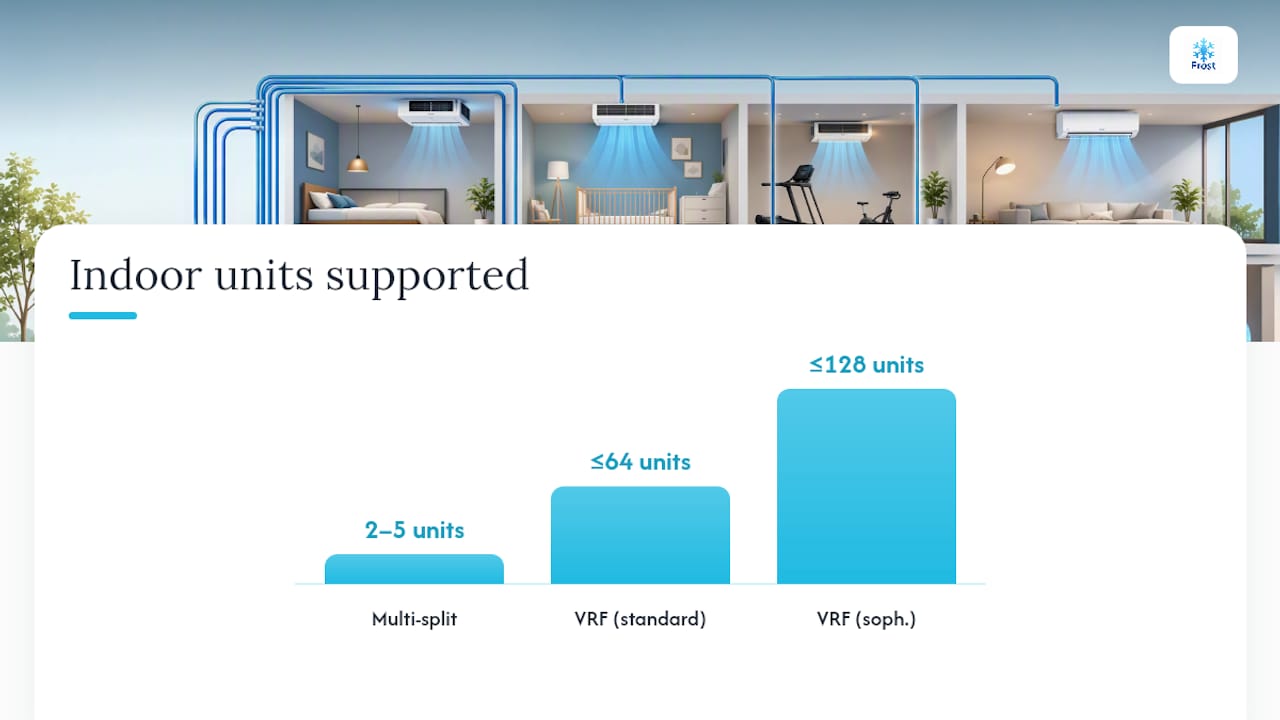
The core difference between VRF and multi-split isn't efficiency or build quality. It's scale and flexibility. A multi-split system connects one outdoor condenser to a handful of indoor units, typically between two and five, and suits residential or light commercial spaces under roughly 200 m². VRF (variable refrigerant flow) scales far beyond that, supporting anywhere from a handful of units up to 64 or even 128 indoor units on sophisticated systems, and it's the standard choice once a building passes 300 to 500 m².
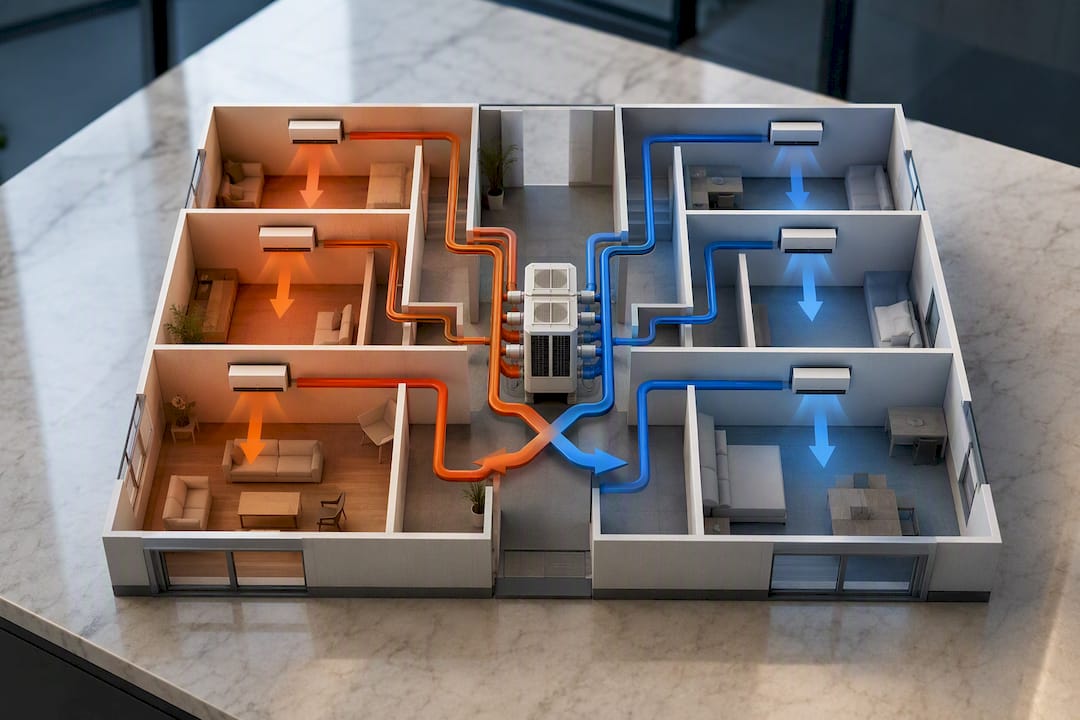
The other differentiator is heat recovery. A heat recovery VRF system lets one zone cool while another heats, drawing the rejected heat from one space and using it in another rather than wasting it. That capability delivers roughly 25 to 30% better efficiency than a standard heat pump setup in buildings with mixed orientation or uneven thermal loads. Multi-split systems have no equivalent; every indoor unit simply runs in the same mode as the outdoor condenser.
Installation footprint follows the same pattern:
- Multi-split: one outdoor unit, 2 to 5 indoor units, standard refrigerant pipework, wiring a competent installer completes in a day or two.
- VRF: one or more outdoor condensers, branch selector boxes, extended refrigerant circuits, and often a central controller or Building Management System (BMS) integration.
- Heat recovery VRF: adds a 3-pipe refrigerant circuit and heat recovery units at each branch, the most capable but also the most complex configuration to design and commission.
How capacity, pipe runs and building layout decide the outcome
Zone count is the first filter, but it's rarely the only one. A multi-split system is built for 2 to 5 indoor units across roughly 200 m². Push past that, either in unit count or floor area, and you're into VRF territory, where systems are routinely specified for dozens of indoor units above 300 to 500 m².
Pipe runs and vertical lift matter just as much as zone count, and this is where a lot of DIY research goes wrong. Multi-split pipework has practical limits, often well under 100 metres of total equivalent length, and modest height differences between the outdoor unit and the furthest indoor unit. VRF pipework is engineered for a different scale entirely, with specialist designs handling total equivalent lengths up to 1,000 to 1,200 metres and far greater vertical rise. That's exactly why a five-storey office block or a hotel spread across a long footprint gets specified with VRF even when the total zone count looks modest on paper.
There's a third factor worth flagging for anyone managing a phased fit-out: VRF's modularity. Because outdoor units and branch circuits can be added incrementally, developers and landlords often install core VRF infrastructure first and add indoor units floor by floor as tenants move in. That defers capital spend until the space is actually let, which is a real advantage over committing to a fully-sized multi-split install from day one.
Pro Tip: Measure your longest realistic pipe run before you get quotes, not after. An installer can tell you almost immediately whether a layout sits comfortably within multi-split limits or needs VRF, and it saves you from comparing two quotes for two completely different systems.
Key thresholds to bring to a site survey:
- Indoor unit count: 2 to 5 suggests multi-split; 6 or more points towards VRF.
- Floor area: under 200 m² generally favours multi-split; above 300 to 500 m² generally favours VRF.
- Pipe run and vertical lift: anything approaching 100 metres or spanning several floors pushes the decision towards VRF.
Energy efficiency: what inverter technology and heat recovery actually save you
Both technologies use inverter-driven compressors, but VRF exploits that technology more aggressively across a wider range of loads. In commercial applications, inverter-driven VRF systems commonly deliver 20 to 30% energy savings compared with fixed-capacity or conventional variable-air systems, because the compressor modulates output to match the actual load rather than cycling on and off at full power.
The headline figures: 20 to 30% part-load energy savings from inverter-driven VRF in typical commercial use, rising to 25 to 30% additional efficiency in heat recovery VRF systems handling mixed heating and cooling loads simultaneously.
Part-load performance is the mechanism behind most of that saving. Most buildings spend the majority of their operating hours at partial load, not peak demand, so a system that scales output efficiently at 30% or 50% capacity saves far more over a year than its rated peak efficiency suggests. Multi-split systems also use inverter compressors and benefit from the same principle, just across a smaller number of zones and a narrower range of simultaneous demand.
Heat recovery is where the two technologies genuinely diverge. In a building with rooms facing different directions, a south-facing office needing cooling in the afternoon while a north-facing meeting room still needs heat, a heat recovery VRF system moves that rejected heat between zones instead of generating and dumping it separately. That's the source of the 25 to 30% efficiency gain over standard configurations, and it's particularly effective in hotels, schools and mixed-orientation offices where simultaneous opposite-mode demand is a daily occurrence rather than an edge case.
Where does this change the payback maths? Buildings with high solar gain on one elevation, variable occupancy through the day, or a genuine year-round mix of heating and cooling demand are where VRF's efficiency premium earns its keep fastest. A small flat with consistent, uniform heating and cooling needs across two or three rooms rarely generates enough simultaneous opposite-mode demand to make heat recovery pay for itself quickly.
Upfront cost versus long-term running cost
VRF costs more to buy and more to install than multi-split, and the gap isn't small. The premium comes from three places: the outdoor condenser technology itself, branch selector boxes needed to route refrigerant to individual zones (only required for heat recovery configurations), and the extended, more complex refrigerant pipework that VRF systems are designed to support.
Multi-split keeps things simpler on every one of those fronts. Fewer components, shorter pipe runs, and installation a competent engineer completes without specialist branch controllers or central BMS integration. That simplicity is precisely why multi-split systems remain cheaper to install and maintain than VRF across the lifecycle of the system, not just at purchase.
Commissioning is the part homeowners and small business owners most often underestimate. VRF systems rely on electronic expansion valves and load-balancing software that need accurate refrigerant charging and control tuning at handover. Get that wrong and you can quietly erase the part-load efficiency gains the system was specified to deliver in the first place, which is one of the strongest arguments for using an F-Gas certified engineer with genuine VRF commissioning experience rather than a generalist.
Where does the higher capital cost make sense?
- A hotel or serviced office block with genuine simultaneous heating and cooling demand across different zones, where heat recovery's 25 to 30% efficiency gain compounds over years of operation.
- A multi-floor commercial building where phased VRF installation lets a landlord defer spend until tenants sign leases.
- A retail unit undergoing a shop fit where BMS integration and centralised energy monitoring matter for lease compliance or multi-site reporting.
Where it doesn't: a three-bedroom house, a single-storey shop, or any space with 2 to 3 zones and short pipe runs. Specifying VRF for that scale is usually overspecification, not a smarter buy, and a well-sized multi-split system will do the job for considerably less money.
A practical checklist before you ask for quotes
Getting comparable quotes from installers starts with answering a short list of questions honestly, in this order:
- How many zones need independent control? Count every room or area that needs its own temperature setting, not just the ones you think matter most.
- Do any zones need opposite modes at the same time? If a home office runs hot with equipment while a bedroom next door needs heating in winter, that's a heat recovery case.
- What's the longest pipe run and the biggest vertical rise? Measure from the likely outdoor unit position to the furthest indoor unit, including any floor-to-floor distance.
- How many floors does the installation span? Single-storey properties rarely need VRF regardless of zone count; multi-storey buildings often do.
- Do you need BMS integration or per-tenant energy monitoring? This matters for landlords, multi-site retailers, or anyone facing MEES or ESOS compliance requirements.
- Are you planning to expand? If you'll add zones within the next few years, VRF's modularity and phased installation may justify the higher starting cost.
- What's your realistic budget ceiling, including servicing? Factor in ongoing maintenance, not just the installation invoice.
Before your survey, gather floor plans and elevations, a rough note of occupancy patterns through the day, and any known compliance triggers like an upcoming EPC reassessment. That turns a generic site visit into a proper technical brief.
Pro Tip: If you're comparing quotes from different installers, insist that each one specifies the exact system type, zone count and pipe run length they've priced against. "Air conditioning installation" quotes that don't specify multi-split or VRF explicitly are almost impossible to compare fairly.
Three quick scenarios: a four-bedroom home with a home office and a garden room, five zones total, short pipe runs, no simultaneous heating/cooling need, multi-split. A single-storey shop with a sales floor and back office, three zones, VRF would be overspecified here. A three-storey office building with south and north-facing wings and a server room needing year-round cooling, VRF with heat recovery. If you're weighing options for a home specifically, this guide to choosing a home air conditioner walks through the same questions in more residential detail.
Servicing, refrigerant risk, and what belongs in a maintenance contract
VRF's complexity doesn't end at installation. Electronic expansion valves, branch controllers and load-balancing software all need periodic checking, and that pushes VRF towards specialist annual maintenance with higher lifecycle servicing costs than a comparable multi-split installation. Multi-split systems are simpler to service precisely because there's less to tune.
Refrigerant risk scales with pipework length. Longer refrigerant circuits mean more joints, more potential leak points, and larger total refrigerant charges, which brings F-Gas regulations on charge size and leak checking frequency into sharper focus on larger VRF installations. Every indoor unit also needs its own condensate drain, and on a 20 or 30 unit VRF system, checking each of those during a service visit takes considerably longer than on a five-unit multi-split.
What to demand in any maintenance contract, whichever system you choose:
- F-Gas certification for every engineer attending site, not just the company as a whole.
- Response time commitments for breakdowns, especially for commercial premises that can't operate without cooling.
- Spare-part availability, particularly for VRF branch selector boxes and control boards, which aren't always stocked locally.
- Remote monitoring, where available, so faults on larger VRF systems get flagged before they cause a full outage.
- Refrigerant leak checks documented at every visit, with charge records kept for compliance purposes.
An installer's view on refrigerant choice and future-proofing
An experienced air conditioning installer has installed and serviced both multi-split and VRF systems across Exeter and the wider South West, and the question that comes up most in site surveys isn't "which is more efficient", it's "which one will still make sense in ten years". Refrigerant choice matters more than most homeowners realise here.
R32 remains the dominant refrigerant across most current split and multi-split installations, but R290 (propane-based) systems are gaining ground as manufacturers prepare for tightening F-Gas phase-down schedules. Specifying a system today without asking about its refrigerant's long-term regulatory position can leave a building owner facing an expensive retrofit well before the equipment's rated lifespan ends.
For a straightforward multi-split install, that conversation is quick. For VRF, it's central to the design, because a large commercial refrigerant charge tied to a phase-out refrigerant is a far costlier problem to fix later than a single split unit. Qualified engineers walk through this at survey stage on every VRF quote.
Phased VRF installs bring their own practical rhythm: an initial site survey confirms condenser location and pipe routing, commissioning validates refrigerant charge and control settings zone by zone, and additional indoor units get added to the existing circuit as later phases of a fit-out complete, without disturbing zones already in service.
James's verdict
Multi-split remains the right call for the overwhelming majority of homes and small commercial units, and readers shouldn't feel talked into VRF by efficiency figures that only apply at a scale they don't operate at. Get a proper load calculation and site survey from an F-Gas certified installer before committing either way. The numbers on paper matter less than the building in front of you.
— James
Get a site survey and a straight answer from Frostairconditioning
Reading about pipe-run limits and heat recovery efficiency only gets you so far. What actually settles the multi-split versus VRF question is a proper site survey, someone measuring your longest pipe run, counting your zones, and checking whether your building genuinely needs simultaneous heating and cooling before you spend a penny.

An air conditioning installer covers Exeter and the South West with qualified engineers who quote honestly on both system types, rather than defaulting to whichever is easier to sell. If you're weighing up a home installation, start with domestic installation. Planning a retail fit-out or office refurbishment, shop fitting covers commercial multi-split and VRF projects from survey through to handover. And whichever system you already run, service maintenance contracts with F-Gas certified engineers keep refrigerant charges compliant and breakdowns rare. Book a survey and get a bespoke quote before your next cooling season catches you out.
Where to go for deeper technical detail
The comparisons and figures used throughout this article draw on published engineering and trade sources rather than manufacturer marketing, which matters when the numbers involved (efficiency gains, pipe-run limits, unit counts) directly shape a specification decision.
- VRF vs multi-split: key differences for engineers covers the capacity thresholds and heat recovery efficiency figures referenced above.
- VRF technology: the missing link to lower utility bills explains the part-load savings mechanism in more technical depth.
- Back to basics: VRF systems gives a clear engineering primer on heat recovery configurations and typical building applications.
- For designers working on larger commercial specifications, REHVA and ASHRAE both publish detailed VRF design guidance worth consulting alongside a site-specific engineer's assessment.
- Landlords budgeting for lifecycle costs may also find this guide to budgeting for rental property maintenance useful when factoring servicing contracts into long-term running costs.
Sources
- VRF vs multi-split: key differences for engineers
- VRF technology: the missing link to lower utility bills
- Back to basics: VRF systems
FAQ
Is VRF better than multi-split AC?
Neither is universally better. VRF suits larger buildings with 6 or more zones, long pipe runs, or a genuine need for simultaneous heating and cooling, while multi-split is usually the smarter, cheaper choice for homes and small offices with 2 to 5 zones.
Is VRF a type of multi-split system?
VRF is technically a more advanced category of multi-split technology, since both connect one outdoor unit to multiple indoor units, but VRF adds far greater scalability, heat recovery capability, and BMS integration that standard multi-split systems don't offer.
What are the disadvantages of VRF?
VRF costs more to buy and install, needs specialist commissioning to avoid negating its efficiency gains, and typically requires more expensive annual maintenance and F-Gas certified servicing than a comparable multi-split system.
Is VRF the same as a mini-split?
No. A mini-split usually refers to a single outdoor unit paired with one or two indoor units, whereas VRF systems scale to dozens of indoor units on one refrigerant circuit, with far greater flexibility for zoning and heat recovery.