

Planned preventative maintenance (PPM) is the right default for anything critical, costly to replace, or capable of stopping trading if it fails; reactive maintenance is fine for cheap, low-risk kit you can genuinely afford to run until it dies. Most UK facilities need both, split by asset criticality rather than by budget mood on a Monday morning. The rest of this guide shows how to draw that line.
TL;DR:
- Most UK facilities should apply PPM to critical assets with high failure impact, while allowing run-to-failure for low-value equipment to optimize costs.
- Reactive maintenance can cost three to five times more than planned work when factoring in emergency labour, expedited parts, and lost revenue during downtime.
- A well-structured PPM program can reduce unplanned downtime by 30 to 50 percent and extend equipment life by 30 to 40 percent.
- Asset criticality, replacement lead times, and downtime costs should guide whether to use PPM, condition monitoring, or run-to-failure policies.
- Combining PPM for critical assets with reactive maintenance for non-essential items creates a cost-effective, resilient maintenance strategy.
Table of Contents
- PPM vs reactive maintenance: what PPM actually involves
- What reactive maintenance really costs once you count everything
- PPM vs reactive maintenance: comparing cost, downtime and risk
- How to decide per asset: a practical framework
- What good PPM looks like day to day in a UK facility
- Why most UK facilities need a hybrid, not a religion
- Get a PPM contract built around your site, not a template
- Sources
- FAQ
PPM vs reactive maintenance: what PPM actually involves
Planned preventative maintenance means scheduled inspections, servicing, and part replacements carried out on a time or usage basis, before anything fails. It is the opposite of waiting for a breakdown. A PPM contract for a commercial building typically covers filter changes, lubrication, refrigerant checks, and statutory safety inspections carried out to a fixed calendar rather than an emergency phone call.
A well-written contract spells out:
- Visit frequency (quarterly HVAC servicing is standard for most commercial sites)
- Scope of works, listed task by task, not just "servicing included"
- Response service level agreements (SLAs) for any faults found during a visit
- Exclusions, so you know what triggers an extra invoice
- Pricing model, whether that is per visit, per asset, or an annual fixed fee
Facility managers should track a handful of numbers to know if a PPM programme is earning its keep: planned maintenance percentage (PMP), mean time to repair (MTTR), total downtime hours, and job completion rate against schedule. World-class PPM programmes run at 85 to 90% PMP; anything under 70% signals a programme that is reactive in practice, whatever the paperwork says.
What reactive maintenance really costs once you count everything
Reactive, or run-to-failure, maintenance means fixing equipment only after it breaks. There is no schedule, no inspection calendar, just a call-out when something stops working. It often looks cheaper on paper because you are not paying for visits when nothing has gone wrong. That is the trap.
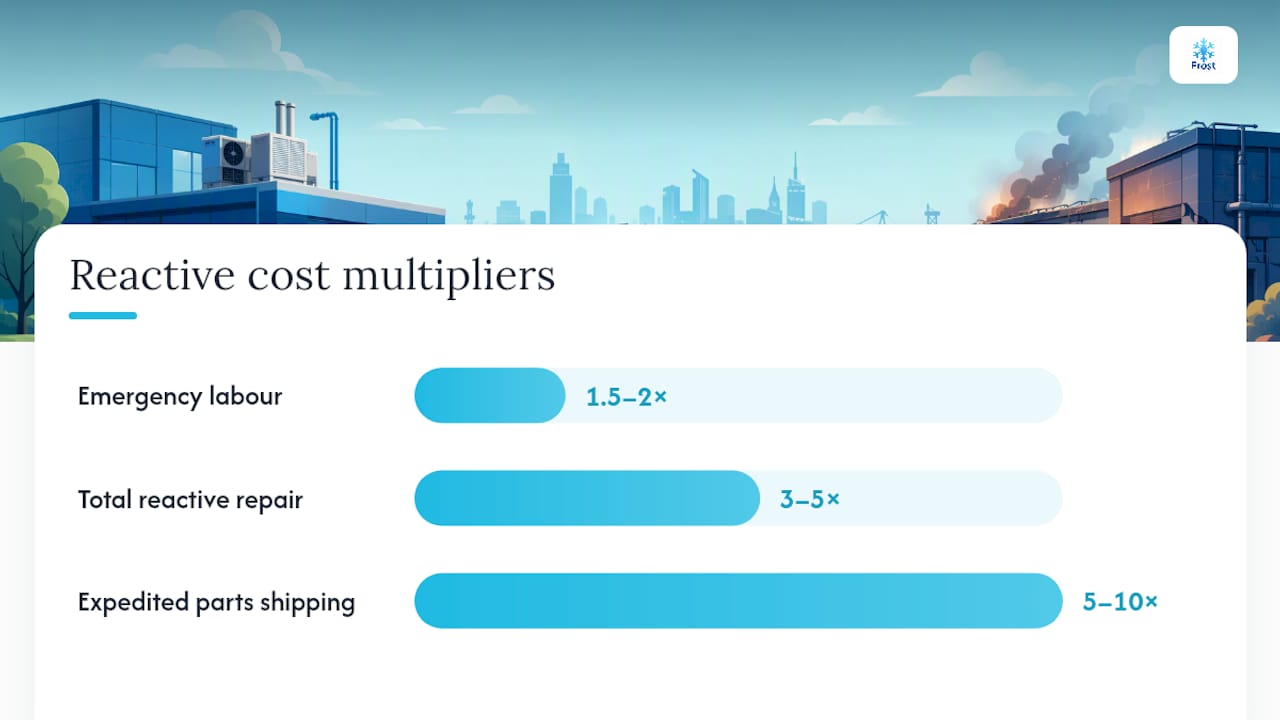
Reactive work can cost three to five times more than the equivalent planned job once you add the costs nobody puts on the quote:
- Emergency call-out labour, typically 1.5 to 2 times standard rates
- Expedited parts shipping, which can run 5 to 10 times normal pricing
- Trading hours lost while a shop, kitchen, or office sits without cooling or power
- Compliance fines if a missed statutory inspection contributed to the failure
- Collateral damage, where one failed part takes out others around it
Statistic to remember: the true multiplier on reactive repairs rarely sits in the invoice you receive. It sits in the overtime rate, the courier fee, and the till that stopped ringing for an afternoon.
Run-to-failure is still a sensible, deliberate choice for genuinely low-value, non-critical kit, a spare desk fan, a single light fitting in a low-traffic store cupboard, where a breakdown costs almost nothing to fix or live without.
PPM vs reactive maintenance: comparing cost, downtime and risk
Siemens frames the core distinction as control versus chaos: PPM puts the business in charge of timing and cost, while reactive maintenance hands that control to whichever part fails first. That framing holds up under the numbers.
Preventive programmes cut unplanned downtime by roughly 30 to 50% and extend equipment life by 30 to 40% compared with run-to-failure operations. IBM's analysis puts the overall cost saving at 20 to 40% once every cost is counted, not just the repair invoice.
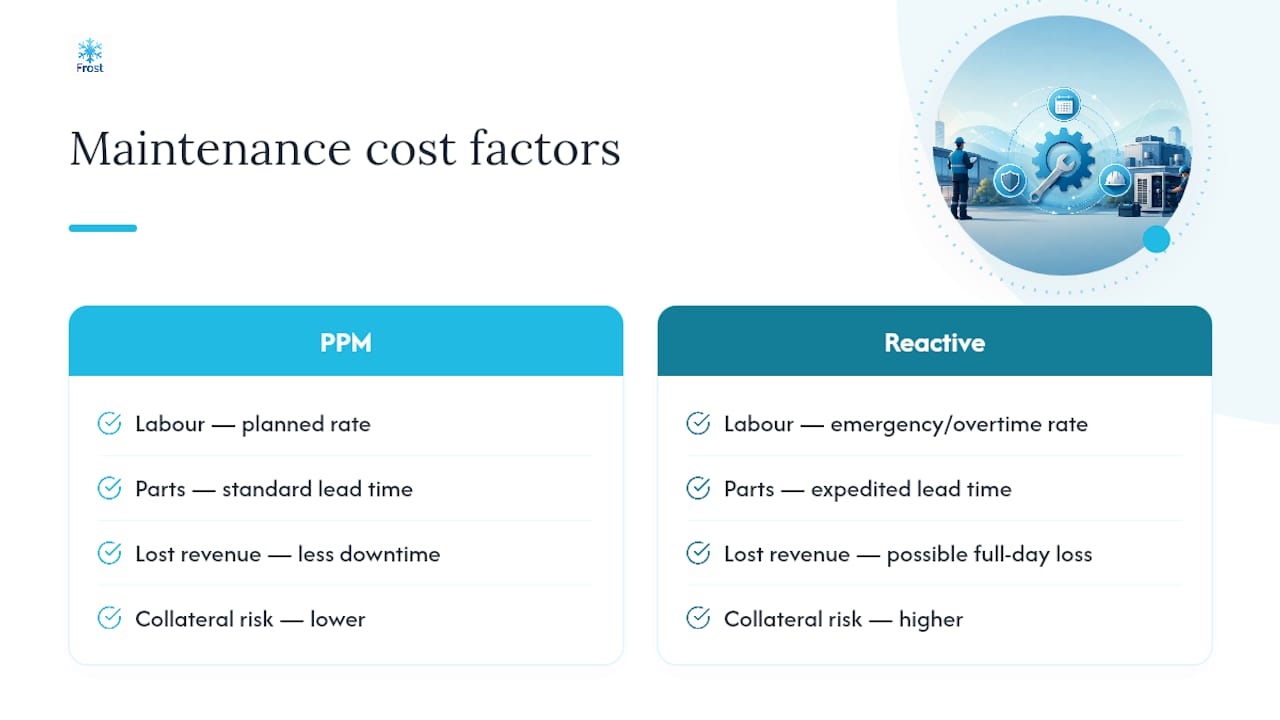
To compare fairly, count four things for any asset: labour (planned rate vs emergency rate), parts (standard lead time vs expedited), lost revenue during downtime, and the risk of one failure damaging adjacent equipment.
A rough worked example for a small commercial site: a quarterly HVAC service contract might run a few hundred pounds a visit. A single emergency compressor failure in August, with expedited parts and an overtime call-out, can easily clear that entire year's servicing budget in one incident, before counting a day of lost trade in a café or shop that suddenly has no cooling.
How to decide per asset: a practical framework
Run every asset through this triage rather than applying one policy site-wide.
- Classify criticality. Grade A: failure stops trading, creates a safety risk, or breaches compliance (main HVAC plant, commercial kitchen refrigeration, fire systems). Grade B: failure is disruptive but not catastrophic (secondary AC units, non-essential lighting circuits). Grade C: failure is a minor inconvenience with cheap, fast replacement (single desk units, non-critical accessories).
- Check the cost-impact factors for each Grade A and B asset: how long do replacement parts take to arrive, what does an hour of downtime cost you in lost trade, is there a backup unit, and does a fault create any safety or compliance exposure.
- Set the policy by grade. Grade A assets go on PPM or condition-based monitoring, no exceptions. Grade B assets usually justify PPM too, on a lighter schedule. Grade C assets can run to failure deliberately.
- Track your planned maintenance percentage monthly and use it to build the business case to finance: NIST's review of maintenance programmes shows measurable ROI once businesses shift high-value assets off reactive-only maintenance.
Pro Tip: *Bring finance a PMP trend line, not a maintenance philosophy.
What good PPM looks like day to day in a UK facility
A proper HVAC PPM visit follows a checklist, not a vibe: filter condition, refrigerant pressure, condensate drainage, electrical connections, and controller settings all get checked and logged every visit, with results kept on file for future reference.
Operators can flag problems long before a technician arrives. Watch for:
- Unusual noise from an outdoor or indoor unit
- A creeping rise in energy bills with no change in usage
- Condensate leaking where it did not leak before
Schedule PPM visits around UK seasonal peaks, before the summer cooling season and before winter heating demand, and make sure statutory F-Gas checks sit on the same calendar rather than as an afterthought. A homeowner's aftercare routine follows the same logic on a smaller scale.
Pro Tip: A proper PPM supplier gives you a documented scope, a named response SLA, and REFCOM/F-Gas certified engineers on the job, not a vague promise to "keep an eye on it."
Why most UK facilities need a hybrid, not a religion
Pure PPM everywhere wastes money on assets that do not deserve it. Pure reactive maintenance eventually produces the exact call-out bill that ruins a quarter's budget. A hybrid programme, PPM on anything critical, run-to-failure on the rest, balances cost against resilience better than either extreme.
Three steps I'd push first: start logging every work order so patterns actually surface, protect planned maintenance windows even when things feel calm, and review the criticality list every quarter. What counted as low-risk last year might not stay that way.
— James
Get a PPM contract built around your site, not a template
A practical alternative to waiting for a breakdown call is to hire a local, F-Gas certified installer who builds annual service contracts around the criticality framework above, backed by an emergency breakdown response, without subcontractors or a call centre in between.
This means engineers familiar with the equipment, same-day response where it counts, and premium branded systems fitted and maintained by the same team. Whether you are running a single commercial kitchen or several retail units, a PPM contract from Frostairconditioning replaces guesswork about when the next failure lands with a fixed schedule and a documented scope. If you are weighing up installation costs alongside maintenance, a shop fitting project or domestic installation can be built with a maintenance plan from day one. Get in touch to request a free survey and a risk-based maintenance quote for your site.
Sources
The cost and downtime figures in this guide come from Siemens' asset management blog, eWorkOrders' cost comparison, NIST's maintenance research review, and Honeywell's preventive maintenance insights. For a practical seasonal-maintenance approach outside HVAC, JH Roofing's seasonal checklist applies the same scheduling logic to a different asset type. For a site-specific quote, visit Frostairconditioning's Service & Maintenance page.
- Reactive vs. Preventive Maintenance: Full Cost Comparison — eWorkOrders
- NIST maintenance research review — NIST AMS
FAQ
What is the 80/20 rule in maintenance?
It generally means that around 20% of your assets, the critical ones, drive roughly 80% of your maintenance cost and downtime risk, which is exactly why criticality-based triage matters more than a blanket policy.
What are the 7 types of maintenance?
Common categories include reactive (run-to-failure), preventive/planned (PPM), predictive, condition-based, corrective, scheduled, and risk-based maintenance, with most real-world facilities running a mix rather than a single type.
What's the difference between preventive maintenance and reactive maintenance?
Preventive maintenance schedules inspections and servicing before failure, giving you control over timing and cost; reactive maintenance waits for a breakdown and typically costs three to five times more once emergency labour and expedited parts are counted.
What are the 5 types of preventive maintenance?
The usual breakdown is time-based, usage-based, predictive, prescriptive, and condition-based preventive maintenance, each triggering servicing on a different signal, whether that is a calendar date, run hours, or a sensor reading.
How much does Frostairconditioning's PPM service cost?
Pricing depends on the site, system, and contract scope, so Frostairconditioning quotes each annual service contract individually after a free survey rather than publishing a flat rate.