
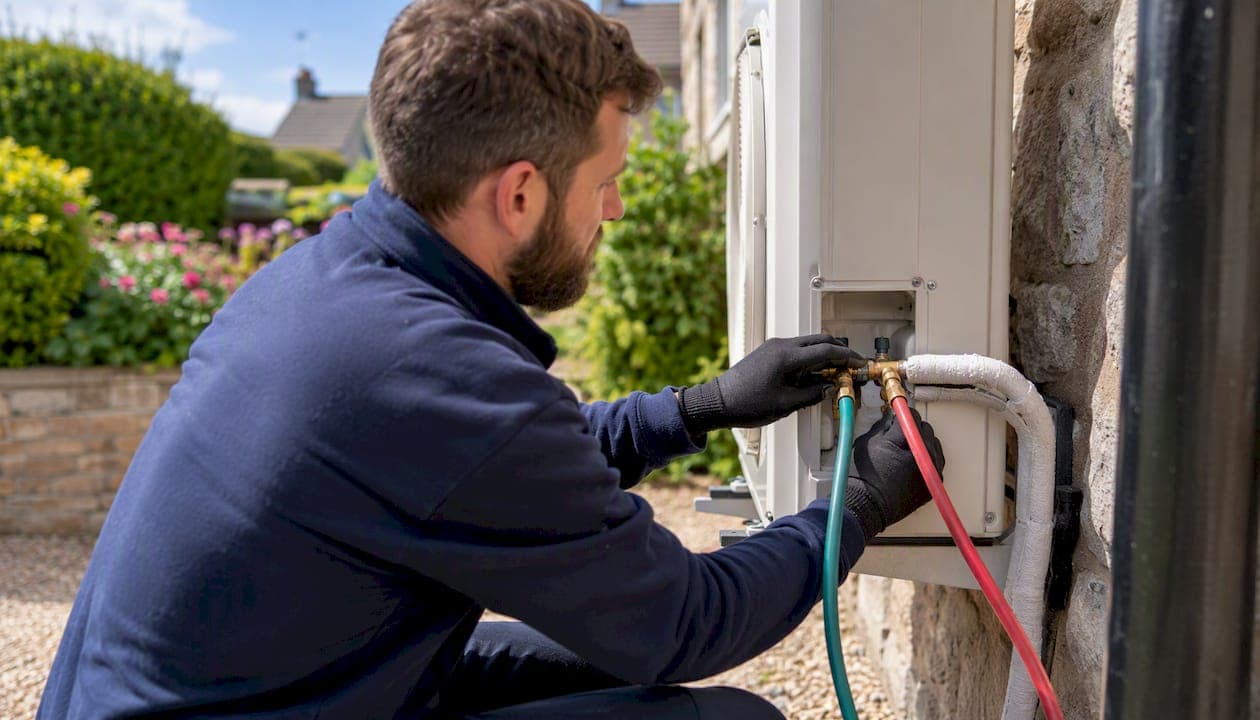
New air conditioners fitted in 2026 almost always run on refrigerants like R-454B or R-32. Existing systems installed before the phase-down mostly hold R-410A, and older units (pre-2010s) may still run R-22, which is now heavily restricted. Cars and vans use R-1234yf almost universally, with a small number of manufacturers trialling the hydrocarbon R-290 in compact systems.
None of this means your existing unit is suddenly obsolete or unsafe.
- GWP contrast: R-410A has a high Global Warming Potential; R-32 and R-1234yf have much lower global warming impacts.
- Safety class: R-410A and R-32 are A1/A2L; R-1234yf and R-290 are mildly to highly flammable (2L/3).
- Urgency: replacement is gradual, not urgent, for anyone with a working R-410A system.
Key Takeaways
Most new UK air conditioners now run on R-454B or R-32, while existing R-410A systems remain fully legal to repair and recharge for years to come.
| Point | Details |
|---|---|
| New installs use A2L gas | R-454B and R-32 are now standard in new residential systems, with lower GWP than R-410A. |
| Old systems aren't obsolete | R-410A units remain serviceable and legal to recharge for many years yet. |
| Refrigerant is never "used up" | A sealed system losing gas always means a leak, not normal consumption. |
| Never DIY a recharge | F-Gas certification and recovery equipment are legally required for refrigerant work. |
| Get certified engineers | Frostairconditioning's REFCOM/F-Gas certified team handles diagnosis, leak repair, recharge and replacement across the South West. |
Table of Contents
- How does refrigerant actually cool a room?
- Which refrigerants will you actually find in your AC?
- What do A1 and A2L safety ratings actually mean?
- What does the refrigerant phase-down mean for existing systems?
- What are the warning signs your AC is low on gas?
- Can you top up AC gas yourself, and what does a service cost?
- What should you check before hiring a technician?
- Sorting a gas leak, recharge or full replacement
- Sources
How does refrigerant actually cool a room?
Refrigerant is the working fluid that moves heat out of your building, not something your AC burns or consumes like fuel. It cycles endlessly between liquid and gas inside a sealed loop, carrying heat from indoor air to the outside.
The cycle runs in four basic steps:
- Evaporation: liquid refrigerant absorbs heat from indoor air and turns to gas.
- Compression: the compressor pressurises that gas, raising its temperature.
- Condensation: the hot gas releases heat outdoors and condenses back to liquid.
- Expansion: the liquid drops in pressure and cools, ready to absorb heat again.
Because refrigerant stays inside a closed system, a correctly installed unit should never need topping up. If yours does, something is leaking, as Carrier's homeowner guide explains in more detail.
Which refrigerants will you actually find in your AC?
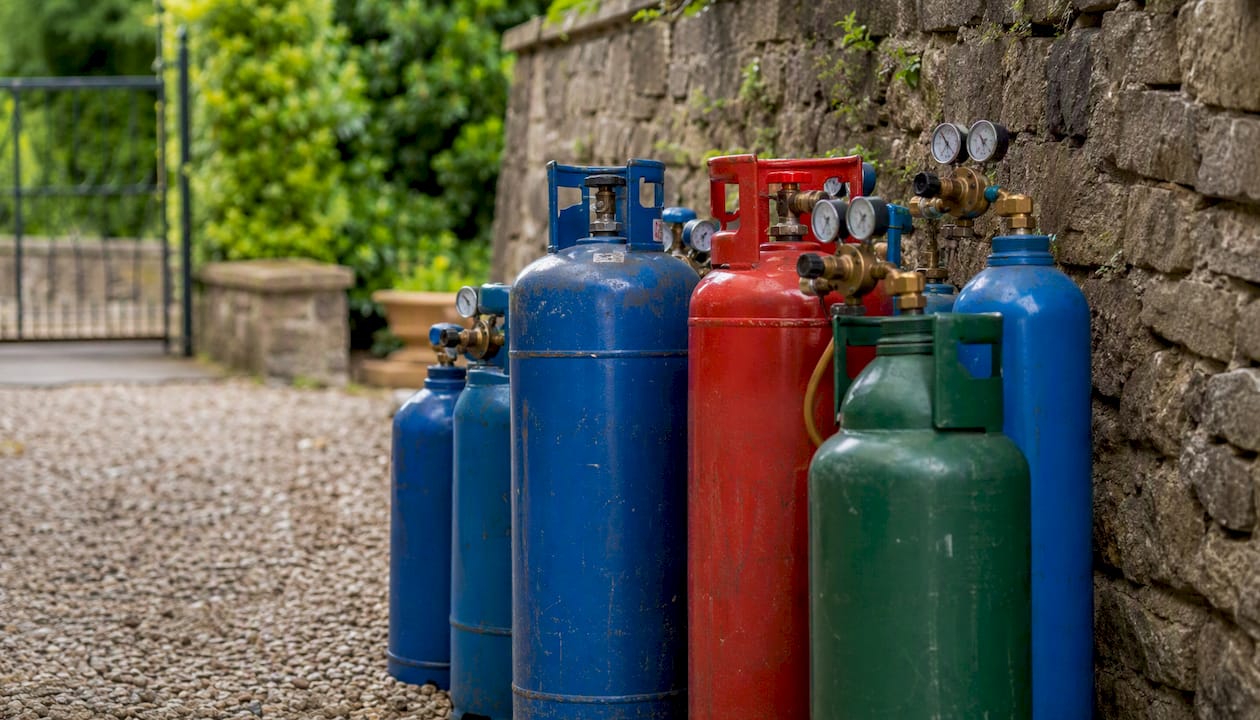
Six refrigerants account for almost everything installed in homes, shops and vehicles across the UK. The table below draws on the ASHRAE and UNEP refrigerant factsheet for GWP and safety classification.
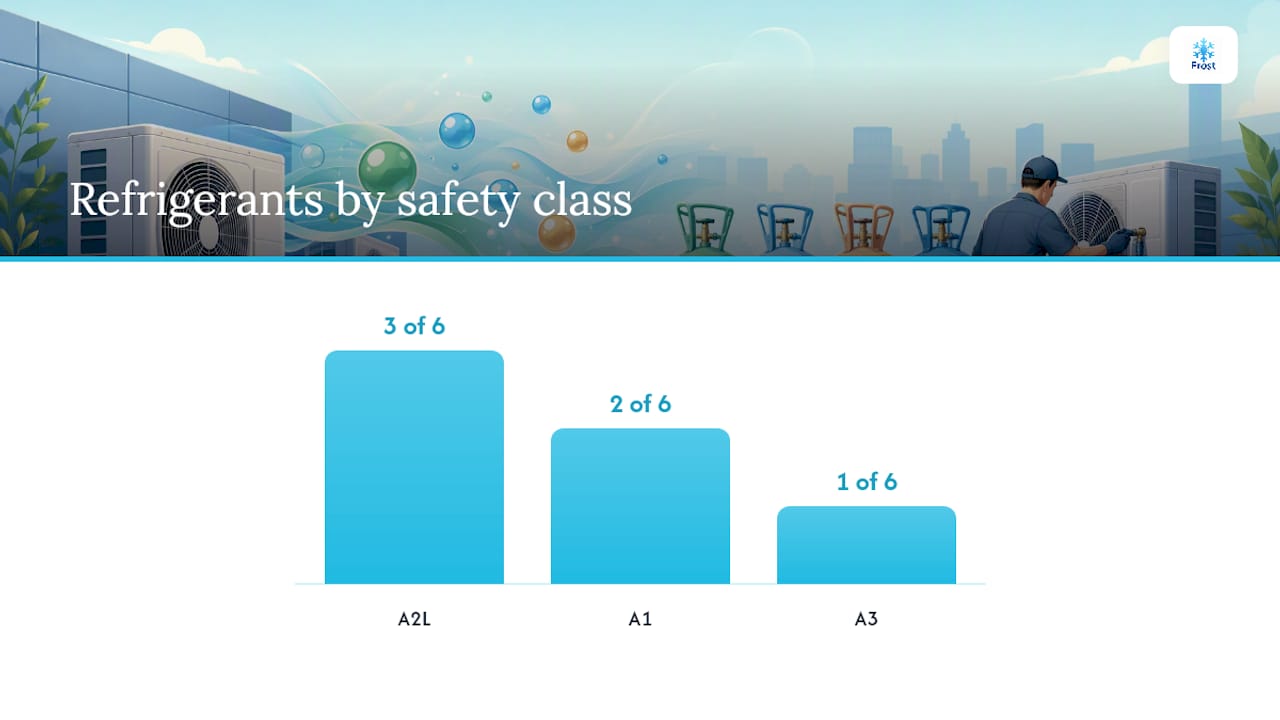
| Refrigerant | ASHRAE safety class | Common use | Regulatory status |
|---|---|---|---|
| R-454B | A2L | New residential splits | Standard for new UK installs |
| R-32 | A2L | New residential splits | Widely used, phasing in further |
| R-410A | A1 | Existing residential/commercial | No longer used in new equipment |
| R-22 | A1 | Older pre-2015 systems | Banned for new equipment and virgin gas |
| R-1234yf | A2L | Vehicle air conditioning | Mandatory for new vehicles |
| R-290 (propane) | A3 | Small packaged/compact units | Niche but growing |
A few practical notes worth knowing:
- R-454B and R-32 dominate new installs because they have significantly lower global warming potential compared with R-410A while maintaining similar efficiency, according to Trane's refrigerant guide.
- R-22 systems are increasingly hard to service due to restrictions on virgin gas production; repairs now rely on reclaimed stock.
- R-1234yf replaced R-134a in vehicles specifically because of its very low global warming potential, despite being mildly flammable.
- R-290 is used mostly in small self-contained units where the refrigerant charge size keeps flammability risk manageable.
You can usually identify which gas your system uses from the data plate on the outdoor unit or inside the service panel. It's stamped clearly on every compliant appliance sold in the UK.
What do A1 and A2L safety ratings actually mean?
ASHRAE Standard 34 classifies refrigerants by toxicity (A or B) and flammability (1, 2, 2L or 3), giving engineers and homeowners a shared shorthand for risk. A1 means non-flammable and low toxicity. That's the profile of R-410A and R-22, and it's why decades of AC installs carried minimal fire risk.
A2L refrigerants like R-32 and R-454B are classed as "mildly flammable" and lower toxicity. They only ignite under narrow conditions, but manufacturers still build in extra precautions:
- Leak detection sensors that shut the system down if refrigerant concentration rises.
- Specific minimum room volumes or ventilation requirements for indoor units.
- Component and wiring changes to avoid ignition sources near refrigerant lines.
Pro Tip: If you're switching to an A2L system, ask your installer whether your indoor unit's location meets the room-size guidance for that refrigerant charge. It's a five-minute check that avoids a costly relocation later.
What does the refrigerant phase-down mean for existing systems?
New residential equipment is now built almost exclusively around lower-GWP refrigerants, following the schedule set out in the F-Gas Regulations. That doesn't mean your R-410A system needs replacing this year, or even soon.
- New equipment: manufacturers have shifted production lines to R-454B and R-32 as standard.
- Existing R-410A systems: remain fully legal to service, repair and top up for years to come.
- Reclaimed gas supply: government guidance confirms reclaimed HFC stock will support servicing well beyond the phase-down date.
- R-22 systems: face the tightest squeeze, since virgin production ended years ago.
Engineers working under F-Gas certification and REFCOM registration follow these rules as a legal duty, not a guideline.
What are the warning signs your AC is low on gas?
Gradually weaker cooling, a frozen evaporator coil, hissing near the indoor or outdoor unit, and rising energy bills for the same output all point towards a refrigerant leak. None of these confirm it alone, since a dirty filter or failing fan can mimic some symptoms.
Quick checks before calling anyone out:
- Feel airflow at the vents; weak flow may just be a blocked filter.
- Look for ice on the indoor coil or refrigerant pipework.
- Listen near the outdoor unit for a faint hiss or bubbling sound.
A strong burning or acrid smell almost always signals an electrical fault, not refrigerant. Refrigerant itself is typically odourless or faintly sweet. If you smell burning, switch the unit off and get it inspected immediately, as Bryant's technical guidance confirms.
Can you top up AC gas yourself, and what does a service cost?
No. Refrigerant handling in the UK requires F-Gas certification, specialised recovery equipment and a vacuum pump, so this isn't a DIY job regardless of how simple online guides make it look.
A proper service visit typically includes:
- Leak detection using electronic sniffers or UV dye.
- Repair of the leak point before any gas goes back in.
- Full system evacuation and vacuum to remove air and moisture.
- Recharge to the manufacturer's exact specified weight.
- Pressure and temperature checks to confirm correct operation.
Typical cost: a straightforward recharge without a leak repair often runs a few hundred pounds, while jobs involving leak detection and pipe repair cost more and take longer. The regional AC gas guide notes charge size and system type are the biggest cost drivers, so get a written quote before work starts rather than relying on a phone estimate.
What should you check before hiring a technician?
Ask for proof of F-Gas or REFCOM certification as a starting point. Anyone lacking that shouldn't be handling refrigerant on your property at all. If your system uses R-32 or R-454B, also confirm the technician has completed A2L-specific training, since the handling procedures differ slightly from older A1 gases.
Worth asking directly:
- Have they worked on your specific refrigerant type before?
- Does their van carry A2L-rated recovery equipment?
- What does the warranty cover after a repair or recharge?
- Will the quote in writing include any leak repair, not just the refill?
Frostairconditioning's service and maintenance team works exclusively with REFCOM/F-Gas certified engineers across the South West, which is worth checking against whoever else you're comparing quotes with.
What do installers see on real service calls?
Pro Tip: On A2L commissioning jobs, expect small extras beyond the recharge itself, like a leak sensor or updated line insulation.
Typical items that come up on-site:
- Leak detection sensors added near indoor units as standard practice now.
- Line sets checked or upgraded to handle A2L pressures correctly.
- Certification and A2L training verified before any refrigerant is touched.
Don't rush a replacement over refrigerant alone
A working R-410A system doesn't need swapping out just because R-32 exists. Base that decision on age, repair cost and performance, and explore replacement options only when the numbers stop adding up.
Sorting a gas leak, recharge or full replacement
There are DIY refrigerant top-up kits sold online, but they skip the leak repair, vacuum and pressure verification that actually make a recharge last. Frostairconditioning's engineers handle the whole job instead: diagnosis, leak repair, safe recharge and, where a system has genuinely reached the end of its life, full replacement with R-454B or R-32 equipment.

Every engineer works under F-Gas and REFCOM certification, and the South West team offers same-day response where the schedule allows, plus 0% finance on new installations for anyone facing a full system swap rather than a repair. If your unit is short on gas, hissing, or just not keeping up on hot days, book a service and maintenance visit and get a proper diagnosis before spending money on guesswork.
Sources
Regulation: gov.uk F-Gas guidance. Safety classification: ASHRAE refrigerant designations. Practical servicing: Frost's air conditioner gas guide.
- UNEP – ASHRAE refrigerant factsheet (April 2023)
- A complete guide to HVAC refrigerants — Trane (blog)