
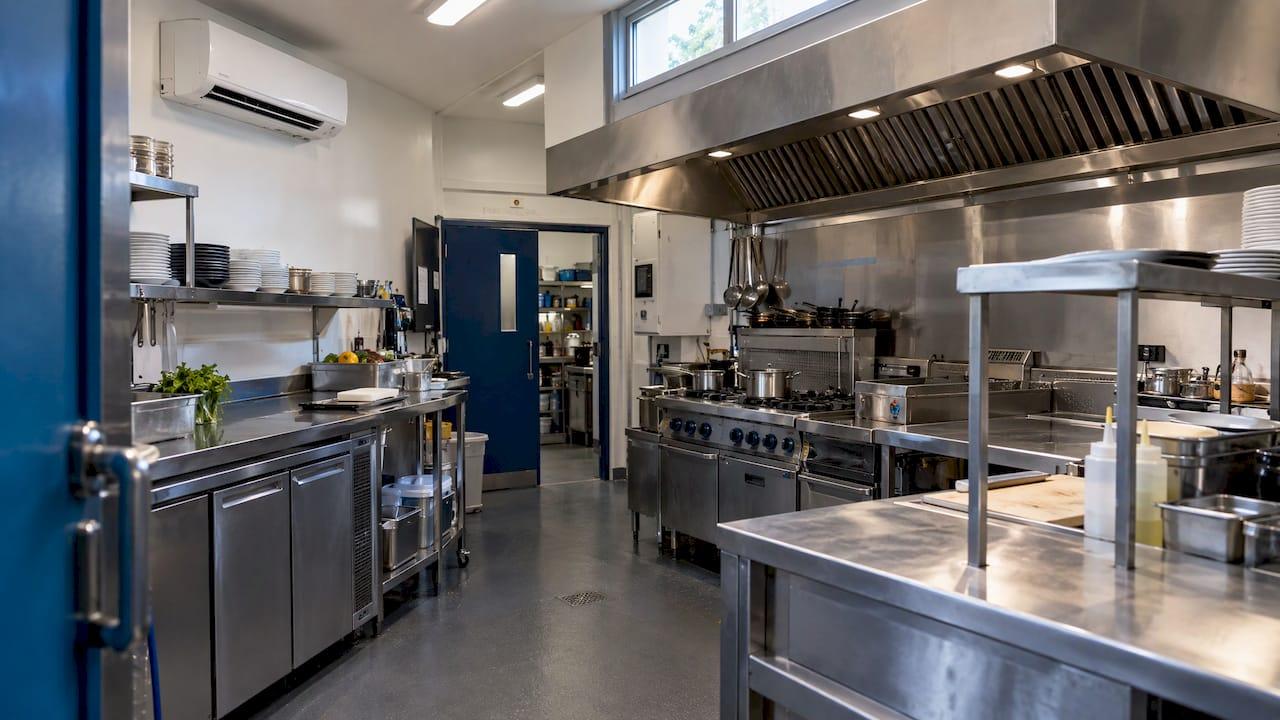
Yes, you can put air conditioning in a commercial kitchen, but it has to be designed around the extraction system, not bolted on beside it. Cool air aimed at the wrong place can pull cooking fumes out of the canopy's reach, and a unit chosen without regard to heat, steam and grease will struggle from the first summer. If your kitchen in Devon or Cornwall is overheating, the answer is a surveyed, properly specified system fitted by F-Gas certified engineers. That is what we do at Frost Air Conditioning from Exeter, with free surveys, 0% finance and installations that are typically completed within 1 to 2 days.
TL;DR
- No UK law sets a maximum kitchen temperature, but employers must provide effective ventilation, and air near cooking equipment can sit well above 28°C even with good extraction.
- Air conditioning supports kitchen ventilation, it never replaces it: the extract canopy must keep working at full efficiency.
- Position matters most: cool air goes towards the hot work positions, not across the cooker line.
- Gas appliances, grease filters and F-Gas refrigerant each bring their own legal duties, so use competent, registered engineers.
- A site survey before any quote is the cheapest way to avoid an unit that is too small, too noisy or in the wrong place.
Table of Contents
- Why commercial kitchens get so hot
- Ventilation first, air conditioning second
- How to cool a kitchen: the options
- Keep the sun out as well
- Choosing and positioning a system
- The rules around a kitchen cooling project
- What installation looks like
- Looking after the system
- Our view
- Get your kitchen surveyed
- FAQ
- Sources
Why commercial kitchens get so hot
A kitchen is a heat factory. Ovens, fryers, grills and hobs give off radiant heat, which warms the surrounding air and turns into the hot, rising air you feel on your face at the pass. Dishwashers and steaming add humidity on top.
The industry's ventilation standard, BESA DW/172, notes that even with the most efficient ventilation, air temperatures near cooking equipment can be well in excess of 28°C. It also notes that no UK legislation sets a maximum permissible kitchen room temperature. So there is no number you must hit, but your duty to staff does not disappear. The Workplace (Health, Safety and Welfare) Regulations 1992 require effective and suitable ventilation in every enclosed workplace.
The symptoms you will recognise: staff flagging mid-service, short tempers, more mistakes, sweat on the pass, and walk-in fridges working harder because the room around them is hot. Heat stress is a genuine welfare issue, not just discomfort, and it is the main reason owners start asking about cooling.

Ventilation first, air conditioning second
The Health and Safety Executive's catering guidance, Catering Information Sheet No 10, sets out what a kitchen ventilation system must do:
- Remove cooking fumes at source.
- Remove excess hot air and bring in cool, clean air.
- Avoid uncomfortable draughts.
- Supply enough air for complete combustion, to prevent carbon monoxide.
- Be easy to clean, to avoid fat build-up and fire risk.
- Run quietly and without vibration.
The second point is where cooling comes in. The same guidance says that where mechanical make-up air (the fresh air brought in to replace what the extract removes) is used, the cooler air should be directed towards the hot work positions. It also says air conditioning or fixed fans can be considered, provided they do not affect the efficiency of fume extraction.
Two practical points follow. First, extraction always has to be replaced with fresh air, so a kitchen with a powerful canopy and no proper supply is often hotter and more uncomfortable than one that is balanced. Second, the HSE says freestanding fans are not effective make-up air and create tripping and electric shock hazards. Moving the hot air around with a pedestal fan is not a fix.
What this means for a unit on the wall
A cooling unit blowing hard across the cooker line can disturb the capture of fumes by the canopy. That is why the layout is decided on site, with the extract canopy, supply air points, door openings and pressure between the kitchen and dining room all taken into account. If a separate contractor designs your extraction, the air conditioning design should work from the same assumptions as theirs. A survey is where those assumptions get checked.
How to cool a kitchen: the options
There is no single product called kitchen air conditioning. Most schemes combine a few elements:
| Approach | What it does | Where it fits |
|---|---|---|
| Tempered make-up air | Brings in fresh air to replace extracted air, cooled before it enters | Kitchens with a large canopy and heavy extraction |
| Spot or workstation cooling | Directs cooled air at the people at the hottest positions | Hot lines, pass, fryer and grill stations |
| Room cooling by wall or ceiling units | Lowers general temperature in prep, wash-up and cold areas | Prep kitchens, bakeries, back-of-house rooms |
| Cooling of adjoining spaces | Keeps dining room, bar or offices comfortable so heat does not push back | Cafés, pubs, restaurants with open kitchens |
In a small café kitchen, the answer may be a single well-placed system serving the prep area, while the cooking line relies on the canopy and make-up air. In a larger restaurant it may be several elements working together. Our café cooling guide and our restaurant air conditioning guide cover the front-of-house side in more detail.
Bakeries and other humid spaces
Bakeries add moisture and heat from proving, baking and cooling, so humidity control matters as well as temperature. CIBSE Guide B notes that humidity control is important in spaces such as bakeries, where loads come from heat and moisture in preparation and service areas. Dishwashers without their own condenser need dedicated extract to control vapour, according to DW/172. Indoor pools and sports clubs are a different design problem, with dehumidification at the centre, and are best discussed with us directly rather than treated as a variation of a kitchen.

Keep the sun out as well
A kitchen with a large south-facing window or a glazed roof gains heat before anyone lights a burner. Reducing that gain lowers the cooling load, which can mean a smaller system. For ideas on blocking heat from windows, shading is worth considering alongside any cooling plan, as long as it is kitchen-suitable and easy to clean away from the cooking line.
Choosing and positioning a system
These are the questions a good survey answers.
How much heat is the kitchen producing?
The load depends on the number and type of appliances, how long they run, the number of staff, the size of the room, glazing and the outside conditions. A kitchen with a charcoal grill and a kitchen with a combi oven and a dishwasher are very different jobs, even at the same floor area. This is why bespoke system design matters more here than in a lounge or office.
Where will the cool air land?
Cool air should reach staff at the hot positions without sweeping across the canopy's capture zone. Position supply points to suit the canopy, the doors and the walking routes. Keep in mind that indoor units need clear access for cleaning and servicing.
What do local rules say?
CIBSE Guide B points out that many aspects of kitchen ventilation are subject to local authority requirements which should be established before design. Planning permission may also apply for outdoor units in some locations, particularly in conservation areas and listed buildings, which are common in Devon and Cornwall town centres. Noise to neighbours is the other frequent issue, especially with flats above shops.
Which brand and capacity?
We supply premium systems from Samsung, Mitsubishi, Toshiba and Daikin. The right model is the one sized to the survey, not the biggest one. Oversizing wastes energy and can leave humidity uncontrolled.
The rules around a kitchen cooling project
Commercial kitchens are covered by a stack of rules. You do not need to memorise them, but you should know which ones touch cooling.
- Ventilation guidance: Approved Document F, the Building Regulations guidance on ventilation, states that its domestic extract rates do not apply to commercial kitchens, which should follow HSE CAIS10, BESA DW/172 and CIBSE Guide B2 instead. It applies in England from 15 June 2022.
- Gas appliances: The HSE explains that under the Gas Safety (Installation and Use) Regulations 1998, where the extract system serves as the flue for a gas appliance, an interlock connecting airflow to the gas supply is required, and gas work must be done by Gas Safe registered engineers. Anything that changes airflow in a gas kitchen needs competent input.
- Canopies, ducts and grease: HSE guidance calls for non-combustible canopies and ductwork with access for cleaning, and grease filters that are easy to remove. Mesh grease filters need regular cleaning, and CIBSE says they provide no flame barrier. A good restaurant kitchen cleaning checklist helps managers keep that routine on schedule.
- Refrigerant: Air conditioning using F-gas refrigerants must be installed and maintained by certified people. CIBSE Guide M states that leak inspections must be carried out by a REFCOM-certified company or competent person holding the relevant F-Gas qualification. Systems over 12kW cooling load also need a statutory inspection every 60 months under the Energy Performance of Buildings regulations.
Our engineers are REFCOM and F-Gas certified and are local, without subcontractors, so the person who surveys the job is part of the team that carries it out. Gas work on catering appliances stays with a Gas Safe registered engineer, and we plan the cooling around it.
What installation looks like
- Free survey. We look at the kitchen, the extraction, the door and window layout and where the outdoor unit could sit.
- Design. We specify the system and the supply positions to suit the hot stations and the canopy.
- Quote and finance. You get the cost in writing, and 0% finance is available to spread it. For a sense of budgets across commercial jobs, see our commercial air conditioning cost guide.
- Installation. Installations are typically completed within 1 to 2 days, and same-day or next-day installs are available, which matters when you cannot shut for long.
- Handover and maintenance. Filters, coils and refrigerant checks keep the system efficient, and annual service contracts are available.
If you want the schedule to suit trade, tell us your quiet days at the survey stage. Kitchens run on tight rhythms, and the work can be planned around them.
Looking after the system
Grease and steam shorten the life of equipment that is not maintained. A planned service keeps filters clean, airflow right and refrigerant levels checked, and it is the point at which small faults get caught before they stop a Saturday service. If a unit does fail in the middle of summer, our emergency breakdown response is there for exactly that case. You can find out about service and maintenance contracts on our site, or look at the service plans.
Our view
Most overheating kitchens we hear about have the same story: the extraction was designed years ago, the menu and equipment have grown since, and the heat has nowhere to go. The temptation is to buy a unit and hang it on the nearest wall.
We think the better route is a free survey first, then a system designed around your canopy, your appliances and your staff positions. We use premium Samsung, Mitsubishi, Toshiba and Daikin equipment, and our own REFCOM and F-Gas certified engineers carry out the work without subcontractors.
That matters in a kitchen, because the person who surveyed your site should be the person who understands why the supply air sits where it does. With 0% finance and installs typically done within 1 to 2 days, you can fix the problem before the next heatwave rather than during it.
James
Get your kitchen surveyed
We install, maintain and fit out commercial premises across Exeter, Devon, Cornwall and the wider South West. If your kitchen, bakery or café is running too hot, our shop fitting and commercial service is the place to start: a free survey, a system designed for your layout and 0% finance to spread the cost.

You can also see the systems we install from Samsung, Mitsubishi, Toshiba and Daikin.
FAQ
Can you put air conditioning in a commercial kitchen?
Yes. It needs to be designed alongside the extraction so that cool air reaches the hot work positions without interfering with fume capture. The HSE says air conditioning can be considered as long as it does not reduce extraction efficiency.
Is there a legal maximum temperature for a kitchen?
No UK legislation sets a maximum permissible kitchen temperature, according to BESA DW/172. Employers must still provide effective and suitable ventilation under the Workplace (Health, Safety and Welfare) Regulations 1992, and they have a duty to look after staff welfare.
Can I just use fans to cool my kitchen?
Freestanding fans are not effective make-up air, and the HSE notes they create tripping and electric shock hazards. Fixed fans that do not affect extraction can be considered, but for a kitchen that overheats, a designed cooling system is the lasting fix.
How long does installation take?
Our installations are typically completed within 1 to 2 days, and same-day or next-day installs are available. The survey confirms what your kitchen needs and how the work fits around your opening hours.
Sources
- HSE Catering Information Sheet No 10: Ventilation in catering
- BESA DW/172 kitchen ventilation specification
- Approved Document F: Volume 2
- CIBSE Guide M legislation summary table
- CIBSE Guide B
- CIBSE Guide B: Heating, ventilating, air conditioning and refrigeration
- How to block heat from windows
- Restaurant kitchen cleaning checklist