
An air conditioner does one thing: it moves heat from inside your home to outside. It does not generate cold air. Instead, it uses a chemical refrigerant in a closed loop to carry heat out of the room, leaving cooler air behind. The Energy Saving Trust and bodies like ASHRAE confirm that all domestic vapour-compression systems follow the same four-step cycle:
- Evaporation — refrigerant absorbs heat from indoor air and turns to gas
- Compression — the compressor raises the gas to high pressure and temperature
- Condensation — the outdoor coil releases that heat into the outside air, and the refrigerant returns to liquid
- Expansion — pressure drops through an expansion device, cooling the refrigerant ready to absorb heat again
A well-sized modern system can move several times as much cooling energy as the electricity the compressor consumes, according to coefficient of performance data. That ratio is why air conditioning is far more efficient than electric resistance heating. Frostairconditioning installs and maintains these systems across Exeter and the South West, so the practical notes throughout this guide reflect real domestic installation experience.
Key takeaways
An air conditioner moves heat from inside to outside using a refrigerant cycle — it does not create cold, and its efficiency depends on correct sizing, clean filters, and certified installation.
| Point | Details |
|---|---|
| Heat transfer, not cold generation | AC removes heat from indoor air via refrigerant evaporation; understanding this explains every efficiency and maintenance decision. |
| COP above 3 is the target | A system with a COP of 3 or above delivers at least three units of cooling for every unit of electricity consumed. |
| Filter cleaning is the highest-return task | Regular filter cleaning during use preserves airflow, efficiency, and indoor air quality at no cost. |
| Refrigerant work requires F-Gas certification | UK law requires REFCOM/F-Gas-certified engineers for any refrigerant handling — always ask for the certificate number. |
| Frostairconditioning covers the South West | REFCOM-certified installation and maintenance across Exeter, Devon, and Cornwall, with finance options and free site surveys available. |
Table of Contents
- How does an air conditioner work, step by step?
- What are the main components inside a home AC system?
- What types of home AC system are available in the UK?
- How much does an air conditioner cost to run in the UK?
- What are the benefits and limits of home air conditioning?
- How do you maintain a home air conditioner yourself?
- When should you call a qualified AC engineer?
- An installer's perspective on what homeowners get wrong
- Frostairconditioning: domestic installation and maintenance in the South West
- Sources
How does an air conditioner work, step by step?
The refrigerant cycle is continuous while the system runs. Each step hands off to the next, and understanding the sequence makes every other aspect of air conditioning — efficiency, maintenance, fault diagnosis — much easier to follow.
-
Evaporation (indoor coil). Liquid refrigerant enters the evaporator coil inside your home at low pressure. Warm room air is drawn across the coil by a fan. The refrigerant absorbs that heat and evaporates into a gas, exactly as sweat evaporates from your skin and cools it. The air leaving the coil is noticeably cooler. As ASHRAE's consumer guidance explains, moisture in the air also condenses on the cold coil surface and drains away — which is why your AC dehumidifies the room as it cools it.
-
Compression. The low-pressure gas travels to the compressor, which is typically housed in the outdoor unit. The compressor squeezes the gas, raising both its pressure and temperature significantly. Think of it as the pump that keeps the whole cycle moving.
-
Condensation (outdoor coil). The hot, high-pressure gas moves to the condenser coil outside. An outdoor fan draws ambient air across the coil, and the refrigerant releases its heat into that air and condenses back into a liquid. On a warm day you can feel the hot air blowing from the outdoor unit — that is the heat extracted from your rooms. HowStuffWorks describes this as two distinct subsystems: one chilling the indoor air, the other rejecting heat outdoors.
-
Expansion. The liquid refrigerant passes through an expansion valve or orifice, which drops its pressure sharply. The temperature falls as a result, and the refrigerant is ready to absorb heat again at the indoor coil. The thermostat controls when the compressor switches on and off to maintain your chosen temperature.
Pro Tip: Correct refrigerant charge and unobstructed airflow are the two factors that most affect real-world performance. An undercharged system runs longer, works harder, and still fails to reach the set temperature. Both are engineer tasks, not DIY fixes.
What are the main components inside a home AC system?
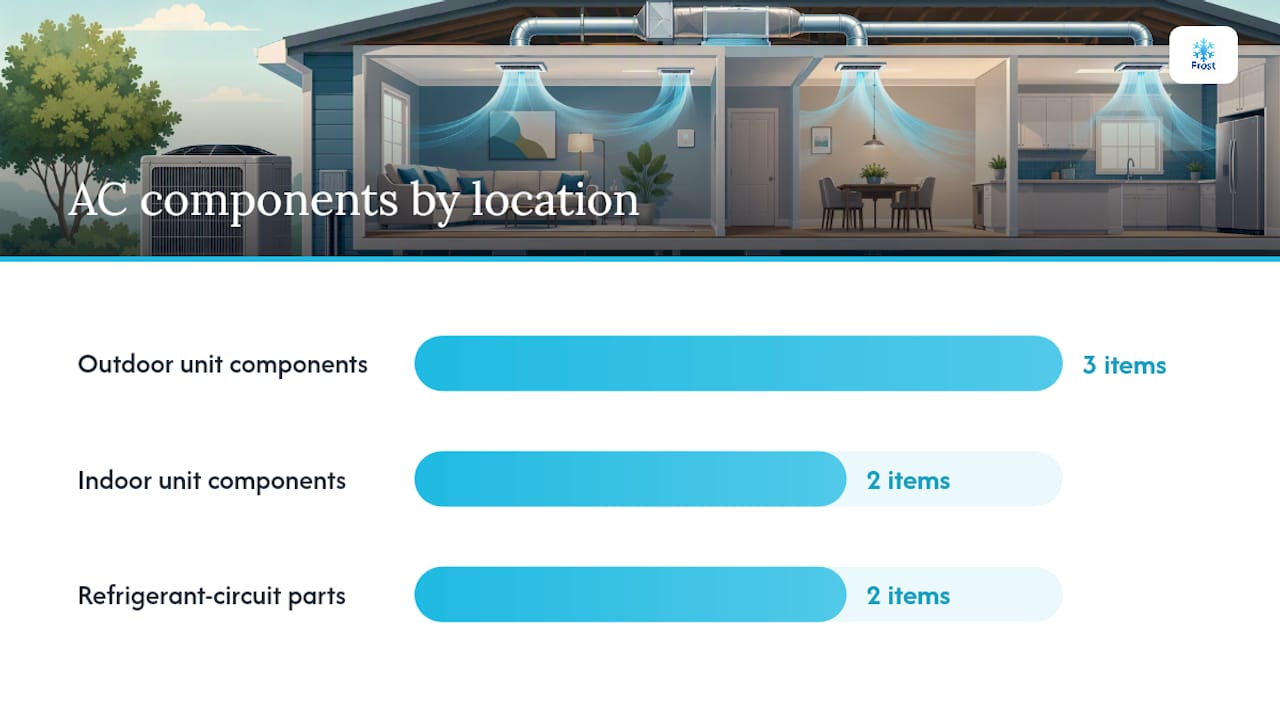
Residential air conditioners have three core mechanical components — compressor, condenser, and evaporator coil — that AHRI identifies as the heart of every domestic system. The supporting parts are equally important in practice.
-
Compressor. The engine of the system. It pressurises the refrigerant gas and drives it around the circuit. Located in the outdoor unit on split systems. A failing compressor is usually the most expensive repair.
-
Condenser coil. Wrapped around or inside the outdoor unit. Releases heat from the refrigerant into the outside air, aided by the outdoor fan. Dirty fins reduce heat transfer and push running costs up.
-
Evaporator coil. Sits inside the indoor unit. Absorbs heat from room air as refrigerant evaporates. Moisture condenses here and drains via the condensate tray and pipe — a blocked drain is one of the most common service call causes.
-
Expansion valve or orifice. Controls the flow of refrigerant into the evaporator, dropping its pressure and temperature. Thermostatic expansion valves (TXVs) adjust dynamically; fixed orifices are simpler and common in budget units.
-
Refrigerant lines. Insulated copper pipes connecting the indoor and outdoor units. Only F-Gas/REFCOM-certified engineers should work on sealed refrigerant circuits — this is a legal requirement in the UK, not just a safety recommendation.
-
Indoor and outdoor fans. Move air across the respective coils. A sluggish indoor fan is often the first sign of a dirty filter.
-
Thermostat. Signals the compressor to start or stop based on room temperature. Modern units use digital or smart thermostats that can be scheduled or controlled remotely.
-
Filters. Catch dust, pollen, and particulates before air reaches the evaporator coil. Clogged filters are the single most common cause of reduced efficiency and poor air quality. Routine filter care is the one maintenance task every homeowner can and should do themselves.
-
Ductwork. Present in ducted systems only. Distributes conditioned air through the building via insulated channels. Leaky or poorly insulated ducts can waste a significant portion of the cooling produced.
Brands such as Daikin, Mitsubishi Electric, Samsung, and Carrier all use these same components, though their engineering, refrigerant choices, and efficiency ratings differ. When you receive quotes, these are the systems you are most likely to see specified.
What types of home AC system are available in the UK?
The system type determines installation complexity, running cost, and how well it suits your home. Here is a plain comparison of the options most commonly installed in UK homes.
| System type | Best for | Pros | Cons |
|---|---|---|---|
| Split system (wall-mounted) | Single rooms or open-plan spaces | Quiet, efficient, no ductwork needed | Requires wall penetration; one unit per zone |
| Multi-split system | Multiple rooms from one outdoor unit | Zoned control, tidy installation | Higher upfront cost; outdoor unit must handle combined load |
| Ducted/central system | Whole-house cooling | Hidden, consistent temperature throughout | Significant installation work; duct losses possible |
| Portable unit | Temporary or rental use | No installation needed | Noisy, less efficient, requires window vent hose |
| Window unit | Single rooms (older UK properties) | Self-contained | Noisy, blocks window, rarely seen in new UK builds |
| Heat pump (reverse-cycle) | Year-round heating and cooling | One system for both seasons; eligible for UK incentives | Higher upfront cost; efficiency drops in very cold weather |
Split systems are by far the most common domestic choice in the South West. An indoor wall-mounted unit connects to an outdoor compressor/condenser via refrigerant lines drilled through the wall. Installation is relatively quick — Frostairconditioning regularly completes same-day installs — and the system is quiet enough for bedrooms.
Ducted systems suit new builds or properties undergoing significant renovation, where ductwork can be routed without major disruption. A central AC guide for UK homeowners covers the specifics of what this involves structurally.
Heat pump reversal is worth understanding separately. A reverse-cycle heat pump uses the same refrigerant circuit but can run it in both directions: cooling in summer, heating in winter. The UK government's heat pump incentive schemes make this increasingly relevant for homeowners looking to replace gas boilers alongside adding cooling capacity.
Portable units are tempting because they need no installation, but they are noticeably noisier, less efficient, and the exhaust hose still needs to exit through a window or wall. For anything beyond a temporary fix, a split system is almost always the better long-term investment.
How much does an air conditioner cost to run in the UK?
Efficiency ratings tell you how much cooling you get per unit of electricity. Three metrics appear on datasheets and product labels:
| Metric | What it measures | What to look for |
|---|---|---|
| COP (Coefficient of Performance) | Cooling energy delivered ÷ electrical energy consumed | Higher is better; typical domestic systems achieve COP 3 or above |
| EER (Energy Efficiency Ratio) | Cooling output at a fixed test condition | Used for spot comparisons; higher is better |
| SEER (Seasonal Energy Efficiency Ratio) | Average efficiency across a full cooling season | Most realistic for UK conditions; Trane's HVAC guidance recommends prioritising seasonal ratings |
A COP of 3 or above means the system moves at least three units of heat energy for every one unit of electricity it consumes. That is the fundamental reason air conditioning is more cost-effective than electric panel heaters for cooling, and why heat pumps are increasingly recommended for heating too.
The factors that actually change your electricity bill day to day:
- Sizing. An oversized unit short-cycles (switches on and off rapidly), wasting energy and wearing the compressor. An undersized unit runs continuously and never reaches the set temperature. AHRI's installer guidance is clear that correct sizing matters more to real-world running cost than a marginally higher efficiency rating on paper.
- Thermostat set point. Each degree lower you set the temperature increases energy use. A setting of 24–26°C is comfortable for most UK homes in summer.
- Insulation and draught-proofing. Heat enters through walls, windows, and gaps. Better insulation means the system runs for shorter periods.
- Filter cleanliness. A blocked filter restricts airflow, forcing the system to work harder for the same output. Clean filters every four to six weeks during heavy use.
- Fan mode. Running the fan without the compressor circulates air at very low cost and can feel comfortable on mild days without engaging the full cooling cycle.
- Pre-cooling. Running the system for 20–30 minutes before the hottest part of the day, then raising the set point slightly, uses less energy than trying to cool a hot room from scratch at peak temperature.
For broader energy-saving measures that complement air conditioning, the Energy Saving Trust provides practical UK-specific guidance on insulation and draught-proofing.
What are the benefits and limits of home air conditioning?
Benefits:
- Cools rooms reliably regardless of outdoor temperature
- Dehumidifies as it cools, reducing that sticky, uncomfortable feeling on humid days — air conditioning's effect on indoor air quality extends to filtering particulates and allergens too
- Reverse-cycle heat pumps provide both cooling and heating from one system
- Modern units are quiet enough for bedrooms and home offices
Limitations:
- Air conditioning recirculates indoor air; it does not bring in fresh air from outside. Ventilation is a separate requirement.
- Outdoor units generate noise — worth considering placement relative to neighbours and bedrooms.
- Installation requires wall penetration and outdoor unit positioning, which may need permitted development checks in conservation areas or listed buildings.
- Running costs depend heavily on how well the system is sized and how the building is insulated.
UK regulatory note. Refrigerant work in the UK is governed by F-Gas regulations. Any engineer handling, adding, or recovering refrigerant must hold a valid F-Gas/REFCOM certificate. This is a legal requirement, not optional. When requesting quotes, ask specifically for the engineer's REFCOM registration number. Disposal of old systems containing refrigerant must also follow approved procedures — you cannot simply skip this to a general waste contractor.
How do you maintain a home air conditioner yourself?
Most of what keeps a system running well is straightforward and safe for homeowners to do. The tasks that are not safe — anything involving the refrigerant circuit — belong to a certified engineer.
Routine tasks and suggested frequencies:
- Filter cleaning or replacement — every 4–6 weeks during regular use. Dirty filters are the leading cause of reduced efficiency and poor air quality.
- Outdoor unit clearance — check monthly. Keep at least 30cm clear of vegetation, garden furniture, and debris. Blocked airflow forces the condenser to work harder.
- Condensate tray and drain check — monthly during heavy use. A blocked drain causes water to back up and can damage ceilings or walls.
- Coil visual check — seasonally. Look for visible dirt or damage on accessible fins. Do not attempt to clean refrigerant coils yourself with chemicals.
- Thermostat battery change — annually, or when the display dims.
Before calling a technician, check these first:
- Is the unit switched on at the isolator (the outdoor switch near the outdoor unit)?
- Has the circuit breaker tripped?
- Is the filter blocked? Remove and clean it.
- Is the outdoor unit obstructed or covered?
- Is the condensate drain clear?
- Is the thermostat set correctly and the batteries fresh?
Always isolate power at the wall before cleaning any accessible part of the indoor unit. Never remove panels that expose electrical components or refrigerant connections.
For a full step-by-step cleaning guide, Frostairconditioning's homeowner maintenance guide covers what to do and what to leave to the engineers.
When should you call a qualified AC engineer?
Some faults are straightforward to diagnose but require professional tools and certification to fix. Calling early usually prevents a minor issue from becoming an expensive one.
Signs that need a professional:
- The system runs but the air coming out is not noticeably cooler than room temperature
- You can smell something chemical or sweet near the indoor unit (possible refrigerant leak)
- Ice forming on the indoor or outdoor coil
- Water dripping from the indoor unit beyond the normal condensate drain
- Unusual noises: grinding, rattling, or high-pitched squealing
- The system short-cycles repeatedly (switches on and off every few minutes)
- The outdoor unit runs but the indoor fan does not, or vice versa
What a qualified engineer checks at a service visit:
- Building heat load and whether the installed system is correctly sized
- Refrigerant pressure and charge — mismatched charge is a leading cause of poor performance, as AHRI's commissioning guidance confirms
- Airflow measurements across indoor and outdoor coils
- Electrical safety: connections, capacitors, contactors
- Condensate drain and tray condition
- System commissioning, controls calibration, and thermostat accuracy
Questions to ask any installer or service engineer:
- Can you show me your REFCOM/F-Gas certificate number?
- Is this system correctly sized for my room or building?
- What warranty does the manufacturer offer, and does your installation work carry its own guarantee?
- Do you offer an annual maintenance contract?
For homeowners in Devon and Cornwall, local troubleshooting guidance covers the faults most commonly seen in South West properties.
An installer's perspective on what homeowners get wrong
The most common mistake is not neglecting the filter — though that is widespread — it is buying or specifying the wrong size system. Bigger is not better with air conditioning. An oversized unit cools the room quickly, then shuts off before it has run long enough to dehumidify properly. The result is a room that feels cold but clammy, and a compressor that wears out faster from repeated short-cycling. A proper heat load calculation, accounting for room volume, glazing, orientation, and insulation, takes about 20 minutes and makes a significant difference to how the system performs over its lifetime.

The second thing homeowners consistently underestimate is how much a dirty filter costs them. A filter clogged with a season's worth of dust can reduce airflow enough to drop system efficiency noticeably, and in some cases causes the evaporator coil to ice over entirely. Cleaning it takes five minutes. Replacing an iced-over coil does not.
Do:
- Clean or replace filters every 4–6 weeks during use
- Keep the outdoor unit clear of vegetation and debris
- Book an annual service before the summer season, not during it
- Ask for the engineer's REFCOM number before any refrigerant work begins
Don't:
- Attempt to top up refrigerant yourself — it is illegal without F-Gas certification and dangerous if the system has a leak
- Block the outdoor unit with garden furniture or fencing to reduce noise
- Set the thermostat to its lowest possible setting expecting faster cooling (it does not work that way)
- Ignore a refrigerant smell or ice on the coil
Frostairconditioning: domestic installation and maintenance in the South West
Frostairconditioning installs and services domestic air conditioning systems across Exeter, Devon, Cornwall, and the wider South West. All engineers hold REFCOM/F-Gas certification, so refrigerant work is handled legally and safely. Systems are specified from Daikin, Mitsubishi Electric, Samsung, and Toshiba, sized to your actual building load rather than a rough room estimate.

Annual service and maintenance contracts cover filter checks, refrigerant pressure verification, condensate drain inspection, and electrical safety — the full list of checks described in this guide. For homeowners ready to move forward, a free site survey and quote is the practical next step: an engineer visits, measures the space, and specifies the right system before any commitment is made.
Sources
- Top Ten Things Consumers Should Know About Air Conditioning
- Air Conditioning System | AHRI
- How Air Conditioners Work: Air‑Conditioning Basics | HowStuffWorks
- Coefficient of performance - Wikipedia