
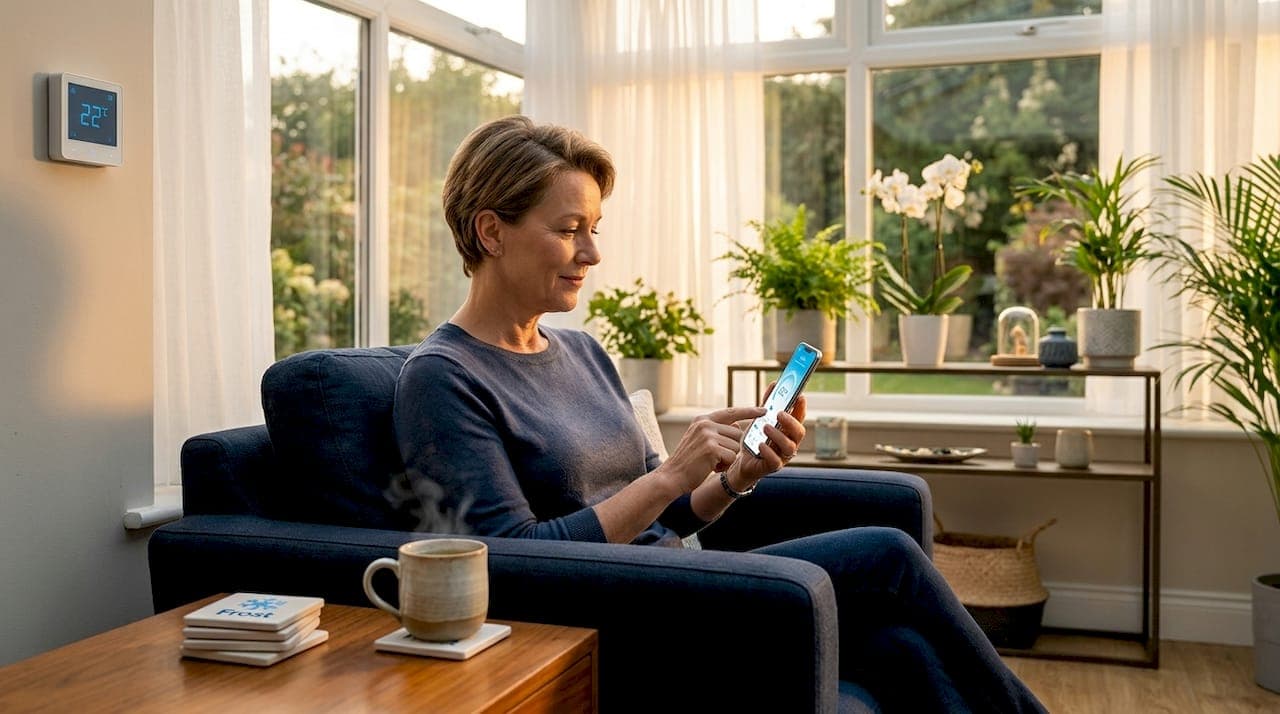
Most people assume "smart air conditioning" means buying an entirely new type of air conditioner. It does not. In most cases, what is smart air conditioning really refers to is the layer of connectivity and control placed on top of your existing cooling equipment. Whether that means a Wi-Fi thermostat talking to your central system or a small retrofit controller plugged in near your wall unit, the core refrigeration technology stays the same. What changes is how intelligently and conveniently you manage it. This guide covers exactly how these smart air conditioning systems work, which type suits your home, and what you genuinely gain.
Key takeaways
| Point | Details |
|---|---|
| Smart AC is about control | It adds Wi-Fi connectivity and automation to existing units, not a new refrigeration technology. |
| Two main routes to go smart | Retrofit IR controllers suit ductless and window units; smart thermostats suit wired central systems. |
| Real energy savings are possible | Inverter systems paired with smart controls can cut electricity use by up to 30 to 40%. |
| Renters can upgrade too | IR-based smart controllers need no rewiring and take minutes to install. |
| Check compatibility first | Smart thermostats and IR controllers are not interchangeable; matching the right product to your system avoids frustration. |
What is smart air conditioning and how does it work
Smart air conditioning is the umbrella term for any cooling system or control device that uses Wi-Fi connectivity to allow remote operation, scheduling, geofencing, and integration with voice assistants. The industry more precisely calls these solutions smart AC controllers, smart thermostats, or connected HVAC systems depending on the setup. Understanding that distinction will save you money and a lot of confusion when you start shopping.
At the most basic level, a Wi-Fi enabled thermostat connects your existing unit to your home network. You then control it through an app on your phone or through voice commands via Alexa, Google Home, or Apple HomeKit. The system can read temperature and humidity sensors, apply schedules automatically, and even detect when you leave the house using geofencing to avoid cooling an empty room.
Retrofit controllers and IR learning technology
For homeowners and renters with a ductless mini-split or a window unit that already has an infrared remote, a retrofit smart AC controller is the simplest path. These compact devices sit near your indoor unit, learn your remote's infrared signals, and then replicate them over Wi-Fi. As Daikin explains, the controller acts as a bridge between your phone and the AC without touching a single wire inside the unit.
The synergy with inverter technology is where things get genuinely interesting. Inverter-based AC units already modulate their compressor speed to maintain temperature rather than cycling on and off. Pair that with smart scheduling and occupancy sensing, and the system is almost never running harder than it needs to. That combination is why inverter systems with smart automation can cut electricity consumption by up to 30 to 40 percent compared with older, non-inverter models.
Pro Tip: Set a geofencing radius of around one kilometre from your home so the system starts cooling before you arrive, rather than blasting cold air the moment you walk through the door. You get comfort without the spike in energy use.
Key features you will typically find across smart AC systems:
- Remote on/off and temperature control via smartphone app
- Weekly scheduling so cooling aligns with your routine
- Geofencing that activates or deactivates cooling based on your location
- Voice assistant compatibility for hands-free control
- Usage reports so you can see exactly where your electricity is going
- Integration with other smart home devices such as occupancy sensors and blinds
Types of smart air conditioning solutions
Not every smart AC product works with every system. Getting this wrong is the most common and most expensive mistake homeowners make.
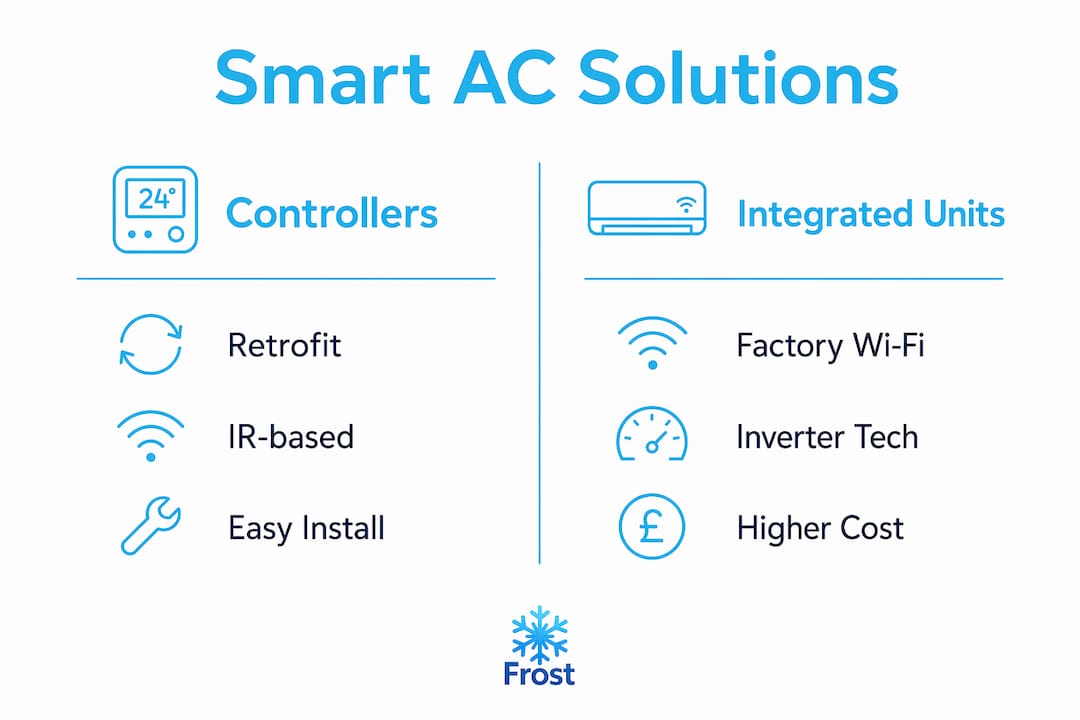
| Solution type | Best suited for | Installation | Key limitation |
|---|---|---|---|
| Smart AC controller (IR) | Ductless mini-splits, window units | No wiring, under 3 minutes | Requires IR line-of-sight to unit |
| Integrated smart AC unit | New installations or replacements | Professional fit required | Higher upfront cost |
| Smart thermostat | Central HVAC with wired connections | May need professional wiring | Not compatible with IR-only systems |
Smart AC controllers for existing units
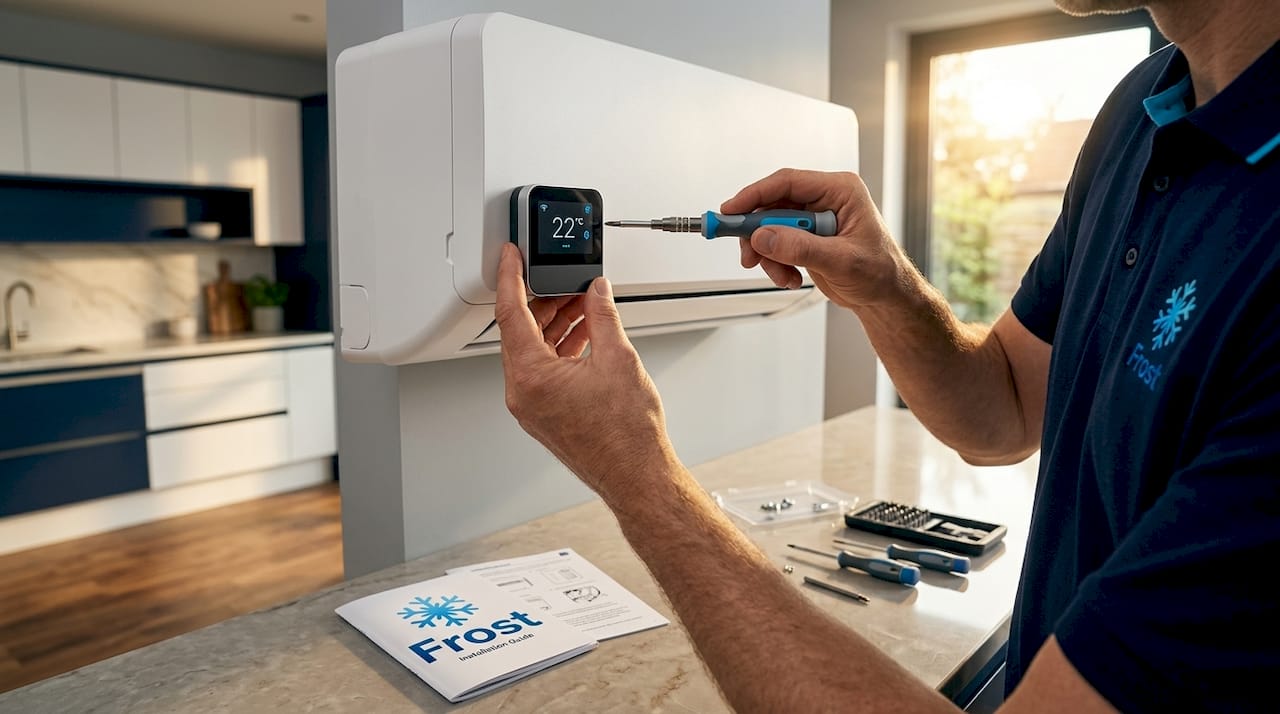
A smart AC controller does not replace your air conditioner. It acts as its new brain, sitting between your AC's IR receiver and your smartphone. Installation takes under 3 minutes, requires no rewiring, and only needs a standard power outlet. For renters who cannot make structural changes, this is often the only viable option and it works remarkably well.
Integrated smart AC units
These are air conditioners built with Wi-Fi connectivity from the factory. A good example is a modern inverter split system with an AI operating mode, human presence sensor, humidity control, and HEPA filtration. Some advanced units like these even offer voice control out of the box and deliver precise comfort without any additional hardware. If you are planning a new installation, opting for a unit with these features built in gives you far better feedback and control reliability.
Smart thermostats for central systems
Smart thermostats are designed for wired, ducted HVAC systems. They are not interchangeable with IR-based retrofit controllers. The fundamental difference between these two product categories confuses a lot of buyers. If you have a central system with a traditional wired thermostat on the wall, a smart thermostat upgrade is likely straightforward. If you have a split unit with a handheld remote, you need a smart controller, not a thermostat.
Pro Tip: Before buying anything, take a photo of your existing AC unit and its remote control. Send it to the manufacturer or retailer and ask directly whether their product is compatible. Two minutes of checking saves a frustrating return.
The best smart thermostats on the UK market now support multi-zone scheduling, detailed energy reporting, and integration with solar panel systems, which makes them a genuinely strong investment for homeowners who own their property.
Benefits of smart air conditioning
The benefits of smart air conditioning fall into three clear areas: energy savings, comfort, and convenience. Each one is real, but the degree you experience depends heavily on how you use the system.
-
Energy savings. Geofencing, occupancy sensing, and smart scheduling mean your system runs only when it needs to. Combined with inverter modulation, this is the most impactful lever you have on your electricity bill.
-
Consistent comfort. Smart controllers adjust output based on occupancy and environment, which prevents the temperature swings you get when you manually switch a unit on and off. The room stays closer to your target temperature throughout the day.
-
Remote access. Forgot to turn the AC off before you left for work? Done from your phone in seconds. Heading home earlier than planned on a hot day? The room will be ready when you arrive.
-
Smart home integration. Wi-Fi connectivity is now the baseline for a unit to qualify as smart, and that connectivity unlocks broader ecosystem control. Link your AC to occupancy sensors, smart blinds, or a whole-home energy dashboard for a genuinely joined-up setup.
-
Environmental impact. Using your AC more precisely means less electricity wasted. Combined with passive measures like external blinds, which significantly reduce heat gain and lessen overall demand, you can run a comfortable home without an outsized carbon footprint.
One limitation worth knowing: most IR-based smart controllers send one-way signals. The command goes to your AC, but without real-time feedback you cannot always confirm the unit received it. This is rarely a problem in practice, but it is worth understanding before you rely on a retrofit controller for critical automated routines.
Pro Tip: Set your target temperature two degrees higher than you think you need and let the smart system adapt. Most people are comfortable at 24°C rather than 22°C, and that two-degree difference makes a measurable difference to your bills over a long summer.
Practical considerations before you buy
Getting smart home climate control right comes down to matching the product to your specific setup, not buying the most popular device on the market.
- Identify your AC type first. Do you have a ducted central system, a ductless mini-split, or a window unit? This single question determines which category of smart solution is appropriate.
- Check IR line-of-sight requirements. IR-based controllers depend on a clear path to your unit's receiver. Walls, furniture, and awkward room layouts can all degrade control reliability. Check placement before committing.
- Assess your Wi-Fi coverage. A smart controller that cannot maintain a stable connection is more annoying than a standard remote. If your AC is in a room with a weak signal, sort the Wi-Fi first.
- Renters should favour retrofit controllers. No professional installation, no modifications to the property, and they go with you when you move. They are genuinely renter-friendly.
- Homeowners installing new systems should prioritise built-in smart features. A unit with native Wi-Fi and two-way communication gives far better reliability and feedback than a bolt-on controller.
- Consider sizing and system efficiency. A smart controller cannot fix an undersized or oversized unit. Get the right AC for your space first, then layer smart controls on top.
- Factor in finance options. Upfront costs for integrated smart AC units can be significant. Installers offering 0% finance, such as Frostairconditioning, make it easier to choose the right system rather than the cheapest one.
Where smart AC technology is heading
The next generation of smart air conditioning systems moves well beyond scheduling and remote control. AI-driven optimisation is already appearing in premium units, where the system learns your preferences over weeks and adjusts automatically without you touching an app.
Machine learning is being applied to predict cooling demand based on weather forecasts, occupancy patterns, and even calendar data. Sensor accuracy is improving rapidly, with newer units offering true duplex communication so the controller always knows the actual state of the unit, not just the last command sent.
The broader push is towards grid-friendly technologies. Demand-response systems can receive signals from energy suppliers and automatically reduce cooling load during peak grid periods, potentially earning homeowners credits on their bills. As the UK grid incorporates more renewable energy, smart AC systems that can respond to real-time grid conditions become part of the solution rather than part of the problem.
Environmental and regulatory pressure is also pushing adoption. Stricter building efficiency standards and rising energy costs mean that a smart home investment in connected cooling pays off faster than it did even five years ago.
My honest take on smart AC, after seeing hundreds of installs
I've seen smart air conditioning sold as a silver bullet more times than I can count, and I want to give you a more grounded picture.
The single biggest gain I've seen for most homeowners is not the voice control or the app dashboard. It's the scheduling. People who actually configure their system to match their routine see real, consistent savings. People who buy the smart controller, never set it up properly, and just use it as a remote are gaining almost nothing over a standard unit.
Retrofit controllers genuinely do transform older split systems. I've watched homeowners go from running their unit all day "just in case" to running it only when it's needed, simply because they can now check and control it from their phone. That behaviour change is worth more than any AI feature.
What most people overlook is the Wi-Fi coverage issue. A smart device in a room with poor signal will frustrate you endlessly. Sort your network before you worry about which controller to buy.
And one opinion I hold firmly: if you are fitting a new system, always choose a unit with native smart connectivity over a retrofit add-on. The two-way communication alone is worth it for the reliability. Go built-in wherever you can and save the retrofit route for existing equipment.
— James
Ready to make your home smarter with Frost?
If you've been weighing up smart air conditioning for your home, Frostairconditioning makes the whole process straightforward. Based in Exeter and covering the South West, the team handles domestic installations of modern inverter split systems with built-in Wi-Fi connectivity, so you get native smart control from day one. All engineers are F-Gas certified, same-day installs are available, and 0% finance means you can choose the right system without compromise.
Once your system is in, Frostairconditioning's service and maintenance packages keep it running at peak efficiency year after year. Get a personalised quote for your property and find out exactly what a smart system would cost to install and run in your home.
FAQ
What is smart air conditioning in simple terms?
Smart air conditioning refers to cooling systems or retrofit controllers that connect to your home Wi-Fi, allowing remote control, scheduling, and automation via a smartphone app or voice assistant. The refrigeration technology itself stays the same; what changes is how you manage it.
How does a smart AC controller differ from a smart thermostat?
A smart AC controller uses infrared signals to communicate with ductless mini-splits and window units, requiring no wiring. A smart thermostat connects via wiring to a central HVAC system. They are not interchangeable, so matching the right product to your system type is critical.
Can renters use smart air conditioning?
Yes. IR-based smart AC controllers need no professional installation, no rewiring, and install in under 3 minutes using a standard power outlet. They are completely removable, making them an ideal option for rented properties.
How much energy can a smart air conditioning system save?
Results vary, but inverter systems combined with smart controls can reduce electricity consumption by up to 30 to 40 percent compared with non-inverter models running without automation. Effective scheduling and geofencing are where most of those savings come from.
Do smart AC controllers work with all air conditioners?
No. They work with units that use a standard infrared remote, typically ductless mini-splits and window units. Central ducted systems require a wired smart thermostat instead. Always check compatibility with your specific unit model before purchasing.