
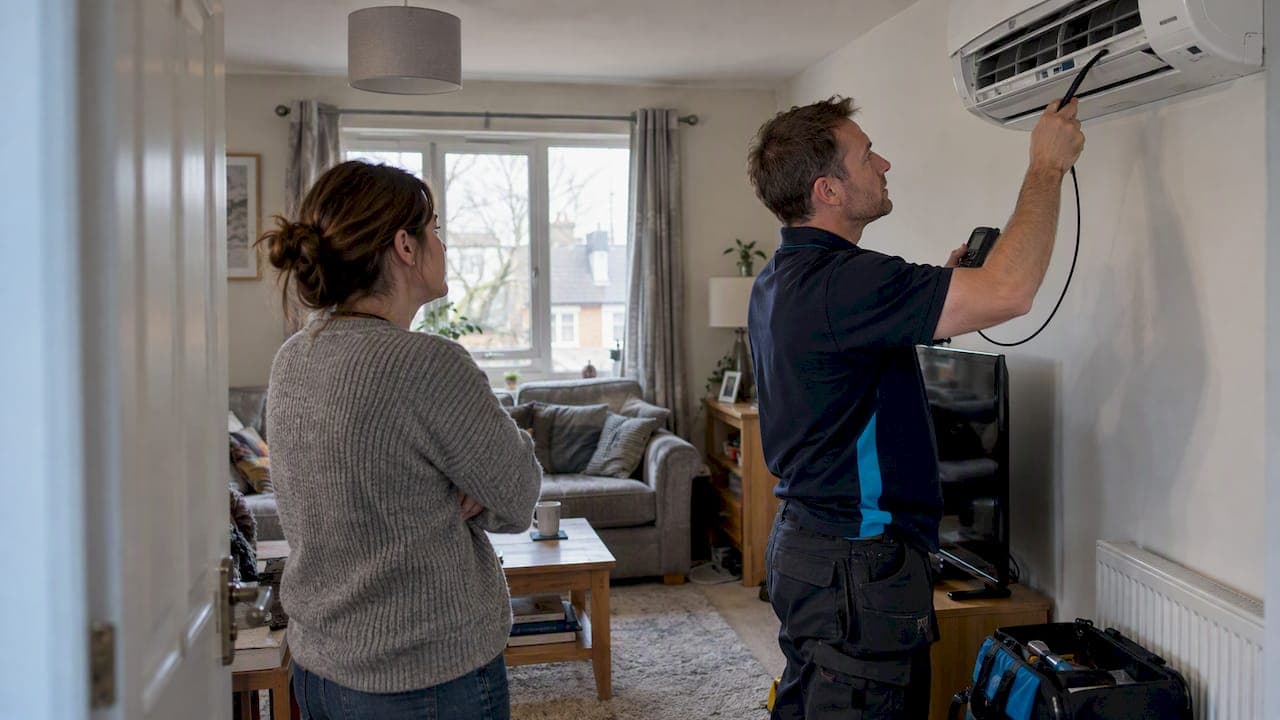
If your unit has stopped in a heatwave, is leaking or smells of burning, call an F-Gas certified engineer for an emergency weekend visit now. For anything less urgent, book the earliest weekday slot. Refrigerant work legally needs an F-Gas certified engineer, and out-of-hours call-outs can add roughly £40–£100 to the bill.
TL;DR:
- Weekend callout fees commonly run £170–£220, versus £130–£180 on weekdays; labor costs about £30–£60 per hour, with parts billed separately.
- Treat burning smells, sparks, electrical faults, damaging leaks, or total cooling failure around vulnerable occupants or critical equipment as urgent; reduced cooling can usually wait.
- Before booking, verify valid F Gas certification and company registration; reject any engineer who offers a refrigerant top up without locating and repairing the leak.
- Give the engineer the unit’s brand, model, error code, symptoms, and photos before arrival, since details can help them bring parts and avoid another visit.
Table of Contents
- What should you gather before you call a weekend engineer?
- What do weekend call-outs cost in the UK?
- Is it an emergency, or can it wait until Monday?
- How do you check a weekend engineer is properly qualified?
- What happens during a weekend repair visit?
- What I would do before the next heatwave
- How can Frost Air Conditioning help with weekend and emergency repairs?
- FAQ
- Sources
What should you gather before you call a weekend engineer?
A prepared caller gets a faster diagnosis and a better chance of a fix on the first visit. Spend a little time collecting the following before you pick up the phone:
- Brand and model: the label is usually on the side of the indoor unit or on the outdoor unit's casing.
- Error codes: note any code flashing on the display or the remote.
- Symptoms: describe exactly what is happening, such as warm air, no power, a rattling noise, ice on the pipework or water dripping.
- Photos or a short video: show the unit, any leak and the outdoor condenser.
- Timeline: when the fault started, what changed just before it, and when the unit was last serviced.
- Access: where the indoor and outdoor units are, and whether a ladder or key is needed.
Engineers are much better prepared when you give them the brand, model and any visible error codes at the first call, because they can bring the right parts and may avoid a return visit. Clear symptoms also help them prioritise your job. Professionals advise stating the error code or specific sound when you ring, since availability tightens significantly during heatwaves.
Say plainly that it is a weekend emergency and ask for an estimated arrival window. Before the visit, clear the area around both units, move furniture and pets out of the way, and make sure the engineer can reach the outdoor unit safely.
Pro Tip: Film the fault happening, for example the unit short-cycling or the water dripping, as a short clip you can send before the engineer arrives. It often tells them more than a description does.
If you want to rule out simple causes first, our common AC problems list covers the checks you can safely try yourself.
What do weekend call-outs cost in the UK?
Expect to pay more than on a weekday. The first-hour charge carries the premium, and labour and parts are then billed on top. Checkatrade's cost guide puts labour at roughly £30–£60 per hour and gives call-out fees of about £130–£180 on weekdays against £170–£220 at weekends. That is the same ballpark as the £40–£100 out-of-hours uplift quoted above.

Weekend call-out fees are commonly around £170–£220, compared with roughly £130–£180 on weekdays. The gap is small next to the cost of a major failure, which is why a quick diagnosis matters more than haggling over the call-out fee.
Repair costs vary widely with what has failed:
- Minor fixes: a blocked condensate drain, a failed sensor or a loose connection is usually quick, so labour can make up a substantial part of the bill.
- Leak repair and regas: the engineer must find and fix the leak before recharging, so this takes longer than a simple top-up and costs more.
- Compressor replacement: the most expensive common repair, running to several hundred pounds and more, because the part is costly and the job involves recovering refrigerant, swapping the component and testing the system.
On an older unit, a large repair bill may be the point to compare it with replacement. Our domestic installation page explains the options if you reach that decision.
Ask for an estimate that splits out the call-out fee, labour and parts. Agree a limit before work starts, and ask the engineer to call you if the diagnosis points to something bigger than the quote. Season matters too: repairs and regassing tend to be cheaper and easier to book in spring, while heatwaves push demand up and weekend slots get scarce.
Is it an emergency, or can it wait until Monday?
Safety overrides cost every time. Beyond that, a simple test works: is something being damaged, or is anyone at risk, while you wait? Waiting until Monday is usually safer and cheaper for non-emergency faults, so use the list below to decide.
- Call now: a burning smell, sparks, a tripping breaker or any sign of an electrical fault. Switch the unit off at the isolator first.
- Call now: water leaking onto floors, ceilings or electrics, where damage is building by the hour.
- Call now: a total shutdown in extreme heat, especially if the space is occupied by elderly people, babies, pets or heat-sensitive equipment.
- Call now (business): a failure that stops you trading safely, such as a server room or a food storage area overheating.
- Wait until Monday: reduced cooling, intermittent faults, odd noises with no other symptoms, or a remote that has stopped responding.
Timelines vary with the fault. Cleaning, a drain clearance, a control fix or a regas after a simple leak repair can often be done in a single visit. A failed compressor, fan motor or circuit board usually means ordering a part, which can delay completion while you wait for the part.
If you are unsure, ring the engineer, describe the symptoms and ask for their view. A short call costs nothing and a good engineer will tell you honestly whether it can wait. Our troubleshooting tips for Devon and Cornwall include pre-call checks that help you answer their questions.
How do you check a weekend engineer is properly qualified?
Verify before you book, not after the van arrives. In the UK, work on refrigerant circuits, such as recovery, recharging or leak repair, must be carried out by someone holding valid F-Gas certification. The Gov sets out what is required.
Use these questions on the phone:
- Certification: ask for proof of F-Gas certification and the company's registration, such as REFCOM, and check them.
- Parts: ask whether the engineer carries common parts for your brand or will need to return with parts.
- Pricing: ask for the diagnostic fee, call-out fee, hourly labour rate and a parts quote, ideally in writing.
- Process: ask what happens if the fault turns out to be a leak.
- Red flag: walk away from anyone offering to "top up" the gas without diagnosing and repairing the leak. A system that has lost refrigerant has a leak, and topping up without fixing it wastes money and is not compliant.
Our guide to verifying UK F-Gas compliance walks through the verification steps in more detail, and our explainer on air conditioner gas covers why this work is regulated.
What happens during a weekend repair visit?
A good weekend visit follows the same sequence as a weekday one. The engineer will usually work through these steps:
- Safety checks: isolating power, checking for electrical faults and making sure the area is safe to work in.
- Inspection: examining the indoor unit, outdoor unit, pipework, drainage and filters.
- Diagnosis: reading error codes, testing pressures and electrical components, and leak testing where needed.
- Immediate repair: fixing what can be fixed with parts on the van, such as drain blockages, connections, capacitors or sensors.
- Temporary measures: if a part has to be ordered, making the system safe, switching off the faulty component and advising on interim cooling.
A repair may be possible during the visit when the fault is simple or the engineer carries the right part. A return visit may be needed for compressors, fan motors, circuit boards and brand-specific components. Where refrigerant has been lost, the engineer should locate and repair the leak before recharging. Venting gas or topping up without a repair is not compliant.
While you wait for parts, an engineer may suggest closing blinds, running fans, keeping one cooler room in use or arranging portable cooling. Follow their advice rather than restarting a unit they have isolated.
Pro Tip: Ask the engineer to note the fault, the work done and any parts ordered on the invoice. It speeds up any warranty claim and gives the next engineer a clear history.
Regular servicing reduces the odds of a weekend breakdown, and our piece on why you should service your air conditioner covers the costs and benefits.
What I would do before the next heatwave
My view is that most weekend call-outs are made harder by what happens before the engineer arrives, not by the fault itself. Clear access to both units, keep the model details and service history somewhere you can find them, and ring early in a heatwave, because arrival windows stretch when everyone's unit fails on the same hot Saturday. Insisting on a certified engineer is not fussiness. It is the clearest sign you are dealing with a reputable one.
— James
How can Frost Air Conditioning help with weekend and emergency repairs?

Frostairconditioning is an Exeter-based installer covering the South West, and our REFCOM and F-Gas certified engineers handle breakdowns as well as installations. If your unit has failed, our emergency breakdown response is a route to someone who can diagnose it properly.
- Emergency breakdown response: we provide a certified engineer to diagnose the fault, with same-day or fast response where availability allows.
- Service and maintenance: regular servicing catches faults before they strand you on a bank holiday weekend.
- Annual service contracts: for homes and businesses, so maintenance is booked rather than chased.
- Free survey and clear quotes: we explain what the repair involves and what it will cost before work begins.
- Finance options: ask about available finance if a failed unit needs replacing rather than repairing.
We service both homes and commercial premises, using systems from Samsung, Mitsubishi, Toshiba and Daikin. Pricing is available on request, so get in touch through our service and maintenance page with your unit's brand, model and symptoms and we will tell you what we can do and when.
FAQ
How much does it cost to fix an air con leak in the UK?
It depends on where the leak is and how much refrigerant has been lost, so a diagnosis comes first. Leak repair plus a regas is a bigger job than a simple top-up, and repair examples range from small parts to compressor replacements costing several hundred pounds and more. Ask for a quote that separates call-out, labour and parts.
How long does it take to fix an aircon?
Simple faults such as a blocked drain or a loose connection can often be fixed in one visit. If a part has to be ordered, such as a compressor or circuit board, expect that the repair may require a return visit. The engineer should give you a realistic timeline once the fault is diagnosed.
Is there a shortage of aircon engineers in the UK?
Availability tightens significantly during heatwaves, according to fixradio.co.uk's report on an AC engineer shortage. That is why calling early and describing the symptoms clearly helps you get prioritised.
What are the rules for air conditioning repair in the UK?
Anyone working on a refrigerant circuit must hold valid F-Gas certification, as set out in the GOV.UK F-Gas qualifications guidance. Check the certificate before you book, and avoid anyone who offers to top up gas without repairing the leak.
Sources
- Gov
- How much does a home air con service cost in 2026?
- Air Conditioning Repair Costs in 2026 - MyBuilder