
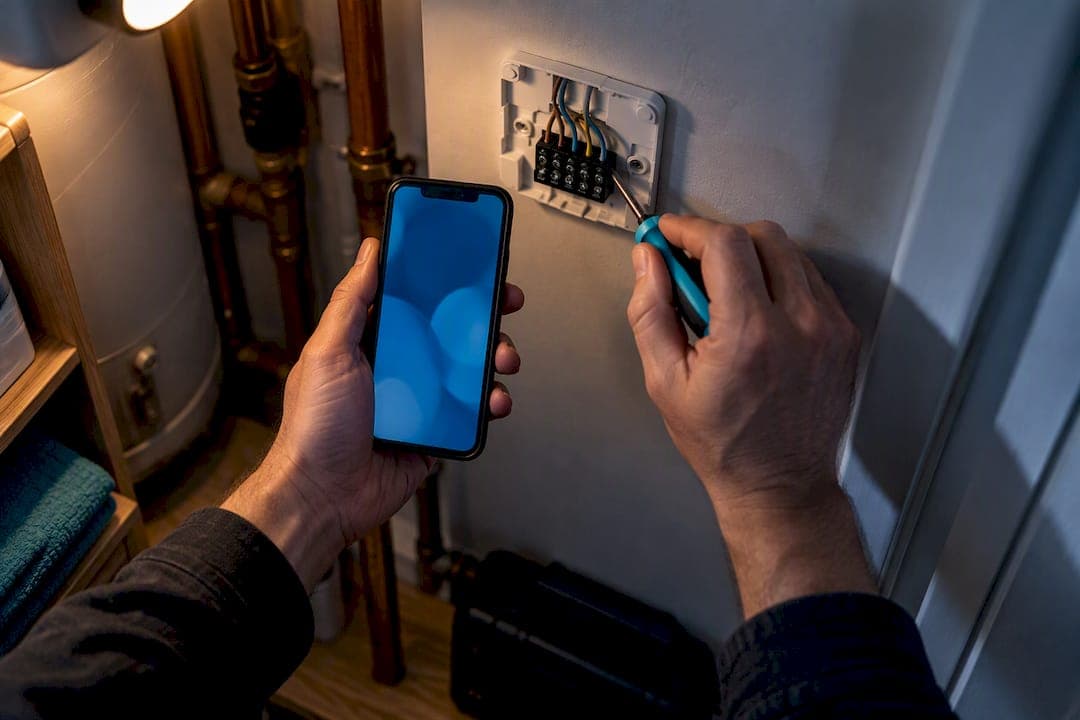
Most smart thermostats control 24V ducted systems and many heat pumps, provided a C-wire (or a workaround for one) is present. Mini-splits and any air conditioner run by an infrared remote fall outside that world entirely; they need an IR smart controller such as Sensibo or Cielo rather than a wired thermostat. Homes with both ducted and ductless setups typically end up running a hybrid: one wired thermostat plus an IR controller per ductless head.
TL;DR:
- Most smart thermostats require a C-wire for reliable operation; without it, power extenders are recommended, especially for sensitive systems.
- Wired smart thermostats generally work with forced-air, central air conditioning, and air-to-air heat pumps, but not with line-voltage or proprietary systems.
- Mini-splits and remote-controlled units need IR smart controllers like Sensibo or Cielo, which mimic remote signals but cannot read current system states directly.
- Proper system diagnosis involves photographing wiring, checking for a C-wire, and verifying the outdoor unit’s model before purchasing or installing new controls.
- A professional compatibility survey can prevent issues, especially in complex multi-zone homes or for systems with unusual wiring or proprietary controls.
Table of Contents
- Checking your smart thermostat aircon compatibility: wiring and the C-wire
- Which HVAC systems work with standard smart thermostats
- Why mini-splits and IR aircon need a different kind of controller
- Planning smart control for mixed ducted and ductless homes
- A step-by-step compatibility check before you buy
- What Frost's engineers check on a compatibility survey
- Why most compatibility advice online misses the point
- Get a professional compatibility check from Frost Air Conditioning
- Sources
- FAQ
Checking your smart thermostat aircon compatibility: wiring and the C-wire
Before you buy anything, pull the cover off your existing thermostat and look at the wires. Every terminal is usually labelled, and those letters tell you exactly what system you're dealing with.
- R or RC/RH: power feed from the transformer
- Y: calls for cooling
- W: calls for heating
- G: runs the fan
- C: the common wire that gives the thermostat continuous 24V power
The C-wire is the one that trips up most DIY installs. Without it, some smart thermostats "steal" tiny amounts of power from the other wires to stay charged, which can cause erratic screen behaviour or the system dropping out at odd moments on more sensitive control boards. If you don't see a C-wire, that's not a dead end. Google Nest documentation covers this directly, explaining the power connector and wiring requirements that smart thermostats generally need to run reliably.
Before touching anything, switch off power at the breaker, then photograph the wiring with your phone. That single photo is often all a compatibility checker or an installer needs to tell you what's possible.
Pro Tip: Zoom in on the terminal block and photograph it from directly above so every letter is legible. Blurry, angled photos are the number one reason DIY compatibility checks go wrong.
Where there's genuinely no C-wire and running a new one isn't practical, a power extender kit (PEK) is the manufacturer-approved fix rather than relying on power-stealing long term.
Which HVAC systems work with standard smart thermostats
Standard 24V smart thermostats are built around forced-air heating and cooling, so the systems below cover most straightforward homes.
- Forced-air furnaces and central air conditioning: the default use case for nearly every mainstream smart thermostat
- Air-to-air heat pumps: widely supported, though multi-stage units need you to confirm the thermostat handles the right number of stages
- Line-voltage systems (electric baseboard heating, some radiant setups): generally incompatible, since these run at mains voltage rather than 24V
- Proprietary or manufacturer-specific controllers: often locked out of third-party thermostats altogether
A compatibility matrix from SmartHomeExplorer backs this up. Reviewers consistently rate Ecobee and Nest as strong performers on 24V systems, while flagging that neither can do anything with a mini-split. Dual-fuel systems, where a heat pump and a gas furnace share duties, sit in a grey area too. They often work with mainstream thermostats, but the staging logic varies enough between manufacturers that it's worth checking your exact model before assuming it'll behave.
Why mini-splits and IR aircon need a different kind of controller
Mini-splits and most window or portable units are switched, adjusted, and scheduled entirely through an infrared remote pointed at the indoor unit. There's no 24V control loop for a wired thermostat to plug into. The internal logic board only listens for infrared signals, so a wired thermostat has nothing to connect to even if you wanted to install one.
That's where IR smart controllers come in. A device like the Sensibo Air Pro or Cielo Breez Max sits in the room and learns your existing remote's signals, then reissues them on a schedule, by geofencing, or on command through a voice assistant. Flair's guidance on mini-splits and window units explains how these controllers use omnidirectional infrared to replicate the remote without touching any wiring.
- Replicates temperature, mode and fan-speed commands from your existing remote
- Adds scheduling, geofencing and app control on top of what the remote could do
- Works with Alexa and Google Assistant on most current models
The trade-off is that some units can only send commands, not read the aircon's actual current state, so the app's display of "current temperature" is sometimes an estimate rather than a live reading from the unit itself. Feature gaps also show up on advanced remotes; if your remote controls swing direction or has several fan speed presets, check the controller supports every one you actually use before buying.
Pro Tip: Keep your original remote somewhere safe after installing an IR controller. It's the fastest way to recover control if the smart controller ever loses its Wi-Fi connection.
Planning smart control for mixed ducted and ductless homes
Plenty of UK homes run a mix: ducted air conditioning downstairs, a couple of ductless heads in loft conversions or extensions. Trying to force one device to control everything wastes money and usually fails outright.
- Map every zone in the house and note whether it's ducted or served by an individual head
- Label the control type for each zone: wired thermostat candidate or IR remote unit
- Count devices needed: one smart thermostat for the ducted system, one IR controller per ductless head
- Link them through a voice assistant or a routines app so "goodnight" or "I'm home" triggers every zone together, even though the devices aren't natively linked
- Get a site survey if you're unsure about zone counts or wiring; on properties with several transformers or unusual wiring, it's worth the visit before you buy anything
For background on how zoned systems are typically laid out, Target Air Systems' guide to zoned HVAC is a useful primer if you've never mapped a multi-zone property before.
A step-by-step compatibility check before you buy
Run through this before ordering anything, whether it's a wired thermostat or an IR controller.
- Use the official checkers from Nest or Ecobee, entering your exact wire labels rather than guessing
- Photograph the thermostat wiring and the outdoor unit's nameplate, and keep both on your phone
- If there's no C-wire, or the system looks proprietary, don't force it. A PEK or a short call to a professional resolves it faster than trial and error
- When you do call an installer, hand over the wiring photo, the outdoor unit's model number and a rough zone map. It cuts a survey down from an hour of investigation to minutes
Our guide to AC controls covers the practical differences between wired interfaces and remote-based control in more depth if you want to read further before deciding.
Pro Tip: Send the wiring photo and nameplate details ahead of any site visit by email or message. Installers can often confirm compatibility before they even arrive, which shortens the appointment.
What Frost's engineers check on a compatibility survey
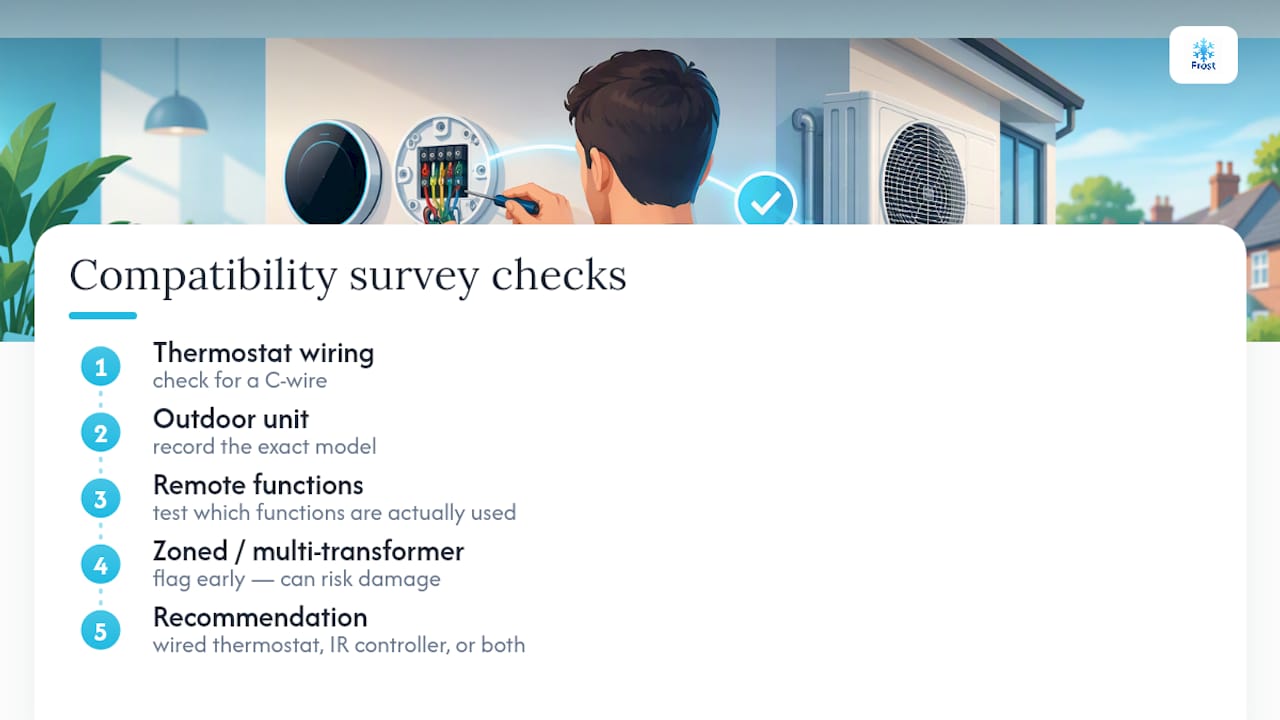
On a typical survey, F-Gas certified engineers check the thermostat wiring for a C-wire, note the outdoor unit's exact model, and test which remote functions the existing system actually uses before recommending a wired thermostat, an IR controller, or a mix of both. Zoned or multi-transformer wiring gets flagged early, since misreading it can risk damaging equipment if handled incorrectly. That on-site check is usually what separates a smooth install from a returned box.
Why most compatibility advice online misses the point
The bulk of smart thermostat content assumes you've got a furnace and a 24V control loop sitting behind the wall plate. It rarely mentions that a huge number of UK homes run ductless systems, or a combination of both, where that advice simply doesn't apply.
The real skill here isn't picking the "best" smart thermostat. It's correctly diagnosing which category your system falls into before you spend a penny. Get that step wrong and no amount of app features will fix it; an IR controller bought for a system that actually has a C-wire and ducting is money left on the table, and a wired thermostat bought for a mini-split simply won't switch on.
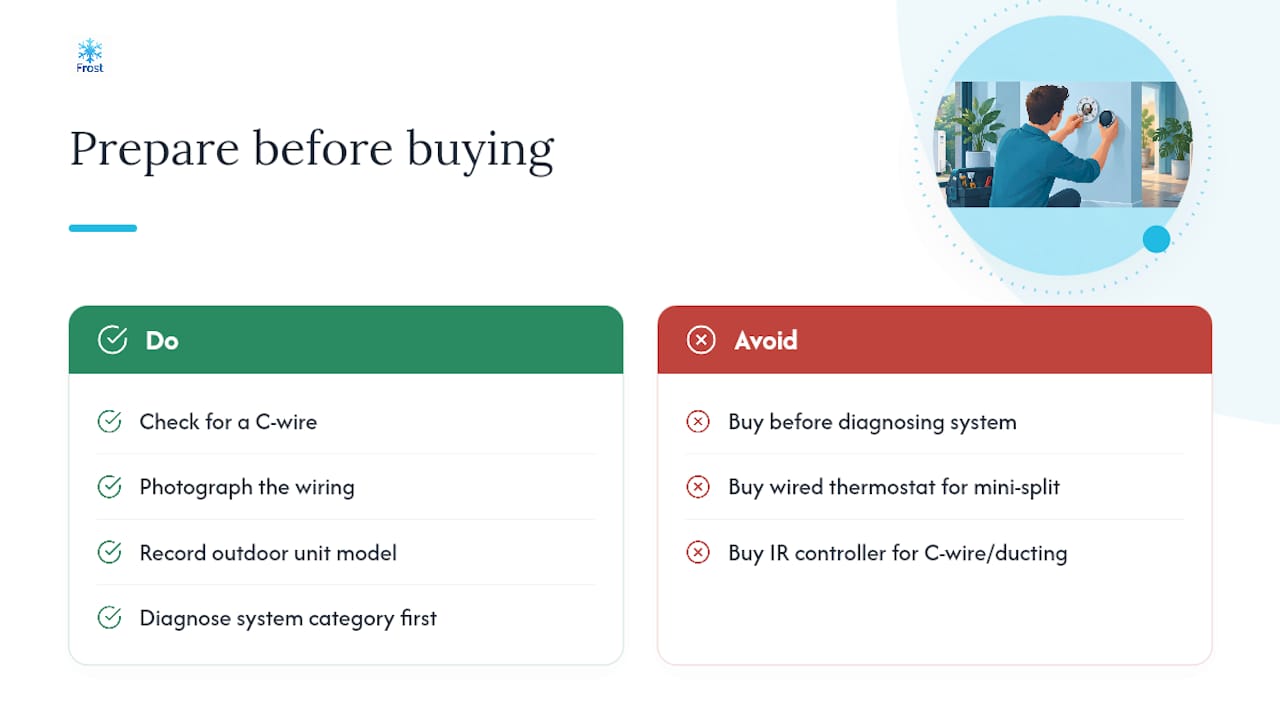
What the evidence keeps pointing back to is preparation. A clear photo of your wiring, the outdoor unit's model number, and an honest note of what your remote actually does will get you a faster, more accurate answer than reading another buying guide. Homeowners who skip that step and go straight to a shopping cart are the ones who end up with a returned parcel and a system still running off the original remote.
If there's one thing worth prioritising above all else, it's checking for a C-wire and photographing the wiring before doing anything else. Everything downstream, whether that's a manufacturer checker or a phone call to an installer, moves faster once that groundwork is done.
— James
Get a professional compatibility check from Frost Air Conditioning
If you'd rather skip the wire-labelling and just get a straight answer, Frost Air Conditioning is the practical alternative to guessing your way through a compatibility checker. As certified engineers, they run these checks on-site regularly, and installations can be arranged promptly once system requirements are confirmed.

For a survey, have your existing thermostat wiring photographed, the outdoor unit accessible, and any remote to hand so we can confirm exactly what your ductless or ducted setup requires. Book a domestic installation survey to get a straight answer on what your home actually needs, or check current service and maintenance options if you already have a system that needs attention.
Sources
- ecobee power extender kit (product page)
- Flair — mini‑splits and window units guidance
- SmartHomeExplorer — smart thermostat compatibility guide
FAQ
Can any thermostat work with any AC unit?
No. Standard 24V smart thermostats work with forced-air and most heat pump systems, but they cannot physically connect to a mini-split or any unit controlled purely by infrared remote. Those systems need a dedicated IR smart controller instead.
How do I know if a smart thermostat is compatible with my system?
Check your existing wiring for the standard labels (R, Y, W, G, C) and run those against a manufacturer compatibility checker before buying. If your air conditioner is only ever operated by a handheld remote, skip the wired thermostat entirely and look at an IR controller instead.
What is the 3-minute rule for air conditioners?
The 3 minute rule refers to waiting roughly three minutes after switching an air conditioner off before restarting it, giving internal pressures time to equalise and protecting the compressor. It's a general aircon operating guideline rather than a smart thermostat compatibility issue, and most smart controllers won't override built-in compressor protection anyway.
What smart thermostat works with Daikin?
Compatibility with Daikin systems depends entirely on whether the unit is a ducted system with standard 24V wiring or a ductless unit run by remote. Ducted Daikin systems can often work with mainstream wired thermostats once you've confirmed wiring through a manufacturer checker, while ductless Daikin units typically need an IR controller such as Sensibo or Cielo. They can confirm which route applies to your setup during a domestic installation survey.