
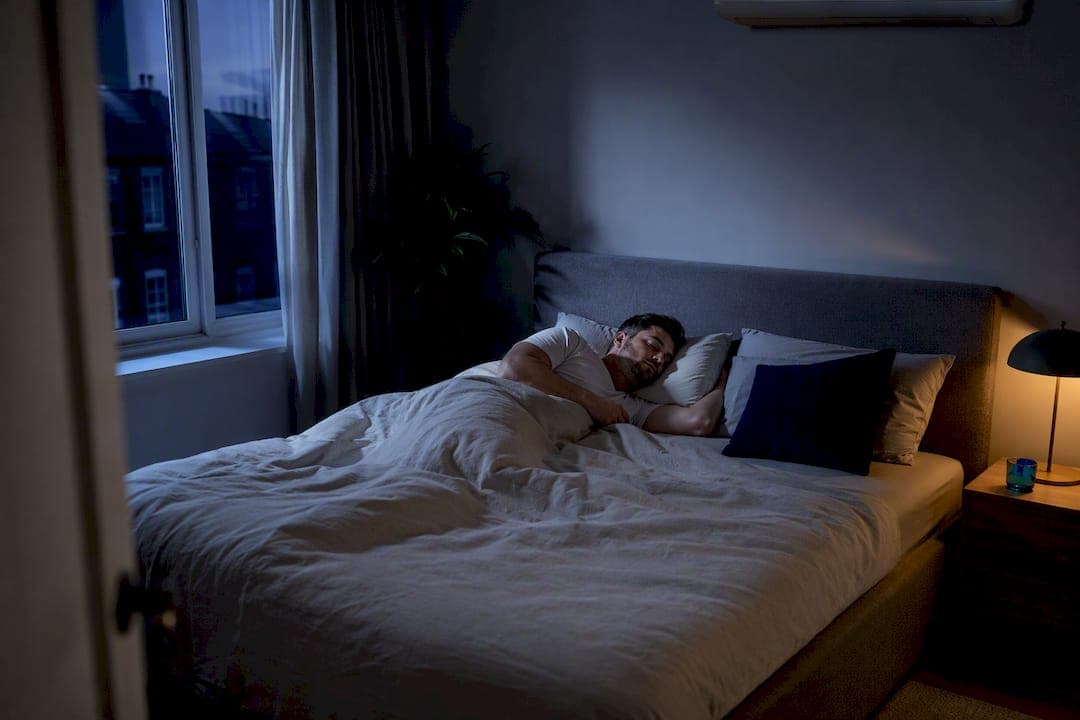
Set your bedroom air conditioning between 16°C and 18°C for the best chance of a full night's sleep. That's the range backed by The Sleep Charity and Silentnight, with babies and older adults needing slightly different targets. Start your unit's sleep mode at a comfortable temperature and adjust downwards until you stop waking up.
TL;DR:
- Maintaining bedroom temperatures between 16°C and 18°C optimizes sleep, but adjustments may be necessary based on duvet tog rating, activity level, and personal comfort.
- Babies should be kept in rooms around 16°C to 20°C to prevent overheating, while older adults often sleep better at slightly warmer settings around 18°C.
- Using Sleep Mode or a timer to gradually raise the setpoint overnight helps prevent waking up cold while saving energy costs by avoiding constant low-temperature operation.
- Proper airflow direction and humidity control are crucial, with fans directed away from the bed and lower tog duvets in summer, to ensure air conditioning effectively promotes restful sleep.
- Persistent issues like uneven cooling or excessive humidity suggest system faults requiring professional inspection and accurate sizing by an experienced installer.
Table of Contents
- Recommended aircon sleep temperature UK: finding your personal setting
- Aircon settings for babies, children and older adults
- How to set your aircon at night for uninterrupted sleep
- Energy costs of running aircon at low overnight temperatures
- Bedding, humidity and airflow: the details that make aircon actually work
- When your bedroom still won't cool properly
- Getting your bedroom properly set up with Frost Air Conditioning
- Sources
Recommended aircon sleep temperature UK: finding your personal setting
The UK consensus for adult sleep is a narrow band: 16°C to 18°C. British Gas backs this figure, and Silentnight widens it slightly to 15.6°C to 19.4°C for readers whose comfort sits at either edge. Anything above 24°C tends to cause restlessness, according to both sources.
There's a physiological reason this range works. Your core body temperature naturally drops in the evening, triggering melatonin release and easing you into deeper sleep stages. A bedroom that's too warm fights that drop; one that's too cold forces your body to burn energy warming itself back up, which can pull you out of REM sleep. The Sleep Charity frames it as supporting a process your body already wants to do, not overriding it with brute-force cooling.
Rather than guessing, run a simple trial:
- Set your unit to 19°C on night one and note how you sleep.
- Drop the setpoint by 1°C each following night.
- Stop once you wake feeling rested rather than too hot or shivering.
- Factor in your duvet's tog rating: a 10.5 tog winter duvet needs a warmer room than a 4.5 tog summer one.
- Adjust for activity: a room that felt fine after a quiet evening might feel too warm after exercise or a hot bath.
Most people land within that 16°C to 18°C band within a week of testing.
Aircon settings for babies, children and older adults
Standard adult guidance doesn't automatically apply once you've got a newborn's cot in the room, or an elderly relative who feels the cold more sharply. NHS guidance on newborn care stresses avoiding overheating as a specific safety priority, not just a comfort one.
For a baby's nursery, keep the room between 16°C and 20°C, which reduces overheating risk while still keeping the space comfortable, according to guidance summarised by Temperature. Older adults, by contrast, often do better slightly warmer, around 18°C, since circulation and body-fat changes with age reduce natural heat retention.
A few practical safeguards matter here regardless of age:
- Never point an air conditioning unit's airflow directly at a cot or a sleeping baby.
- Use a simple room thermometer rather than judging by feel, especially in a nursery.
- Check on an elderly relative's room separately from the rest of the house; central settings rarely suit everyone under one roof.
- Dress babies in one layer less than you'd wear yourself, and skip hats and heavy blankets once the room's cool enough.
How to set your aircon at night for uninterrupted sleep
Getting the number right matters less than how you apply it, since most modern systems are built to adjust automatically once you tell them what you want. Sleep Mode, standard on most residential units from brands like Daikin and Hitachi, works by gently raising the setpoint through the night, often by around 1°C per hour on some models, according to Hitachi's own guidance. That prevents you waking cold at 3am after the room's been holding a fixed low temperature for hours.
A practical nightly routine looks like this:
- Pre-cool the bedroom to your target temperature about 30 minutes before bed.
- Switch to Sleep Mode or set a timer that allows the temperature to rise 1°C to 2°C over the following few hours.
- Set fan speed low and point airflow away from the bed, never directly at where you'll be lying.
- Use a smart app or scheduler if your unit has one, so you're not reaching for a remote at midnight.
- Check the unit's noise setting; a quieter fan speed matters more once the room's actually cool.
Daikin's guidance is explicit that direct cold airflow over a sleeper causes as much disturbance as the wrong temperature reading. Position matters as much as the number on the display.
Pro Tip: If your unit lacks a built-in Sleep Mode, a basic timer set to raise the target temperature by 1°C two hours after you go to bed achieves almost the same effect manually.
Energy costs of running aircon at low overnight temperatures
Every degree you drop the thermostat costs you. Raising your setpoint by just 1°C can save roughly 3% to 5% on cooling energy use, according to Homebuilding's analysis of typical UK cooling setups. Run a unit at 16°C all night rather than letting it settle at 18°C, and you're paying that difference for six or seven hours, every night, all summer.
Sleeping at the coldest setting your unit allows isn't a sleep strategy. It's an energy bill with a side effect of occasionally decent sleep.
The fix isn't sacrificing comfort, it's timing. Pre-cool the room to your target before you get into bed, then let the temperature drift up 1°C to 2°C overnight using Sleep Mode or a timer, exactly as covered above. Homebuilding recommends 24°C to 26°C as a sensible daytime baseline, which gives you a natural starting point before the bedroom-specific drop for nighttime. Using eco or auto modes rather than a fixed manual setting also stops the compressor working harder than it needs to once the room's already at target, a point worth reading further on in this guide to boosting aircon energy efficiency.
Bedding, humidity and airflow: the details that make aircon actually work
Temperature is only part of the equation. Get the surrounding conditions wrong and even a perfectly set thermostat won't deliver decent sleep.
- Swap to a lower tog duvet (around 4.5) in summer months; a heavy winter duvet fights against whatever cooling your unit provides.
- Watch humidity alongside temperature. Air conditioning naturally dries the air, but a stuffy, humid room feels warmer than the thermostat suggests.
- Understand your home's dew point if condensation is forming on windows or walls, since that's a sign moisture is settling somewhere it shouldn't. Quay Point Plastering's guide to dew point explains the mechanics clearly for UK homes.
- Close curtains or blinds during the day to keep solar gain out before your unit has to work against it come evening.
- Position your unit so the airflow doesn't create a direct draught over the bed; a few feet of adjustment can eliminate that "too cold" feeling even at the same setpoint.
- Choose a quieter unit or fan setting if noise is waking you as much as temperature ever did, covered in more depth in this piece on quiet air conditioning systems.
Small adjustments here often solve problems that people assume need a colder setpoint to fix.
When your bedroom still won't cool properly
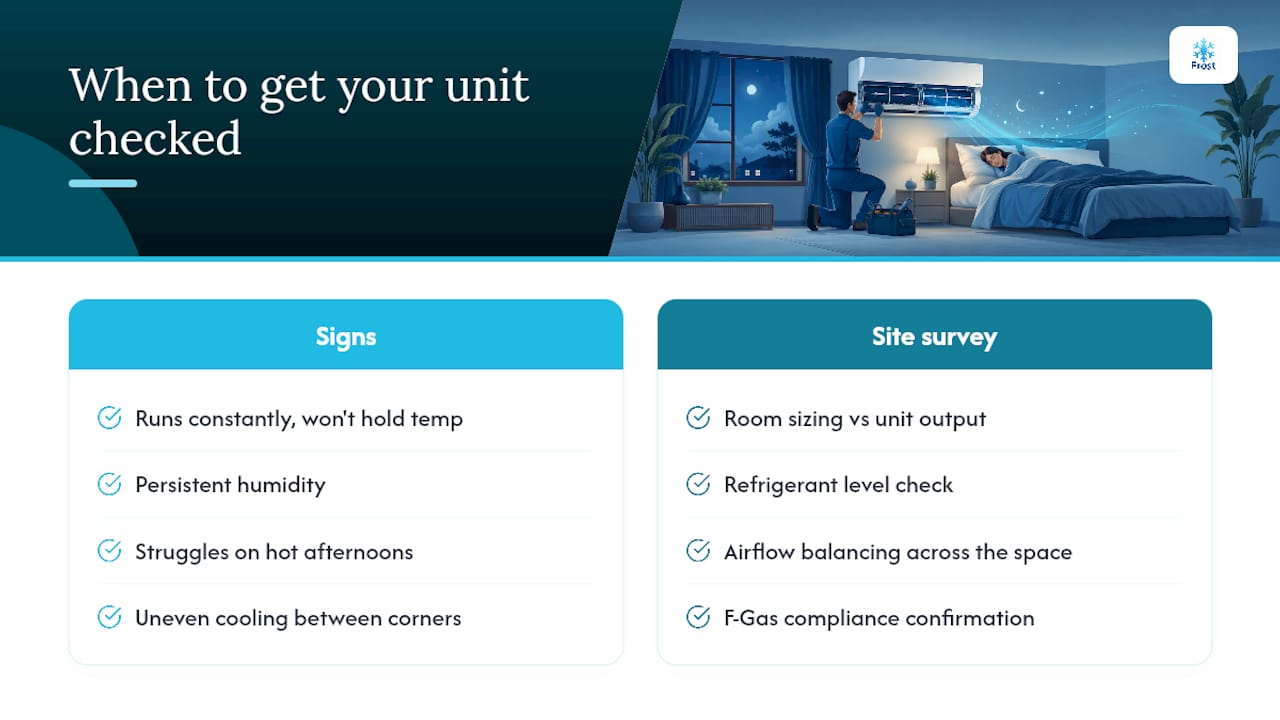
If you've followed every setting above and your room's still too hot, too cold, or the unit's running constantly without holding a steady temperature, that's usually a sign the system itself needs attention rather than the settings. Persistent humidity, a unit that struggles on hot afternoons, uneven cooling between corners of the room, or unusual noise are the signs I'd tell any homeowner to get checked rather than live with.
A proper site survey covers room sizing against unit output, a refrigerant level check, airflow balancing across the space, and confirmation the installation meets F-Gas compliance standards. Undersized units are a common culprit behind bedrooms that never quite reach target temperature, no matter how the thermostat's programmed.
— James
Getting your bedroom properly set up with Frost Air Conditioning
A practical route to solving this properly is using an F-Gas certified installer experienced in fitting systems from major brands, with sleep modes and smart scheduling covered above.

A domestic installation starts with a site survey to get sizing and placement right the first time, so airflow never blasts directly over the bed and the unit isn't fighting a room it can't cool properly. Same-day installs are available where the job allows, and 0% finance options mean the cost doesn't have to land in one lump. If your current setup already needs attention rather than replacement, the service maintenance team can check refrigerant levels and airflow balance before another summer of broken sleep sets in. Get in touch for a design estimate and find out what a properly sized system actually feels like at 2am.
Sources
For deeper guidance beyond this article, The Sleep Charity covers sleep environment science in full, Silentnight offers practical temperature ranges, NHS provides newborn safety advice, and British Gas rounds out general home temperature guidance.
- The ideal temperature for sleep | Silentnight
- Sleep environment | The Sleep Charity
- What's the ideal home temperature? | British Gas